
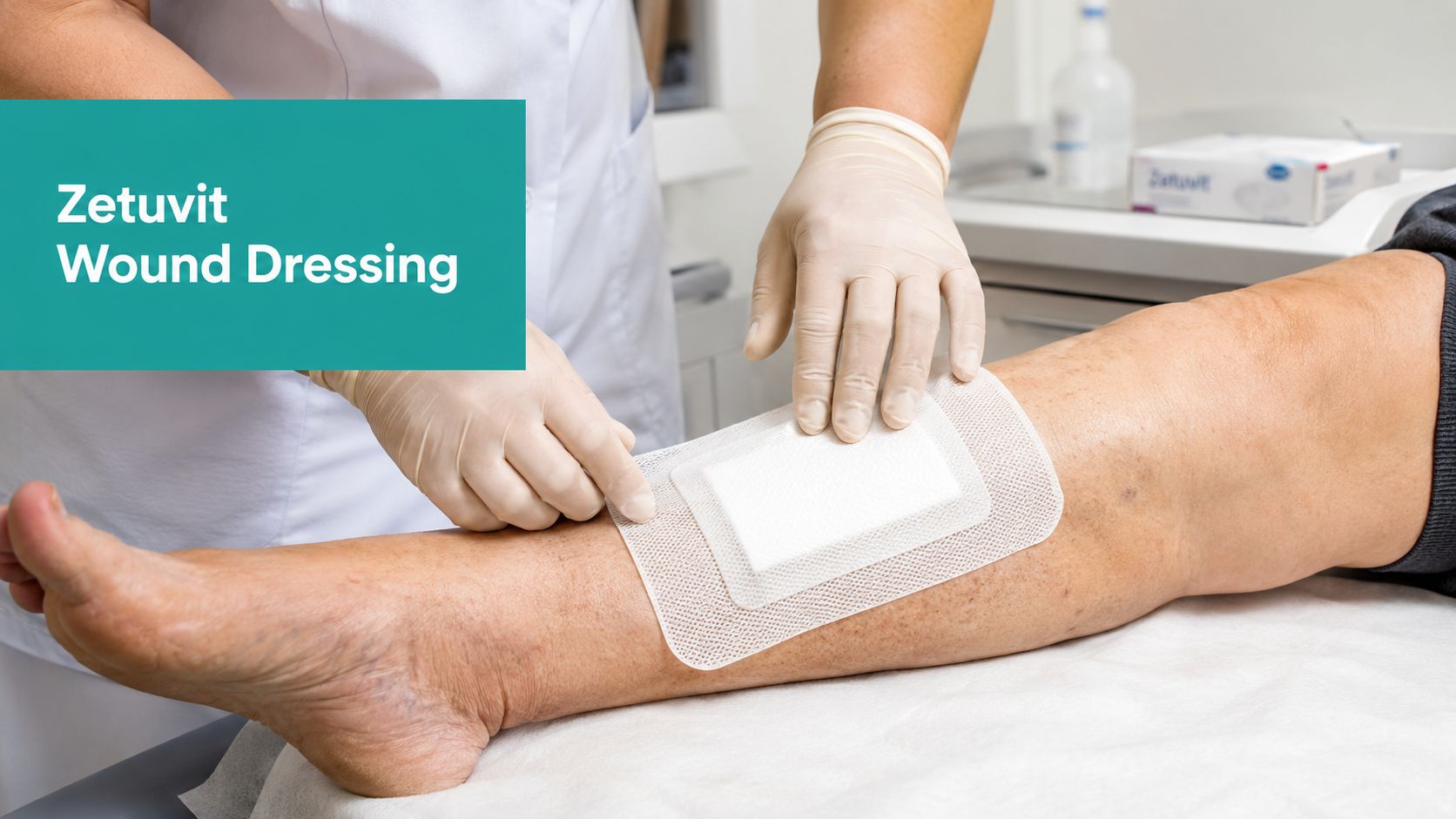
By the time a patient tells you, “I changed that dressing twice before lunch,” the problem usually isn't adherence. It's dressing selection. The classic setup is a venous leg ulcer with enough drainage to soak through a basic absorbent layer, wick sideways into the wrap, and leave the periwound white, soft, and breaking down by the next visit.
That's where the Zetuvit wound dressing enters the conversation in real practice. Not as a cure-all, and not as a substitute for debridement, compression, offloading, or infection control. It's a tool for a specific problem: moderate to heavy exudate that is turning routine wound care into constant rescue work. Used well, it can stabilize a messy wound environment. Used poorly, it disappoints fast.
Table of Contents
- Managing High Exudate Without Daily Dressing Changes
- Inside a Superabsorbent Polymer Dressing
- Wound Indications and Critical Contraindications
- When to Select a Superabsorbent Dressing
- Correct Application for Maximum Wear Time
- Troubleshooting Common Dressing Issues
- Documenting Use for Audits and Reimbursement
Managing High Exudate Without Daily Dressing Changes
A heavily draining wound will expose every weak point in your plan of care. Venous ulcers do it. Dehisced post-op wounds do it. So do pressure injuries in patients who are medically complex, undernourished, or hard to keep offloaded. You start with a reasonable dressing, and then the drainage wins.
The pattern is familiar. The dressing saturates early, the fluid tracks laterally, the peri-wound gets macerated, and nursing time gets consumed by unscheduled changes. The patient loses confidence because the wound “always leaks,” and the chart starts to show repeated dressing failure without a clear explanation of why.
What the right dressing category changes
For these wounds, the issue isn't just absorbency. It's whether the dressing can hold on to fluid after it absorbs it, especially when there's compression, movement, gravity, or a shoe pressing on the area. That's why a superabsorbent polymer dressing gets considered when the wound character is moderate to highly exuding, not only because the wound exists.
If you're seeing persistent leakage, edge maceration, or repeated strike-through, stop treating it like a routine low-output wound. Reassess drainage amount, type, and timing. If you need a refresher on drainage patterns and what they usually mean clinically, this review of drainage from a wound is a useful quick reference.
Practical rule: When the dressing fails before your planned follow-up, believe the wound. Don't just tape more absorbent material on top and call it a plan.
A Zetuvit wound dressing makes the most sense when your actual goal is to stretch wear time, reduce leakage events, and protect the skin around the wound long enough for the rest of the care plan to work. That's a narrower use case than many newer clinicians think. It also happens to be the use case that matters most in busy outpatient wound care.
Inside a Superabsorbent Polymer Dressing
The useful part of the Zetuvit wound dressing isn't the brand language. It's the structure. This dressing class is built to move fluid away from the wound surface and trap it in the absorbent core instead of letting it spread across the skin.

Why the layers matter
A simple absorbent pad can take up fluid, but when output rises, the fluid often migrates sideways. That lateral spread is what leaves the peri-wound soggy and starts the cascade toward maceration and leakage. A superabsorbent polymer dressing is trying to do something different. It encourages vertical wicking into the dressing core, then retains that fluid instead of letting it pool back toward the wound edge.
Wounds International describes this type of dressing as a five-layer construct with very high absorption and retention capacity, including retention under load, which is exactly what matters in highly exuding wounds and under compression. The same source also notes it should not be used on dry wounds or exposed tendon, muscle, or bone in its discussed context of use (Wounds International discussion of the five-layer SAP dressing structure).
That “under load” piece is easy to underestimate. A dressing can look excellent on a tray table and fail once the patient stands up, wraps the leg, transfers, or puts pressure on the foot. If the core can't retain fluid when compressed, you get strike-through and a false sense that the wound suddenly worsened.
How this changes bedside judgment
Think of the Zetuvit wound dressing less like a sponge and more like a fluid-management system. The wound-facing layer is designed to let exudate move through quickly while limiting adherence, and the deeper absorbent layers do the heavy lifting. That's what makes it useful in wounds where standard absorbent approaches keep breaking down.
A newer clinician often focuses on “how much can it absorb.” I'd focus first on where the fluid goes after absorption. If it remains controlled in the core, you protect the wound edge. If it spreads outward, your peri-wound pays the price.
For a broader look at how dressing categories support healing strategy, this overview of wound healing dressings is worth keeping handy.
- Vertical fluid movement: Pulls exudate away from the wound-facing surface.
- Retention under pressure: Helps prevent leakage when compression or body weight is involved.
- Lower dressing trauma: A nonadherent contact interface matters when the wound bed is fragile.
- Microclimate support: The goal is moisture balance, not desiccation.
Dressings don't heal wounds by themselves. They create conditions that either help the wound progress or keep it stuck.
Wound Indications and Critical Contraindications
The Zetuvit wound dressing is for the wound that's too wet, not the wound that merely exists. That distinction matters more than the label on the chart. In practice, selection should follow exudate volume, wound depth, peri-wound risk, and the larger treatment plan.
When it fits
This dressing class is intended for moderate to high exudate wounds and is used on acute and chronic wounds such as venous leg ulcers, pressure ulcers, diabetic foot ulcers, surgical wounds, burns, and traumatic wounds when the wound is draining enough to justify a superabsorbent approach. Clinically, that usually means serous or serosanguinous drainage that is overwhelming a simpler absorbent plan.
For diabetic foot ulcers, think in terms of wound character, not diagnosis alone. A Wagner 1 to 2 ulcer with moderate drainage can be a reasonable fit. A dry superficial Wagner 1 lesion is not. If a plantar wound is draining enough to threaten the surrounding skin or soak through dressings between visits, a superabsorbent option makes sense. If it's dry, this is the wrong tool.
If drainage has increased unexpectedly, pause and reassess for bioburden or infection rather than reflexively upgrading absorbency alone. This primer on how to tell a wound is infected is useful when the drainage pattern changes faster than the wound size does.
When to avoid it
Don't use this dressing on a dry wound. Don't use it over exposed tendon, muscle, or bone. It's also a poor fit when the wound needs moisture donation rather than fluid capture. That sounds obvious, but it's a common field error. People see a “good dressing” and start applying it broadly.
The other misuse is expecting this dressing to perform debridement. It won't. If there's devitalized tissue, call that out in the note and address it with the correct wound bed preparation plan. If you performed debridement, document depth and tissue removed clearly enough to support the correct CPT family, such as 11042 to 11047 when appropriate.
Zetuvit Indication and Contraindication Summary
| Wound Characteristic | Use Zetuvit | Avoid Zetuvit |
|---|---|---|
| Moderate to heavy serous drainage | Yes | |
| Heavy serosanguinous drainage with peri-wound maceration risk | Yes | |
| Venous ulcer under compression with leakage problems | Yes | |
| Wagner 1 to 2 diabetic foot ulcer with meaningful exudate | Yes | |
| Dry or minimally exuding wound | Yes | |
| Wound with exposed tendon, muscle, or bone | Yes | |
| Wound needing moisture donation rather than absorption | Yes | |
| Sloughy wound where clinician expects the dressing to debride | Yes |
When to Select a Superabsorbent Dressing
Selection gets easier when you stop asking which dressing is “better” and start asking which failure mode you're trying to prevent. For the Zetuvit wound dressing, the main target is uncontrolled exudate with skin damage risk, leakage, and frequent dressing turnover.
The tipping point in real practice
Standard absorptive dressings often work fine until they don't. The tipping point is usually obvious at bedside even if it isn't written well in the chart. You see edge breakdown, repeat saturation, drainage under the wrap, odor from trapped exudate, and too many unplanned changes. At that point, the cost question shouldn't be “why use a more advanced dressing,” but “why keep using one that is already failing.”
In a clinical evaluation, superabsorbent polymer dressings like this managed exudate effectively in 94% of cases, improved peri-wound skin in 36% and the wound edge in 29% within 14 days, and were associated with a 20% reduction in wound area over that period (clinical evaluation of SAP dressing performance in exudate management). Those numbers matter because they line up with what clinicians care about first in high-output wounds: control the fluid, protect the edges, and stop the wound from sabotaging the rest of your treatment.
What it does better than simpler absorbent categories
This isn't about replacing every other dressing category. It's about knowing when a wound has moved beyond them.
- For moderate drainage with stable skin: A simpler absorptive option may still be enough.
- For copious output under compression: A superabsorbent dressing usually has a stronger case because retention under pressure becomes the issue.
- For wounds with repeated leakage events: Choose the dressing category built for fluid containment, not just uptake.
- For wounds with fragile peri-wound skin: Prioritize fluid control that reduces lateral spread.
A lot of dressing selection errors happen because clinicians focus on the wound bed and forget the peri-wound. The peri-wound often tells you the current dressing has already lost the argument.
If the peri-wound is whitening, denuding, or itching from chronic wetness, that's not a minor side issue. It's evidence that your exudate plan isn't working.
Correct Application for Maximum Wear Time
A Zetuvit wound dressing can fail because of the wound. It can also fail because it was applied like a generic absorbent pad. Those are not the same thing. Small application errors create big downstream problems.
Non-negotiable setup steps
The manufacturer guidance is practical and worth following closely. The pad should extend 1 to 2 cm beyond the wound margins, the white side faces the wound, and the dressing should be changed when exudate reaches the edges, with a maximum wear time of up to 5 to 7 days depending on the product variant and wound condition (manufacturer IFU guidance on sizing, orientation, and wear time).
That overlap matters. If the dressing only matches the wound dimensions exactly, you lose the chance to capture fluid before it reaches vulnerable peri-wound skin. The overlap is part of the fluid-management strategy, not a cosmetic preference.
A field-tested application sequence
Prep the wound bed correctly. Cleanse the wound, assess tissue type, and manage nonviable tissue separately if indicated. This dressing is for exudate handling, not active debridement.
Measure more than the open area. Account for the skin at risk around the wound. If the peri-wound is already damp or fragile, choose a size that protects it.
Orient the dressing correctly. The white side goes toward the wound. If that sounds basic, good. Basic errors are common and costly.
Secure according to location. A bordered version may be enough in a low-friction area. On lower extremities, mobile patients, or wounds under compression, think about how movement and external pressure will affect seal and retention.
Set the change rule in advance. Don't write “change PRN” and move on. Define the trigger. Edge saturation, leakage, loss of adherence, and strike-through are all legitimate reasons for earlier change.
What shortens wear time
Several things reliably cut wear time down.
- Undersizing the pad: Fluid reaches the edges too soon.
- Ignoring the surrounding skin: Maceration starts outside the wound bed, then undermines the whole dressing plan.
- Applying to the wrong wound type: Dry wounds and low-output wounds won't benefit from this approach.
- Overpromising the interval: “Up to” doesn't mean every wound gets the maximum.
The goal isn't to force a dressing to stay on for the longest allowed interval. The goal is to match wear time to wound output without leakage or skin damage.
Troubleshooting Common Dressing Issues
When a Zetuvit wound dressing “fails,” I'd first ask whether the wound, the application, or the overall plan set it up to fail. Most problems fall into one of three buckets.
Maceration
If the peri-wound is getting white and soggy, don't assume the dressing category was wrong. Check sizing first. If the pad didn't extend far enough beyond the wound, fluid likely escaped before the core could manage it. Then check timing. A saturated dressing left on too long will still macerate skin.
Also look at exudate character. Thick drainage, uneven wound contours, or undermined edges can redirect fluid in ways that defeat an otherwise appropriate dressing.
Adherence or trauma at change
This usually means one of two things. Either the wound was too dry for a superabsorbent dressing in the first place, or the dressing interval exceeded what the wound could tolerate. Sometimes the contact layer is fine, but the wound environment changed and nobody adjusted the plan.
If the dressing is sticking, reassess moisture balance before you blame technique. A dry wound managed with a high-absorption dressing is a mismatch.
Odor and “leakage despite a good dressing”
Odor isn't automatically infection, and leakage isn't automatically product failure. Odor can come from trapped exudate, prolonged wear, necrotic tissue, or infection. Leakage can come from poor edge seal, wrong size, or a wound producing more fluid than documented.
Use a simple troubleshooting frame:
- Was the wound selected appropriately?
- Was the dressing large enough and oriented correctly?
- Did the actual exudate volume exceed the planned interval?
- Is there a new issue such as infection, tissue breakdown, or poor compression tolerance?
One good dressing choice doesn't rescue a weak overall plan of care.
Documenting Use for Audits and Reimbursement
Good clinicians lose money. Not because the wound care was wrong, but because the note didn't show medical necessity. A payer or auditor can't infer why you chose a high-performance absorptive dressing. You have to write it.

What the note must prove
Superabsorbent dressings may remain in place for up to 7 days depending on wound condition, and documenting the shift from daily changes to a multi-day wear plan helps support the clinical and economic rationale for medical necessity, including reduced nursing labor, lower supply use, and better quality of life (extended wear time as a medical-necessity justification).
That means your documentation should show all of the following:
- Drainage burden: amount, type, and how fast prior dressings failed
- Peri-wound impact: maceration, denudement, dermatitis risk, or edge breakdown
- Treatment goal: absorb exudate, protect surrounding skin, support longer wear interval, allow compression or offloading plan to work
- Why simpler care was inadequate: frequent saturation, leakage, or repeated unplanned changes
Phrases that stand up better in review
Avoid vague language like “draining wound” or “continue advanced dressing.” That gets denied because it says almost nothing.
Write like this instead:
“Moderate to heavy serous drainage with peri-wound maceration at the inferior margin. Prior absorptive dressing saturated before scheduled change, with leakage through secondary cover.”
Or this:
“SAP dressing selected to manage high-volume exudate, protect peri-wound skin, and support extended wear interval under compression.”
If you performed debridement, separate that service clearly. Document tissue type removed, depth, instrument used, pain control if applicable, post-debridement measurements, and the reason ongoing exudate control remains necessary after the procedure. That distinction matters when you're supporting CPT 11042 to 11047.
Two note examples that are actually defensible
Venous leg ulcer under compression
- Assessment: “Chronic lower leg ulcer with heavy serous drainage and peri-wound dermatitis risk. Current drainage level compromises dressing integrity before next scheduled visit.”
- Plan: “Apply SAP dressing as primary absorptive layer under compression to control exudate, reduce leakage, and protect peri-wound skin. Change earlier for edge saturation or strike-through.”
Post-op diabetic foot wound
- Assessment: “Post-surgical foot wound, Wagner 1 to 2 context, moderate serosanguinous drainage. Offloading in place. Drainage volume increases risk of dressing failure and surrounding skin breakdown.”
- Plan: “Use superabsorbent dressing sized beyond wound margins to contain exudate and reduce dressing trauma during changes.”
If your team is tightening note quality, it helps to understand the workflow trade-offs in comparing AI and manual transcription, especially when wound documentation has to capture measurements, peri-wound findings, procedures, and supply justification in one visit.
A practical documentation workflow also helps. EkagraHealth AI is one example of a platform that can support wound imaging, documentation, and coding workflows so the note reflects the wound you treated instead of the rushed summary you remember later.
If your wound team is spending too much time charting dressing failure, coding debridement, and defending supply use after the fact, EkagraHealth AI is built for that part of the job. It supports wound documentation, imaging workflows, and billing alignment so your notes are easier to defend when claims and audits hit.
