
When you see fluid seeping from a cut, scrape, or surgical site, you're looking at what we in the clinical world call exudate. This drainage is a completely normal part of the healing process. But what it looks, feels, and smells like offers a wealth of information about how that wound is doing. Understanding this fluid is more than just clinical routine; it's a foundational skill that directly impacts patient outcomes, prevents complications, and ensures the financial stability of a healthcare practice. From the initial assessment at the bedside to the final claim submission, mastering wound drainage is a critical component of modern healthcare.
Why We Have to Get Wound Drainage Assessment Right

Think of wound drainage as a real-time report card straight from the wound bed. This fluid isn't just a messy byproduct of injury; it's a story being told. Every drop contains a dynamic mix of water, proteins, growth factors, inflammatory mediators, and white blood cells that reveal exactly what's happening just beneath the skin's surface. A deep understanding of this biological narrative is what separates a novice from an expert clinician. The ability to interpret these signs allows for proactive, rather than reactive, wound management.
That’s why assessing drainage isn't just another box to check. It's how the entire care team communicates. When we all evaluate and document drainage the same way, we create a shared language that makes it easy to track healing or spot trouble long before it becomes a crisis. This standardized communication is the backbone of effective, interdisciplinary wound care, ensuring continuity and consistency across shifts and departments. Without this shared understanding, patient care can become fragmented, leading to suboptimal outcomes and increased risk.
Reading the Wound's Report Card
If a wound could give you a daily grade on its own healing, the drainage would be the main metric. Is the fluid clear and minimal? That’s an 'A' for healthy healing. But what if it's thick, green, and has a foul odor? That’s a failing grade, shouting that an infection is taking over. This isn't just a simple pass/fail system; the nuances in color, consistency, and volume provide a detailed diagnostic picture.
An experienced clinician uses this report card to answer some critical questions:
- Is the wound moving through the inflammatory phase as expected?
- Are there subtle signs of a brewing infection that needs a swift response?
- Is the current dressing doing its job to manage moisture, or is it overwhelmed?
- Does the patient's underlying condition (e.g., diabetes, venous insufficiency) correlate with the type and amount of exudate observed?
By learning to interpret the characteristics of wound exudate, we can stop reacting to problems and start proactively managing them. This isn't passive observation; it's the key that dictates our next move—from choosing the right dressing to deciding if antibiotics or deeper investigation are needed.
Better Outcomes, Lower Costs
Mastering how to assess drainage from a wound is one of the most effective ways to head off serious complications. If exudate isn't managed well, it can lead to maceration, where all that moisture breaks down the healthy skin around the wound. This not only enlarges the wounded area but also causes significant pain and discomfort for the patient. Worse, it creates the perfect breeding ground for biofilm formation and subsequent infection, which brings healing to a grinding halt and can lead to systemic issues like sepsis.
Ultimately, getting this right leads to better patient outcomes and keeps healthcare costs down. When you catch problems early, you can prevent expensive interventions like debridement or surgery, reduce the risk of hospital readmissions, and get your patients back on their feet much faster. Effective exudate management shortens healing times, which in turn reduces the overall cost of care, including supplies, nursing time, and specialist consultations.
The 4 Main Types of Wound Drainage and What They Mean

As an experienced clinician, you learn to "read" a wound. Just like a mechanic can diagnose an engine by its sounds, you can tell a lot about what’s happening beneath the skin by looking at the fluid it produces. This fluid, called exudate or drainage, is a rich source of information, changing its color and consistency as the wound moves through the healing process. These changes are direct indicators of the cellular activities occurring within the wound bed.
Getting a handle on these changes is absolutely critical for making the right call at the bedside. Most of what you'll see falls into four main categories, each telling a different story about the wound’s status. Recognizing these types is the first step in formulating an effective treatment plan.
Serous and Sanguineous Drainage
Let’s start with the basics. The first type is serous drainage. This is the thin, clear, or straw-colored fluid that shows up during the initial inflammatory phase of healing. It's composed primarily of water, salts, and proteins like albumin. A great real-world example is the liquid you'd find in a minor blister. Seeing a small amount of this is a good thing; it means the body’s healing engine is warming up, delivering nutrients and clearing debris as it should.
Next up is sanguineous drainage, which is simply fresh blood. This bright red, watery fluid appears when there's active bleeding, which you'd expect right after an injury or surgery has damaged capillaries. It's normal in the immediate aftermath, but if you're still seeing it days later, it’s a red flag that something has disrupted the healing process, such as trauma to the wound bed or a clotting disorder.
Serosanguineous and Purulent Drainage
Now, what happens when you mix the first two? You get serosanguineous drainage. This is a combination of serous fluid and a little blood, giving it a pale pink or light reddish appearance. It’s also thin and watery. You’ll see this all the time in fresh surgical incisions and other new wounds as they transition from the bleeding phase to the inflammatory phase. It’s a textbook sign that healing is progressing nicely.
The last one, purulent drainage, is the one that should always get your immediate attention. This is pus. It’s thick, milky, and opaque, and can show up as yellow, green, tan, or gray, depending on the causative bacteria (e.g., Pseudomonas often produces greenish, sweet-smelling pus). Purulent fluid is packed with dead bacteria, white blood cells (neutrophils), and other debris from the body's fight against infection. It often comes with a foul odor, another giveaway of bacterial activity. To dig deeper, check out our guide covering if pus is always a sign of infection.
Purulent drainage is never normal in a healing wound. It signals that the healing cascade has been hijacked by infection, and it demands swift action—such as wound culturing, antimicrobial dressings, and possibly systemic antibiotics—to prevent serious complications.
To make identifying these drainage types easier during your assessments, we've put together a quick-reference chart.
Quick-Reference Wound Drainage Identification Chart
This chart is a simple tool to help you quickly connect the dots between what you see on the dressing and what it means for your patient's wound.
| Drainage Type | Color | Consistency | Clinical Significance |
|---|---|---|---|
| Serous | Clear, pale yellow | Thin, watery | Normal; part of the inflammatory healing phase. |
| Sanguineous | Bright red | Thin, watery | Active bleeding; normal initially but concerning if it persists. |
| Serosanguineous | Pale pink or reddish | Thin, watery | Normal; a common sign of healthy healing post-injury. |
| Purulent | Yellow, green, brown, tan | Thick, opaque | Infection; never normal and requires immediate intervention. |
By familiarizing yourself with these four types, you’ll be better equipped to interpret the subtle (and not-so-subtle) cues a wound provides, leading to more timely and effective care.
How to Properly Assess and Measure Wound Exudate
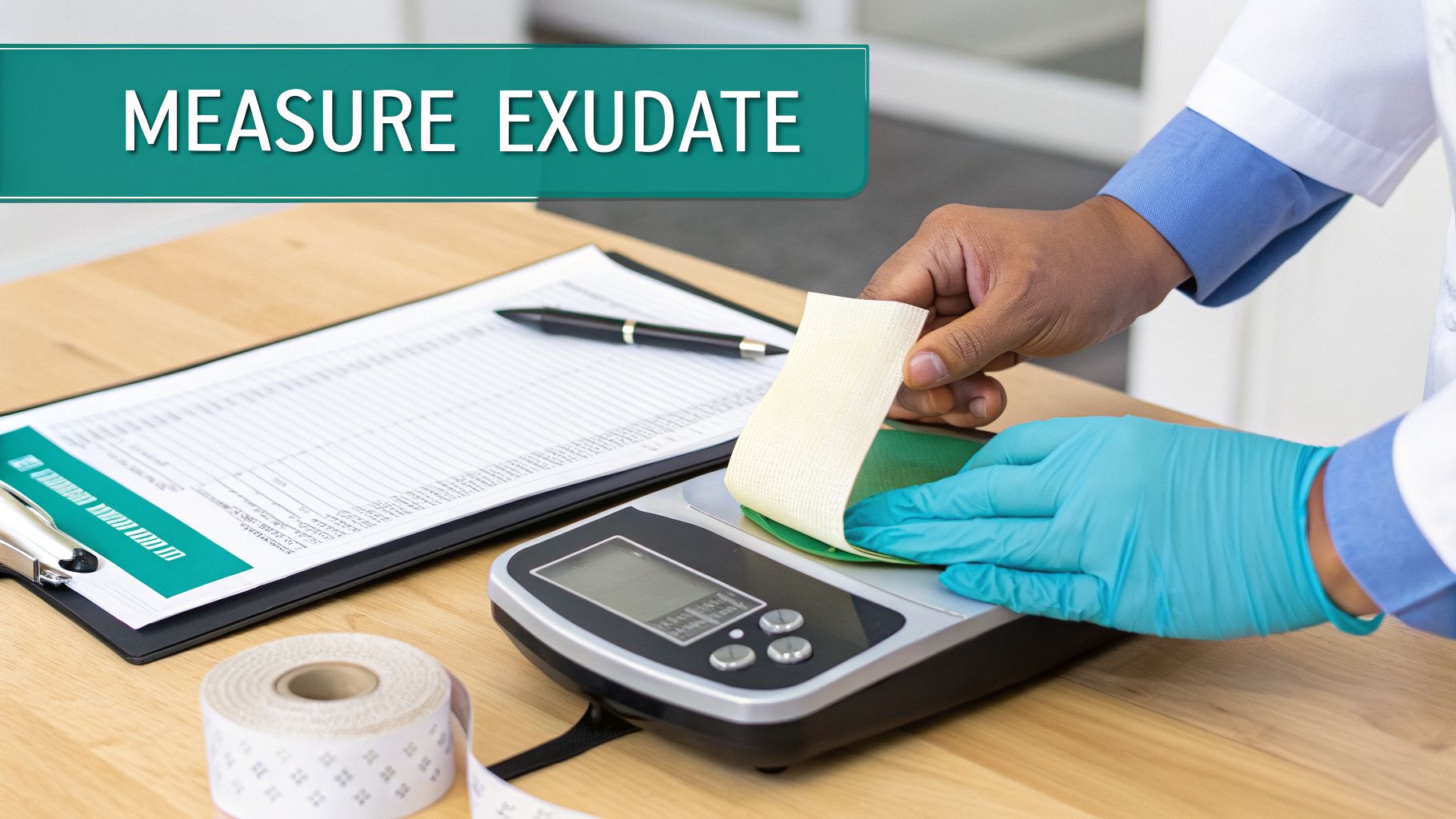
Once you’ve identified the type of drainage a wound is producing, the next move is to figure out how much there is. Measuring the volume of this exudate—what we often call wound output—is what separates clinical guesswork from good data. Without it, you’re just guessing if a wound is getting better or if your care plan is falling short. Accurate quantification is essential for tracking trends, justifying the use of specific dressings, and communicating effectively with other healthcare providers.
Fortunately, we have a couple of straightforward methods for this. The key is to pick a method and stick with it, creating a consistent record that the entire care team can follow. This ensures that when one clinician documents "moderate" drainage, everyone else knows exactly what that means.
Clinical Methods for Measuring Drainage
Consistency is everything. Whether you're in a busy hospital ward or making a home health visit, using a standardized approach to measuring exudate is the only way to track progress accurately and avoid miscommunication. This data becomes a critical part of the patient's longitudinal record.
- Visual Estimation: This is the quickest and most common method. You simply look at the soiled dressing and use descriptive terms to estimate how much drainage is present. It’s a fast, at-a-glance assessment ideal for busy clinical settings, but its subjectivity is a key limitation.
- Dressing Weighing: For a more precise, objective number, you can weigh the used dressing. Just be sure to subtract the weight of an identical clean, dry dressing. The math is simple: one gram of weight equals one milliliter of fluid. This method is particularly useful in research settings or for wounds with copious drainage where precise tracking is critical for fluid balance management.
A shared vocabulary is non-negotiable for visual estimates. Using standard terms like "scant," "minimal," "moderate," and "copious" ensures the entire care team is speaking the same language, painting a clear and reliable clinical picture.
Standardizing Visual Assessment Terms
To make visual estimates truly useful, your team needs to agree on what each term represents. This eliminates the guesswork and ensures that "moderate" to one nurse means the same thing to another. Establishing a facility-wide protocol for these definitions is a best practice.
Here’s a widely accepted breakdown:
- Scant: The dressing is just lightly stained; there's very little moisture. Wound bed may be dry.
- Minimal/Small: Less than 25% of the dressing is saturated with drainage. The dressing could likely be left longer.
- Moderate: The dressing is saturated somewhere between 25% and 75%. This level of exudate typically requires regular dressing changes.
- Copious/Large: More than 75% of the dressing is saturated, often meaning it needs to be changed frequently to prevent leakage and maceration.
This kind of precise language is critical in high-stakes situations, like postsurgical recovery. Think about cardiovascular diseases, which were responsible for a staggering 17.9 million deaths globally in 2019. Patients undergoing thoracic surgery often have chest drains to manage fluid, and tracking that output is a matter of safety. A sudden increase in sanguineous drainage—say, more than 50mL/day—could be the first sign of a serious complication like a postoperative bleed. You can learn more about the technology behind this by exploring the latest surgical drainage market insights on gminsights.com.
For a deeper dive into this subject, check out our guide on the best wound assessment tools for nurses. Modern platforms are even using image analysis to quantify drainage automatically, which cuts down on charting time and gives you hard data to back up your clinical decisions.
The High Cost of Poor Drainage Management
Ignoring the drainage from a wound is a bit like finding a slow leak under your sink. At first, you might just throw a towel down. But if you don't fix the source, you’ll soon be dealing with soaked floorboards, warped cabinets, and a nasty mold problem. It’s a mess that gets exponentially worse over time, causing structural damage and escalating repair costs.
The same is true for wound exudate. When it isn't managed correctly, it doesn't just make a mess of the dressing. It actively sabotages the healing process, setting off a chain reaction of problems—for the patient’s health and the healthcare system's budget. This mismanagement can turn a simple, acute wound into a complex, chronic problem.
Clinical Consequences of Mismanagement
When too much drainage sits on and around a wound, it turns the area into a swamp. The first thing you'll see is periwound maceration. This is when the healthy skin around the wound gets waterlogged, turning white, soft, and incredibly fragile. It’s painful for the patient, and it effectively makes the wound bigger by breaking down the skin's protective barrier, making it susceptible to further injury.
But maceration is just the beginning. That constant moisture overload creates a domino effect:
- Healing Grinds to a Halt: A wound needs to move past the inflammatory stage to start rebuilding. If old exudate, rich in degradative enzymes like matrix metalloproteinases (MMPs), isn't cleared away, the wound stays stuck in that initial phase, unable to form healthy new granulation tissue.
- Infection Risk Skyrockets: That warm, wet environment is a perfect breeding ground for bacteria. The risk of a serious infection goes way up, leading to the formation of biofilm, which is highly resistant to treatment.
- Patient Suffering: Imagine constantly dealing with soaked, leaking dressings, malodor, and irritated, painful skin. It’s a huge source of physical discomfort and emotional distress for the patient, impacting their quality of life, sleep, and overall well-being.
Think of it this way: proper drainage management is like having a good construction crew on site. It clears away debris and creates a stable foundation so the real rebuilding work can happen. Without it, the whole project stalls indefinitely.
The Staggering Financial Burden
All these clinical problems, of course, have a massive financial impact. Every complication means more costs—more expensive dressings, more nursing time spent on changes, longer hospital stays, and pricey antibiotics to fight infections. This is especially true when dealing with chronic wounds, which affect millions of people and represent a significant drain on healthcare resources.
Take venous leg ulcers, for example. In the United States alone, an estimated 500,000 to 600,000 people live with these wounds, which are notorious for producing heavy drainage. Managing them costs the healthcare system nearly $1 billion every year. When exudate isn't controlled, it just fuels the fire, but we know from research that using the right advanced dressings can cut healing time by up to 50% in some cases. You can dive deeper into the data by reading this research on chronic wound exudate.
And the financial fallout doesn't stop at discharge. Hospital readmissions are a huge headache for administrators, and poor wound care is a common culprit. A patient gets sent home, but without a solid plan for their drainage, they often end up right back in the hospital with an infection or a wound that has completely broken down, leading to penalties for the hospital and increased costs for the entire system.
It’s simple: getting drainage right from the start is one of the smartest financial decisions a clinic or hospital can make. It's a direct investment in the patient’s recovery and the facility's bottom line.
Choosing the Right Strategy for Managing Exudate
Once you’ve assessed the risks, it’s time to get proactive about managing wound exudate. The entire game is about finding and maintaining moisture balance. Think of it like this: a healing wound is a delicate ecosystem. Too dry, and the new cells can't migrate and do their work, leading to a scab and delayed healing. Too wet, and you're just inviting maceration and infection.
A smart management plan does more than just soak up fluid. It protects that fragile skin around the wound, slashes the risk of infection, and creates the perfect stage for the body's natural healing process to shine. This means your strategy has to be tailored to the wound's specific output, whether it’s minimal, moderate, or heavy, and it must be re-evaluated at every dressing change.
Matching Dressings to Drainage Levels
The cornerstone of managing exudate is picking the right dressing. There's no magic bullet here—the choice is dictated entirely by how much fluid the wound is producing. Your goal is to find a dressing that can handle the current output, keeping the wound bed moist but never soggy, and protecting the periwound skin.
Here’s a quick breakdown of how to match dressings to exudate levels:
- For Low Exudate: Look to transparent films or hydrogels. These are great because they donate a bit of moisture to a dry wound bed and create a protective barrier without absorbing much, which also lets you keep an eye on the wound. They are ideal for superficial wounds with minimal drainage.
- For Moderate Exudate: Foam dressings are the reliable workhorses of wound care. They hit a sweet spot, absorbing a good amount of fluid while also providing a soft cushion over the wound. Many also have non-adherent contact layers to prevent trauma upon removal.
- For Heavy Exudate: When a wound is producing a lot of fluid, you need to bring in the heavy hitters. This is where hydrofibers and calcium alginates excel. They are super-absorbent materials that transform into a gel when they contact exudate, locking away excess fluid and bacteria and preventing it from damaging the skin.
For wounds with significant drainage, specialized products like Alginate Wound Dressings are incredibly effective. Making this choice helps you avoid maceration, extend wear time, and can mean fewer painful dressing changes for the patient.
Advanced Interventions for Complex Wounds
But what happens when even the most absorbent dressing is overwhelmed? For wounds with truly excessive drainage, or for those that have simply stalled out in the healing process, it might be time to escalate to a more advanced therapy.
Negative Pressure Wound Therapy (NPWT) is often the next step. This technology involves applying a specialized vacuum-assisted dressing that actively pulls fluid away from the wound. It does more than just manage drainage; it also helps reduce swelling, promotes granulation tissue formation, and encourages the wound edges to contract, which can significantly speed up healing.
NPWT is a go-to for complicated surgical wounds (like dehisced incisions), major traumatic injuries, and chronic ulcers that just aren't responding to standard care. It’s a powerful tool for taking back control when exudate becomes unmanageable and is often a bridge to surgical closure.
This is where modern clinical platforms are becoming such valuable partners. By tracking drainage trends and wound measurements over time, systems like Ekagra Health AI give clinicians the hard data needed to back up a change in strategy. This technology can highlight when a simple dressing isn't cutting it anymore, providing the evidence to justify escalating care to an advanced option like NPWT and ensuring the treatment plan always matches the patient's real-time needs.
From Charting to Cash: How Good Documentation Drives Reimbursement

As any seasoned clinician knows, accurately assessing wound drainage is only half the job. The other, equally critical half is documenting it perfectly. In the world of wound care, your charting isn't just a record for clinical continuity—it's the financial lifeblood of your practice. It's the primary evidence that justifies your actions to payers and auditors.
Every single detail you note down about that wound’s drainage directly justifies the treatments you provide and, frankly, is what ensures you get paid for your expertise. Without strong documentation, the most expertly delivered care can be deemed medically unnecessary by a third-party reviewer, leading to financial losses.
If your notes are vague or inconsistent, you’re practically inviting denied claims and leaving revenue on the table. When documentation fails to paint a clear, objective picture of the wound's condition, payers have an easy out to question the medical necessity of advanced dressings, procedures, or your time. This creates a mountain of administrative headaches and a very real financial hit.
The Direct Line from Your Notes to Your Revenue
Think of every chart note as the core piece of evidence you’re submitting to an insurance payer. If your documentation just says "moderate drainage," you're leaving far too much open to interpretation. It’s a red flag for any reviewer because it lacks the objective data needed to support the use of a high-cost dressing or procedure.
Instead, a note that specifies "moderate serosanguineous drainage, approximately 65% saturation of a 4×4 gauze over 8 hours, with no malodor noted. Periwound skin remains intact." provides the objective, undeniable proof needed to justify your clinical decisions. That’s the kind of detail that gets claims approved without a fight.
This level of specificity is also essential for correct CPT and ICD-10 coding. Revenue cycle teams depend on these documented details to accurately code procedures like an incision and drainage (CPT 10180) or to select the appropriate ICD-10 code that reflects the wound's severity and complexity. Considering that failures in exudate management contribute to 20-30% of prolonged hospital stays, the financial and clinical stakes couldn't be higher.
In wound care, precise documentation is the bridge between excellent clinical work and financial stability. It proves the value of what you do, protects your revenue, and satisfies the strict standards that govern our field. Good charting isn't just good practice—it's a powerful financial tool.
How Technology Eases the Documentation Burden
This is where smart, voice-driven platforms like Ekagra Health AI are truly changing how we work. Instead of getting bogged down in hours of tedious, manual charting after a long day, you can simply focus on your patient. The system listens and captures your clinical observations as they happen, automatically structuring them into precise, defensible notes that meet payer requirements.
Tools like an AI Healthcare Medical Record Analyzer can drastically improve how quickly and accurately patient data is processed, which is fundamental to getting properly reimbursed. Ekagra Health AI builds on this by suggesting relevant CPT and ICD-10 codes on the spot and generating clean claims in just minutes. This kind of automation can cut paperwork time by up to 70%, which means fewer errors, faster claim submissions, and a healthier revenue cycle.
If you'd like to see how to structure these notes for maximum impact, our detailed wound care documentation template is a great place to start. By automating the workflow from your voice to the final claim, you can finally protect your revenue and get more time back for what truly matters: caring for your patients.
Common Questions About Wound Drainage Management
Let's tackle some of the common questions that come up when you're managing wound drainage. Getting these fundamentals right can make all the difference in your patient outcomes, so think of this as a quick, practical review to keep you sharp.
When Should I Be Concerned About the Amount of Drainage?
Your clinical intuition is key here, but there are definite red flags. You should be concerned anytime you see a sudden, dramatic change. A consistent trend is just as important as a single observation.
Pay close attention if a previously dry wound suddenly starts leaking or if the volume of drainage skyrockets from minimal to copious between dressing changes. Any fluid that turns thick, cloudy, or has a foul odor (purulent) is also a major warning sign of infection. From a practical standpoint, if a dressing is soaking through much faster than expected, it’s time to investigate the cause and adjust the treatment plan.
While every case is different, a drainage volume greater than 50mL per day is a solid benchmark for many wound types. Hitting that number often signals an underlying issue, like an infection, a fluid collection (seroma or hematoma), or uncontrolled systemic disease, that requires you to escalate the plan of care.
Think of a sudden change in wound drainage as the wound's alarm system. It’s signaling a problem in the healing environment, and it needs your immediate attention. Don't just change the dressing more often; ask 'why' this is happening.
What Is the Difference Between Active and Passive Drains?
It really comes down to whether you're letting fluid escape on its own or actively pulling it out. The choice depends on the type of surgery, the location of the wound, and the anticipated amount of drainage.
A passive drain, like a simple Penrose drain, is the most basic type. It's just a soft, flexible tube that creates a path of least resistance for fluid to follow. Gravity and natural capillary action do all the work, allowing drainage to seep out into an absorbent dressing. It's simple and effective for wounds with minimal expected drainage, such as after a small abscess drainage.
On the other hand, an active drain, such as a Jackson-Pratt (JP) or Blake drain, uses suction to physically pull fluid from the wound bed. This is usually done with a small, compressible bulb that creates a low-pressure vacuum. Active drains are your go-to when you need to prevent fluid from collecting (like a seroma) and are a staple after many surgeries (e.g., mastectomies, abdominal surgeries) to help lower the risk of infection and promote tissue apposition.
How Can Technology Actually Help with Drainage Documentation?
Honestly, the biggest headache with drainage is often documenting it accurately and efficiently, especially under time pressure. This is where modern tools have become a game-changer by streamlining the entire process from observation to billing.
For example, an AI system like Ekagra Health AI can listen in while you're examining the wound. As you describe what you see—the type, amount, consistency, and odor of the drainage—the AI captures and structures all those critical details into a compliant, well-written note. It removes the need for manual typing and reduces the risk of forgetting key information.
It can even measure the wound directly from a photo, pull up the right CPT and ICD-10 codes based on your documented findings, and get a clean claim ready to go. It’s less about fancy tech and more about getting back time and reducing cognitive load. You can focus on the patient instead of the paperwork, all while minimizing the kinds of documentation errors that lead to reimbursement headaches and audit risks.
At Ekagra Health AI, we turn your clinical observations into complete, compliant, and ready-to-bill documentation in just minutes. Find out how our voice-to-claim workflow can slash your administrative burden by up to 70% and safeguard your revenue at https://ekagrahealth.ai.
