
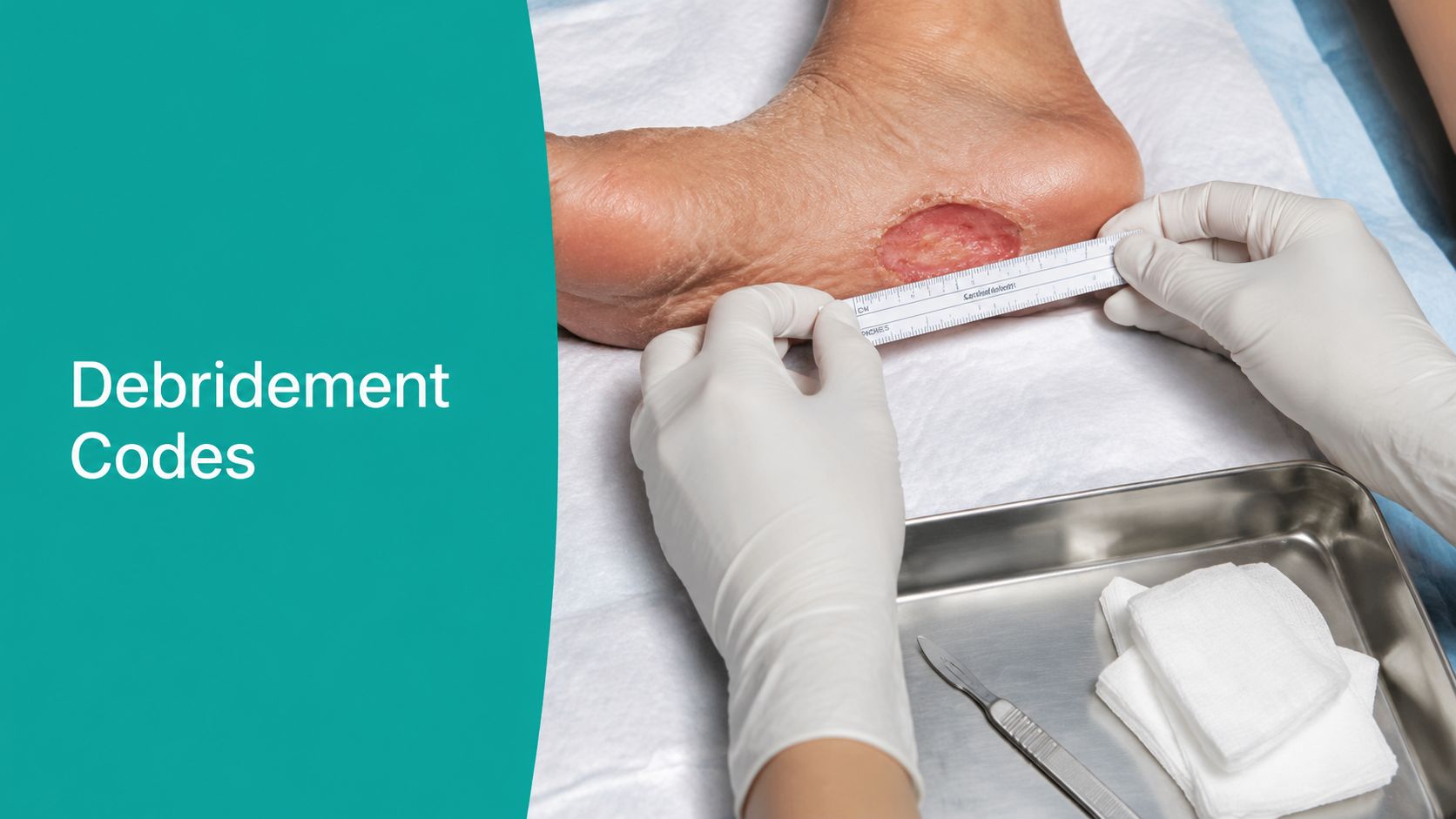
A denied 11043 claim usually starts long before billing touches the account. The wound note says “sharp debridement,” the ulcer looked dirty, the patient had a Wagner 3 diabetic foot ulcer, and everyone assumed the code would follow the visible wound depth. Then the payer reads the chart differently. The note doesn't prove what layer was cut away, the measurements are thin, and the claim comes back.
That's the frustrating part. The clinician did meaningful work, the coder used a plausible code, and the documentation still wasn't strong enough to defend it. For cpt code for excisional debridement, the gap is rarely the procedure itself. It's the proof.
Introduction with a Real Coding Challenge
A patient returns to clinic with a plantar ulcer that still has slough and rolled edges. The wound looks deep enough to worry anyone at the bedside, but the procedure note only says “sharp debridement performed.” Billing sends 11043, the denial arrives, and now the team is sorting through a chart that never clearly said whether subcutaneous tissue, muscle, or bone was excised.
That's a familiar failure point in wound care. The code choice has to match the final tissue layer removed, not the visual drama of the wound, and it has to reflect the debrided surface area that was treated, not just the wound's full size. When those details are missing, the claim can fall apart even if the bedside care was appropriate.
The practical fix is simple, but the discipline isn't. Clinicians, coders, and billing staff need to align on what proves excisional debridement, how to count units, and how to separate multi-wound visits without mixing depths. If you're seeing payer pushback on chronic ulcer claims, this is the part of the chart that needs tightening first.
Understanding Excisional Debridement CPT Codes
The code family and why the old structure matters
CPT moved excisional wound debridement away from the older 11040 to 11044 family on January 1, 2011, when 11040 to 11041 were deleted and the wound-care structure shifted to 11042 to 11047 and 97597 to 97598 (AAPC). The split still matters because selective and excisional debridement are not interchangeable. Skin-level work belongs in 97597 to 97598, while 11042 to 11047 applies when viable tissue is cut to a deeper layer.
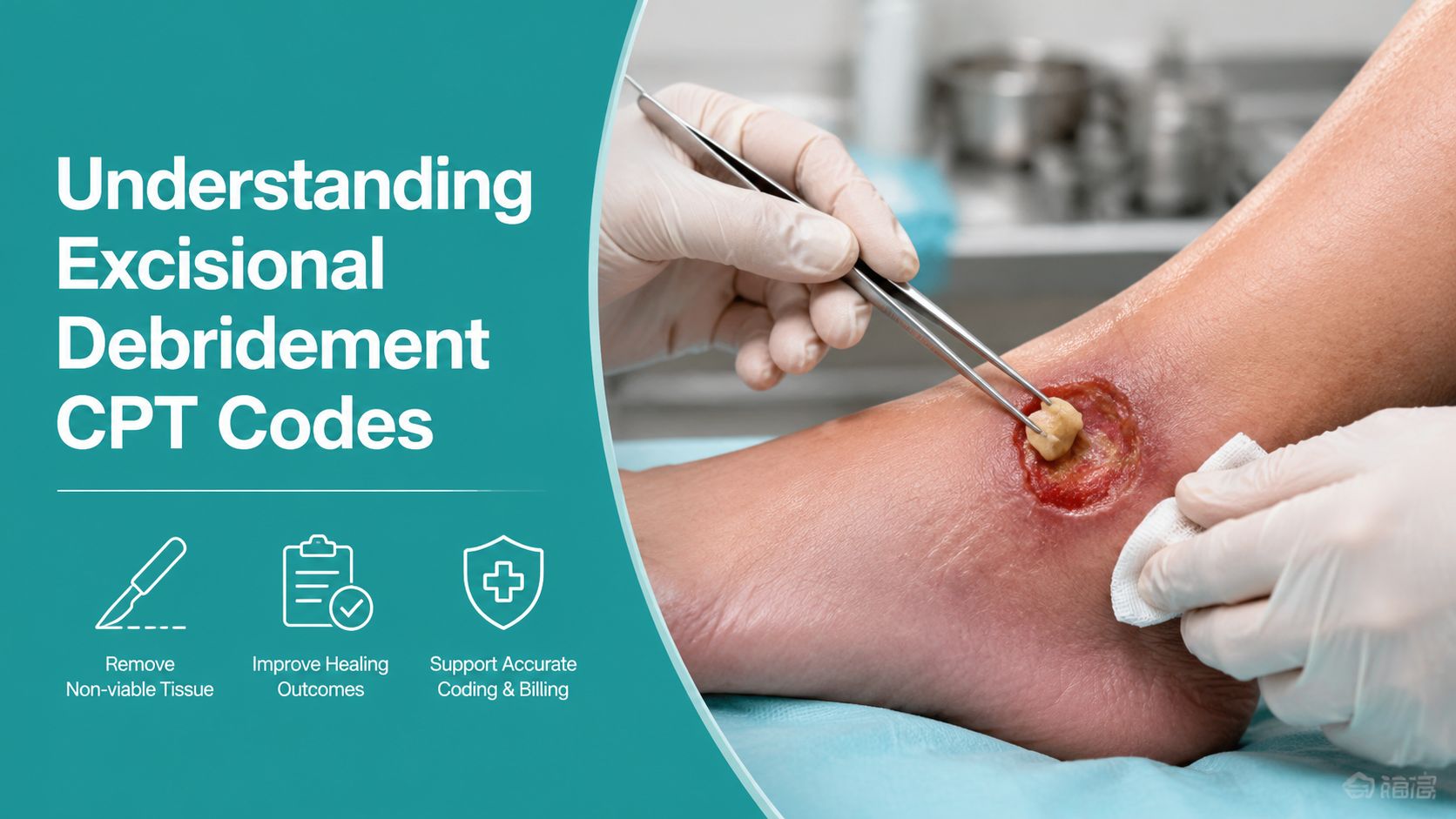
The coding decision turns on what the note proves. If the provider removes devitalized surface tissue without cutting into viable tissue, that stays in selective debridement. If the procedure reaches subcutaneous tissue, muscle, fascia, or bone, the claim belongs in the 11042 to 11047 family. That is the practical frame for the cpt code for excisional debridement.
A lot of denials start with a note that describes the wound well but does not prove excision. Size, depth, and appearance help tell the story, yet the code still follows the tissue removed. In chart review, I look for language that shows a cutting procedure, not just wound cleansing or surface scraping. If the chart cannot support that distinction, the cleaner code is usually the selective debridement reference for skin-level work, not an excisional code (Use a selective debridement reference alongside excisional coding when the wound is limited to skin-level work).
How to map depth to the right code
The code structure rests on two things, the deepest tissue removed and the total debrided surface area. The first 20 sq cm is billed with the base code for that depth, and each additional 20 sq cm uses the matching add-on code (HCCI). A wound can look extensive and still not support a deeper code unless the record shows that deeper tissue was excised.
Use a bedside test before the claim goes out. What was cut away? That chooses the code family. How much area was treated? That drives the unit count. Multi-wound visits make this even more important, because a shallow ulcer and a deeper ulcer on the same patient cannot be blended together without losing the coding trail. If the note does not separate the wounds and depths cleanly, the claim is vulnerable.
Documentation Requirements and Pitfalls
What the note has to show
The documentation standard for excisional debridement is unusually strict because the record has to show that actual tissue was cut away, not merely irrigated, scraped, or mechanically cleaned. AAPC's guidance lists five required elements, “excisional,” instrument, tissue removed, wound size, and depth reached (MedStates). AHIMA makes the same point in different language, the chart has to show a definite cutting away of tissue beyond the wound margin.
That's where a lot of notes fail. “Sharp debridement performed” sounds clinical, but it doesn't prove much by itself. A stronger entry names the instrument, states what was removed, gives the wound measurement, and says what layer was reached.
A note that survives review usually reads more like this, in substance, not as a template to copy blindly:
- Instrument used, scalpel or curette.
- Tissue removed, necrotic subcutaneous fat, slough, or devitalized muscle.
- Pre- and post-debridement measurements, so the treated surface area is visible.
- Depth endpoint, such as viable subcutaneous tissue with bleeding tissue exposed.
What surveyors and coders are looking for
The phrase “excisional debridement” is not enough on its own. The record has to prove excision beyond the wound margin, and it has to tie the procedure to the actual wound encounter. That's why notes that mention only “slough removed” or “wound cleaned” often collapse under payer review.
Best habit: finish the procedure note by asking, “Could someone who wasn't in the room tell what layer was cut, with what instrument, and how much area was treated?”
If that answer is fuzzy, the documentation still needs work. For workflow support, a structured documentation layer like medical necessity documentation prompts can help standardize the fields that auditors expect without turning the note into a copy-paste block.
Calculating Units and Using Modifiers
Surface area drives the billing
A wound can look large and still code small if the excision stayed shallow. For excisional debridement, the code family is 11042 to 11047, and billing turns on the deepest tissue layer cut away plus the total surface area debrided. The base code covers the first 20 sq cm, and each additional 20 sq cm uses the matching add-on code. Add-on codes don't stand alone.
| Excisional Debridement Code and Area Reference | CPT Code | Tissue Depth | Area Covered (sq cm) |
|---|---|---|---|
| Base code | 11042 | Subcutaneous tissue | First 20 |
| Add-on code | 11045 | Subcutaneous tissue | Each additional 20 |
| Base code | 11043 | Muscle | First 20 |
| Add-on code | 11046 | Muscle | Each additional 20 |
| Base code | 11044 | Bone | First 20 |
| Add-on code | 11047 | Bone | Each additional 20 |
Depth comes first, area comes second. If the note says the deepest layer removed was subcutaneous tissue, the base code comes from that depth. If the debrided portion crosses the next area threshold, the add-on code follows. The same logic applies at muscle and bone levels.
Where modifiers fit and where they don't
Modifier use matters when there are distinct wounds or distinct procedures on the same date. One wound should not be pushed into another wound's depth bucket just to make the claim fit. An add-on unit also should not be billed by itself because the visit involved a large burden of wounds. The code still has to reflect the treated area within the correct depth sequence.
A clean billing workflow checks three things in order:
- Depth of actual excision
- Debrided area, not total wound area
- Whether wounds are separate enough to support distinct reporting
In multi-wound charts, the math is where denials start. Separate wounds at different depths can change the code family, while two wounds at the same depth may need their treated areas combined for unit calculation. If your team is validating surface-area math, use a billing-units reference during claim review before the claim goes out. That check catches the notes where the sizes were measured correctly but the billed units still drifted off the documentation.
A structured note field for depth and area is easier to trust than a cleanup pass after the visit. When the wound is debrided in more than one location, the record has to show which site belongs to which depth and which surface area went with it.
Coding Examples with Wound Sizes and Wagner Grades
A Wagner 2 foot ulcer debrided to subcutaneous tissue
A patient has a 4 cm by 3 cm plantar ulcer with slough and devitalized subcutaneous tissue. That gives you a treated surface area of 12 sq cm, and the documented depth ends at subcutaneous tissue. That fits the 11042 family, because the deepest tissue removed is subcutaneous and the debrided area stays within the first 20 sq cm.
Many teams frequently overcode. The wound may look ugly and the Wagner grade may feel ominous, but the code follows what was removed. If only subcutaneous tissue was excised, don't move up to muscle or bone just because the ulcer looked advanced.
A Wagner 3 heel ulcer debrided into muscle
Now take a 6 cm by 5 cm heel ulcer. The visible size is larger, and the debridement reaches muscle. The base family changes because the deepest tissue removed changed. That places the claim in 11043 rather than the subcutaneous family.
If the chart also shows a larger treated area beyond the first 20 sq cm, the matching add-on code follows. The key is still the same, the note has to support the layer reached and the area treated. A bigger wound is not a substitute for better documentation.
Two related toe ulcers with mixed depths
This is the trap that gets missed most often. One toe ulcer gets debrided to subcutaneous tissue, while the second only has slough removed at the surface. Guidance says to sum surface area only within the same tissue depth and not mix depths in one code. For a single wound, code the deepest tissue removed (HMP Global Learning Network).
So the two wounds must be separated by depth. The deeper wound follows the excisional family for its depth. The superficial wound doesn't get pulled into that same calculation just because it was treated on the same day. That's the part that trips up multi-wound visits in outpatient wound centers, SNFs, and mobile programs.
A chart that lumps mixed-depth wounds into one bucket is asking for an audit trail it can't defend.

Common Denials and Practical Billing Tips
Why claims get denied
The most common denial pattern is blunt. The chart says “excisional debridement” but doesn't prove tissue removal beyond the margin. AHIMA says the record needs the instrument, extent, depth, and evidence of tissue removal, and missing those elements often leads to denials (AHIMA). That's not a coding nuance. That's a documentation failure.
A few other denial triggers show up over and over.
- Undocumented depth: the note never states the deepest layer removed.
- Missing measurements: there's no defensible area calculation.
- Solo add-on units: the bill tries to send only the add-on code.
- Mixed depths in one bucket: wounds at different depths are aggregated incorrectly.
What actually helps in day-to-day workflow
Good wound teams catch these errors before the claim leaves the building. Real-time chart prompts, a quick unit check, and a depth verification step at the end of the procedure save a lot of appeals. For some practices, a structured note system like EkagraHealth AI helps keep the SOAP note aligned with the coding fields during the visit, especially when multiple wounds are being treated in the same encounter.
That doesn't replace clinical judgment. It just keeps the note from drifting away from the facts that payers inspect. And if your billing team is buried in denials, a clean documentation trail makes it easier to recover unpaid invoices without arguing over what the chart failed to say in the first place.
Conclusion and Next Steps
The cpt code for excisional debridement rises or falls on proof. Map the actual tissue removed to 11042 to 11047, count the debrided area correctly, and document the instrument, depth, and tissue excision in plain language. Mixed-depth wounds need separate thinking, not a single messy bucket.
Audit a handful of recent claims today. If the note can't prove the layer removed and the area treated, fix the documentation workflow before the next denial lands.
A CTA for EkagraHealth AI.
