
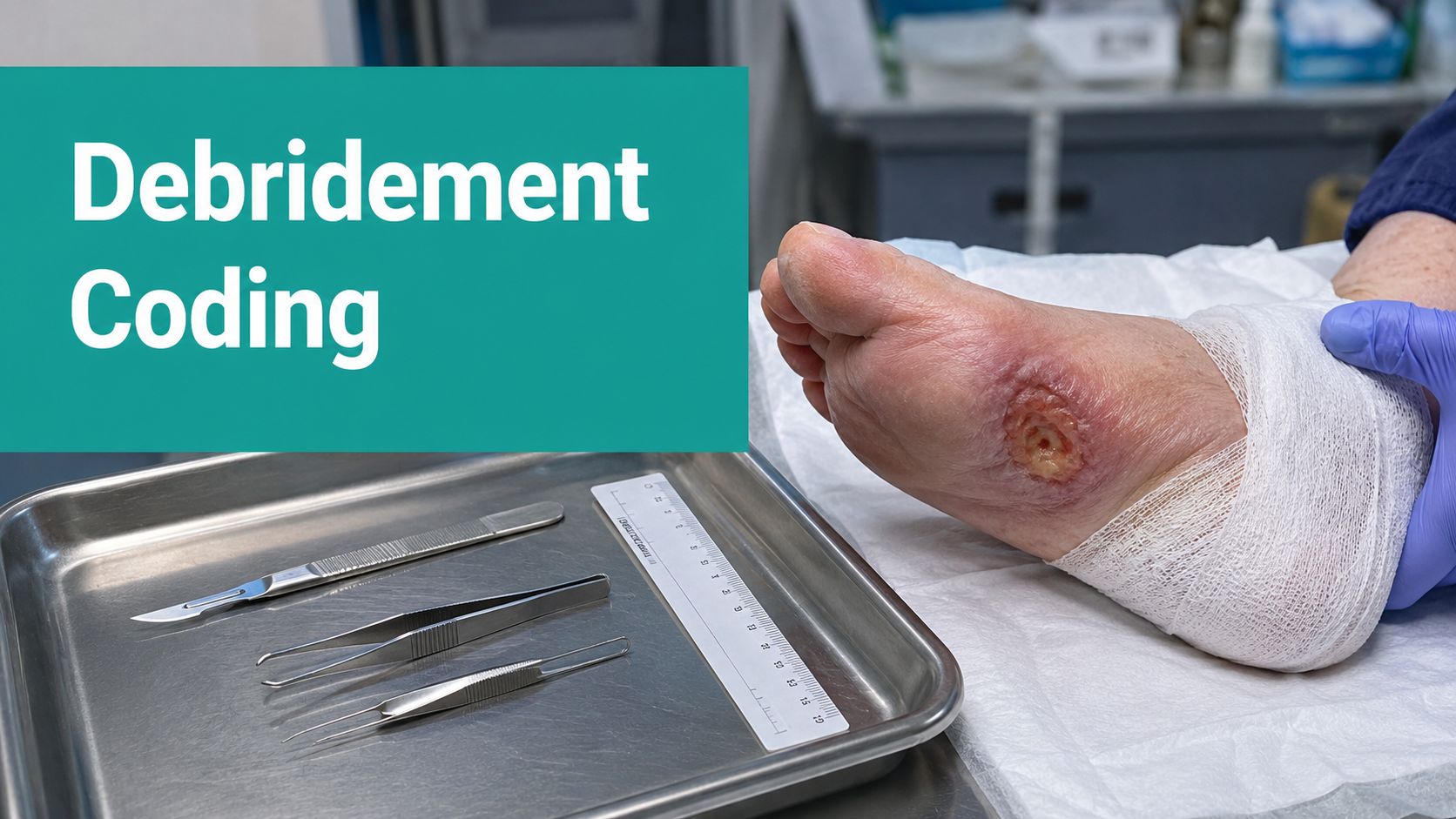
You debrided the wound correctly. The note looked solid. You documented slough, fibrin, serosanguinous drainage, healthy granulation after treatment, and the patient absolutely needed the work. Then the claim came back denied.
That happens because wound care coding doesn't reward clinical intuition. It rewards documentation that matches the code set exactly. In practice, the biggest disconnect shows up when clinicians move back and forth between selective debridement CPT code rules and surgical debridement rules without spelling out the details payers expect.
The other trap is multiple wounds. One plantar diabetic ulcer debrided to subcutaneous tissue. One smaller leg ulcer cleaned sharply at the dermal level. Clinically, that's ordinary wound care. From a billing standpoint, it's where undercoding, overcoding, and modifier mistakes start.
Why Your Perfect Debridement Note Still Gets Denied
A common denial scenario looks like this. A patient with a Wagner Grade 2 diabetic foot ulcer comes in with adherent yellow slough, moderate serosanguinous exudate, rolled edges, and periwound callus. You sharply remove devitalized tissue, improve the wound bed, expose healthier tissue, dress it, and move on to the next room.
Two weeks later, billing tells you the claim was denied for lack of medical necessity or incorrect coding.
The problem usually isn't the wound care. It's the mismatch between what you did and what the note proves. A clinically strong note can still fail if it doesn't make the coding logic obvious. Payers aren't standing at bedside. They're reading words.
What payers want that clinicians often skip
They want to know exactly what tissue was removed, how it was removed, how much surface area was treated, and whether the procedure stayed in the selective lane or crossed into excisional depth. If that distinction is fuzzy, the claim becomes vulnerable.
Good wound care documentation describes the wound. Good billing documentation defends the code.
That's why a note that says “sharp debridement performed, tolerated well” is weak even when the procedure itself was excellent. It doesn't tell the reviewer whether you performed selective debridement, surgical debridement, or something that should've been billed as non-selective care.
The real source of many denials
The denial often starts with one of these gaps:
- Missing measurement logic: No clear wound area in square centimeters.
- Unclear tissue level: The note describes visible depth, but not the deepest tissue removed.
- No instrument detail: “Debrided” without saying scalpel, scissors, forceps, or similar.
- Poor tissue description: No mention of slough, fibrin, exudate, debris, devitalized epidermis, dermis, or biofilm.
- Mixed wounds coded together: Multiple wounds treated at different depths but combined as if they belonged under one rule set.
Once you know where the disconnect happens, you can fix it. The coding itself isn't mysterious. The chart just has to show your thinking as clearly as your hands showed your skill.
CPT 97597 and 97598 The Area-Based Codes
You debride three ulcers in one visit. One is a small venous ulcer with loose fibrin. One is a pressure injury with scattered slough. One looks deeper, but the work you performed stayed selective. Clinically, that feels straightforward. Coding gets messy fast if the note does not separate which wounds belong in the 97597 and 97598 calculation and which details support selective, rather than excisional, work.
That disconnect causes trouble more often than poor technique.
CPT 97597 covers the first 20 sq cm of selective debridement. CPT 97598 is the add-on code for each additional 20 sq cm or part of that additional area. These are area-based codes, so the math matters. Payers want to see how you got the total, especially when more than one wound was treated in the same session.
What selective debridement means for coding
Selective debridement involves targeted removal of devitalized tissue while preserving viable tissue. In practice, the tissue removed often includes slough, fibrin, biofilm, exudate, debris, devitalized epidermis, or devitalized dermis. The procedure must read like skilled wound management, not routine cleansing or dressing change.
The note should make that distinction obvious.
If I review a denial-prone chart, the problem is often not the procedure. The problem is that the documentation sounds passive. “Wound cleaned” or “debrided as tolerated” does not explain what was removed, how it was removed, or why the service meets selective debridement criteria.
The area rule is simple. The wound mix is not.
With 97597 and 97598, the treated surface area is aggregated for wounds that were selectively debrided in the same encounter. That sounds easy until the patient has multiple wounds with different appearances and different levels of tissue involvement.
Here is the practical rule. Do not let the visual depth of one wound pull every other wound into the wrong coding family. For selective debridement, the calculation follows the wounds that received selective removal of non-viable tissue. If you treated several wounds selectively, add those areas together and code from the total treated area.
Example:
- Wound 1: 8 sq cm selectively debrided
- Wound 2: 8 sq cm selectively debrided
- Wound 3: 8 sq cm selectively debrided
Total selective area treated: 24 sq cm
That supports 97597 + 97598, not three separate 97597 entries.
Where clinicians get into trouble is combining wounds without showing the logic. If one wound note reads like selective debridement and another reads like excisional removal to a deeper tissue layer, those wounds need to be documented and coded according to the work performed on each one. A single blended paragraph is how good claims become bad claims.
What the note needs to show
For 97597 and 97598, I want the chart to answer a reviewer's questions in one pass:
- Exact wound location and laterality
- Individual wound measurements, so the total treated area can be verified
- Tissue removed, stated in clinical terms such as slough, fibrin, debris, biofilm, devitalized epidermis, or devitalized dermis
- Method used, such as scissors, scalpel, curette, forceps, or waterjet if applicable
- Confirmation that viable tissue was preserved
- Medical reason the devitalized tissue was limiting healing and required skilled removal
Pre-debridement and post-debridement measurements can strengthen the record, but the minimum goal is clarity about the treated area and the tissue removed. If the biller has to infer your square centimeters from scattered wound descriptions, the claim is already at risk.
Selective vs Surgical Debridement Coding At-a-Glance
| Attribute | Selective Debridement (97597/97598) | Surgical/Excisional Debridement (11042-11047) |
|---|---|---|
| Primary coding basis | Surface area | Deepest tissue removed |
| First code rule | 97597 covers the first 20 sq cm | Base code chosen by tissue depth |
| Additional work | 97598 for each additional 20 sq cm or part thereof | Additional coding depends on surgical debridement family |
| Typical tissue target | Non-viable tissue at or along viable margin | Tissue excised to the deepest level removed |
| Instruments commonly documented | Scissors, scalpel, forceps, high-pressure waterjet | Surgical excisional technique with depth-specific removal |
| Common denial trigger | Missing square centimeter measurements | Missing depth and extent documentation |
Practical rule: If your documentation is organized around total treated area and selective removal of devitalized tissue, 97597 and 97598 usually fit. If your documentation is organized around the deepest tissue excised, you are likely in the surgical debridement code family.
Surgical Debridement The Depth-Based 11042-11047 Codes

Surgical debridement coding starts with one question: What is the deepest tissue layer you removed? Not what you saw. Not how deep the wound looked before you started. What you removed.
Think of the wound bed like visible layers in rock or the layers of an onion. Surface contamination and slough sit above. Then come deeper structures. The code follows the deepest layer reached by excisional removal.
The code family is built around tissue depth
In practical wound care billing, clinicians commonly think of this progression:
- 11042 when debridement reaches subcutaneous tissue
- 11043 when debridement reaches muscle and/or fascia
- 11044 when debridement reaches bone
The add-on structure in that family follows the same depth logic. The key point is that the family is depth-based, not just area-based.
Code what you removed
Many notes often fail in this regard. A full-thickness ulcer may expose subcutaneous tissue, tendon, or even deeper structures, but the CPT code depends on the deepest tissue removed during debridement.
If the note says “wound extends to subcutaneous tissue” but doesn't state that subcutaneous tissue was debrided, the billed depth may not hold up.
For payer compliance and audit survival, providers must document the condition requiring debridement, exact site, extent and depth of debridement, method(s) used to remove tissue, specific type of tissue removed, whether any cutting occurred outside or beyond the wound margin, and laterality; auditors must confirm viable tissue exposure to support medical necessity for codes 11042–11047 (AAPC discussion of high-risk debridement coding and documentation).
What excisional notes need that selective notes may not
A surgical debridement note should show:
- The tissue plane reached: Subcutaneous tissue, muscle/fascia, or bone.
- The excisional nature of the procedure: Not just superficial cleansing.
- The exact site and side: “Right plantar forefoot” beats “right foot.”
- The extent of removal: How much tissue and from where.
- Viable tissue exposure: Medical necessity has to be obvious.
If you can't prove the depth of tissue removed, don't bill the deeper code and hope the reviewer fills in the blanks.
That's the practical dividing line between selective and surgical coding. One lives on area. The other lives on depth. Confusing the two creates most debridement payment problems.
Crucial Documentation That Satisfies Payers and Auditors

Documentation isn't just a clinical record. It's also the legal and financial support for the claim. If you want fewer denials, chart like someone else will read every word with a highlighter.
That means your note must do more than sound competent. It must show medical necessity, procedure detail, and coding support in plain language.
The non-negotiables
At minimum, every debridement note should lock down these elements:
- Wound identity: Exact anatomic site, laterality, and which wound number you treated if the patient has several.
- Measurements: Pre- and post-debridement dimensions, with square centimeter calculation when area-based coding applies.
- Depth removed: Especially if there's any possibility the service belongs in the 11042 to 11047 family.
- Tissue description: Adherent yellow slough, moist fibrin, necrotic dermis, debris, hyperkeratotic edge, or biofilm if that is the target.
- Method and instruments: Curette, scalpel, scissors, forceps, or high-pressure waterjet.
- Result of debridement: What tissue was exposed or improved afterward.
- Periwound findings: Maceration, erythema, induration, callus, rolled margins, undermining, tunneling, odor, and exudate character when relevant.
Biofilm is where many 97597 notes fall apart
This is one of the most frustrating real-world problems. Clinically, you may be removing biofilm sharply because the wound stalls, drainage persists, and the bed needs disruption to move healing forward. Coding reviewers, however, often deny that work if the note reads like generic cleansing.
Recent wound care literature for 2025 to 2026 emphasizes that biofilm removal requires sharp, selective instrumentation such as scissors or scalpel to disrupt the microbial matrix, yet CMS and many payer policies still classify enzymatic or wet-to-dry biofilm removal as non-selective. That creates a billing paradox where clinicians are often denied 97597 because the medical record lacks explicit documentation of viable tissue exposure and instrument used, which are mandatory for medical necessity (MedPyxis discussion of biofilm-focused 97597 documentation).
So if biofilm is your clinical target, say exactly what you did. Don't leave the reviewer to infer that it was sharp selective work.
“Biofilm debridement” by itself is too vague. Document the instrument, the non-viable material removed, and the viable tissue exposure that justified the procedure.
A note structure that usually holds up better
Try documenting in this order:
- State the indication clearly. Example: stalled diabetic foot ulcer with adherent fibrin and suspected biofilm limiting granulation.
- Describe the wound before treatment. Include exudate type, tissue quality, periwound status, and measurements.
- Name the instrument and method. Sharp selective debridement with scalpel and forceps is much stronger than “cleaned.”
- Describe the tissue removed. Be specific.
- Document what remained after debridement. Granulation tissue, improved wound base, viable tissue exposure, bleeding response if clinically relevant.
- Capture post-procedure care. Dressing, offloading, follow-up instructions.
Documentation workflows matter too. If signatures, authorizations, or bedside documentation steps are still fragmented, teams often lose detail between visit and final claim. Clean digital workflows and tools for eSignatures for healthcare compliance can help tighten that chain, especially in mobile and multi-site wound programs.
For teams rebuilding their note standards, a focused framework for medical necessity documentation is often more useful than a generic wound template because it forces the note to support the code, not just describe the visit.
Coding Complex Scenarios and Avoiding Common Denials
Most cheat sheets fall short of being helpful. Real patients don't arrive with one neat wound at one neat depth.
A typical day includes a plantar diabetic ulcer, a venous leg ulcer, and a sacral injury on the same patient, each with different tissue characteristics. If you treat them all in one encounter, coding has to follow the tissue removed from each wound, not the convenience of one blended claim line.
The rule that matters most with multiple wounds
When coding debridement, the primary code must reflect the deepest tissue layer removed, not merely what is visible, and for multiple wounds, surface areas can only be combined if they were treated at the same depth; you never sum across depths, and if wounds are debrided to different depths, each must be coded separately with modifier 59 appended to the second code (teaching review on debridement depth and modifier 59 use).
That one rule explains a lot of denials.
Scenario one with mixed depths
Patient has:
- Right heel Wagner Grade 2 diabetic ulcer with callused rim, undermined edge, and necrotic subcutaneous tissue removed during debridement
- Sacral partial-thickness wound with fibrinous surface material sharply debrided without cutting into viable subcutaneous tissue
These are not aggregatable under one surface-area total. They live in different coding frameworks because the tissue removed differs.
A clean way to think through it:
| Wound | Clinical finding | Coding logic |
|---|---|---|
| Right heel ulcer | Debrided to subcutaneous tissue | Surgical family code based on depth |
| Sacral wound | Selective removal of surface non-viable tissue | 97597/97598 logic if documentation supports selective work |
If both are billed on the same date, the second distinct procedure may require modifier 59 to show it was separate.
Scenario two with multiple selective wounds
Suppose a patient has several lower-leg ulcers with fibrin and debris, all selectively debrided at the same tissue level. In that case, area aggregation may be appropriate because the wounds belong to the same selective framework.
What gets practices in trouble is mixing this logic with a deeper diabetic foot ulcer from the same visit. The foot ulcer can't be thrown into the same area total if the tissue removed was deeper.
Scenario three with exposed structures but shallow removal
This one causes overcoding. A wound may expose deeper structures, but if your procedure only removes superficial non-viable tissue and does not excise to those deeper layers, the code follows the tissue removed, not the anatomy on display.
That's why the phrase “wound probes to” should never drive the CPT code by itself.
Exposed tendon doesn't automatically mean a deep debridement code. The operative detail has to show what you actually removed.
A practical decision sequence
Use this sequence when you're coding a difficult visit:
- First sort each wound by deepest tissue removed.
- Then separate selective wounds from surgical wounds.
- Aggregate only wounds treated at the same depth under the same rule set.
- Use modifier 59 when different debridement procedures were performed separately on the same date and the documentation supports it.
- Check that each wound has its own site, tissue, measurement, and instrument details in the note.
Teams that want a cleaner workflow between diagnosis selection and procedure coding usually benefit from reviewing how ICD-10 and CPT codes should align at the claim level, especially in mixed-etiology wound patients.
Automating Accuracy with EkagraHealth AI
A clinician can do the procedure correctly, document the wound well enough for clinical care, and still hand billing a note that is hard to code cleanly. That gap shows up all the time in debridement visits with multiple wounds at different depths. The chart may describe the patient accurately, but the claim still fails because the coding logic was never made explicit.
That is the problem automation should solve.
A good wound note often reflects how the wound looked. A billable wound note also has to reflect what was removed, from which wound, to what depth, by what method, and whether those wounds belong in the same code family at all. In mixed-depth encounters, that disconnect is where denials start.
Where manual processes fail
The usual miss is not lack of effort. It is one omitted detail that matters to coding and audit review:
- the instrument used
- the tissue removed
- the post-debridement measurement or total area when area-based coding applies
- clear separation of wounds treated at different depths
- support for distinct procedural coding when more than one debridement service was performed
I see this in fast clinic days, mobile rounds, and SNF work. The clinician documents the patient's wound burden well, but the note blends all wounds into one narrative. That creates trouble later. Billing has to guess which wounds were selective, which were surgical, and whether the square centimeters were aggregated correctly or should have been split by depth and code set.
EkagraHealth AI is designed to reduce that gap between the clinical story and the coding requirements. It helps capture wound measurements, tissue descriptions, debridement details, and coding cues from the encounter so the final note supports what was done. That matters even more when one visit includes a superficial leg ulcer, a deeper diabetic foot ulcer, and a pressure injury that was assessed but not debrided.
The software should not act like a passive chart repository. It should prompt for missing elements while the encounter is still fresh. If the note supports selective debridement but never identifies the instrument, that should be flagged before charge entry. If two wounds were debrided on the same date but belong under different coding rules, the chart should make that visible before the claim is built.
For teams reviewing medical coding automation tools for wound care documentation, the standard is simple. The tool has to reduce ambiguity, separate wounds cleanly, and help the submitted CPT code match the tissue removed, not just the wound description in the assessment.
If your group is tired of debridement denials, fragmented notes, and coder callbacks, EkagraHealth AI deserves a close look. It is built for wound care workflows and helps turn bedside documentation into cleaner CPT and ICD-10 support without forcing clinicians to reconstruct the visit after the fact.
