
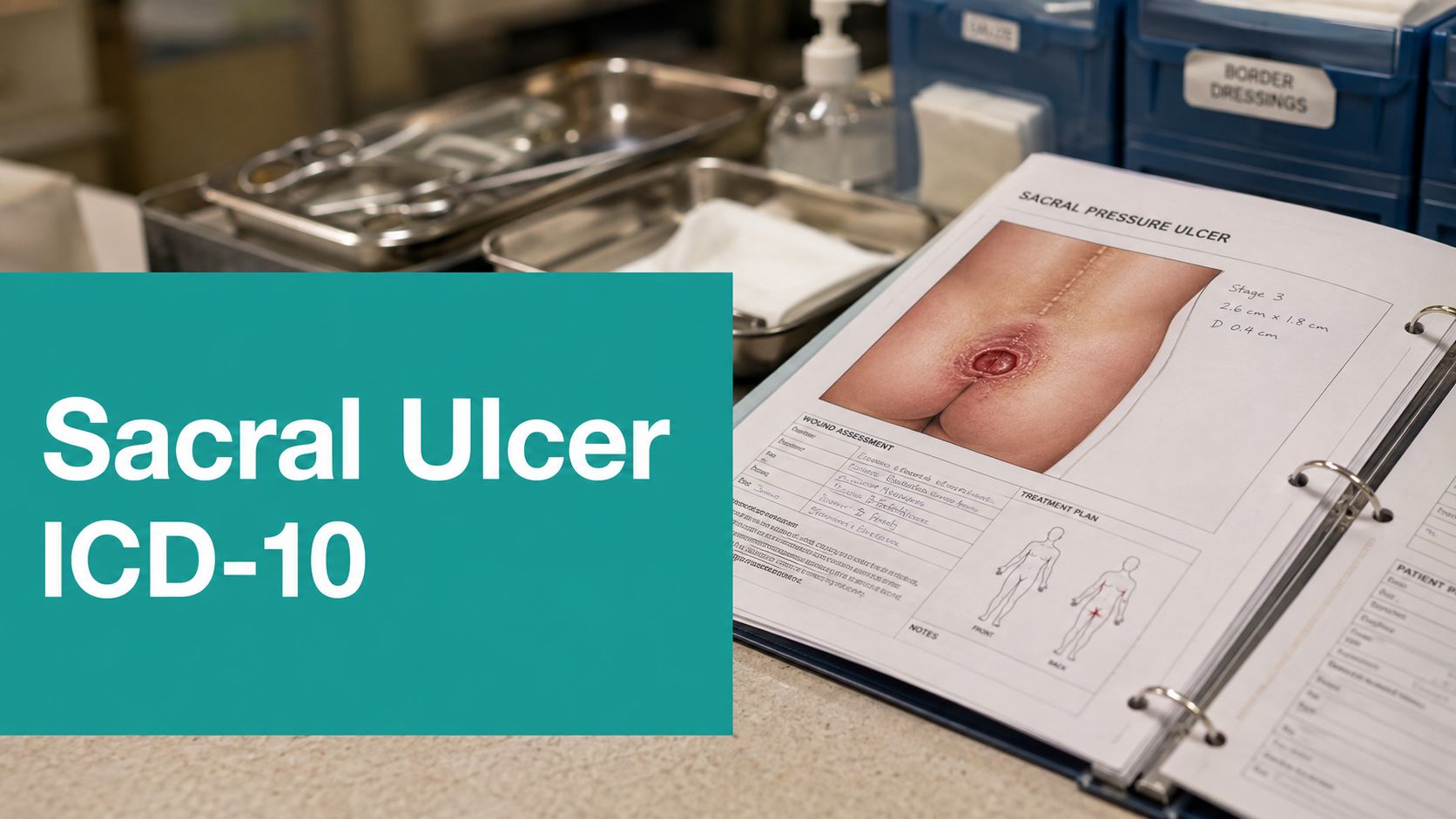
A wound care note can look clinically busy and still fail coding review. “Sacral pressure ulcer, 3 cm by 4 cm, moderate drainage” tells the reader where the wound is and what it looks like, but it doesn't establish the stage, tissue depth, present-on-admission status, or the level of tissue removed during debridement. That gap can turn an otherwise appropriate encounter into an unspecified-stage diagnosis paired with a procedure code the record can't support.
The practical issue with sacral pressure ulcer ICD-10 coding isn't memorizing a list. It's documenting the wound's clinical state at the encounter, then making sure the diagnosis and procedure codes follow that state when the wound changes.
When the Chart Says Sacral Ulcer But the Code Falls Short
During chart review, a common note reads: sacral pressure ulcer, measured with a wound probe, moderate serosanguinous drainage, no odor, dressing changed. The measurement is useful, and the exudate description helps with treatment planning. But without a stage or tissue-depth description, the coder can't determine whether the wound is stage 2, stage 3, stage 4, unstageable, or a deep tissue pressure injury.
The fallback is L89.159, pressure ulcer of the sacral region, unspecified stage, listed by the AAPC sacral pressure ulcer code reference. That code accurately reflects an incomplete record, but it gives the claim less diagnostic precision. It also weakens the connection between the diagnosis and a debridement service when the procedure note describes deeper tissue removal.
How the gap reaches the claim
Suppose the same encounter includes sharp debridement. The procedure note says necrotic tissue was removed, but doesn't identify whether the deepest tissue removed was skin, subcutaneous tissue, muscle, or bone. The diagnosis says only “sacral ulcer.” A reviewer now has no reliable way to confirm that the selected CPT family matches the work performed.
That's where denials arise. The problem isn't always that the treatment was unreasonable. It's that the wound description, stage, and procedure depth don't tell the same story.
Practical rule: Measurements and drainage descriptions support care, but they don't replace staging criteria.
At the bedside, document the sacral location, the current stage or why staging is impossible, the deepest visible or exposed tissue, whether the wound was present on admission, and the condition after any debridement. Coders can't infer the highest stage from treatment intensity, dressing choice, or the fact that a wound “looks deep.”
The L89.15 Code Family and How Combination Codes Work
The sacral region uses a combination-code structure under ICD-10-CM category L89. The code carries both the anatomic site and the stage, so the record must support both elements at the same encounter. The CMS ICD-10-CM coding guidelines also direct reporting of as many L89 codes as needed when a patient has multiple pressure ulcers.
Sacral Pressure Ulcer ICD-10-CM Code Range
| Code | Stage or descriptor |
|---|---|
| L89.150 | Sacral pressure ulcer, unstageable |
| L89.151 | Sacral pressure ulcer, stage 1 |
| L89.152 | Sacral pressure ulcer, stage 2 |
| L89.153 | Sacral pressure ulcer, stage 3 |
| L89.154 | Sacral pressure ulcer, stage 4 |
| L89.156 | Pressure-induced deep tissue damage of the sacral region |
| L89.159 | Sacral pressure ulcer, unspecified stage |
The code family matters because a generic “pressure injury” diagnosis doesn't establish the sacral site or the clinical category. If the documentation says “sacral ulcer” but gives no stage and no reason the wound can't be staged, the record supports unspecified-stage coding rather than a more specific code.
Code the documented state
The stage must reflect the current documented condition. A wound covered by eschar may initially be unstageable. If debridement exposes viable tissue and the clinician documents the resulting depth, the diagnosis should follow the newly visible state for that encounter, subject to the applicable coding review process.
The same logic applies to deep tissue damage. It isn't a catch-all for a wound that looks dark or severe. The clinician must identify the presentation and select the dedicated code when it fits.
Stage-Specific Clinical Descriptors That Support Each Code
Stage selection depends on tissue involvement, not the amount of drainage, the wound's odor, or the dressing used. CMS identifies L89.153 as a stage 3 sacral pressure ulcer involving full-thickness skin loss with damage or necrosis of subcutaneous tissue. L89.154 represents stage 4, with soft-tissue necrosis extending through underlying muscle, tendon, or bone, as described in the CMS full-code description.
What the note should show
- Stage 1: Document intact skin with non-blanchable erythema and the absence of an open wound.
- Stage 2: Describe partial-thickness skin loss and the exposed dermal layer. Don't use stage 2 when slough, eschar, granulation tissue, adipose tissue, or deeper structures are present.
- Stage 3: State full-thickness skin loss and identify subcutaneous tissue involvement. “Exposed fat” or “visible adipose tissue” is more useful than calling the wound deep.
- Stage 4: Identify exposed or directly palpable muscle, tendon, or bone, or document necrosis involving those structures when clinically present.
A wound can have undermining, tunneling, or exposed fat without automatically being stage 4. The note needs to distinguish those findings and state the deepest involved structure.
For a practical staging workflow, clinicians can use this sacral wound staging reference while documenting the encounter. Photos, when obtained according to organizational policy, and serial measurements help establish whether the wound has become smaller, stalled, or revealed a different base after debridement.
A wound's stage can change as the base becomes visible. The record should explain the change instead of making the coder reconcile conflicting labels.
Unstageable Wounds Versus Deep Tissue Injury
Black eschar over the wound base creates a specific problem. If the covering prevents the clinician from seeing or assessing the extent of tissue destruction, the wound is unstageable, not automatically stage 3 or stage 4. The correct sacral code is L89.150 until the base can be evaluated and the clinician documents the new state.
Deep tissue pressure injury is different. It commonly presents with intact or partially intact skin and persistent purple or maroon discoloration, or a blood-filled blister associated with underlying tissue damage. It isn't an early stage assigned just because the skin looks dark.
The distinction affects more than diagnosis
A sacral wound with obscuring eschar and an adjacent area of purple or maroon intact skin may represent two clinically distinct pressure injuries. The chart should identify each site or area separately, describe the presentation, and support separate L89 coding when both conditions are present. CMS's coding framework distinguishes the dedicated deep-tissue category from stage-based sacral codes, so deep tissue damage uses L89.156, not a generic sacral stage code.
The same encounter can therefore include an unstageable sacral ulcer and a separate area of deep tissue damage. A single “sacral pressure injury” label loses that distinction and can create confusion about treatment, monitoring, and procedure linkage.
Use the unstageable pressure ulcer documentation guide when the base is obscured. Document the covering material, whether it's adherent, what can and can't be visualized, and whether debridement was performed. Once the base is exposed, record the post-debridement depth and update the wound assessment.
Linking Diagnosis Codes to Debridement CPT Selection
The diagnosis describes the wound. The procedure code describes what the clinician removed. Those two records need to align.
CMS identifies CPT codes 11042, 11043, 11044, 11045, 11046, and 11047 as surgical debridement codes for removal of devitalized tissue from wounds in its Medicare wound debridement guidance. The selected code depends on the deepest tissue removed and the documented treated area.
Document the tissue removed, not just the wound's appearance
A stage 3 sacral ulcer may have exposed subcutaneous fat, but the procedure note must still state what was debrided. If removal reached skin and subcutaneous tissue, the record needs to support that level. If the clinician removed devitalized muscle, the note must say so. Bone removal requires documentation that bone was involved in the debridement, not merely visible at the base.
The add-on codes in the same family apply when the reported service meets the applicable area requirements. Surface area, method, instruments, deepest tissue removed, and hemostasis should be recorded in the procedure note.
When sacral excision is involved
Sacral pressure ulcer excision has a site-specific CPT family, including excision with primary closure and excision with ostectomy. Those codes aren't interchangeable with general wound debridement codes.
For a stage 4 sacral ulcer with exposed bone, pairing L89.154 with an ostectomy code, a debridement code, or both depends on the operative work performed. The diagnosis alone doesn't answer that question. A claim becomes vulnerable when the wound note says “bone exposed,” the procedure note describes only superficial tissue removal, and the selected CPT code implies deeper excision.
Review the selective debridement CPT coding discussion alongside the actual procedure note. The central audit question is simple: does the documentation prove the tissue removed and the procedure family billed?
Documentation Template Elements That Pass Audit
A reliable note follows the clinical examination rather than the billing code list. Start with the wound's exact site, then describe the current state in terms another clinician and a coder can verify.
Core wound assessment
Record:
- Anatomic site: State sacral region and distinguish it from coccyx, buttock, or another nearby location when clinically relevant.
- Current stage: Include staging criteria, not just a stage number.
- Tissue depth: Identify exposed fat, tendon, muscle, or bone, or explain why the base can't be assessed.
- Admission status: Document whether the wound was present on admission when that status is known and relevant.
- Measurements: Record length, width, and depth, then track them serially using a consistent method.
- Exudate: Describe type and amount, such as serous, sanguineous, or serosanguinous, without treating drainage as a staging criterion.
- Periwound: Include maceration, erythema, induration, dermatitis, undermining, and skin integrity.
- Healing trajectory: State whether the wound is improving, stable, or stalled, and document the clinical response.
After debridement
The post-procedure note deserves separate attention. Record the material removed, instruments used, deepest tissue reached, post-debridement measurements, wound-bed appearance, and hemostasis. If removal exposes a deeper structure, document the new visible state and update the diagnosis for the current encounter.
The code shouldn't remain anchored to the initial appearance when the clinician has established a different stage. A before-and-after description gives the coder an audit trail instead of forcing an inference.
Weak Documentation Versus Strong Documentation Examples
The following comparison shows why a few additional clinical details can change the coding outcome.
| Weak note | Strong note |
|---|---|
| “Sacral pressure ulcer, 3 cm × 4 cm, moderate drainage.” | “Stage 3 sacral pressure ulcer, present on admission, 3 cm × 4 cm × 1 cm, full-thickness skin loss with exposed subcutaneous fat, moderate serosanguinous drainage, periwound intact.” |
| No stage documented. | Stage and supporting tissue description documented. |
| No tissue depth. | Exposed subcutaneous tissue identified. |
| No admission status. | Present-on-admission status recorded. |
| No periwound assessment. | Periwound condition recorded. |
The weak version supports the site and measurements, but not the stage. It leads toward L89.159, unspecified stage, and leaves the claim exposed if a deeper debridement service is billed without supporting procedure detail.
The strong version supports L89.153, stage 3 sacral pressure ulcer, because it identifies full-thickness skin loss and exposed subcutaneous fat. It also gives reviewers a coherent clinical story: the wound was present on admission, the dimensions are clear, drainage is characterized, and the surrounding skin was assessed.
Strong documentation doesn't mean longer documentation. It means the note contains the facts the code requires.
If debridement occurs, add the tissue removed and the post-procedure wound state. A stage 3 diagnosis paired with a procedure note that reaches muscle still needs reconciliation, because the procedure may have changed the documented wound status or may reflect a different area treated.
Support Surface Coverage and Monthly Documentation Requirements
Support surface coverage depends on more than placing a stage code on the claim. The CGS Medicare support surface checklist requires a stage 3 or stage 4 pressure ulcer plus severe mobility limitation for the coverage pathway described there.
The record also needs ongoing practitioner documentation. That includes monthly ulcer size, whether the care plan is being modified when healing stalls, and why continued bed use remains reasonable and necessary.
Keep the clinical story current
An initial L89.154 may have been correct when the wound had documented stage 4 involvement. Later, the wound may show a different current state after treatment or debridement. The record should explain the change rather than carrying forward the old label without reassessment.
Coverage problems often arise from maintenance documentation. The original diagnosis may be accurate, yet the claim still lacks current measurements, a response to stalled healing, or a rationale for continued use of the support surface. Link each monthly assessment to the active wound description and the current care plan.
Surveyors and payers look for continuity. They want to see that the practitioner knows the wound's present condition, recognizes when progress has stalled, and has adjusted care when clinically indicated.
Quick Reference for Common Sacral Ulcer Coding Scenarios
Use the clinical presentation as the starting point, then verify that the diagnosis and procedure documentation agree.
- Sacral ulcer with adjacent deep tissue damage: Describe the wounds as separate findings when they're clinically distinct. Use the dedicated deep-tissue code, L89.156, for the sacral deep tissue injury and add other L89 codes supported by the record.
- Eschar obscures the base: Use L89.150, unstageable, while the true depth can't be determined. After debridement exposes the base, document the new depth and use the current supported stage.
- Multiple pressure ulcers: Assign as many L89 codes as needed for the ulcers documented at the encounter. Record each wound separately rather than combining measurements or stages.
- No stage in the note: L89.159 is the fallback for unspecified stage. Treat it as a documentation gap, not a preferred long-term choice.
- Pressure injury versus another etiology: Confirm the cause before using L89. A non-pressure chronic ulcer, traumatic wound, or diabetic foot ulcer follows a different coding logic.
- Wagner grading: Keep Wagner grading associated with diabetic foot ulcer assessment. Don't substitute it for pressure-ulcer staging or use it to select an L89 code.
- Present on admission: Record the status when the patient enters the facility or service, then maintain the wound's serial history as treatment continues.
The code lookup is the final step. The clinical distinction comes first.
Building a Documentation Workflow That Prevents Denials
A clean claim starts before the visit ends. The clinician identifies the wound as sacral, documents the stage or the reason it's unstageable, records tissue depth and present-on-admission status, and completes the procedure note with the deepest tissue removed. The coding team then has a defensible diagnosis and a CPT selection that follows the work performed.
For wound care practices, SNFs, and mobile programs, EkagraHealth AI can serve as a documentation backbone by listening during visits, drafting SOAP notes, mapping CPT and ICD-10 codes, and supporting wound image analysis with measurements and annotations. The objective isn't to replace clinical judgment. It's to reduce missing details while preserving an audit-ready record.

Build the workflow around four checks before signing the note:
- Site and stage: Confirm the diagnosis reflects the current documented wound state.
- Depth and procedure: Match the deepest tissue removed to the selected CPT family.
- Serial evidence: Preserve measurements, photos when appropriate, periwound findings, and stage changes.
- Coverage support: Keep monthly practitioner documentation aligned with the care plan and support-surface rationale.
EkagraHealth AI helps wound care teams capture staging, tissue depth, measurements, and procedure details during the visit, then connect that documentation to CPT and ICD-10 coding. Visit EkagraHealth AI to see how the platform can support cleaner claims and more consistent sacral pressure ulcer documentation.
