
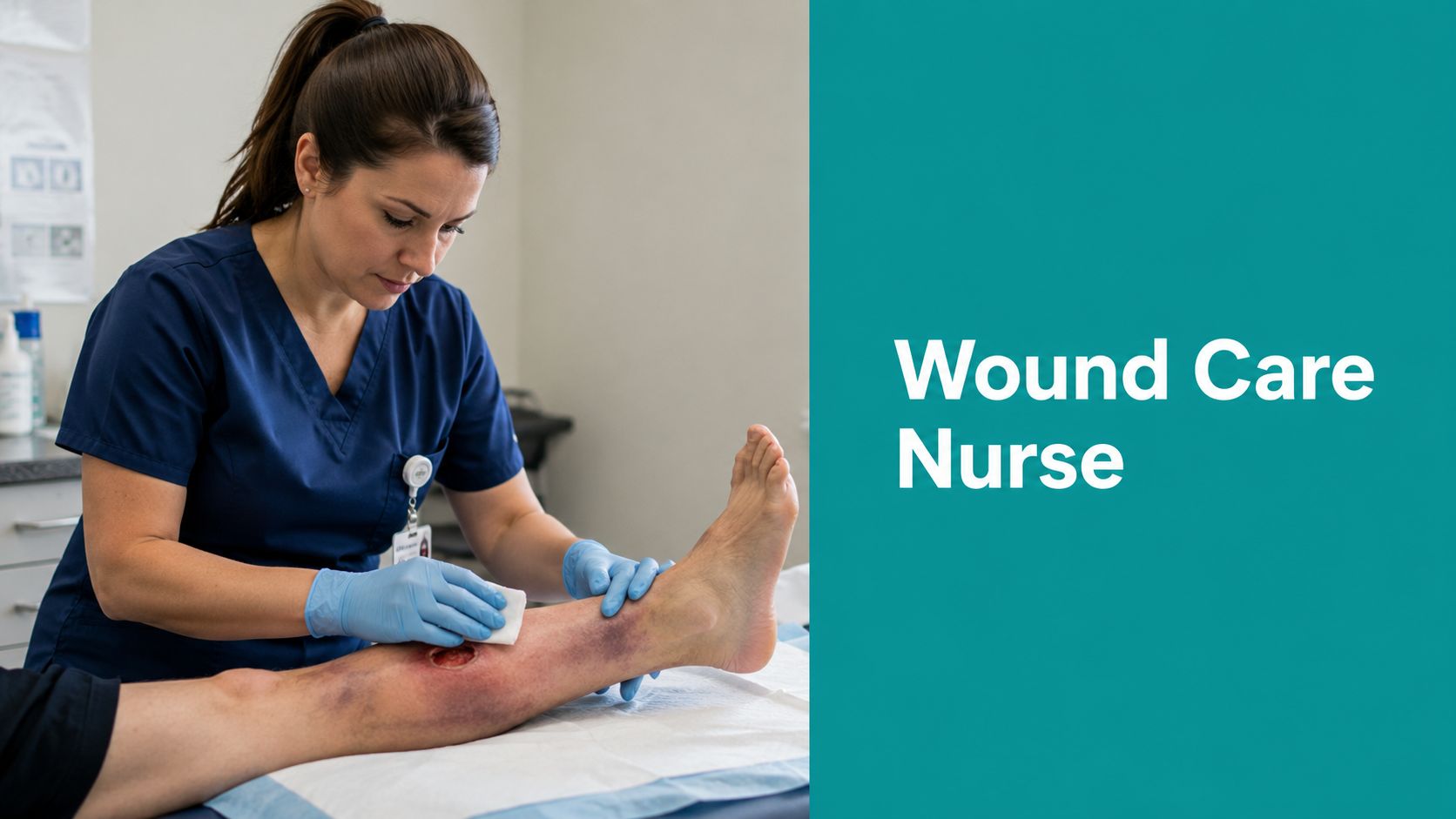
The most common advice on how to become a wound care nurse is also the least useful: get some Med-Surg time, pick a certification, and apply. That leaves out the part that determines whether you'll survive in the role. Wound care is a case-mix specialty and a documentation specialty. If your background is too general, your notes are vague, or your hours don't clearly count as wound-specific, you'll feel it fast.
The nurses who do well in this field usually build two things in parallel. First, they get repeated exposure to hard wounds, not just routine dressing changes. Second, they learn to document like reimbursement and survey readiness depend on every word, because they do.
Your Foundation in Clinical Practice and Case Mix
Your first wound care job will expose weak clinical foundations fast. The nurses who struggle are usually not short on compassion. They are short on repeated wound-specific reps, precise assessment language, and the kind of charting discipline this specialty demands.
If you plan to pursue the WOCNCB route later, a BSN is part of the gatekeeping for a reason. Wound care specialists are expected to do more than change dressings. You are expected to connect perfusion, nutrition, pressure, moisture, infection risk, mobility, support surfaces, and comorbid disease into one defensible plan of care. The BSN requirement reflects that broader level of clinical reasoning, not just a preference for more school. ADN-prepared nurses and LPNs can still build strong wound careers, but they need to be intentional about case mix and realistic about which credentials may be available now versus later.
Early on, build a patient load that teaches judgment. Routine skin checks, standard post-op dressing changes, and one-off consults are not enough. You need follow-up exposure. You need to see what happened after the first recommendation, whether the offloading plan failed, whether edema control worked, whether the drainage changed, and whether the wound stalled because the original etiology was wrong.
For clinicians who need to refresh the body systems behind delayed healing, essential physiology training for care staff is a useful review.
Build a case mix that prepares you for the job
Broad Med-Surg experience helps, but only if it includes wounds that force you to assess, reassess, and defend your choices in the chart.
Prioritize repeated exposure to:
- Complex pressure injuries with undermining, tunneling, moisture damage, contractures, and offloading problems
- Diabetic foot ulcers where glycemic control, footwear, infection surveillance, and adherence affect every visit
- Venous leg ulcers with edema, high drainage, fragile periwound skin, and recurrence
- Arterial or mixed-etiology wounds where perfusion limits what treatment is safe
- Post-surgical and dehisced wounds that require close attention to tissue quality, drainage pattern, and signs of deeper complications
Those reps change how you document. Newer nurses often write “improving” because the wound looks cleaner. That is not enough. Strong wound nurses chart what changed and why it matters: less adherent slough, decreased maceration, stable measurements, improved granulation, lower drainage volume, no new odor, pain unchanged or increased, offloading tolerated poorly, compression accepted or refused. That level of detail protects patient care and supports billing. It also keeps your note from falling apart under audit.
A resume with only general bedside experience leaves employers guessing. Can you follow a chronic wound over weeks? Can you recognize when a treatment failed? Can you document a wound in language that supports ongoing skilled need? Those are separate skills.
Choose settings that build wound judgment
The best training ground is a setting where wound care is frequent and longitudinal. Skilled nursing, inpatient rehab, home health, vascular or surgical services, podiatry-adjacent practice, and dedicated wound teams usually provide better experience than a unit where wounds are handled as an occasional task.
It helps to learn wound terminology correctly early. Mislabeling etiology leads to bad treatment plans and bad notes. If you want a practical refresher, this guide to different wound types in clinical practice is a useful reference.
A strong foundation shows up in the examples you can give. Pressure redistribution that failed twice before the plan changed. A diabetic foot wound that stalled because offloading was inconsistent. A venous ulcer that improved only after edema management became realistic for the patient. Those are the cases that make you credible, trainable, and far more useful on day one.
Choosing Your Wound Care Certification Pathway
Certification gets talked about like it is the whole job. It is not. It is an entry ticket, a screening filter, and in some settings, a billing and privileging issue. The right choice depends on where you plan to work, what your license permits, and how fast you need to get into a wound-heavy role without boxing yourself into the wrong lane.
The two broad routes nurses usually compare are a traditional board-style wound credential path and a more accessible wound care certification path open to a wider group of clinicians. Both can lead to solid wound work. They do not carry the same weight in every employer setting, and that matters more than the letters alone.
Wound Care Certification Comparison
| Attribute | Traditional board-style pathway | Broader-access wound certification pathway |
|---|---|---|
| Education baseline | Usually aimed at RNs with a BSN and, in many cases, formal specialty education | Often open to a wider mix of licensed clinicians, including some LPNs/LVNs and allied professionals |
| Eligible clinicians | Commonly built around RN practice standards | Broader eligibility across disciplines, depending on the certifying body |
| Experience pathway | Tends to require either a formal education track or significant recent wound-specific practice hours | Often allows a supervised clinical training route or documented wound care experience |
| Timeline | Slower, especially if you still need degree progression or specialty hour accumulation | Faster for clinicians who need a practical entry point into wound-focused work |
| Recertification | Periodic renewal is standard | Periodic renewal is standard |
| Common employer fit | Acute care systems, hospital wound teams, and roles tied closely to specialty-service expectations | Skilled nursing, post-acute care, mobile wound programs, outpatient settings, and organizations that need flexibility in staffing |
Match the credential to the job, not your ego
If your target is a hospital wound team, an ostomy-heavy service, or a system that screens hard for traditional specialty credentials, the more formal route often fits better. It takes longer. It can be rigid. That is also why some hospital leaders trust it.
If you are an LPN/LVN, an RN without a BSN, or a nurse trying to get into wound care sooner in post-acute or outpatient practice, the broader-access certification route may be the smarter move. Getting into the field earlier gives you case volume, repetition, and better clinical judgment. Those things matter.
Hiring managers care about fit. They also care about whether you can carry a wound caseload without creating documentation problems.
A practical way to choose is to review job postings in the setting where you plan to work and track which credentials appear repeatedly. Then compare that against your current license, education, timeline, and budget. If you need structured education before sitting for an exam, these wound care CME learning options can help you build a study plan that matches the role you want.
The trap people hit
Nurses often overestimate what counts as wound experience.
General med-surg time, routine skin checks, and occasional dressing changes do not always satisfy wound-specific eligibility standards. Certifying bodies and employers usually want proof that you managed wounds directly over time. That means assessment, staging or etiology identification, treatment selection, follow-up, and care-plan changes based on response. If your experience cannot be verified clearly, your application can stall.
Newer nurses are sometimes caught off guard. They spend months chasing a credential, then realize their documented experience is too vague because their role never separated wound work from general bedside care. A generic job description does not help much.
Before you commit to a pathway, ask three blunt questions:
- Does my current role give me wound-specific hours that can be verified?
- Does this credential match the employers I want?
- Will this path help me do the clinical work and the paperwork that comes with it?
That last question gets ignored too often. Wound care is technical work, but not just in the hands-on sense. It is also measurement accuracy, treatment rationale, recurring reassessment, and defensible charting. If you want a useful outside read on how employers think about applied skill sets, see Learniverse insights on technical skills.
Choose the path that gets you credible in your setting and trainable on day one. The wrong certification is usually the one that looks good on paper but leaves you unprepared for the case mix, pace, and documentation burden of real wound practice.
Mastering Core Hands-On Wound Care Skills
A credential may get your resume noticed. Your hands are what keep you in the room.
Most new clinicians think they need to memorize products. That's not the hard part. The hard part is matching wound bed, perfusion status, drainage, pain pattern, and patient adherence to the right intervention without creating a bigger problem.
Debridement judgment
You don't need to be reckless to be effective. You need judgment.
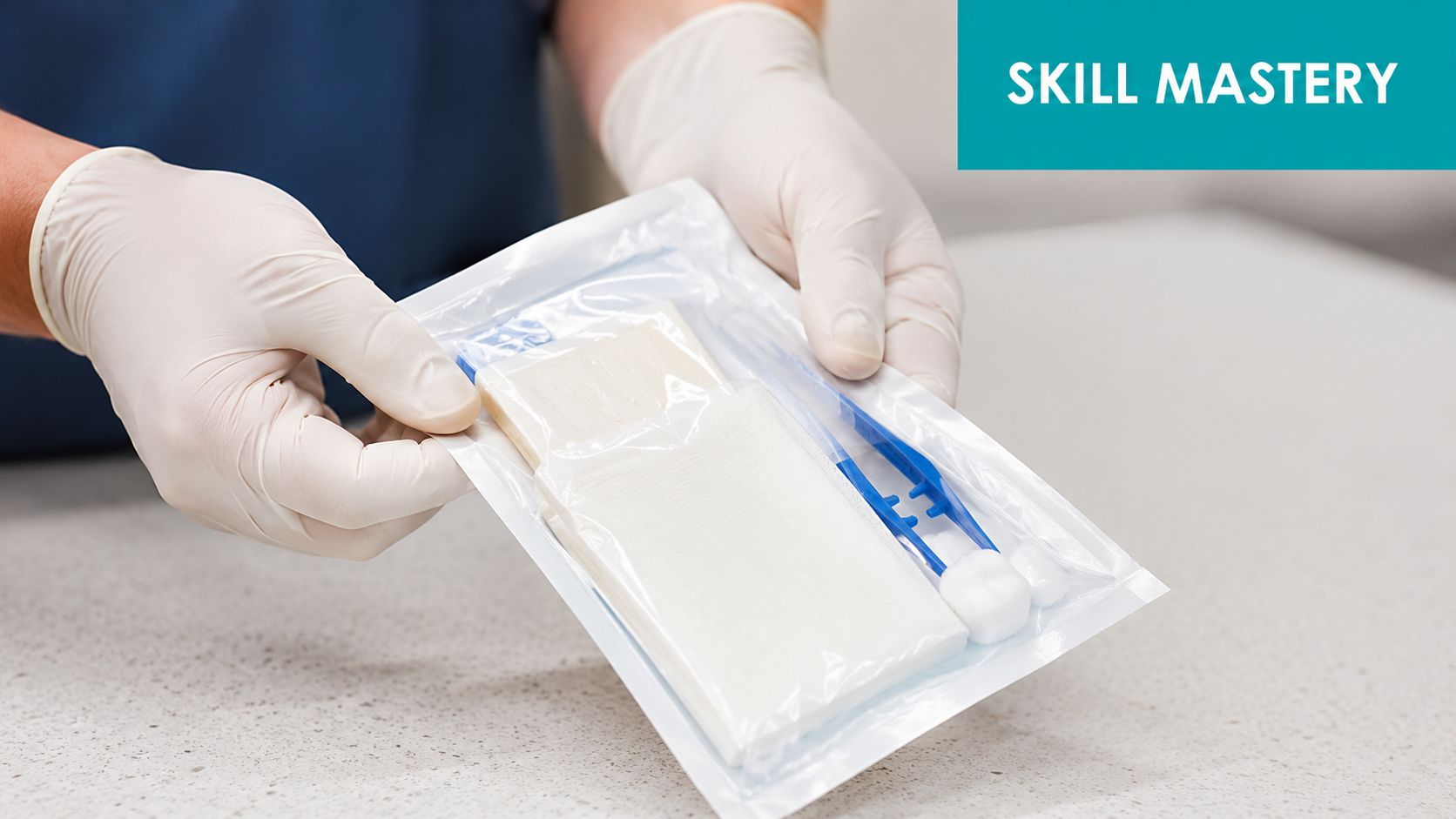
Good wound clinicians can tell when devitalized tissue is blocking progress and when the wound is not ready for aggressive intervention. If you're participating in sharp debridement workflows, proficiency means recognizing tissue types clearly, documenting what was removed, and not overstating depth. It also means knowing when pain, perfusion concerns, unstable eschar, or broader vascular issues should slow you down and trigger escalation.
If your tissue description is weak, your treatment choices usually are too.
Dressing strategy and moisture balance
Enzymatic and autolytic approaches sound simple on paper. At the bedside, they fail when the wound is too wet, too dry, or badly selected in the first place. A strong nurse doesn't just apply a product. You reassess whether slough is loosening, whether exudate has shifted from serous to serosanguineous or purulent, and whether periwound maceration is getting worse because your dressing plan can't keep up.
For partial-thickness injuries and superficial tissue loss, this quick reference on partial-thickness wound presentation is useful because depth errors early in practice are common.
NPWT and offloading
Negative-pressure wound therapy can help. It can also create trouble when seal integrity is poor, drape placement damages fragile skin, or the clinician misses signs that the wound environment has changed. “Good” here means you can troubleshoot leaks, protect the periwound, and recognize when the wound trajectory no longer matches the current plan.
Offloading is even less glamorous and just as important. Diabetic foot ulcers and pressure injuries won't improve consistently if the patient keeps loading the same area. The technical side of wound care isn't only procedural. It's pattern recognition, habit-building, and consistency. That's why broader thinking around Learniverse insights on technical skills matters more than a narrow checklist mindset.
Strong wound nurses don't just know what to apply. They know why a wound failed the last plan.
The Reality of Wound Care Documentation and Billing
A lot of nurses get into wound care because they like the clinical side. The surprise is that wound care is also a documentation job with patient care built around it. If you cannot chart clearly, support medical necessity, and keep diagnosis and procedure coding aligned, you will struggle, even if your bedside care is solid.
Newer nurses are often blindsided by how much of the day disappears into wound measurements, staging or grading, photography, supply tracking, treatment justification, and coding support. That workload is one of the fastest paths to frustration in this specialty. It also cuts into patient time if you do not build a repeatable charting process early.
What payers and surveyors look for
A clean note is not enough. The record has to show what you found, what you did, and why the treatment was reasonable for that wound on that day.
If you document a diabetic foot ulcer, state the Wagner grade and include findings that support it. If you document a pressure injury, stage it correctly and describe the tissue so the description matches the stage. If the wound has moderate serosanguineous drainage, macerated edges, and periwound erythema, write that plainly. “Stable” tells a reviewer almost nothing.
Reviewers usually focus on a few predictable questions:
What exactly did you assess
Document dimensions, depth, tissue type, undermining or tunneling when present, exudate type and amount, odor, pain, and periwound condition.Why was the intervention appropriate
Connect debridement, dressing choice, compression, offloading, or escalation to the wound findings you documented.Does the coding match the wound and the work performed
Vague notes create problems fast, especially around debridement depth and diagnosis specificity.
Where nurses get into trouble
The usual problem is not bad intent. It is disconnect.
The wound is described one way, the procedure code implies something more extensive, and the diagnosis does not fully support the story in the note. That is how denials start. In wound care, small wording gaps turn into billing problems quickly.
Debridement is a common example. If the claim involves CPT codes 11042 through 11047, your note needs depth-specific detail. A reviewer should be able to tell what tissue was debrided and how deep the debridement went. The same issue shows up when ICD-10-CM selection does not match etiology, laterality, severity, or associated conditions documented in the assessment.
A denied claim often starts with one lazy sentence.
I tell newer wound nurses to chart for the person who was not in the room. They do not know the patient, they do not know your reasoning, and they are not going to fill in blanks for you. If you want a practical framework for stronger documentation that can hold up when payment is challenged, read this guide on how to get dispute-ready claims.
A practical way to think about charting
Use a fixed sequence every time:
- Identify the wound correctly
- Describe it with specifics
- State what changed since the last visit
- Justify the treatment plan
- Match the diagnosis and procedure to the documented findings
That approach is faster than free-writing and trying to clean up the coding logic later. It also protects you when the wound stalls, deteriorates, or needs a change in plan. Chronic wounds do not always improve on schedule. Your chart still has to show that your assessment was sound, your treatment choice made sense, and your follow-up reflected what the wound was doing in real time.
A Practical SOAP Note Template for Wound Care
A wound note does not fail because the dressing choice was wrong. It fails because the chart leaves too much for the reviewer to assume. In wound care, that is how a clinically reasonable visit turns into a denial, a query, or ultimately extra work.
A SOAP note should do two jobs at once. It should help the next clinician understand the wound fast, and it should support why today's treatment was reasonable. If it only does the first job, you are left fixing the chart later.
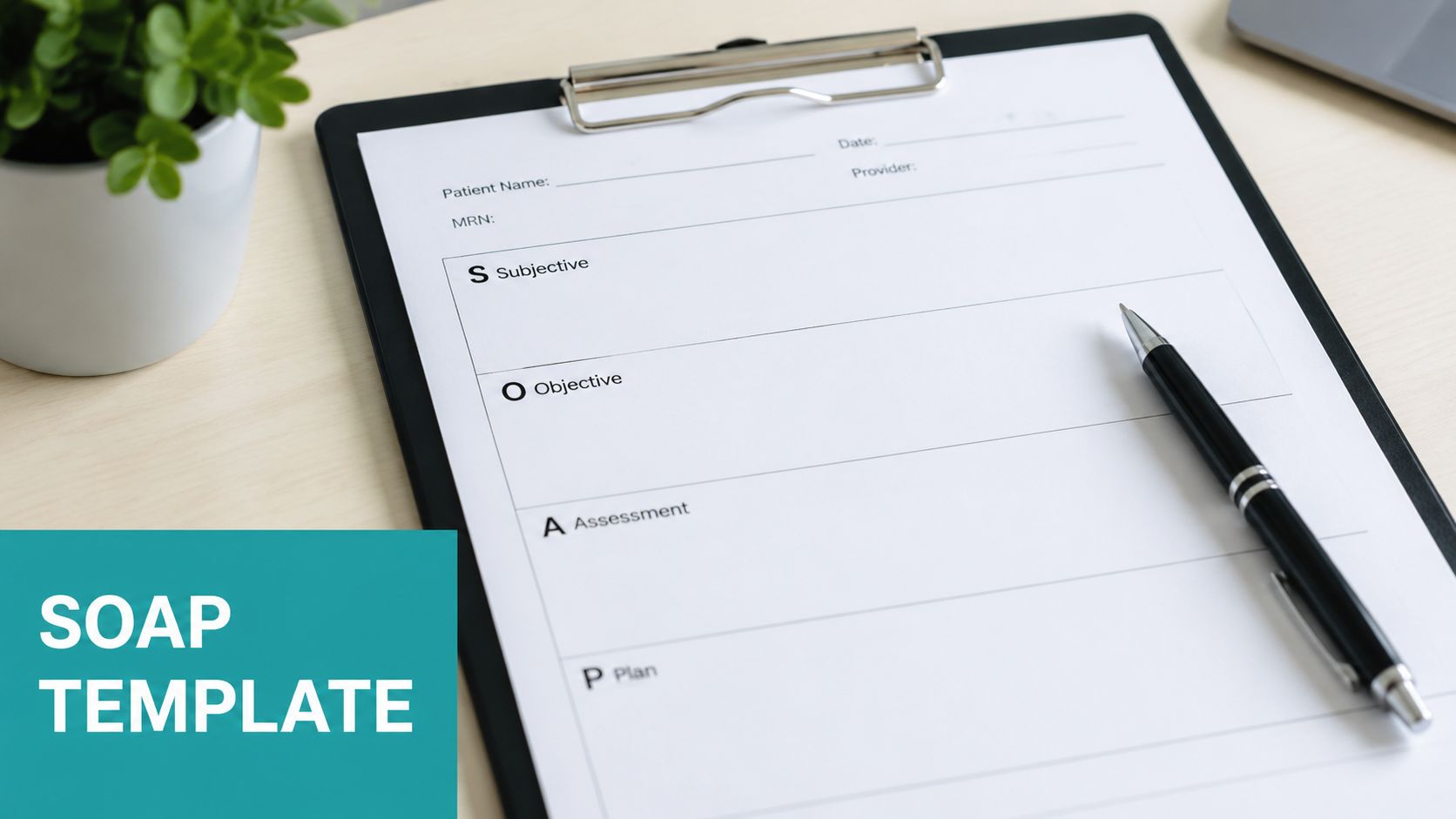
A workable template
Use this for a chronic lower extremity wound follow-up, then adjust it to your setting, your order set, and the wound etiology.
Subjective
Patient reports ongoing drainage from left lower leg ulcer with aching pain that increases when the leg is dependent for long periods. Denies fever, chills, or recent trauma. Reports inconsistent use of prescribed compression at home.
Objective
Left lower leg ulcer assessed, measured, and photographed per facility protocol. Wound bed shows mixed granulation tissue and adherent slough. Drainage is moderate and serous. No malodor. Periwound skin is hyperpigmented with mild edge maceration. Lower leg edema present. No new undermining or tunneling identified on exam.
Assessment
Chronic lower extremity ulcer consistent with venous insufficiency. Healing remains delayed by poorly controlled edema and inconsistent adherence to compression. No systemic signs of infection at this visit. Current wound status supports continued local wound care and compression-based management.
Plan
Cleanse wound. Perform debridement if indicated and document the procedure separately with tissue type, level, tolerance, and post-debridement measurements. Apply ordered absorptive dressing. Re-educate patient on compression use, leg positioning, and edema control. Reassess drainage, periwound condition, edema, and treatment tolerance at next visit.
What makes this note usable
The template works because it answers the questions reviewers and covering clinicians ask.
The subjective section documents symptoms, adherence, and red flags. The objective section describes what you saw, not what you felt about it. The assessment explains the delay in healing and ties barriers to the wound's current status. The plan shows why today's care makes sense.
That connection matters. If the wound has more drainage, more maceration, or less progress, your plan should reflect that change clearly.
Common note defects
These are the charting misses I see over and over:
No measurements or vague progress language
“Improving” means very little without size, tissue description, drainage, and periwound findings.Treatment without support
If you changed the dressing, increased visit frequency, added compression teaching, or performed debridement, the note should show what finding drove that decision.Periwound ignored or underdescribed
Maceration, erythema, induration, callus, denudement, fragile skin, and edema often explain why a wound is stalled.Adherence issues buried or omitted
If the patient is not using compression, offloading, or prescribed supplies, document it plainly. That is part of the clinical picture, not a side comment.
One practical habit helps more than any template. Write the SOAP note before you are tired enough to start shortcutting the assessment. Wound care nurses spend a lot of time cleaning up documentation after the visit because the billing logic was not built into the original note. It is faster to chart the wound completely the first time than to reconstruct why you did what you did after a claim gets questioned.
The procedure note cannot carry the whole visit. The SOAP note still has to show the clinical story.
Navigating Your Career Path and Growth
A wound care career does not stall because a nurse lacks passion. It usually stalls because the role is heavier than expected. The work is part assessment, part teaching, part coordination, and a large part documentation. Nurses who stay in this specialty build systems early.
Your setting shapes the job more than people expect. Hospital wound teams usually give you stronger backup, easier specialist access, and a cleaner escalation process when a wound turns. Skilled nursing, home health, and mobile wound roles give you more independence, but they also hand you the operational mess. You deal with supply gaps, inconsistent follow-through, family pressure, and charting that has to hold up without another clinician in the room. Choose based on the kind of friction you handle well.
Mentorship matters, but choose the right mentor. Find someone who will challenge your assessment, your staging, your treatment rationale, and your note quality. A mentor who only teaches dressing selection is giving you half the job. The stronger mentor will review your chart and ask harder questions. Why did you call this stable? What supports this debridement? Why did you increase visit frequency? Those questions make you better and protect you later.
Specialization can widen your options once your fundamentals are solid. Hyperbaric oxygen programs, ostomy care, continence, limb preservation, lymphedema, diabetic foot programs, and wound program coordination all use the same clinical backbone in different ways. Some roles bring more procedures. Some bring more patient education. Some bring more paperwork and staff oversight than bedside care. Know what you are signing up for before you chase a title.
Leadership is not always the upgrade people think it is.
Program leads and educators often spend less time at the bedside and more time building protocols, auditing charts, training staff, answering supply questions, and defending clinical decisions to administrators and payers. For some nurses, that is a good trade. For others, it is a fast way to lose the part of wound care they enjoy. A promotion only helps if it fits the kind of work you want to do every week.
If you want long-term stability in this field, become the nurse whose notes are clean, whose wound trajectories are easy to follow, and whose recommendations make operational sense. Clinical judgment gets attention. Documentation keeps you employable. In wound care, the nurse who can assess well and chart fast usually has more career mobility than the nurse who only knows products.
If your team is tired of losing hours to wound charting, coding clean-up, and billing friction, take a look at EkagraHealth AI. It's built for wound care practices that need faster SOAP notes, cleaner CPT and ICD-10 mapping, and less administrative drag at the point of care.
