
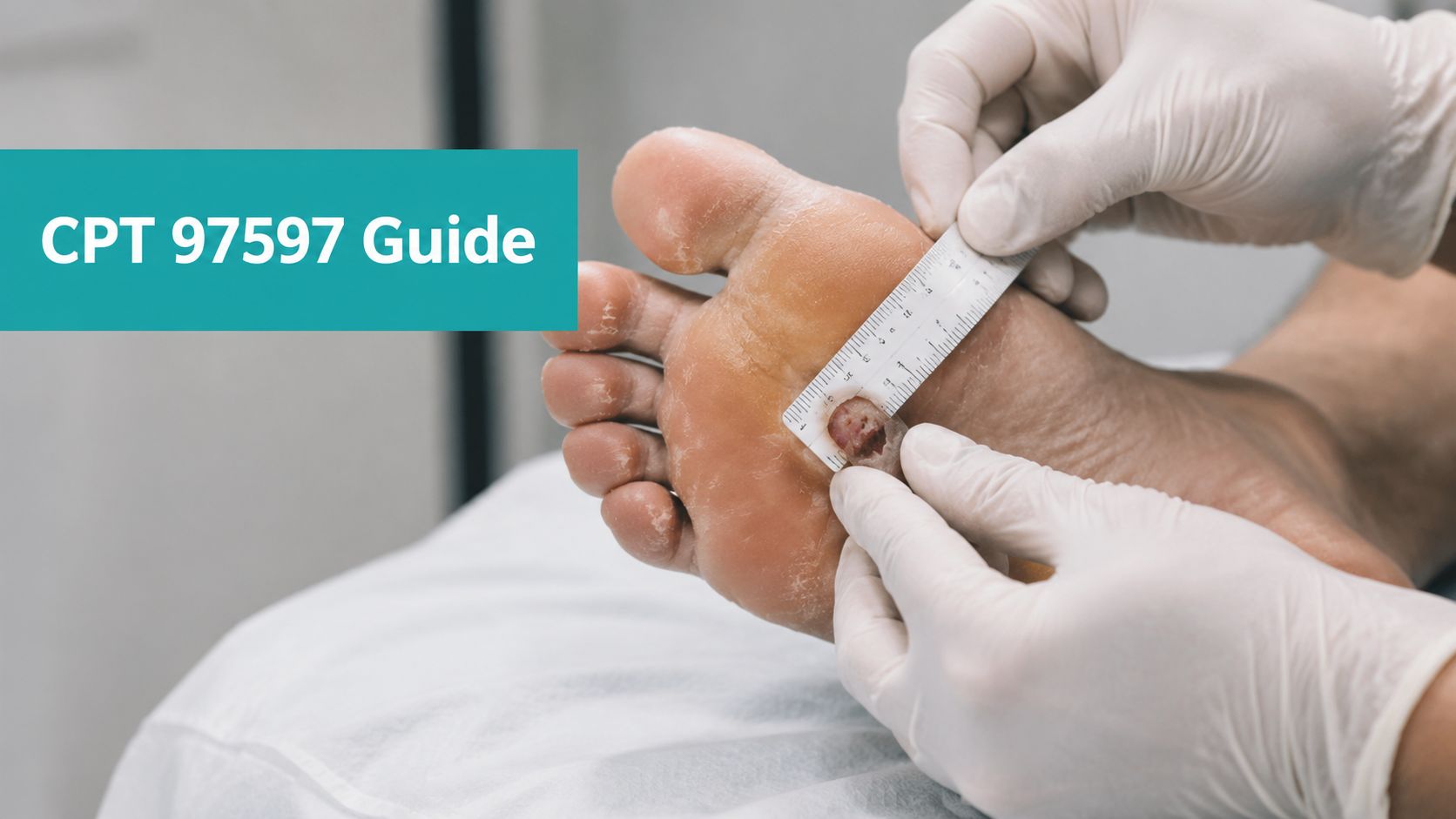
You're in the room, the wound is cleaned up enough to see the edges, and the clock is already working against you. A heel ulcer has yellow slough, a plantar forefoot wound is sitting next to it, and somebody has to decide whether this is 97597, 97598, or a deeper debridement code before the note gets signed. That's the problem with cpt 97597 in real life. The code looks simple until the documentation has to survive a payer review.
Most bad claims aren't bad because the clinician picked the wrong family by accident. They're bad because the note never proves what tissue was removed, how deep the work went, or how the area was counted. That's where clinics lose money, then act surprised when the denial lands. The cleanest 97597 claims I see follow a pattern. They describe the wound, name the tissue, record the area, and make it obvious why the service stayed in the selective debridement lane.
The 12 cm² Heel Ulcer That Almost Got Billed Wrong
The note was almost too familiar. A diabetic patient came in with a Wagner 2 heel ulcer and a smaller Wagner 1 pressure injury on the lateral foot. The heel had yellow slough. The lateral wound had surface fibrin. The clinician had about thirty seconds to decide whether this was one selective debridement encounter, two wounds under one session, or a deeper excisional job that belonged in the 11042 to 11047 family.
That's the moment where sloppy charting turns into a silent downcode. If the record says “debrided wound” and nothing else, the biller has to guess. If the record says the wound had devitalized epidermis and dermis removed with scissors and forceps, and the area stayed within the selective debridement threshold, the code path becomes much easier to defend. The billing problem starts to look like a documentation problem, which is usually what it is.
Practical rule: if the note doesn't show the tissue layer and the total area, the code choice is already at risk.
A lot of clinicians still think of cpt 97597 as a billing line. It isn't. It's a workflow decision made in the room, then proven on paper. If you want a clean audit trail, write the wound note the way you'd want it read back in a record review. For a legal framing of documentation review, the clinical billing framework legal use discussion is a useful reminder that the record has to support the service, not just mention it.
What the CPT 97597 Descriptor Actually Covers
CPT 97597 is selective debridement of devitalized tissue from an open wound, and the official language matters because payers read it as written. The code is for the first 20 cm² or less of aggregate treated surface area in a session. It includes selective removal with scissors, scalpel, or forceps, and it also allows high-pressure water jet techniques, with or without suction, when the goal is removal of devitalized tissue.
What belongs inside the code
Think of the encounter in layers. The code covers the debridement itself, plus topical applications, wound assessment, whirlpool when performed, and instructions for ongoing care. CMS also says dressings applied during 97597 are included and can't be billed separately, and whirlpool is generally treated as a component of the service rather than a separate charge in the same encounter. That's where a lot of quiet revenue leakage starts, or where a duplicate-service denial appears because someone tried to bill the bundle twice. CMS coverage language also makes the threshold clear, devitalized tissue must be present. Simple cleansing or removal of secretions does not meet the requirement. The CMS article on active wound care is the cleanest place to see that point stated plainly. CMS guidance on selective debridement and bundled supplies
What does not belong inside the code
Routine dressing changes without debridement don't fit. Cleansing a wound bed without documented devitalized tissue doesn't fit. “Removed drainage” or “cleaned exudate” also doesn't fit unless the note shows actual nonviable tissue removal. If the chart language can't distinguish devitalized tissue from secretions, the payer has an easy denial.
The descriptor line is short, but the operational meaning is strict. You're not billing for touching the wound. You're billing for selective removal of nonviable tissue from an open wound, within a defined area, with bundled aftercare in the same session. If that sounds basic, good. Most denials happen because the note never proves the basic part.
Selective Versus Excisional and Where 97597 Stops
Selective debridement and excisional debridement are different, and claims go sideways when clinicians blur the line. The boundary between them is where the 97597 claim usually succeeds or fails. 97597 fits when the note shows removal of clearly nonviable surface tissue, including fibrin, slough, devitalized epidermis or dermis, biofilm, and exudate. Once the documented work reaches subcutaneous tissue, muscle, or bone, the claim belongs in 11042 to 11047 territory. The deepest layer removed controls the code, not the prettiest wound photo in the chart.
The dividing line in real notes
A wound can look ugly and still stay within 97597 if the clinician only removes superficial nonviable tissue. A wound can look small and still require excisional debridement if the note shows removal of necrotic fat or tissue down to muscle. That is why chart language such as “mixed slough with exposed fat” needs a careful read. Exposed fat in the wound bed does not automatically force surgical debridement, but if the note says the provider removed subcutaneous tissue to viable fat, the service has crossed out of selective debridement.
The wound appearance matters, but the deepest tissue actually removed decides the family.
Wagner grading helps frame the wound, but it does not control tissue depth. Wagner 1 and 2 ulcers with surface slough are common 97597 candidates when the work stays limited to epidermis and dermis. Once the wound behaves like a deeper defect, especially when necrosis extends below the dermis, selective coding stops fitting the chart. The cleanest way to teach a new clinician is blunt. If the instrument crossed into subcutaneous tissue, stop thinking 97597 and start thinking 11042 or deeper.
For a tighter coding comparison, the internal reference on CPT code for excisional debridement helps separate selective from excisional logic without muddying the charting standard.
Measurement, Area, and Add-On Code 97598
Area math is where clean notes pay off. 97597 covers the first 20 cm² of total selective debridement in the session, not the first wound, and not the first instrument pass. Once the treated area goes beyond that threshold, 97598 is the add-on code for each additional 20 cm² or part thereof. The unit count follows the aggregate surface area treated in the session.
A quick way to keep the math honest
A patient with a 12 cm² heel ulcer and an 8 cm² plantar forefoot ulcer totals 20 cm². That supports one unit of 97597. If the combined selective debridement goes past 20 cm², 97598 applies for each additional 20 cm² or fraction of that range. Billing by wound count or by instrument change is where claims go sideways. The code follows the amount of selective debridement work across the treated surface, no matter how many times the clinician switched instruments.
A few measurement habits keep the chart defensible. Measure before debridement, then document the post-debridement size if the wound changes. Use consistent units. Do not include surrounding erythema or periwound irritation in the calculation. If you need a quick refresher on documenting wound dimensions cleanly, these wound measurement examples help show how the numbers should read in real charting.
After debridement, the wound may look smaller, cleaner, and more precise, which is exactly why the post-measurement matters. If the note only gives a vague size range or mixes up pre- and post-debridement measurements, the code review gets harder and the payer has room to question the area billed.
Audit habit: record the dimensions the same way every time, then add the areas before you code.
AAFP's coding clarification on wound care is useful because it reinforces that this is a total wound surface area rule. AAFP clarification on wound care coding and total surface area
Modifiers, ICD-10-CM Pairings, and Medical Necessity
Modifiers are not decoration. They're there because wound care often happens on the same date as an E/M visit, a procedure on a different site, or another billable service. In real practice, 59 or the appropriate X-modifier is used when the debridement is distinct from another procedure on the same date. LT and RT belong on the line when laterality matters. 25 only makes sense when there's a separately identifiable E/M service with its own work. If the visit was just the debridement, the modifier usually doesn't belong there.
Diagnosis codes that actually support the work
The diagnosis has to map to the wound treated. That means the L97 series for non-pressure chronic ulcers, L89 for pressure injuries staged by depth, E11.621 and related diabetic ulcer combinations, and I70.2- codes for ischemic ulcers when vascular disease is driving the lesion. Reviewers look for that match immediately. If the diagnosis is vague, generic, or mismatched to the wound location and type, the claim looks weak even when the procedure note is solid.
Documentation reviewers also want three things to line up. The diagnosis should identify the wound. The note should show why selective debridement was necessary. And the description should justify why the work stayed selective instead of excisional. That alignment is what keeps a chart from looking like a template with a code dropped in at the end.
For teams that need tighter documentation logic, the medical necessity documentation reference gives a practical way to think about diagnosis support, wound description, and payer-facing necessity language without overcomplicating the note.
Why Most 97597 Denials Are Self-Inflicted
Most denials I see are not mysterious. They come from missing proof, not missing effort. The biggest failures are no documented devitalized tissue, claims for simple cleansing or exudate removal, separately billed dressings that are already bundled, and diagnosis codes that don't support the wound or the service. CMS is explicit that 97597 and 97598 require devitalized tissue, and that dressings applied during the encounter are included. Whirlpool is generally part of the code, not a separate line item in the same session.
Five lines that save a claim
A note that survives review usually includes:
- Specific tissue removed: say fibrin, slough, devitalized dermis, or other nonviable tissue.
- Depth reached: state whether the work stayed superficial or crossed into deeper tissue.
- Instrument used: scissors, scalpel, forceps, or high-pressure water jet.
- Area treated: list the total cm², and if possible the pre- and post-debridement measurements.
- Clinical reason: explain why the tissue was nonviable and why the debridement was necessary.
That's enough to make the chart readable by a coder, a reviewer, and a payer nurse who's looking for a shortcut to denial. If the note says “sharp debridement performed, wound cleaned, dressing applied,” expect trouble. If it says “selective sharp debridement of devitalized dermal slough with scissors and forceps, 12 cm² pre-debridement and 11 cm² post-debridement, viable tissue exposed,” the claim has a real spine.
Some denials still come from payer-specific quirks, and those usually need an appeal with the note excerpted clearly. But most of the time, the problem was on the front end. A better note would have prevented the fight.
Two Real Chart Notes and How They Read to an Auditor
Paid note
Right heel diabetic ulcer, Wagner 2, with adherent fibrin and devitalized dermis. Selective sharp debridement performed with scissors and forceps after topical cleansing. Pre-debridement size 3.0 cm by 4.0 cm, post-debridement size 2.8 cm by 3.8 cm. Fibrin and nonviable dermal tissue removed to bleeding tissue, total treated area 12 cm². ICD-10-CM supports diabetic foot ulcer with laterality and severity.
Denied note
Sharp debridement performed. Dressing applied. Patient tolerated well. Follow up next week.
The difference is brutal and completely avoidable. The first note tells the auditor what was removed, how it was removed, how much area was treated, and why the code fits the wound. The second note could describe almost any wound visit on any day. It gives the reviewer nothing to defend the charge.
Model standard: write the wound type, tissue removed, instrument used, area treated, and diagnosis linkage every time.
If a template doesn't force those five elements, it's not helping you. It's letting the chart drift toward denials.
A Five-Line Checklist Before You Submit 97597
Before you drop the claim, make sure the note says devitalized tissue and names the deepest layer reached. Make sure the total treated area in cm² is clear, with pre- and post-debridement measurements if the wound changed. Make sure the instrument and technique are written down. Make sure the ICD-10-CM code matches the wound type and laterality. Make sure you didn't try to bill a separately payable dressing or whirlpool in the same encounter when it was bundled.

That's the whole game. 97597 is a high-volume code that rewards disciplined documentation and punishes sloppy notes.
If your team keeps losing time to wound notes that don't prove the code, EkagraHealth AI can help by drafting the chart, mapping the CPT and ICD-10 pair, and checking medical necessity in the workflow. Visit EkagraHealth AI to see how it fits wound care documentation and billing without adding more clerical burden to the visit.
