

A 74-year-old patient is two days out from surgery. The Braden score looks moderate, so the admission checklist feels complete. But intake has worsened, the patient slides down in bed during transfers, and a Stage 2 pressure injury is beginning at the sacrum. The total score didn't change the fact that the patient's risk changed.
That's where a Braden Scale calculator earns its place, and where it can mislead a team. The calculator adds the six subscales quickly, but the clinician still has to interpret the pattern, identify what changed, and connect the result to prevention. A score without an action plan is just another completed field.
Why the Braden Score Still Matters at the Bedside
The Braden Scale was developed in 1987 from a sample of 102 older hospital patients, and the cutoff of 18 remains the standard “at risk” threshold in many settings (original Braden Scale publication). Its structure came from bedside clinical observation, not algorithmic automation. That's part of why it still fits daily wound care: it asks about the patient's ability to sense discomfort, stay dry, move, eat, and avoid damaging shear.

The tool has useful predictive value, but it isn't a crystal ball. A major review covering 60 studies and 49,326 patients reported pooled sensitivity of 0.78 and specificity of 0.72 across thresholds ranging from 10 to 20. At a cutoff of 18, sensitivity was 0.82 and specificity was 0.70 (PLOS Medicine review). Those figures support using the score as an early warning, not as permission to reduce surveillance.
The patient in the opening example might have a tolerable total score, but the subscale pattern tells a different story. Worsening nutrition, reduced mobility, and friction during transfers should move the prevention plan immediately. The same applies to edema, vasopressor exposure, poor perfusion, incontinence, sedation, and postoperative immobility. Some risks are only partly represented in the score.
Practical rule: Use the calculator to trigger prevention. Use clinical judgment to decide how aggressive and how frequent that prevention needs to be.
A strong risk assessment should lead to repositioning, offloading, moisture management, nutrition review, support-surface selection, and skin reassessment. Teams managing hospital-acquired pressure injuries can also use the score as one part of a broader prevention and documentation process, as outlined in this pressure injury prevention resource.
Scoring the Six Subscales With Real Patient Examples
The calculator is only as accurate as the observations entered into it. Score the patient you're seeing today, not the patient described in yesterday's handoff. When the clinical picture falls between two descriptions, document the observed behavior and choose the score that best reflects the patient's actual ability.
Sensory perception
Consider a confused patient with diabetes who doesn't reliably feel discomfort in the heels. The patient may not report pain when the heels rest against the mattress, and may not respond consistently when staff reposition the legs. That patient belongs in a more impaired sensory category than a patient who can clearly identify pressure and ask for relief.
This item often varies between raters because staff interpret “responds to pressure-related discomfort” differently. Test the patient's response, review cognition, and document whether the patient can communicate discomfort and follow instructions.
Moisture
An incontinent SNF resident with frequent brief changes, perspiration, and episodes of stool exposure has more moisture risk than a patient whose skin stays dry between scheduled care. Don't score from the presence of incontinence alone. Consider how often the skin is exposed, whether the patient can request care, and whether moisture is already causing maceration or erythema.
The calculator should support a moisture plan, not replace one. The note should identify the source, cleansing approach, barrier strategy, and reassessment.
Activity
A bedbound patient after a stroke has very limited activity, even if the patient participates in therapy while seated. Activity describes how much the patient moves around, not whether the patient receives therapy. A patient who remains in bed except for brief transfers has a different risk profile from one who walks regularly with assistance.
Activity is another subscale with meaningful interrater variation. Case-based training helps staff distinguish occasional therapy participation from functional mobility throughout the day.
Mobility
A patient with Parkinson's disease may shift position independently but still be unable to reposition fully, lift the pelvis, or relieve heel and sacral pressure. That patient shouldn't receive the same mobility score as someone who can turn, bridge, and adjust position without help.
Watch the patient move. Ask for a position change, observe whether the patient completes it, and record the level of assistance required. A patient who starts the movement but needs staff to finish it remains at substantial risk.
Nutrition
An oncology patient eating less than half of offered meals needs a nutrition assessment, regardless of whether the total Braden score crosses a local threshold. Review intake trends, swallowing concerns, nausea, treatment effects, and the current nutrition plan. The score should reflect the patient's intake and nutritional pattern, not a general impression that the patient “looks well.”
Friction and shear
A chair-bound patient who repeatedly slides downward and requires staff to pull the patient back into position has friction and shear risk. That risk increases when transfers are performed without adequate assistance or when the patient can't control descent into a chair.
Record the behavior and the preventive response. The plan may include transfer assistance, repositioning technique, an appropriate chair surface, and education for everyone involved in the transfer.
Document the subscale pattern in the same place as the total. A useful skin assessment and documentation workflow should make it easy to see whether the score fell because of nutrition, mobility, activity, moisture, sensory perception, or friction and shear.
Thresholds and Setting-Specific Cutoffs That Actually Work
A cutoff is a workflow decision, not a universal law. The standard threshold of 18 is a reasonable starting point in many general inpatient and nursing home settings, but the same score behaves differently in an ICU, postoperative unit, home-health episode, or mobile wound visit.
A hospitalized-patient meta-analysis found pooled sensitivity of 0.72, specificity of 0.81, and an sROC AUC of 0.84 (hospitalized-patient meta-analysis). ICU evidence shows a different trade-off. In critically ill adults, a meta-analysis reported sensitivity of 0.89 and specificity of 0.28, meaning the scale identified most patients who developed pressure injuries but also flagged many patients who did not (ICU meta-analysis).
| Setting | Sensitivity | Specificity | Recommended cutoff |
|---|---|---|---|
| General hospitalized patients | 0.72 | 0.81 | Use the locally approved threshold |
| ICU adults | 0.89 | 0.28 | Consider a more sensitive local trigger |
| Nursing home population | 79% | 74% | 18 |
| Inpatient study | 0.75 | 0.68 | 17 |
| ICU-focused analysis | 83% | 64% | 16 |
The nursing home findings are especially useful for SNF teams. At a cutoff of 18, sensitivity was 79%, specificity was 74%, positive predictive value was 54%, negative predictive value was 90%, and correct classification was 75% (nursing home validation study). A negative result can be reassuring, but it doesn't eliminate the need to inspect the skin or respond to a changing condition.
Published cutoffs range from 10 to 20, with sensitivity and specificity varying widely across populations and studies (recent evidence review). Set the threshold with the wound team, nursing leadership, and the realities of the setting. In an ICU, a low-specificity trigger may be acceptable because missing a rapidly developing injury is more concerning than initiating prevention for a patient who ultimately doesn't develop one.
Turning the Score Into a Real Prevention Plan
The total score should open the prevention order set, not close the assessment. Tie every intervention to the patient's subscale deficits and current condition.
Lower-risk presentation
Use standard skin surveillance, a complete admission skin assessment, and a twice-daily visual inspection when the patient's condition is stable. Confirm that the patient can move, maintain dryness, eat adequately, and report discomfort. A lower score doesn't justify ignoring a new decline.
Moderate-risk presentation
Add a defined turning and repositioning schedule, review the support surface, manage moisture at each episode of exposure, and request nutrition input when intake is poor. For a patient whose primary issue is friction and shear, staff technique and transfer equipment may matter more than just adding another reminder to turn.
High-risk presentation
Escalate to a higher-specification support surface when clinically indicated, including low-air-loss or alternating-pressure options. Offload the heels, assess skin and any existing wound daily, and notify the wound team when the patient has a prior injury, worsening subscale, or new discoloration.
For facilities reviewing mattress options, the Top Mobility Protektr 500 mattress is a resource to consider during support-surface review. Selection still depends on patient weight, mobility, moisture, shear, care environment, and the manufacturer's use guidance.
A practical SNF example is a resident with a history of sacral injury, low nutritional intake, and a friction/shear subscale of 1. The plan should include nutrition escalation, assistance with every repositioning and transfer, sacral and heel offloading, moisture protection, daily skin review, and documentation of whether the resident slides or requires pulling in bed. The score supports the plan, but the subscale narrative explains why those interventions are necessary.
Common Mistakes and How to Fix Them
Prevention failures usually begin when the Braden score becomes a completed task instead of a clinical signal. Correcting the workflow requires attention to timing, subscale trends, local thresholds, and staff calibration.
Admission-only scoring
A patient's risk can change after surgery, infection, sedation, poor intake, or reduced mobility. Recalculate when the condition changes, not only when policy requires an admission score. Preserve each result so the record shows whether risk is stable, improving, or worsening. The lowest score during hospitalization may be more informative than the first-day result, as discussed in the Braden Scale review.
Total-score fixation
The total can hide the bedside problem. Record which subscales drive the score, whether they are improving or declining, and which intervention addresses each finding. A worsening nutrition or activity subscore may require action even when the total remains in the same broad category. Review the pattern, not just the label.
Automatic use of 18
The familiar default threshold may not fit every patient population. Use a local trigger supported by your patient mix, prevention resources, and escalation process. Document who approved that threshold and when it will be reviewed. A cutoff is useful only when it reliably prompts assessment and intervention.
Weak staff calibration
Sensory perception and activity often produce scoring disagreement. Use shared case scenarios, have staff score the same patient description, compare their reasoning, and address discrepancies during competency review. A policy cannot teach the difference between “can shift” and “can reposition” without observation practice.
A calculator standardizes arithmetic. It does not standardize assessment unless the team trains together.
When the score changes, the note should identify the changed subscale and the immediate response. That connection keeps the calculator tied to bedside prevention rather than checkbox completion.
Documentation and Coding Tips That Survive Survey
Surveyors and payers look for a clear chain from risk identification to intervention. State when reassessment occurs, then document the findings behind the score and the prevention response.
A concise entry might read: “Braden score reflects reduced mobility, poor intake, and friction during transfers. Patient requires assistance to reposition, slides in chair, and has declining meal intake. Initiated scheduled repositioning, heel offloading, moisture protection, support-surface review, and nutrition referral.”
Record the score's subscale findings in the same note as the prevention plan. This shows why the interventions were selected and gives the next clinician a baseline for reassessment. Document who was notified when risk increased and when effectiveness will be checked.
Keep risk documentation separate from active injury documentation. If a pressure ulcer is present, code its site and stage within the ICD-10-CM L89.0–L89.95 series, supported by the wound assessment. The Braden score does not establish stage. It also does not replace documentation of location, tissue involvement, drainage, odor, periwound condition, or progression.
If debridement is performed, document the tissue removed, depth, instrument or method, total area, and medical necessity supporting the applicable CPT 11042–11047 code range. A recalculated score with no care-plan change leaves the record vulnerable. Tie each meaningful score change to an intervention, notification, and follow-up assessment.
Wiring the Braden Scale Calculator Into Your Workflow
Build the calculator into the points where risk changes: admission, condition change, and recurring review in long-stay settings. Display the six subscales, the trend, the approved setting-specific cutoff, and the prevention actions triggered by the result.
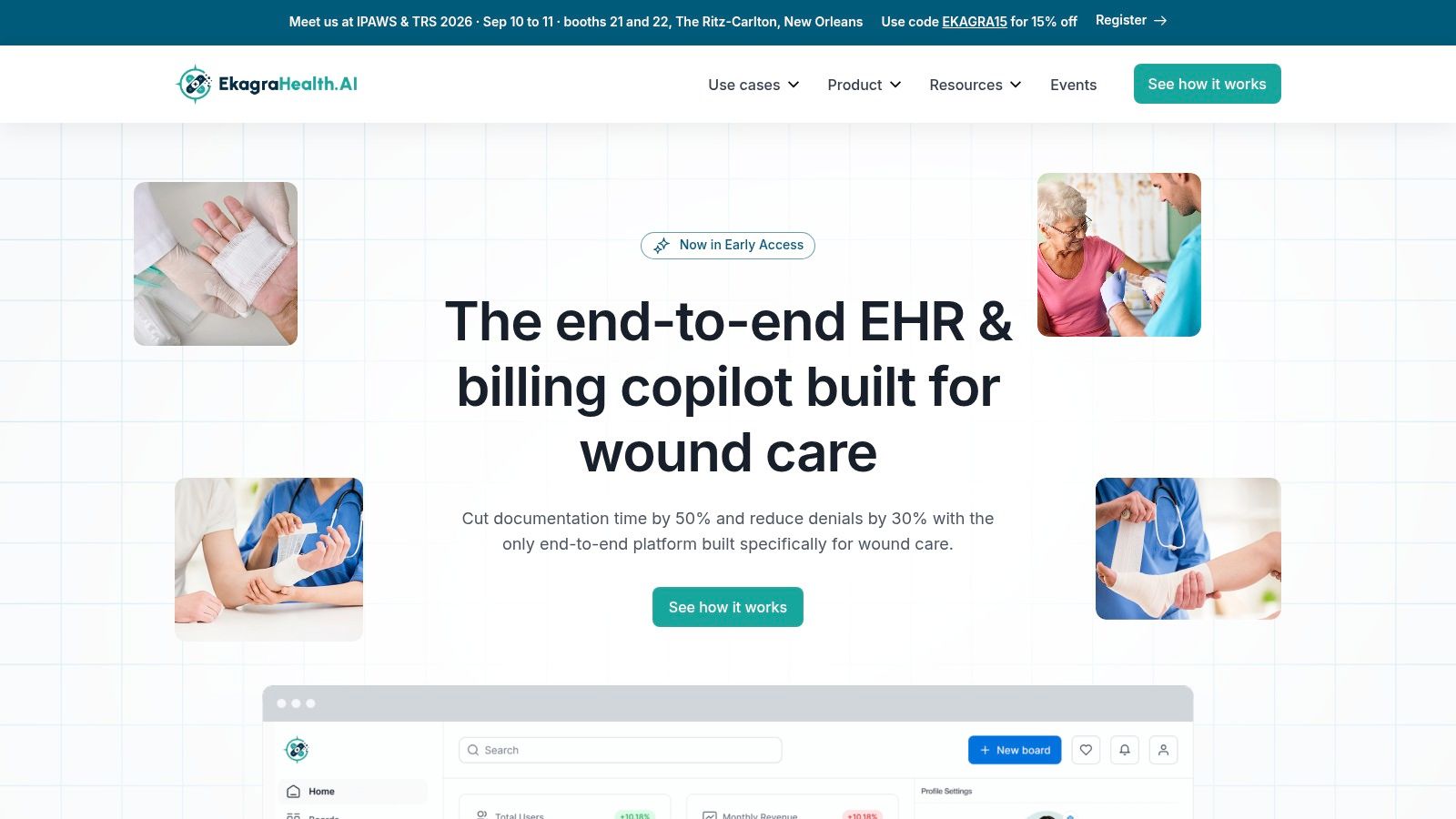
The EHR or clinical platform should carry the score into the assessment, care plan, wound note, and billing workflow without forcing staff to retype the same facts. EkagraHealth AI can support that documentation and billing backbone by carrying the score, subscale narrative, prevention plan, and ICD-10 and CPT-coded claim in one workflow. Teams evaluating clinical decision support systems should look for that connection between bedside observation and follow-through.
Choose one failure mode from this article, then audit it in the next chart review cycle. If admission-only scoring is the problem, add a condition-change trigger. If subscales disappear in the note, make them required fields.
EkagraHealth AI helps wound care teams turn bedside observations into structured documentation, prevention plans, and coded claims, including the Braden subscale details that often get lost in a total score. Visit EkagraHealth AI to see how the platform can support wound notes, coding, and billing in one clinical workflow.
