
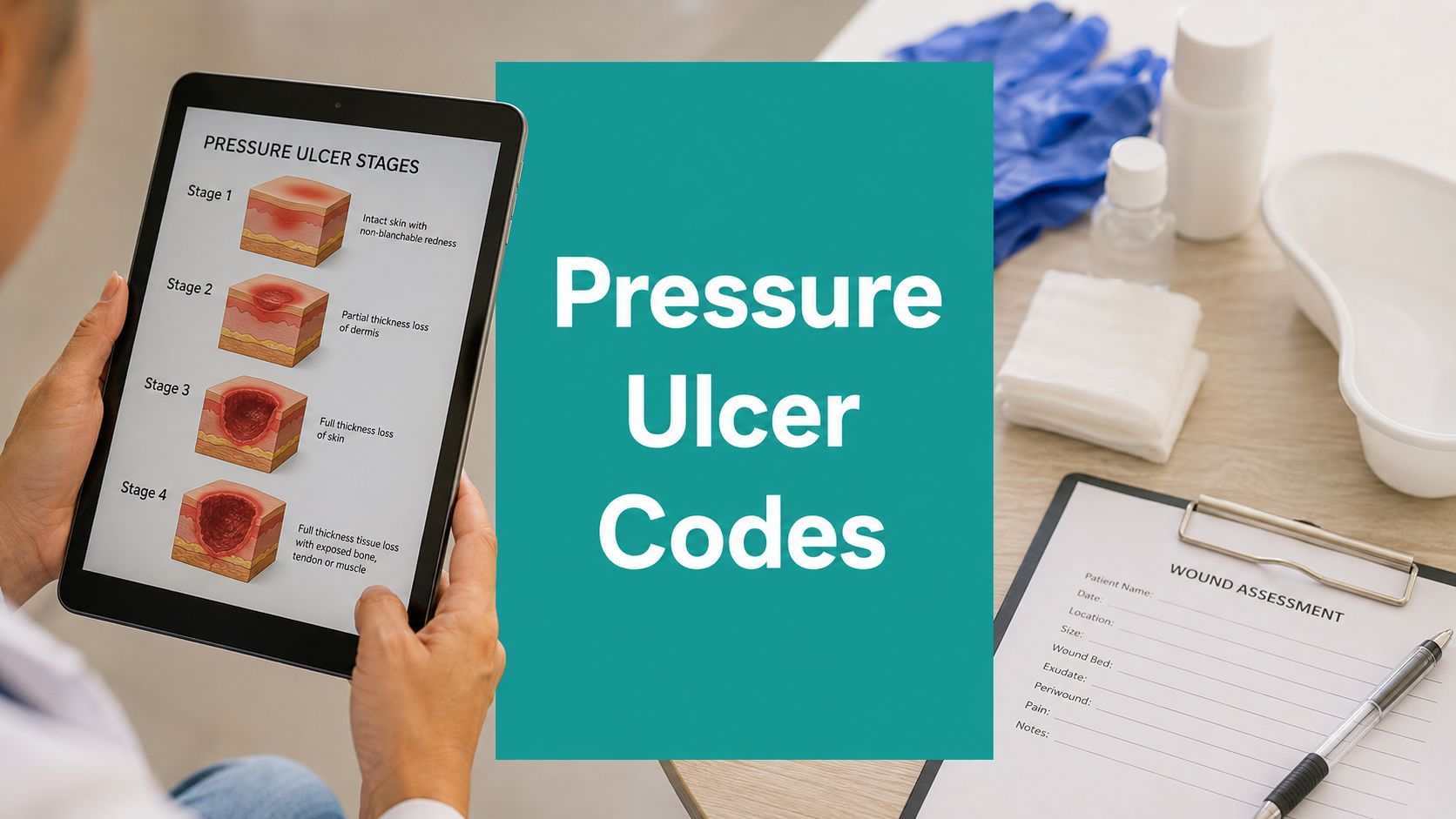
Memorizing L89 codes isn't the hard part. The hard part is getting a bedside note that survives coding, query, and audit review. A sacral wound called “pressure injury” with no stage, no site detail, and no tissue description gives the coder too little to work with, which is how clean clinical work turns into an unspecified claim.
That gap matters because ICD-10-CM pressure ulcer coding is a site-and-stage problem, not just a wound label problem. L89 is built to carry anatomy, laterality when applicable, and severity, and CMS guidance expects the documented stage only, with unstageable used when the wound can't be staged and unspecified stage only when the stage isn't documented at all. The chart language has to support the code, not the other way around.
Why Most Pressure Ulcer Coding Fails at the Bedside
The failure point is often assumed to be code selection. It's not. The actual failure point is the bedside note that leaves the coder guessing.
A wound described only as “pressure injury, sacrum” is too thin to carry a defensible code. The chart needs the site, stage, laterality when relevant, and tissue findings that show why the wound is what it is. Without that, the coder either queries, delays the claim, or lands on an unspecified code that weakens the entire record.
The note has to do more than name the wound
A pressure ulcer note should read like a clinical record, not a label. If the heel has stable eschar, say stable dry eschar, describe drainage, or the lack of it, and document whether the base can be assessed. If the sacral wound has slough after debridement, say what was removed and what became visible. That's the kind of detail that holds up when a payer reviews medical necessity or a surveyor checks whether the stage matches the tissue description.
Practical rule: if the note doesn't tell the next clinician how the wound looked, it probably won't support the code either.
The pressure ulcer coding literature makes the downstream problem obvious. A stricter case definition identified 1.4% prevalence, while a broader one identified 4.2% after misclassification adjustment, a nearly 3-fold swing driven by code selection and chart interpretation (PMC study). That's not an abstract coding issue. It's what happens when documentation is loose enough to let the wound be coded one way today and another way tomorrow.
If the SOAP note can't support the stage, the denial isn't a surprise. It's a charting problem wearing a billing badge.
Mapping the L89 Code Family by Site and Stage
L89 works as a combination-code family. One code is meant to capture anatomic site, laterality, and stage together, which is why “pressure ulcer” by itself never finishes the job. CMS guidelines also allow as many L89 codes as needed when a patient has multiple pressure ulcers, so each distinct site needs its own code when the documentation supports it.
The practical structure is straightforward once you stop thinking of L89 as a list and start thinking of it as a matrix. The big anatomical groupings include the back, elbow, hip, heel, ankle, sacral region, ischial region, and other sites. Stage extensions cover Stage 1 through Stage 4, deep tissue pressure injury, unstageable, and unspecified stage, with laterality when the site code calls for it. That's why a right heel wound and a left heel wound aren't interchangeable, and why bilateral wounds don't collapse into one generic entry.
Common L89 Pressure Ulcer Codes by Anatomical Site
| Anatomical Site | L89 Code Range | Laterality Options | Stage Extensions |
|---|---|---|---|
| Head and ear | L89.8xx | Right, left, unspecified depending on the site | Stage 1, 2, 3, 4, unstageable, unspecified |
| Back, shoulder, scapula, spine | L89.1xx | Site-specific, usually unspecified laterality | Stage 1, 2, 3, 4, unstageable, unspecified |
| Hip, trochanter, ischium | L89.2xx | Right, left, unspecified depending on the site | Stage 1, 2, 3, 4, unstageable, unspecified |
| Sacral region, coccyx, buttock | L89.3xx | Usually no laterality needed for sacral region | Stage 1, 2, 3, 4, unstageable, unspecified |
| Heel and ankle | L89.5xx | Right, left, unspecified | Stage 1, 2, 3, 4, unstageable, unspecified |
For a quick staging refresher, keep a pressure injury staging guide close when you're charting at the bedside.
A wound that spans two regions needs careful documentation. If the ulcer clearly crosses from sacrum into buttock tissue, the note has to support how the sites are being described clinically. If the lesion is two separate pressure areas, they're coded separately. If the chart is vague, the coder shouldn't be forced to guess which body region matters more.
Unstageable Versus Unspecified Stage and Why It Matters
A lot of charts fall apart here. Unstageable and unspecified stage are not close cousins. They mean different things, and payers treat them differently.
Unstageable means the wound was examined, but the true depth couldn't be determined because eschar, slough, a graft, or other coverage blocked the base. Unspecified stage means the stage wasn't documented at all. One is a clinical limitation. The other is a documentation failure.
The bedside scenario has to drive the code
A heel with stable dry eschar and no drainage is a classic unstageable scenario when the base can't be assessed. The note should say that the wound bed is obscured and stage cannot be determined clinically. A sacral ulcer after sharp debridement, where slough is removed and subcutaneous fat is exposed, is documented differently. That wound is no longer a mystery. If the note says “pressure injury” and stops there, the coder is left with an unspecified stage and a much weaker chart.
A clean note usually includes three things:
- What blocked staging: eschar, slough, graft, or post-debridement findings
- What was visible: intact skin, fat exposure, bone exposure, or tissue obscured
- Why the stage is what it is: the clinical reason the code should be unstageable or stageable
The wound bed tells the story. If the note doesn't describe the wound bed, the claim has no story to tell.
This distinction also affects quality reporting and claim edits because unstageable ulcers are not just a softer way of saying “unknown.” They are a defined clinical category. Unspecified stage, on the other hand, leaves too much ambiguity for clean reporting. In SNFs and home health, the trap is often shorthand documentation like “pressure injury” with no staging follow-through, then billing staff try to infer the rest from scattered narrative text. That's how query volume rises and simple claims get delayed.
Sequencing Codes When Infection or Osteomyelitis Is Present
A pressure ulcer with osteomyelitis or gangrene is not a one-code situation. The L89 code comes first, then the associated manifestation or complication code follows. That sequencing matters because the pressure ulcer remains the underlying condition in the claim logic, while the secondary code explains the complication.
A sacral Stage 4 ulcer with osteomyelitis on MRI needs both the ulcer code and the M86 series code for osteomyelitis. A heel ulcer with gangrene that leads to amputation needs the L89 code followed by I96 for gangrene when the documentation supports it. A trochanteric Stage 3 with cellulitis needs the ulcer code and the infection code that matches the documented condition. The clinician's note has to tie the complication to the wound, not just mention it somewhere in the chart.
What the note has to prove
The chart needs enough detail to show that the complication is real, current, and linked to the ulcer. That means MRI findings for bone involvement when osteomyelitis is claimed, vascular or tissue findings when gangrene is present, and clear inflammatory signs when cellulitis is documented. If the debridement note says there's no exposed bone and no signs of deeper extension, don't force the code as if there were. That's how the denial arrives.
The most common sequencing errors are boring but expensive. People put the infection first, omit the ulcer stage, or code only the complication and lose the wound detail. Others use a stage that doesn't match the described tissue depth, which creates OCE edits and makes the claim look careless. The cleaner chart is the one that names the wound first, then layers on the complication only if the record supports it.
Pressure Injury Versus Pressure Ulcer Terminology Gaps
The language shift from pressure ulcer to pressure injury caused real friction in practice, even though ICD-10-CM still keeps the diagnosis family under L89. Clinicians write what they see on the wound. Coders have to translate that into the code set that the payer recognizes.
That mismatch becomes messy with deep tissue pressure injury, device-related wounds, and mucosal sites. A suspected deep tissue injury on a bony prominence may be documented clinically as an injury, but the code still has to live in the L89 family when it stageable as a pressure ulcer. Device-related pressure injuries from tubing or braces are another place where chart language needs discipline. The note has to identify the device pressure, the site, and the tissue findings, not just say “red area.”
Mucous membrane pressure injuries are a different problem. Current guidance still leaves them without an ICD-10-CM code in FY2026 guidance, which means overconfident staging after a photo review is a bad habit. If the lesion is on a mucosal surface, don't force it into a body-site template that doesn't fit. That's one of those places where the bedside description has to stay clinically accurate even if the code set feels awkward.
The more structured coding guidance being used internationally points in the same direction, tighter documentation, fewer assumptions. That's the right trend. Wound care teams do better when the note reflects the actual tissue, the actual device, and the actual location instead of a shortcut label.
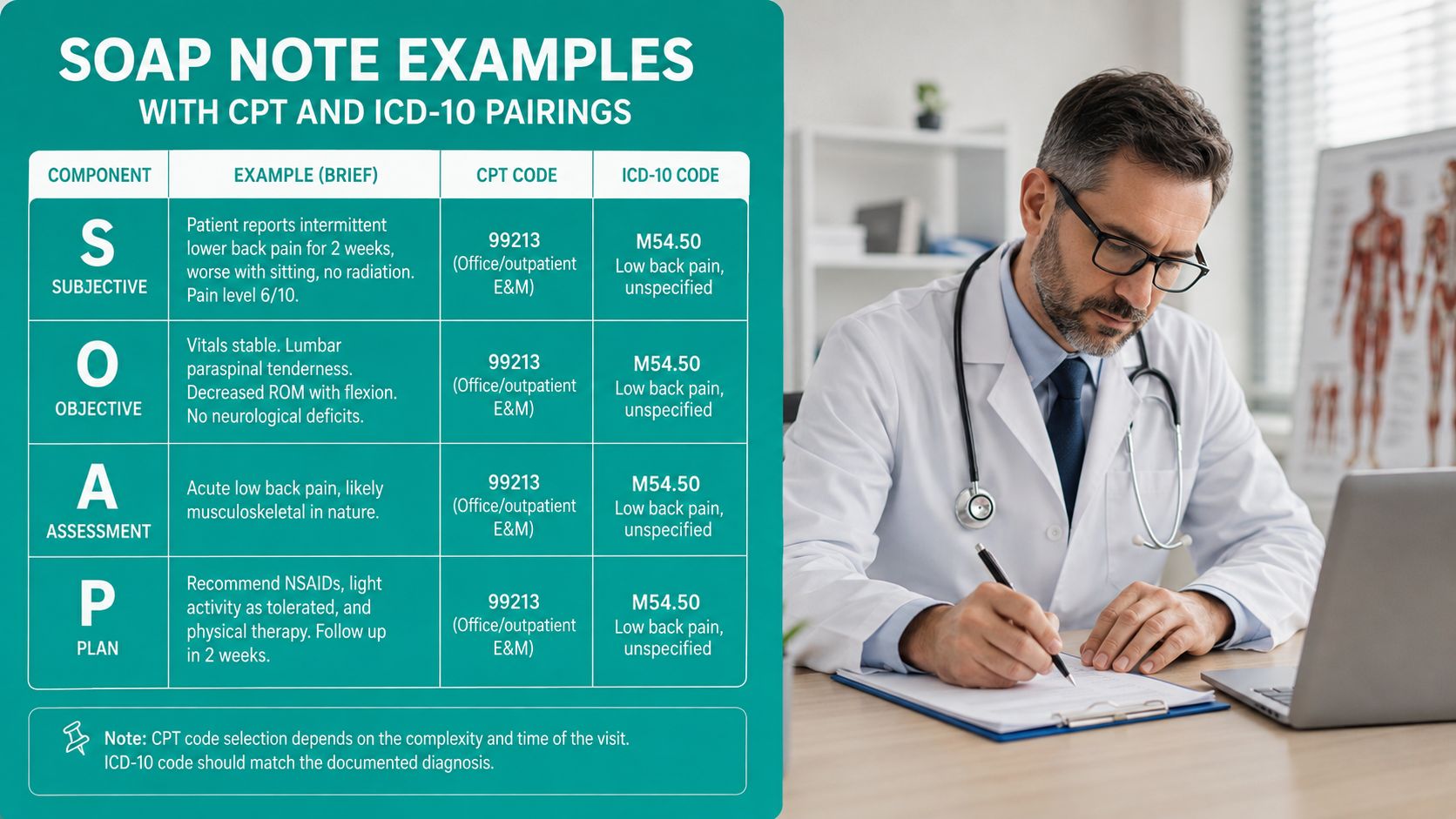
SOAP Note Examples with CPT and ICD-10 Pairings
A chart is easier to defend when the SOAP note starts with wound specifics instead of generic reassessment language. Auditors usually look first for whether the note supports the stage, site, and procedure depth that were billed. They also check whether the wound description changed in a way that matches the treatment.
Follow-up visit, Stage 3 sacral ulcer with sharp debridement
Subjective: Patient reports increased drainage from the sacral wound and pain with sitting. No fever. Dressing has been changed daily at home.
Objective: Sacral ulcer measures with a clean wound bed after sharp debridement. Tissue description shows slough at the base before debridement, then visible subcutaneous tissue after removal. Periwound skin is mildly macerated with moderate serous exudate.
Assessment: Pressure ulcer of sacral region, Stage 3. The stage is supported by the tissue findings and depth documented after debridement.
Plan: Sharp debridement performed to the depth documented in the exam. Select the 11042 to 11047 family based on documented depth and surface area. Reassess drainage, offloading adherence, and dressing response at the next visit. For code pairing and note structure, this ICD-10 and CPT coding reference is useful for keeping the diagnosis and procedure aligned.
That note holds up because it ties the stage to the tissue, the tissue to the procedure, and the procedure to the plan. It avoids filler language that breaks down under review.
New patient visit, heel deep tissue pressure injury with stable eschar
Subjective: Caregiver noticed a dark heel area during bathing. The patient denies new pain, but the skin has not improved with offloading at home.
Objective: Heel lesion is covered with stable dry eschar. There is no drainage, no fluctuance, and no visible base. Periwound skin is intact.
Assessment: Unstageable pressure ulcer of the heel because the wound bed cannot be clinically staged under the eschar.
Plan: Continue offloading and protective dressing. If a separately identifiable evaluation is performed, the visit may support modifier 25 with the evaluation and management service when paired with a procedure.
For additional wound-care templates, see these SOAP note examples with CPT and ICD-10 pairings.
EkagraHealth AI can draft this kind of structured SOAP note at the point of care, then help map documented findings to a candidate CPT and ICD-10 pairing for clinician and coder review so the chart does not have to be rebuilt later from memory.
Documentation Habits That Prevent Payer Denials
Denials in wound care are usually predictable. The same five problems show up over and over, and none of them are mysterious.
- Missing stage documentation: Say the stage plainly, or say why it can't be staged.
- No laterality when the site requires it: Right, left, or unspecified has to be in the note when the code family expects it.
- Inconsistent staging across visits: If the wound changes, explain why. Debridement, new exposure, or resolution can change the picture.
- Debridement depth doesn't match the billed code: The note has to support the depth, not just the fact that something was debrided.
- No measurements: Length, width, and depth, when measurable, are part of the medical necessity story.
Surveyors look for coherence. If the wound is documented as Stage 3 but the tissue description sounds superficial, they'll notice. If the plan is advanced but the wound exam is vague, they'll notice that too. The safest chart is the one where the assessment, measurements, and treatment plan all point in the same direction.
Good note language is plain and specific. “Full-thickness sacral ulcer with slough removed, fat exposed, moderate serous drainage, periwound maceration” is defensible. “Pressure injury looks better” is not.
How Coding Accuracy Affects Quality Reporting and Reimbursement
Pressure ulcer documentation does more than support a claim. It shapes quality reporting, case-mix review, and how the organization's pressure injury burden appears in the chart. AHRQ's PSI-03 defines the event as Stage III or IV pressure ulcers or unstageable secondary diagnoses per 1,000 discharges in adults age 18 and older, so staging accuracy affects the record at both the bedside and the reporting level (AHRQ PSI-03 definition).
The burden is large enough that coding errors do not stay small. Global burden analyses show that in 2021 there were about 2.47 million new cases worldwide, up from about 1.14 million in 1990, while age-standardized incidence changed only slightly from 31.5 to 30.3 per 100,000 (global burden summary). In the U.S., the same summary describes up to 3 million adults affected annually. Hospitalization data in that source also reports 3,683,219 discharges associated with pressure ulcers, 33.8% Stage III/IV, and mean charges of $89,082 per discharge (hospitalization burden summary). That is why vague staging, missing laterality, or a loose description of tissue loss can change more than reimbursement. It can distort how the organization looks in quality reporting and utilization review.
Documentation quality also depends on the workflow around it. Delayed chart completion, unclear charge capture, and messy claim routing all make coding drift more likely, which is why how managed IT boosts healthcare efficiency is a useful reference for practices trying to keep wound documentation aligned with the visit. A note that is finished cleanly, routed correctly, and matched to the clinical exam is less likely to trigger avoidable denials or data cleanup later.
Quick Reference for Pressure Ulcer Code Selection
The fastest way to avoid errors is to confirm the code family before you finalize the note. For pressure ulcer icd 10 work, the default family is L89, and each wound gets the most specific code the documentation supports. If there are multiple pressure ulcers, assign separate L89 codes as needed, and add secondary codes for complications like infection, osteomyelitis, or gangrene only when the chart supports them.
Bedside checklist
- Anatomical site: sacrum, heel, hip, ischium, back, elbow, ankle, or another documented site
- Laterality: right, left, or unspecified when the code family requires it
- Stage: 1, 2, 3, 4, deep tissue pressure injury, unstageable, or unspecified only when not documented
- Wound dimensions: length, width, and depth when measurable
- Tissue type: slough, eschar, granulation, fat exposure, bone exposure, or intact skin
- Periwound condition: maceration, erythema, induration, warmth, or intact skin
If the wound is a diabetic foot ulcer, look to the L97 series instead. Non-pressure chronic ulcers belong in L98.4 or another appropriate chronic-ulcer family, and arterial insufficiency ulcers need the vascular context, not a pressure-ulcer label. That distinction saves a lot of rework, especially when the wound's location makes it tempting to call everything a pressure injury.
When the note is built correctly at the bedside, the claim is usually easier, the queries are fewer, and the chart reads like a clinician wrote it, not a coder guessing from fragments.
If your team is tired of rebuilding wound notes after the visit, EkagraHealth AI can help structure the SOAP note, capture the wound details that support L89 coding, and map the documentation to the right CPT and ICD-10 pairings before the chart is closed. Visit EkagraHealth AI if you want a workflow built for wound care documentation that has to stand up to payer review.
