
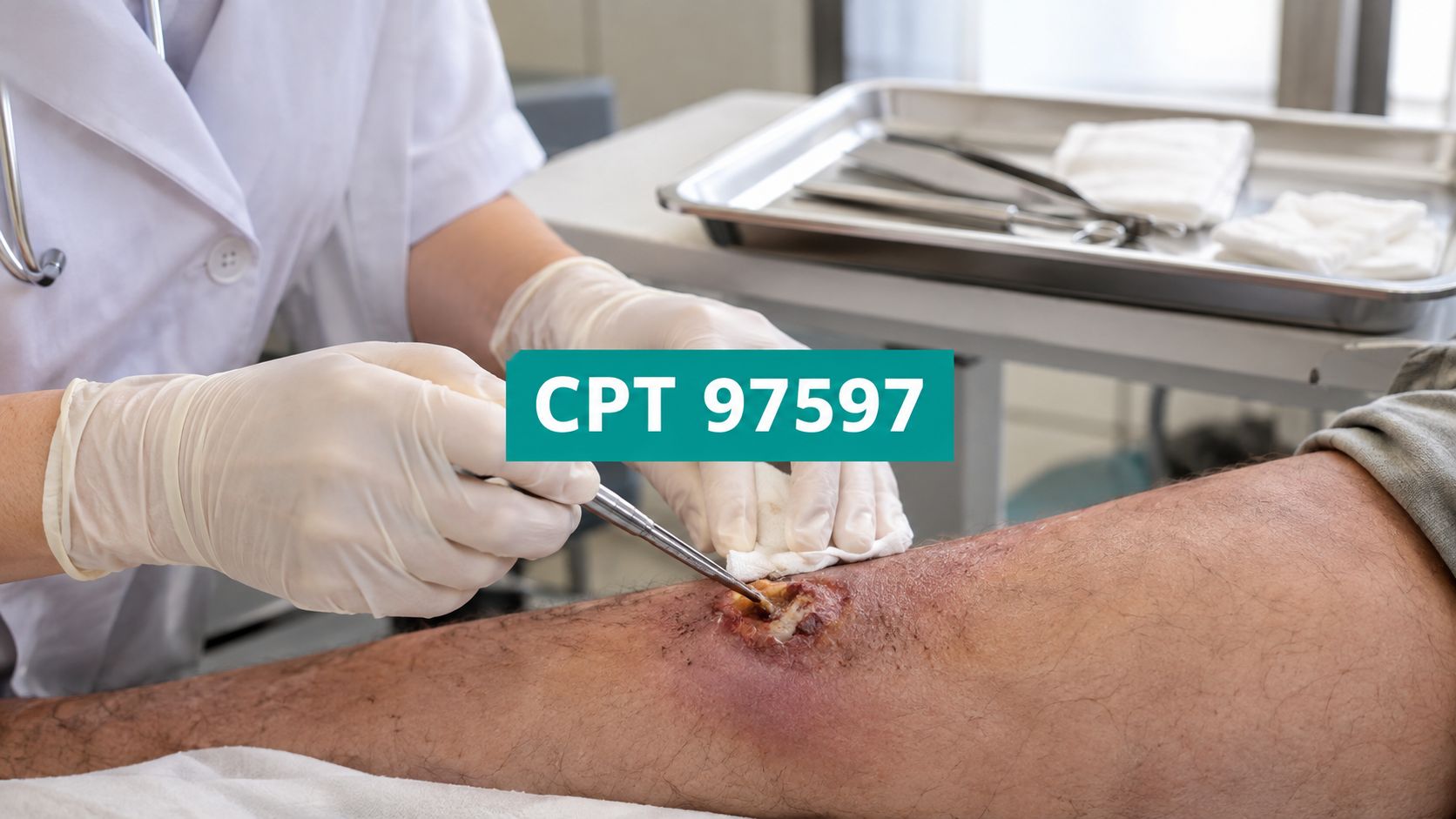
You've got the note half-finished, the wound's been cleaned, and the claim is about to go out. Then the denial lands because the chart says “debridement performed,” but it never proves devitalized tissue was there, never pins down the area, and never shows why the work belonged under 97597 instead of a dressing change or a deeper debridement code. That's the part clinicians and coders keep getting burned on, because 97597 is not a vague wound-care line item. It's a very specific billing decision tied to what tissue was removed, how much was treated, and how deep the work went.
Why 97597 Is Not Just Another Wound Care Code
A lot of 97597 denials start with a very ordinary visit. The patient comes in with a chronic ulcer, someone removes slough, the note says debridement was done, and everybody assumes the code will stand up. Then the payer asks for proof that the work met the definition of selective debridement, not just cleansing or irrigation. CMS and wound-coding guidance draw that line hard, because simple cleansing or removal of secretions does not qualify as debridement when devitalized tissue isn't being removed.
The part auditors care about
The operative question is not whether the clinician was busy. It's whether the note proves selective debridement of an open wound with the right tissue target. That distinction matters most in chronic wounds, where the same visit can easily include cleansing, dressing changes, offloading advice, and a legitimate debridement. Only one of those supports 97597. The others are bundled or non-billable as debridement work.
Practical rule: if the chart can't show devitalized tissue, it usually can't support 97597.
That's why this code gets so much attention from auditors in venous leg ulcers, diabetic foot ulcers, and pressure injuries. The code isn't about how dramatic the visit looked. It's about whether the clinician removed fibrin, slough, devitalized epidermis or dermis, exudate, debris, or biofilm from an open wound in a way that meets the definition of selective debridement. The denials usually aren't subtle. They're about missing tissue detail, missing area detail, or a note that reads like a routine wound care visit instead of a true debridement.

The 97597 CPT Code Description and Its 20 Square Centimeter Rule
The cleanest way to think about the 97597 cpt code description is this, it covers selective debridement of an open wound when the total treated surface area is 20 square centimeters or less in that session. The descriptor explicitly includes removal of fibrin, devitalized epidermis and/or dermis, exudate, debris, and biofilm. That matters because the code is about the tissue removed, not just the fact that a wound was touched.
How the area threshold works in real life
The 20 cm² limit is a billing milestone, not a clinical guideline. If the total selectively debrided area in the session stays at or below that threshold, 97597 is the base code. If the treated area goes beyond 20 cm², then 97598 comes in as the add-on for each additional 20 cm² or part thereof. The rule resets per session, which means the total area for all wounds treated that day is what matters, not whether the clinician worked on one wound or three.
A simple example shows why this gets missed. A 19 cm² venous ulcer falls under 97597 alone. A 21 cm² venous ulcer requires 97597 plus 97598. That one-centimeter difference changes the claim structure, so the measurement has to be real, not rounded, guessed, or written as “small” and left at that.
| Scenario | Total Wound Area | Code(s) to Bill | Notes |
|---|---|---|---|
| Single selective debridement session with one wound | 19 cm² | 97597 | Fits within the first 20 cm² |
| Single selective debridement session with one wound | 21 cm² | 97597 + 97598 | The extra area pushes into the add-on code |
| Multiple wounds treated in the same session | Combined area under 20 cm² | 97597 | Aggregate area drives the code |
| Multiple wounds treated in the same session | Combined area over 20 cm² | 97597 + 97598 | Apply the add-on once the first 20 cm² is exceeded |
The billing unit follows the session, not the wound label. If two wounds are debrided on the same day, the total treated area is what drives 97597 and 97598.
If you want a deeper code-by-code breakdown of selective debridement logic, the comparison at EkagraHealth AI's selective debridement CPT code page fits well with the area rules people struggle with at the bedside.
When 97597 Fits and When the 11042 Through 11047 Family Takes Over
The line between 97597 and the 11042 through 11047 family is about depth of tissue removed, not the tool in your hand. A curette doesn't automatically mean 97597, and a scalpel doesn't automatically mean a surgical code. What matters is the layer you removed and whether the record supports that depth.
Tissue depth drives the code
Here's the practical split. Epidermis and dermis fit the selective debridement side of the house. Once the debridement reaches subcutaneous tissue, you're in 11042 territory. If the work goes deeper into muscle and fascia, the surgical codes move to 11043 and 11044. If bone is involved, the code family continues into 11046 and 11047.
| Code Group | Tissue Depth | Typical Use Pattern |
|---|---|---|
| 97597 | Epidermis, dermis, superficial selective removal | Open wounds needing selective debridement |
| 11042 | Subcutaneous tissue | Excisional debridement to subcutaneous level |
| 11043 / 11044 | Muscle and fascia | Deeper surgical debridement |
| 11046 / 11047 | Bone | Deepest debridement levels |
A mixed-bed visit is where teams get tripped up. If one wound is a shallow venous ulcer with slough that can be selectively removed, and another wound on the same patient needs subcutaneous excision, you don't force both into the same code just for convenience. You code each wound by the depth treated, document each site separately, and make sure the note supports the different layers removed.
Clinical judgment still matters, but coding follows the deepest documented tissue level removed on each wound.
For the other common trap, don't let “debridement” language blur into non-selective work. If the visit was really irrigation, wiping away exudate, or changing dressings, that's not enough for 97597. If the note doesn't show tissue level and medical necessity, the payer will usually treat it like a documentation failure, not a harmless wording issue.
What Auditors Want on the Page
Auditors don't want prose. They want facts that line up with the code. For 97597, that means the chart has to show the wound's size, the tissue removed, the wound bed status, and why debridement was medically necessary that day. If those pieces are missing, the note reads like a service that happened. It doesn't read like a service that qualifies.
The checklist that actually holds up
- Exact wound measurements: length, width, and depth in centimeters, not “small” or “improving.”
- Tissue description: percent of devitalized tissue versus viable tissue, with the type of tissue removed.
- Exudate details: amount and type, such as serous, serosanguineous, purulent, or no drainage.
- Periwound status: maceration, erythema, callus, edema, induration, or intact skin.
- Procedure depth: the anatomical layer reached during removal.
- Instrument used: curette, scissors, forceps, scalpel, or another selective technique.
- Medical necessity: why the tissue had to be removed now, especially in a chronic wound that isn't progressing.
- Wagner grade when relevant: especially for diabetic foot ulcers.
Each item should read like a real note, not a templated sentence. “Selective debridement performed with curette, slough removed from wound bed, periwound maceration present, wound measured 2.0 cm by 1.5 cm by 0.2 cm, and debridement was necessary due to persistent devitalized tissue delaying healing” is the kind of language that helps. “Debridement done, tolerated well” does not.
Dressings are another easy denial trigger. CMS states that dressings applied during these services are included and may not be billed separately. That means if the billing team tries to carve out dressing work as a separate charge, the claim is inviting trouble. For documentation habits that support the medical necessity side, the note standards in EkagraHealth AI's medical necessity documentation resource are aligned with what payers keep asking for in wound charts.

The Five Most Common Denial Reasons and How to Fix Them
The denial patterns around 97597 are boring because they repeat. That's useful. Once you know what keeps breaking, you can fix the chart before the claim ever leaves the office.
1. The note never proves devitalized tissue was present
The denial usually says the record doesn't support selective debridement. The primary problem is that the note describes cleaning or dressing care, but not devitalized tissue removal. Fix it by naming the tissue type removed and the layer it came from.
2. Wound size is vague or missing
Payers don't like “small ulcer” or “approximately improved.” They want the actual treated area. Fix it with length, width, depth, and the total area treated in the session.
3. Dressings were billed separately
CMS already says dressing work is included in the service and can't be billed separately. If the claim splits out bundled dressing care, it's handing the payer an easy denial. Fix it by keeping those items in the note as part of the procedure, not as separate billable services.
4. The code choice doesn't match the depth
97597 gets forced into a surgical debridement frame, or the reverse happens. If the record shows subcutaneous tissue, muscle, fascia, or bone, the 11042 through 11047 family is the right place to look. Fix it by documenting the deepest tissue level removed and coding to that level.
5. The ICD-10 pairing doesn't support the story
A pressure injury code paired with a non-pressure chronic ulcer narrative, or a wound diagnosis that doesn't reflect the site and chronicity, can undercut medical necessity. Fix it by making the wound diagnosis and the procedure note agree on the wound type, location, and reason for debridement.
A claims team that has to chase these denials every week should also look at workflow, not just note templates. Clean charting helps, but so does front-end review, and that's where boost revenue with outsourced billing can be useful as a process reference for practices that are trying to keep denials from stacking up. If you want the claim to survive review, the record has to show the service was real, necessary, and correctly coded before it leaves the building.
For the modifier side of the same problem, the guidance at EkagraHealth AI's modifier 25 resource is worth keeping in mind when a wound visit overlaps with a separately identifiable evaluation.
Real Note Examples for Mixed Wounds and Multiple Sites
Clean examples help more than generic advice, because wound billing usually breaks at the point where two sites or two depths show up in the same visit. The code choice gets easier when the note shows exactly what happened and why each wound was handled the way it was.
Example 1, one shallow diabetic foot ulcer
“Right plantar diabetic foot ulcer, Wagner grade 2, measured 1.8 cm x 1.2 cm x 0.2 cm. Selective debridement performed with curette, devitalized slough removed from epidermal and dermal tissue, no deeper tissue exposed. Total treated area under 20 cm².”
Codes: 97597
ICD-10-CM: diabetic foot ulcer diagnosis consistent with the wound narrative.
Example 2, venous ulcers totaling more than 20 cm²
“Left lower leg venous ulcers x2, combined selective debridement area 38 cm². Slough and fibrin removed from open wound beds with scissors and forceps, periwound maceration noted, serous drainage present.”
Codes: 97597 + 97598
ICD-10-CM: venous ulcer diagnosis consistent with laterality and chronic venous disease.
Example 3, mixed wound depths on the same day
“Right heel pressure injury stage 3 with exposed subcutaneous tissue required excisional debridement to subcutaneous level. Separate left pretibial venous ulcer had adherent slough selectively removed from epidermis and dermis only.”
Codes: 11042 for the pressure injury site, 97597 for the venous ulcer site, with site-specific documentation for each wound. If the payer needs laterality or procedure-to-procedure distinction, the procedural relationship has to be clear in the note and claim.
The point is not to overcomplicate the visit. It's to keep each wound in its own lane. If the clinician did selective debridement on one site and deeper excision on another, the chart has to prove that separation or the payer may collapse the claim into the wrong bucket.
Payer Nuances Worth Knowing Before You Bill
Medicare generally follows the 97597/97598 structure, but MACs still scrutinize the record for tissue level, wound size, and medical necessity. Medicaid plans can be stricter or looser depending on the state, and commercial carriers often mirror Medicare while adding their own documentation habits. Some will want the chart completed the same day. Others want stronger proof that debridement was repeated for a reason, not just because the wound was still open.
Local coverage rules still matter more than any broad summary. If a practice bills these services regularly, someone on the team should know where the MAC policy lives and what that payer expects for repeat debridement, wound photos, and post-visit documentation. FY 2026 CPT updates are being discussed in the coding world, but the practical issue at the bedside is still the same. The note has to justify the code on the day of service.
Quick Answers for Clinicians in the Room
Yes, 97597 can still be appropriate when cellulitis is also being treated, but the record has to separate the infection management from the debridement service. If the wound is being cleaned but no devitalized tissue is removed, the code doesn't suddenly become valid because cellulitis is present.
Repeat frequency is where payer skepticism starts. Some plans question repeated debridement quickly if progress isn't documented, even when the wound is chronic. The safest chart shows why the tissue had to be removed again and what changed since the last visit.
The same documentation standard applies in SNFs, outpatient clinics, and other covered settings. The setting changes the payment pathway and, in some cases, consolidated billing rules, but it doesn't lower the documentation bar.
Prior authorization depends on the payer, especially under Medicare Advantage and many Medicaid plans. If a practice treats repeat debridement as routine, it'll eventually hit a denial wall.
EkagraHealth AI helps wound care teams capture the note, map the code, and keep the documentation tied to what auditors read. If your clinic is fighting 97597 denials, visit EkagraHealth AI and see how the workflow fits point-of-care wound documentation, coding, and clean claim submission.
