
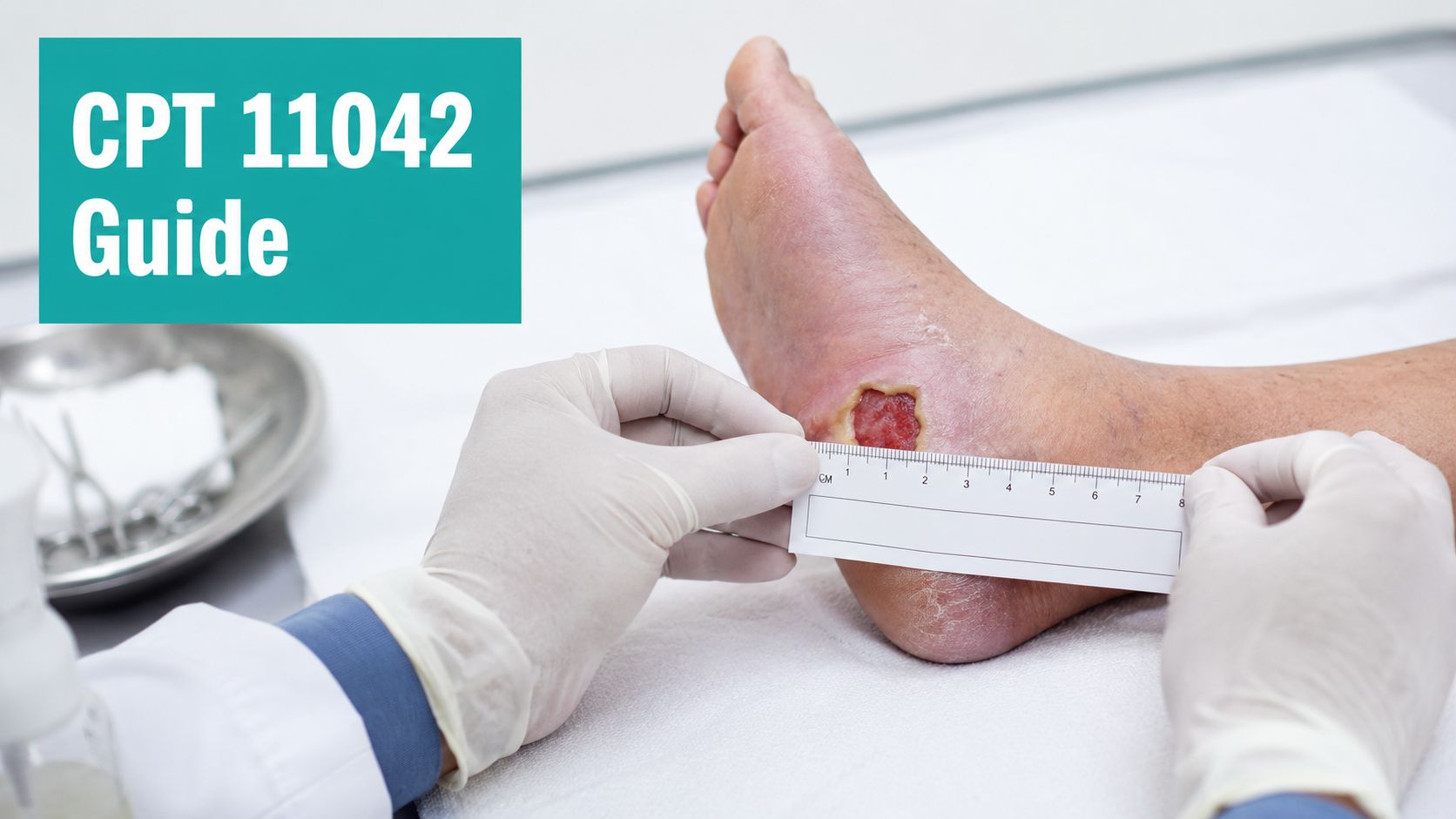
The chart looked fine at a glance. The ulcer was dressed, the note said debridement was done, and the clinician felt the visit was clean. Then the claim came back denied because the record didn't prove subcutaneous debridement, didn't support the area math, and left the payer room to say this was just wound cleansing, not CPT 11042.
That's the trap with this code. On paper, it sounds straightforward. In real wound care, it lives or dies on whether the note shows the deepest tissue excised, the first 20 cm², the correct add-on arithmetic, and the right diagnosis pairing. I've seen good procedures fail because the chart read like a dressing change with a surgical adjective bolted on.
A Diabetic Foot Ulcer That Almost Got Denied
A patient shows up with a chronic plantar wound, the kind that makes the whole room focus. The clinician documents a Wagner 3 diabetic foot ulcer, uses a curette, removes devitalized tissue until subcutaneous fat is visible, and gets bleeding tissue at the base. Clinically, that is real work, and the documentation still has to prove it.
The denial happened because the note never said subcutaneous tissue outright. It said “debrided ulcer” and “improved wound bed,” which reads fine to a human and weak to an auditor. There was no measurement tied to the debridement, no clean area calculation, and the diagnosis pairing was not tight enough to show the service matched the wound type.
Practical rule: if a reviewer cannot tell what layer was removed, what instrument was used, and how much tissue was treated, the claim is vulnerable even when the procedure was appropriate.
That is why CPT 11042 is really a documentation code in work clothes. The procedure happens on the bed, but the payment decision happens in the chart. Medicare's Q3 2026 Physician Fee Schedule shows the code was billed roughly 2.0 million times in 2024 and affected 481,115 beneficiaries, so this is mainstream wound care and mainstream work gets audited hard. The same source places it at #121 of 7,879 CPT codes by volume or allowed dollars, which tells you how often small documentation slips turn into big revenue problems. See the fee-schedule discussion below. For a practical way to document size without creating arithmetic errors, review these wound measurement examples.
The Depth and Area Logic Behind CPT 11042
A debridement can look straightforward in the room and still become a denial on the back end if the depth and area math is loose. I have seen notes with a clean wound bed and a good result still fail because the chart never pinned down what was removed, how deep the excision went, or how the surface area was calculated.
CPT 11042 is the code for surgical debridement of subcutaneous tissue for the first 20 cm² or less. If epidermis and dermis come off too, that stays inside the code, but payment still follows the deepest tissue removed, not the wound's surface appearance before you start. If the note only describes fibrin, slough, or superficial cleansing from skin layers, it does not belong in 11042.
| CPT Code | Deepest Tissue Removed | Area | Code Type |
|---|---|---|---|
| 11042 | Subcutaneous tissue, epidermis and dermis if also removed | First 20 cm² or less | Base code |
| 11045 | Subcutaneous tissue, each additional 20 cm² or part thereof | Beyond first 20 cm² | Add-on |
| 11043 | Muscle or fascia | First 20 cm² or less | Base code |
| 11046 | Muscle or fascia, each additional 20 cm² or part thereof | Beyond first 20 cm² | Add-on |
| 11044 | Bone | First 20 cm² or less | Base code |
| 11047 | Bone, each additional 20 cm² or part thereof | Beyond first 20 cm² | Add-on |
The arithmetic is fixed, and auditors know it. A 55 cm² subcutaneous debridement is 11042 plus two units of 11045. A 55 cm² debridement that reached muscle is 11043 plus two units of 11046. The note needs to show the math in plain language, not leave the reviewer to infer it from the procedure title. Medicare's Q3 2026 Physician Fee Schedule data for CPT 11042 places the national allowed amount at $132.60 in the office and $55.78 in a facility, with 3.97 total RVUs non-facility and 1.67 facility, which is why a sloppy area calculation is not a small mistake.
Practical rule: code the deepest layer you excised, then sum the area for wounds at that same depth. Do not mix depth planes to make the math look cleaner.
For a quick check on how to document size without creating avoidable arithmetic errors, use a consistent wound-sizing workflow and record the post-debridement area once in the note, not scattered across comments, progress text, and procedure fields. These wound measurement examples that fit the chart are a useful reference when you want the numbers to survive review.
Documentation Elements That Survive an Audit
The note has to read like someone who performed sharp excisional debridement wrote it. Start with the wound type and etiology, then name the location and laterality, then give the length times width measurement in centimeters. “Large ulcer” doesn't help. Neither does “debrided as needed.”
A good chart also separates what was seen from what was removed. If the wound had slough over subcutaneous tissue, say that. If the curette reached viable fat, say that too. Auditors look for a note that proves the layer, the tool, and the endpoint of debridement without forcing them to guess.
What the reviewer wants to see
- Wound identity: diabetic foot ulcer, pressure injury, venous ulcer, or other chronic ulcer with the correct location.
- Depth statement: explicit language that the debridement reached subcutaneous tissue.
- Tool used: curette, scalpel, scissors, or another sharp instrument.
- Bleeding control: pressure, hemostatic dressing, cautery if used, or another clear method.
- Tissue removed: slough, nonviable fat, necrotic tissue, undermined tissue, or similar, tied to the layer excised.
- Area math: length times width, then total surface area for the tissue plane treated.
A note that says “wound cleaned and debrided” is weak. A note that says “sharp excisional debridement of devitalized subcutaneous tissue using curette, with hemostasis by pressure, total area 14.2 cm²” gives the reviewer something concrete to verify.
That level of detail matters because denials usually start with missing proof, not missing work. Palmetto GBA's CERT summary cited in CMS guidance reported a 7.4% podiatry error rate, with 50.1% of audited claims lacking sufficient documentation and 47.2% incorrectly coded. CMS article on debridement coding and documentation
Before submission, I tighten the note against a structured medical-necessity documentation review and look for the same failure points every time. Missing depth language, vague tissue descriptions, and sloppy area math are the ones that keep coming back.
For teams trying to clean up procedure notes, a 8 essential document review steps style pass helps catch the small omissions that turn into large denials later.
Charting Examples Across Common Wound Types
A good template saves time, but only if the diagnosis pairing matches the wound and the depth. Here's where people drift into trouble.
Diabetic foot ulcer with subcutaneous debridement
The wound is a chronic plantar ulcer in a patient with diabetes, documented with E11.621 and the appropriate L97 code set. The note says the ulcer had adherent slough and devitalized subcutaneous tissue, and the clinician performed sharp debridement with a curette until bleeding fat was seen.
Sample chart language:
“Chronic plantar diabetic ulcer, right foot, with devitalized subcutaneous tissue. Sharp excisional debridement performed with curette to subcutaneous fat, total debrided area 8.4 cm². Hemostasis achieved with pressure. No tendon or bone exposed.”
That supports 11042 if the total treated area is within the first 20 cm². The key is that the note proves the depth, not the diagnosis alone.
Stage 3 pressure injury with undermining
Pressure injuries can work for 11042 when the service reaches below the dermis. A Stage 3 ulcer with undermining and slough can justify subcutaneous debridement if the note shows that the clinician excised devitalized tissue in that layer. The diagnosis set must reflect the pressure ulcer stage and location, and the documentation has to show the tissue plane.
Sample chart language:
“Stage 3 pressure injury of the sacrum with adherent slough and undermining. Sharp debridement performed with scalpel to remove devitalized subcutaneous tissue. Wound bed pink and bleeding after debridement, hemostasis with pressure.”
That reads like a real procedure note. It also gives the payer enough structure to understand why this wasn't simple surface cleaning.
Venous ulcer with superficial fibrin only
People often overcode. If the wound only has adherent fibrin on the surface and the clinician removes material limited to epidermis and dermis, 11042 is not the right family. That's a selective debridement conversation, not a subcutaneous one.
Sample chart language:
“Chronic venous ulcer with superficial fibrin removed from wound surface. No subcutaneous tissue excised.”
That note protects you from inappropriately forcing a surgical code onto a superficial procedure. Precision here prevents the worst kind of denial, the one that starts with a payment recoupment letter months later.
How CPT 11042 Fits With the Rest of the Debridement Family
Once the depth is clear, the code choice gets simpler. 11042 is the subcutaneous tier. 11043 moves to muscle or fascia, and 11044 reaches bone. Their add-ons follow the same pattern with 11045, 11046, and 11047 for each additional 20 cm² or part thereof. The structure is depth first, area second.
That matters when one patient has more than one wound. If the debridement depth is the same, the area is aggregated for that depth. If the depth differs, the surfaces do not get blended into one number just to make billing easier. The note has to keep those planes separate.
Practical rule: when a heel ulcer and a plantar ulcer are both debrided to subcutaneous tissue on the same date, the chart should show the combined area for that depth, not two random wound comments with no arithmetic trail.
The cleanest way to think about it is this, 11042 is not a “one wound, one code” shortcut. It's a depth-and-area framework. That framework is why the code family keeps tripping up teams that document by habit instead of by surgical reality. For a tighter walkthrough of the selective versus excisional boundary, keep a reference handy on selective debridement CPT code distinctions.
Common Denial Reasons and How to Fix Them

Most 11042 denials come from the same charting gaps. The note leaves out depth. The area calculation does not match the wound description. The diagnosis does not support a chronic ulcer. Or the clinician billed 11042 for surface slough that was only wiped away.
Payer rules can narrow the path further. Horizon NJ Health says 11042-11047 are reimbursed for Stage 1 or Stage 2 pressure ulcers only when the claim is paired with a Stage 3 or 4 pressure ulcer diagnosis or a non-pressure chronic ulcer diagnosis, and denied otherwise. That is a reminder I see every week in appeals work, payer policy can be stricter than the code descriptor alone. Horizon NJ Health ulcer debridement policy
Surgical-field denials create another common problem. CMS guidance says debridement in the surgical field of another musculoskeletal procedure is not separately reportable, so the wound work cannot always stand on its own just because it was documented separately. CMS debridement article
Fixes that help
- If depth is missing: state the deepest tissue removed. If the excision reached subcutaneous tissue, write that word plainly in the operative note.
- If area math is vague: document length times width, then state the total debrided area for that tissue plane. A reviewer should be able to follow the arithmetic without guessing.
- If the diagnosis pairing is weak: match the wound type to the chronic ulcer diagnosis the payer expects. A pressure injury code and a non-pressure ulcer code are not interchangeable.
- If only surface fibrin was removed: do not stretch 11042 to cover it. Say what was done and use the code family that fits superficial work.
- If another surgery was performed: confirm whether the wound bed sits inside the same surgical field before the claim goes out. If it does, separate billing may fail on review.
Appeals are stronger when they point straight back to the note. The claim line by itself will not carry a weak chart. A clear sentence on subcutaneous excision, a clean area calculation, and the right diagnosis pairing give the appeal something concrete to defend.
Modifier and Bundling Rules Around CPT 11042
Modifiers are where claims get messy fast. -59 can support a distinct procedural service when debridement is done at a separate site or separate encounter, but it needs a real distinction, not just a billing preference. -25 belongs on a separately identifiable E/M when the visit went beyond the procedure work. -58 fits staged or planned work during the global period, and -78 applies to an unplanned return to the OR.
NCCI edits matter here because debridement can bundle with the primary procedure on the same anatomical site. That's where teams get burned by assuming every wound service stands alone. It doesn't. If the wound bed was already in the surgical field of a larger procedure, the documentation has to show why a separate code is valid, if it's valid at all.
A clean modifier decision starts with anatomy, then timing, then intent. Was it a different wound? A different encounter? A staged return? Or just part of the same operation? Those are not the same thing, and auditors know the difference.
A Practical Pre-Submission Checklist for 11042
Before a claim goes out, I want seven things in the chart. A chronic ulcer diagnosis in the right ICD-10-CM category. A depth statement that clearly names subcutaneous tissue. A length times width measurement in centimeters. An area calculation that supports 11042 and any 11045 units. Instrument and hemostasis language. Correct modifier use, if a modifier is warranted. And a payer-specific diagnosis check so the claim doesn't get downcoded on arrival.
That's the same mindset behind a clean document review workflow. If the note can't survive a quiet read by someone who wasn't in the room, it probably won't survive payer review either. The best time to catch that is before submission, not after the remittance lands.
EkagraHealth AI fits into that point-of-care moment by drafting wound notes, mapping CPT and ICD-10 codes, and checking whether the documentation contains the medical necessity elements a debridement claim needs. Used well, that kind of workflow doesn't replace judgment, it keeps the chart from losing the story the clinician already told.
If your team is still fighting preventable 11042 denials, tighten the note before you tighten the appeals queue. Visit EkagraHealth AI to see how documentation and coding support can help keep subcutaneous debridement claims clean from the start.
