
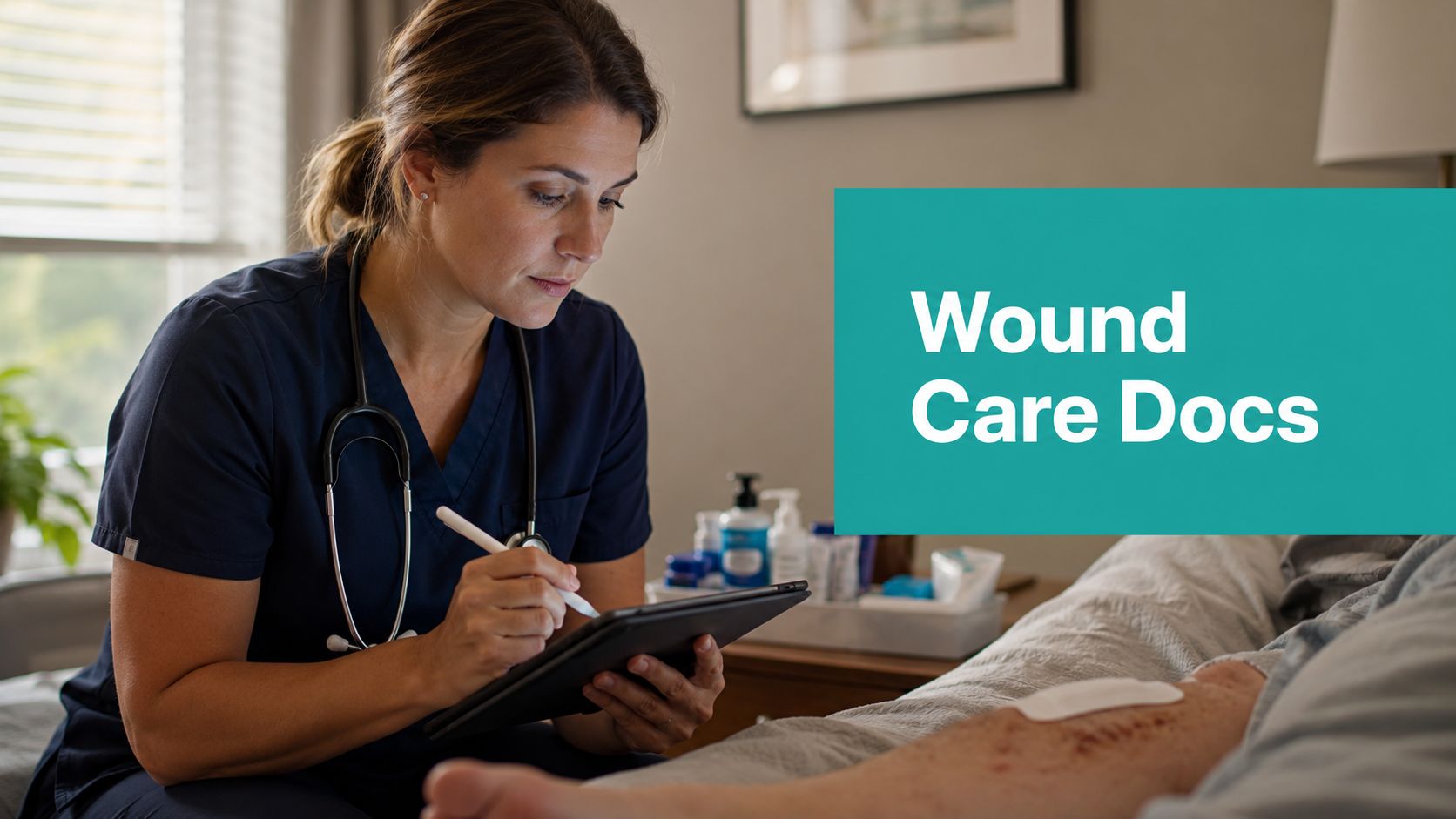
You finish clinic, open the chart queue, and realize half your wounds still live in your head instead of the record. You remember the heel ulcer with thick adherent eschar. You remember the sacral pressure injury with heavy serosanguineous drainage. You remember why you changed the dressing plan. What you don't have, yet, is a note that can survive a payer review.
That's where most wound programs get hurt. Not in the exam room. In the gap between care delivered and care documented.
Point of care documentation in wound care isn't clerical cleanup. It's the clinical record, the billing record, and the legal record all at once. If the note is thin, the claim is thin. If the note is vague, the medical necessity argument is vague. And if the note gets written from memory after a long day, small omissions turn into denials, stalled prior auths, and ugly audit findings.
Why Most Wound Care Documentation Fails Audits
The usual pattern is familiar. A clinician does good work all day, then tries to reconstruct the visit later from scraps: one photo, a few shorthand measurements, maybe a dressing order, maybe not. By then, the wound story is already degraded.

That's not just an individual time-management problem. It's a system problem. Poor point-of-care documentation in wound care remains a systemic failure globally, with audits showing that doctor and nurse documentation routinely fails to meet national standards, and incomplete notes often omit Wagner grades, precise exudate descriptions, and undermining measurements needed to support coding and advanced therapy justification (acute wound documentation evidence).
The details auditors expect
Surveyors and payers don't care that the clinician “knew what they meant.” They care that the chart proves it. In wound care, that means the note has to capture specifics such as:
- Ulcer classification: Wagner grading for diabetic foot ulcers when relevant
- Drainage language: serous, serosanguineous, or purulent, not “draining”
- Undermining and tunneling: documented by depth and clock position, such as “2 cm at 7 o'clock”
- Treatment response: what changed since the prior visit, not just “improved”
Generic documentation causes predictable downstream trouble. Prior authorization for advanced dressings or negative pressure wound therapy can stall when the chart doesn't prove clinical necessity. Coding teams then either query the clinician or code conservatively. Neither helps cash flow.
Practical rule: If a wound note can't tell the wound's story from first presentation through today's intervention, it isn't ready for billing.
What fails in the real world
The weakest notes usually have one of three problems:
Retrospective charting
The clinician writes from memory and loses key descriptors.Checklist-only documentation
Boxes get filled, but the note doesn't explain clinical reasoning.Disconnected workflow
Images, measurements, and procedure details live in different places.
This is one reason wound programs benefit from operational thinking borrowed from field teams. If your clinicians move between rooms, buildings, SNFs, and homes, your documentation process has to support mobility, handoffs, and same-day completion. A practical read on that side of workflow design is this piece on optimizing field service operations, especially if your wound practice covers multiple sites.
The bottom line is simple. Audits fail when the chart reads like a memory aid instead of a clinical record.
Building an Audit-Proof Wound SOAP Note
A wound SOAP note doesn't need to be long. It needs to be usable. The best notes are structured enough for coders and auditors, but specific enough for the next clinician who sees the patient.

Start with Subjective and make it clinically relevant
The Subjective section should answer what the patient or caregiver is reporting that affects wound management. Pain, odor, dressing saturation, offloading adherence, blood glucose issues, and interval events belong here. “No complaints” is rarely enough for a chronic wound follow-up.
Useful Subjective entries include:
- Pain pattern: increased during dressing changes, stable at rest, worse with palpation
- Adherence issues: not wearing offloading boot, difficulty elevating limb, missed dressing changes
- Systemic concerns: fever, chills, appetite decline, increased drainage, malodor
Objective is where most notes live or die
This is the part you cannot afford to phone in. A defensible wound Objective should include measurable findings and standard language that reduces ambiguity.
At minimum, capture:
- Measurements: length × width × depth in centimeters
- Wound bed tissue: granulation, slough, eschar, fibrin, necrotic tissue
- Exudate: type and amount
- Periwound assessment: maceration, erythema, edema, induration, callus, warmth
- Edges and undermining: attached, rolled, undermined, epibole, clock position where relevant
- Odor and infection indicators: documented plainly, without vague shorthand
A clean Objective line reads better than a bloated paragraph. For example: “Right plantar forefoot ulcer measures 1.8 × 1.2 × 0.3 cm. Wound bed 60% granulation, 40% yellow slough. Moderate serosanguineous drainage. Mild periwound callus. No crepitus. Undermining 0.5 cm from 4 to 6 o'clock.”
A good wound note replaces “looks better” with measurements, tissue description, and interval change.
Use PUSH correctly
For pressure injuries, serial scoring matters. The PUSH score requires quantification of wound size, exudate amount, and tissue type, and a delta PUSH score of 3 or more points over 2 weeks indicates non-healing and triggers reevaluation under NPIAP guidance, which directly affects prior authorization renewal (PUSH documentation guidance).
That requirement changes how you write. “Some drainage” won't hold up. The chart needs structured language that tracks over time.
If you want a tighter framework for the wound-care Objective itself, this breakdown of the Objective section of a SOAP note is worth using as a template reference.
Assessment and Plan should show judgment
During the Assessment, you interpret the wound, not merely rename it. Such elements as Wagner grade, suspected bioburden, stalled healing, or concern for pressure redistribution failure are integral to this process.
The Plan should be equally concrete:
- Procedures performed: debridement type and tolerated well or not
- Dressing strategy: what was applied and why
- Offloading or compression: continued, modified, reinforced
- Follow-up timing: next review and what will trigger escalation sooner
- Escalation logic: imaging, vascular referral, culture, surgery, or therapy adjustment
Here's the mistake I see too often: the note contains measurements, but no clinical arc. An audit-proof SOAP note doesn't just describe a wound. It proves you're managing it deliberately.
Coding Debridement and Getting Paid Correctly
Debridement coding is where weak point of care documentation starts costing real money. Most denials aren't caused by exotic coding rules. They come from basic documentation failures.
The biggest one is simple. CPT debridement codes 11042–11047 are based on the deepest layer of tissue removed, not the wound's total depth. If you document the wound as deep to muscle but only remove nonviable subcutaneous tissue, you code the deepest tissue debrided. Misidentifying that layer is a common source of coding errors and audit findings (debridement coding guidance).
What needs to be in the procedure note
For selective debridement and surgical debridement, the chart has to answer specific questions:
- What tissue was removed
- How deep you removed it
- How much area was debrided
- What instrument or method was used
- Why the tissue removal was clinically indicated
If you're billing selective debridement codes 97597–97602, documentation must explicitly capture tissue type removed, depth of removal, and linear dimensions. Generic language like “debrided wound” isn't enough for claim support (selective debridement documentation details).
For CPT 11044, the record must clearly state that bone was exposed and tangibly debrided to healthy bleeding margins, with non-viable cortical bone fragments removed, and pathology confirmation is recommended for audit defense (bone debridement billing guidance).
Quick reference for common debridement documentation
| CPT Code | Deepest Tissue Layer Debrided | Required Documentation Example |
|---|---|---|
| 97597 | Selective removal of devitalized tissue | “Removed 1.5 cm × 1.0 cm of yellow slough from subcutaneous layer” |
| 97598 | Additional selective debridement area | Document the additional treated area with tissue type, depth, and dimensions |
| 11042 | Subcutaneous tissue | “Sharp excisional debridement of nonviable subcutaneous tissue performed” |
| 11043 | Muscle and/or fascia | “Excisional debridement carried through nonviable fascia to viable tissue” |
| 11044 | Bone | “Bone exposed and tangibly debrided to healthy bleeding margins; non-viable cortical bone fragments removed” |
| 11045–11047 | Add-on surgical debridement codes | Document the same core elements plus the additional area treated |
That table isn't a substitute for payer policy. It's a reminder of what your note has to prove before billing ever starts.
What coders and auditors flag immediately
A few charting habits trigger trouble fast:
Using wound depth instead of debridement depth
The wound may probe deeper than the tissue you removed.Naming necrotic tissue loosely
“Debris” doesn't help. Slough, eschar, fibrin, subcutaneous tissue, fascia, muscle, and bone do.Skipping dimensions in centimeters
Area matters for code selection and validation.Failing to identify the deepest tissue removed
That single omission can sink the whole claim.
If your debridement note could apply equally to slough removal and bone debridement, it's too vague to bill safely.
For outpatient teams, the operational side matters too. Coding accuracy depends on how consistently procedures, measurements, and diagnoses are captured during the visit. This overview of an outpatient wound care clinic workflow reflects the kind of documentation structure that reduces coder queries and rework.
The financial consequence of vague debridement notes
When a debridement claim is denied, the problem usually started at the bedside. The payer rarely saw your wound. They saw your words. If the note doesn't show tissue type, depth, dimensions, and rationale, revenue cycle staff are left defending a procedure the chart never fully established.
That's why I tell new clinicians to chart the debridement as if the reviewer has no wound-care background and no access to you for clarification. Because often, that's exactly the situation.
Overcoming the Mobile Documentation Dilemma
The mobile clinician's day looks efficient on paper and chaotic in practice. Early stop at a SNF. Then home health. Then another facility with bad Wi-Fi and no place to sit. By noon, you've seen several wounds and taken mental notes on drainage, undermining, and periwound changes, but the EHR is still waiting.
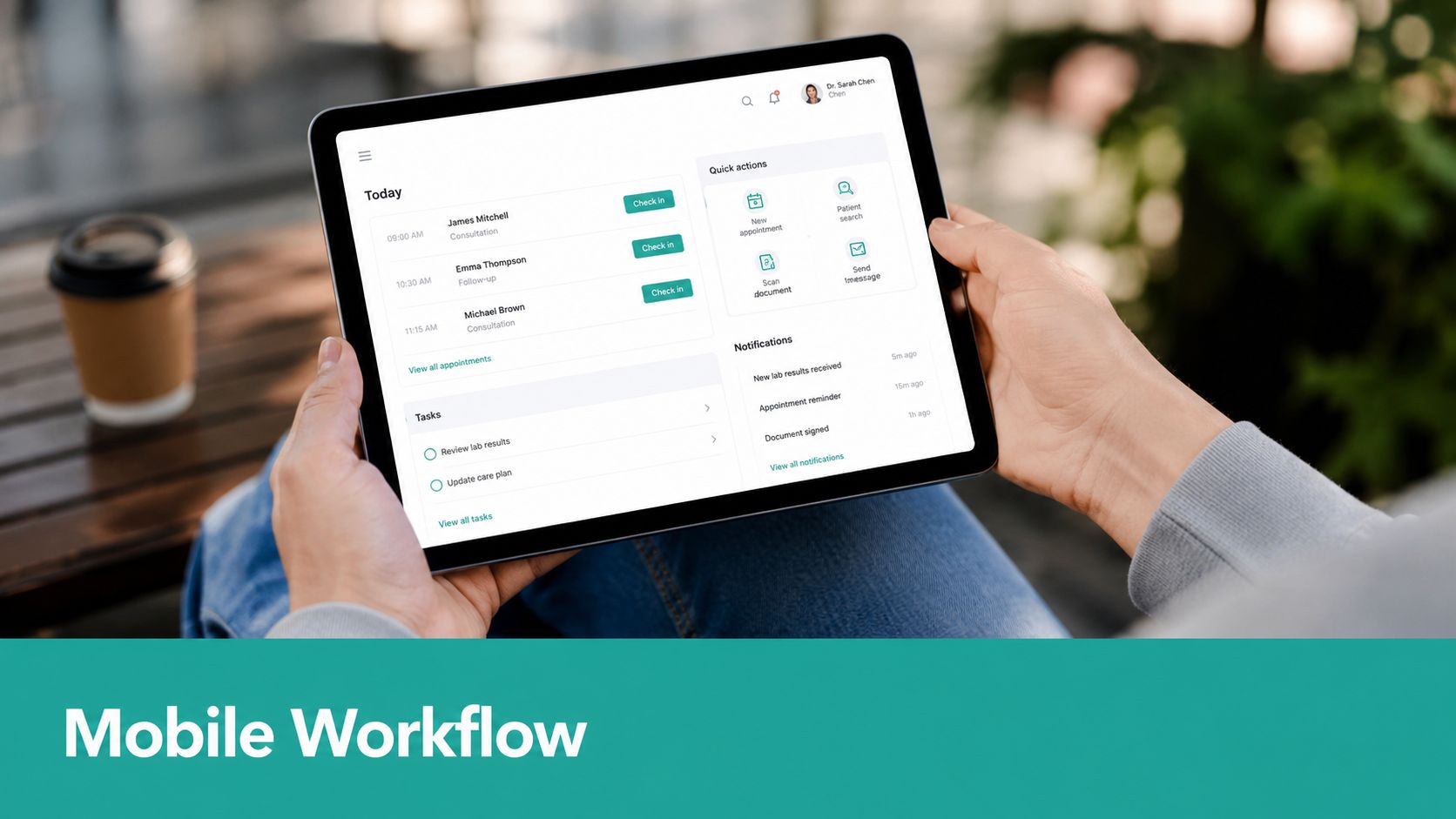
That environment isn't a side issue in wound care. It's most of the work. Seventy-two percent of wound care occurs in SNFs, home health, or mobile settings where clinicians often lack real-time EHR access, while CMS requires point-of-care documentation within 24 hours and wound image annotations with measurements at the time of service.
Why standard advice falls apart in the field
A lot of documentation guidance assumes a clinic setup. Stable internet. Desktop workstation. Integrated camera. Easy coder follow-up. That's not the real world for many wound teams.
In mobile practice, you're dealing with:
- Interrupted charting time: family questions, staff handoffs, transport delays
- Device limitations: battery life, glare, weak connectivity
- Privacy risk: rushed photo capture or unsecured temporary notes
- Serial wound complexity: multiple wounds, multiple sites, repeated measurements in one visit
The result is predictable. Clinicians jot fragments, promise themselves they'll finish later, and then have to rebuild the visit from memory.
What actually helps in mobile rounds
Mobile point of care documentation works best when the workflow is stripped down to essentials. Collect the core defensible elements during the encounter, then finalize the narrative promptly while the case is still fresh.
That means building habits around:
- Same-visit measurements rather than end-of-day reconstruction
- Immediate wound image annotation when required
- Standardized phrasing for periwound findings and drainage descriptors
- Visit-close review before leaving the parking lot or facility hallway
Mobile charting fails when clinicians try to remember later what they could have captured in ten seconds at the bedside.
The hard part isn't clinical knowledge. It's creating a field workflow that doesn't ask the clinician to choose between patient flow and audit readiness.
Real-World Tips for Faster Bedside Charting
You do not need to write more. You need to write cleaner, earlier, and with less rework.
The best time-savers in wound documentation aren't glamorous. They're repeatable habits and systems that remove friction from the parts of charting you do all day.
Start with low-tech fixes
Immediate relief can be achieved through template cleanup alone.
Build smart phrases that reflect actual wound practice
For example, a periwound phrase for intact skin, or a drainage phrase that forces type and amount.Standardize order of observation
Measure first, then bed tissue, drainage, edge, periwound, pain, and intervention. Same order every time.Separate procedure language from assessment language
That reduces the common mistake of mixing what the wound is with what you did to it.Use diagnosis-specific prompts
A diabetic foot ulcer note should prompt Wagner grade. A pressure injury note should prompt staging and PUSH elements.
Then automate the parts that don't need your brain
Technology earns its place not by replacing clinical judgment, but by reducing clerical drag.
AI-driven point-of-care tools have been shown to triple documentation completeness, and the intervention group in one wound assessment workflow study also had a mean wound size reduction of 53.99% when objective digital assessment replaced subjective descriptions (AI wound assessment workflow data).
That finding tracks with what clinicians already know. Notes improve when measurements are captured objectively and immediately. “Looks smaller” becomes dimensions. “Cleaner base” becomes tissue percentages. “Draining less” becomes exudate type and amount.
One practical way to use technology well
A sensible setup looks like this:
Capture the encounter in real time
Voice input or structured prompts during the visit.Document the wound image with measurements immediately
Don't save that step for later.Let the system draft the note structure
Then the clinician edits for accuracy and judgment.Review coding-critical fields before signoff
Tissue removed, depth, dimensions, diagnosis specificity, and rationale.
EkagraHealth AI fits into that kind of workflow by listening during the visit, drafting the SOAP note, and handling wound image analysis with measurements and annotations. That's useful when the goal is to reduce manual entry while keeping the note clinically specific.
Better bedside charting doesn't come from typing faster. It comes from deciding which parts of documentation should never depend on memory.
The trap is waiting for a perfect system. You don't need perfect. You need a workflow that captures the essential details before the next patient pulls your attention away.
From Action to Rationale Proving Medical Necessity
This is the shift many clinicians still miss. Documenting what you did is no longer enough. Your note has to document why that intervention was necessary on that visit.
That gap is driving denials. The debridement vs. documentation paradox causes 30 to 40 percent of debridement claims for codes 11042–11047 to be denied as not medically necessary because clinicians document what was removed but fail to document the specific procedural rationale linking tissue removal to healing trajectory.
What this looks like in the chart
Weak note: “Eschar removed. Debrided to 2 mm depth.”
Better note: “Firm eschar removed to expose viable granulation tissue and reduce the nonviable barrier preventing local antimicrobial penetration and wound bed progression.”
That second version gives the reviewer your clinical thinking. It connects the action to the treatment goal.
If your team struggles with that jump from task documentation to necessity documentation, this resource on medical necessity documentation is a useful framework. The core habit is simple: every significant wound intervention should be tied to a present-tense healing problem you are actively trying to solve.
That's what strong point of care documentation really is. Not longer notes. Smarter notes. Notes that show the wound, the intervention, and the reasoning in one defensible record.
EkagraHealth AI helps wound care teams capture point of care documentation while the visit is happening, with support for SOAP note drafting, wound image measurements and annotations, coding alignment, and cleaner billing workflows. If your practice is tired of after-hours charting, coder queries, and denials tied to thin documentation, take a look at EkagraHealth AI.
