

The objective in soap note is where you document the hard facts. It’s a space for all the measurable, quantifiable, and observable data you gather during your exam—think vital signs, physical findings, and lab results. This is the unbiased evidence that supports your clinical judgment. In wound care, getting this section right is not just good practice; it's the foundation of effective treatment, compliance, and reimbursement.
The Objective Section Is Your Clinical Proof
If the Subjective ('S') section is the patient’s story, the Objective ('O') section is your detective’s log. It’s strictly for the undisputed facts—the "what is" of the patient’s condition that any other clinician could walk in, observe, and verify for themselves. This section must be free of opinions, interpretations, or patient statements. It is pure, unadulterated clinical data.
Here’s a simple way to think about it: A patient might tell you their wound "feels hot," which is a subjective complaint. The objective data, however, is a specific measurement: "Periwound skin temperature is 99.8°F." That shift from feeling to fact is the entire point of the Objective section. The patient's report of a hot feeling goes in 'S', while your temperature measurement goes in 'O'. This separation is crucial for clarity and legal defensibility.
The Foundation of Factual Charting
Getting the Objective section right isn't just about tidy note-taking; it's fundamental to building a defensible medical record. This is the data that validates everything you do. It helps you:
- Support an Accurate Diagnosis: Hard data provides the evidence you need to either confirm a suspected diagnosis or rule it out. For example, documenting purulent drainage and a foul odor objectively supports a diagnosis of a wound infection.
- Justify Your Treatment Plan: Measurable findings are your proof that a specific intervention or procedure is medically necessary. Documenting "40% slough" is the evidence needed to justify debridement.
- Track Clinical Progress: By recording consistent, quantifiable data, you create a clear timeline showing how a wound is—or isn't—healing. This data-driven approach allows you to modify the plan of care based on real evidence rather than a general impression.
- Ensure Proper Reimbursement: Payers rely on objective evidence to approve claims. Without it, you risk denials. A claim for a complex dressing will likely be rejected if the note lacks objective details about copious drainage or deep wound cavities.
This need for structured, factual data is driving huge investments in healthcare technology. In fact, a 2026 Black Book Global Healthcare IT Survey found that 65% of hospitals in rapidly adopting markets are upgrading their EHR systems specifically to better structure and automate this kind of objective data capture. You can learn more by exploring the findings on this global healthcare IT trend and how the industry is evolving. The shift towards value-based care models further emphasizes the importance of objective data in proving quality outcomes.
The 'O' section is where you show, not just tell. Vague notes like "wound looks better" are useless here. Instead, you provide the evidence: "Wound bed is now 80% granulated, a 20% increase from the prior visit." That is the language of clinical precision. Every statement in the objective section should be a verifiable fact.
What to Document in Your Objective Wound Assessment
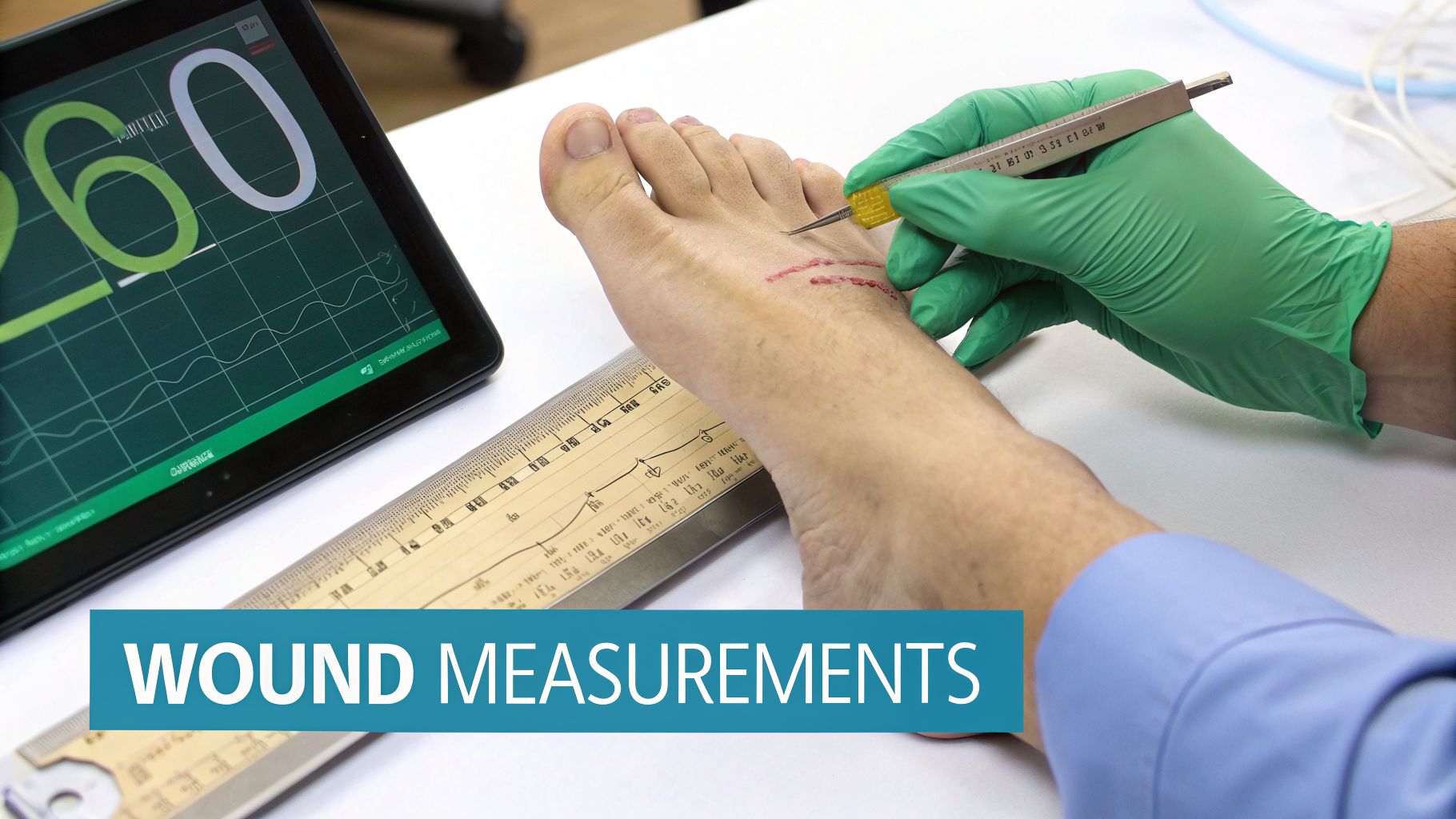
The objective in a SOAP note is all about the facts. Think of yourself as a detective building a case—your job is to report the measurable, observable, and verifiable evidence. This isn't the place for interpretation or guesswork. It's where you lay the factual groundwork that supports your diagnosis and the entire plan of care. A well-documented objective section can withstand scrutiny from auditors, legal reviewers, and other clinicians.
A strong objective section doesn't just jump straight to the wound. It begins by painting a picture of the patient’s overall condition, which provides critical context for the local findings. For example, noting a fever is an objective fact that immediately raises suspicion of a systemic infection that could be tied directly to the wound. Similarly, noting elevated blood glucose levels in a diabetic patient provides context for slow healing.
Start with the Broader Physical Exam
Before you even touch the wound dressing, your objective assessment should capture key systemic and regional data. These findings help connect the dots between the wound and the patient’s overall health, guiding more effective treatment. Think of it as establishing your baseline. A comprehensive physical exam demonstrates a thorough evaluation and supports medical necessity for the visit itself.
This part of the exam should always include:
- Vital Signs: Get a full set—temperature, blood pressure, heart rate, and respiratory rate. An abnormal reading can be your first clue to infection, unmanaged pain, or a cardiovascular issue that’s hindering healing. For example, persistent tachycardia could indicate systemic infection or significant pain.
- Vascular Assessment: Check the pedal pulses (dorsalis pedis and posterior tibial). Are they present? Are they strong, faint, or absent? Use a Doppler if necessary. Note the capillary refill time and any skin discoloration like duskiness or pallor, which are clear signs of poor perfusion that directly impact healing potential.
- Neurologic Assessment: This is where you test sensation, often with a 10g monofilament. Don't just write "neuropathy." Document the specific deficit you observe, like "loss of protective sensation to the plantar aspect of the bilateral feet, confirmed with 10g monofilament testing at 8/10 sites."
- Dermatologic Assessment: Look at the skin of the entire limb, not just around the wound. Is it dry, scaly, or macerated from moisture? Note the color and check the skin turgor. These details tell a story about the patient's hydration, nutritional status, and overall skin integrity.
Your objective documentation must be a fortress of facts. It’s the difference between stating "the leg looks swollen" and documenting "3+ pitting edema extending to the mid-calf with a 2 cm increase in circumference compared to the contralateral limb." The second statement is measurable, defensible, and undeniable. It provides a clear baseline for tracking treatment efficacy.
Getting Specific: Quantifying the Wound
Now we zoom in on the wound itself. This is the heart of your objective note, and vague descriptions simply won't cut it. Every single characteristic has to be measured and described with clinical precision. If you're looking for a structured way to capture these details, our complete wound care documentation template can be a huge help in ensuring you don't miss a single data point.
A comprehensive wound assessment is built on a checklist of essential data points. The following table outlines what you need to document and why it's so important for both patient care and compliant charting.
Essential Components of the Objective Wound Assessment
| Category | Specific Data Points to Document | Clinical Importance |
|---|---|---|
| Location & Type | Use precise anatomical landmarks (e.g., "medial malleolus, left ankle"). State wound type (e.g., "venous stasis ulcer"). | Ensures consistent tracking and informs etiology-specific treatment. Required for accurate coding. |
| Dimensions | Measure length, width, and depth in centimeters (L x W x D). Calculate surface area if possible. | Provides objective data to track healing progress or decline over time. Essential for justifying continued care. |
| Undermining & Tunneling | Use the clock-face method to note location and depth (e.g., "3 cm of undermining from 1 o'clock to 4 o'clock"). | Identifies hidden wound cavities that require packing to prevent abscess formation and ensures all areas of the wound are treated. |
| Wound Bed Composition | Document the percentage of each tissue type present (e.g., "70% granulation, 20% slough, 10% eschar"). | Guides debridement decisions and indicates the current phase of healing. This is critical for justifying procedures. |
| Exudate (Drainage) | Describe the amount (scant, minimal, moderate, copious), color (serous, sanguineous, purulent), and odor (foul, sweet, none). | Helps identify infection and determines the appropriate dressing selection for moisture management. |
| Periwound Skin | Note the condition of the surrounding skin—any erythema, maceration, or induration—and measure its extent (e.g., "2.5 cm of erythema circumferentially"). | The health of the surrounding skin is crucial for healing and can indicate spreading infection or moisture damage from an inappropriate dressing. |
| Signs of Infection | Document classic objective signs: increased erythema, edema, purulent drainage, malodor, and increased temperature of periwound skin. | Supports the diagnosis of infection and the medical necessity for antimicrobial treatments or cultures. |
By methodically documenting each of these components, you create a clear, factual record that not only tracks the wound's journey but also justifies your clinical decisions to colleagues, auditors, and payers. This level of detail is non-negotiable for high-quality wound care and is a core element of the objective in soap note writing.
Translating Clinical Findings Into Powerful Notes

Knowing what to look for during a patient exam is only half the battle. The real skill comes in translating what you see, feel, and measure into a clear, powerful note that leaves no room for interpretation. This is where your clinical expertise meets the art of documentation—transforming raw findings into a data-rich story of the patient’s condition. This skill is what separates a novice from an expert documenter.
The objective here is to move beyond general impressions and document specific, defensible facts. Instead of just writing that a wound has "improved," you need to present the hard evidence that proves it. This means using precise language, consistent measurements, and standard medical terminology to paint a picture that any other clinician can immediately understand and act upon.
Phrasing for Common Wound Types
The specific details you document will naturally change depending on the wound type, but the core principle of objective, measurable data is universal. Let’s look at some strong phrasing for a couple of common scenarios you'll encounter. These examples illustrate how to pack your note with factual, quantifiable information.
Diabetic Foot Ulcer Example
- Location: “Neuropathic ulcer, plantar aspect of the right first metatarsal head.”
- Dimensions: “Measures 2.1 cm x 1.8 cm x 0.4 cm. No undermining or tunneling noted.”
- Wound Bed: “Wound bed is 100% granular with no slough or eschar present. No exposed bone or tendon.”
- Periwound: “Periwound skin is intact with 1 cm callous border. No erythema or maceration.”
- Vascular: “Dorsalis pedis and posterior tibial pulses are palpable at 2+ bilaterally. Capillary refill <3 seconds in all toes.”
- Neurologic: “Patient unable to feel 10g monofilament at the great toe and 3rd metatarsal head.”
Venous Stasis Ulcer Example
- Location: “Venous ulcer, medial aspect of the left lower leg, 5 cm superior to the medial malleolus.”
- Dimensions: “Irregularly shaped wound measuring 6.5 cm x 4.2 cm x 0.2 cm.”
- Wound Bed: “Wound bed is shallow with 80% ruddy granulation tissue and 20% adherent yellow slough.”
- Exudate: “Moderate amount of serosanguinous drainage noted on the dressing, with no odor.”
- Periwound: “2+ pitting edema from ankle to knee. Hemosiderin staining present on the lower half of the leg. Skin is dry and flaky.”
These examples are packed with facts that tell a clear, undeniable story. They are defensible for billing, easy to track for progress, and provide a rock-solid foundation for your assessment and plan.
Moving From Vague to Valuable
One of the biggest mistakes I see in objective documentation is the use of vague, subjective language. This not only weakens your clinical note but can also cause real problems with reimbursement and continuity of care down the line. The solution is simple: replace every subjective impression with an objective measurement. Every clinician should actively audit their own notes to hunt down and eliminate these weak phrases.
An objective note is a legal document and a clinical tool. Phrases like 'looks better' or 'drainage is decreasing' have no place here. You must show the improvement with data: "Wound bed now 80% granulated, up from 60% at the last visit. Drainage has decreased from moderate to scant."
To make this distinction as clear as possible, just look at the difference between weak and powerful phrasing. Burn this table into your memory; it's a cheat sheet for stronger documentation.
| Vague & Weak (Don't Do This) | Precise & Powerful (Do This Instead) |
|---|---|
| "Wound looks better." | "Wound dimensions decreased to 3.1 x 2.5 cm. Granulation tissue is now 90%." |
| "Less drainage." | "Exudate is now scant and serous, changed from moderate serosanguinous." |
| "Smells bad." | "Foul, purulent odor noted upon dressing removal." |
| "Redness around the wound." | "2 cm of erythema and induration surrounding the wound from 12 to 3 o’clock." |
| "Leg is swollen." | "3+ pitting edema noted from foot to mid-calf, left lower extremity." |
| "Patient has neuropathy." | "Negative protective sensation at 5 of 10 sites on right foot via 10g monofilament." |
When you consciously choose precise language and back it up with numbers, you create an objective note that is both compliant and genuinely useful. It becomes a powerful tool that helps you and your team deliver truly excellent patient care.
How Technology Is Changing Objective Data Capture
Let's be honest: manual charting is a slog. We've all been there—trying to jot down measurements by hand, eyeball tissue percentages, and then transcribe everything after a long shift. This process is not just slow; it’s filled with opportunities for small errors and inconsistencies that can affect everything from patient outcomes to billing. The administrative burden is a leading cause of clinician burnout.
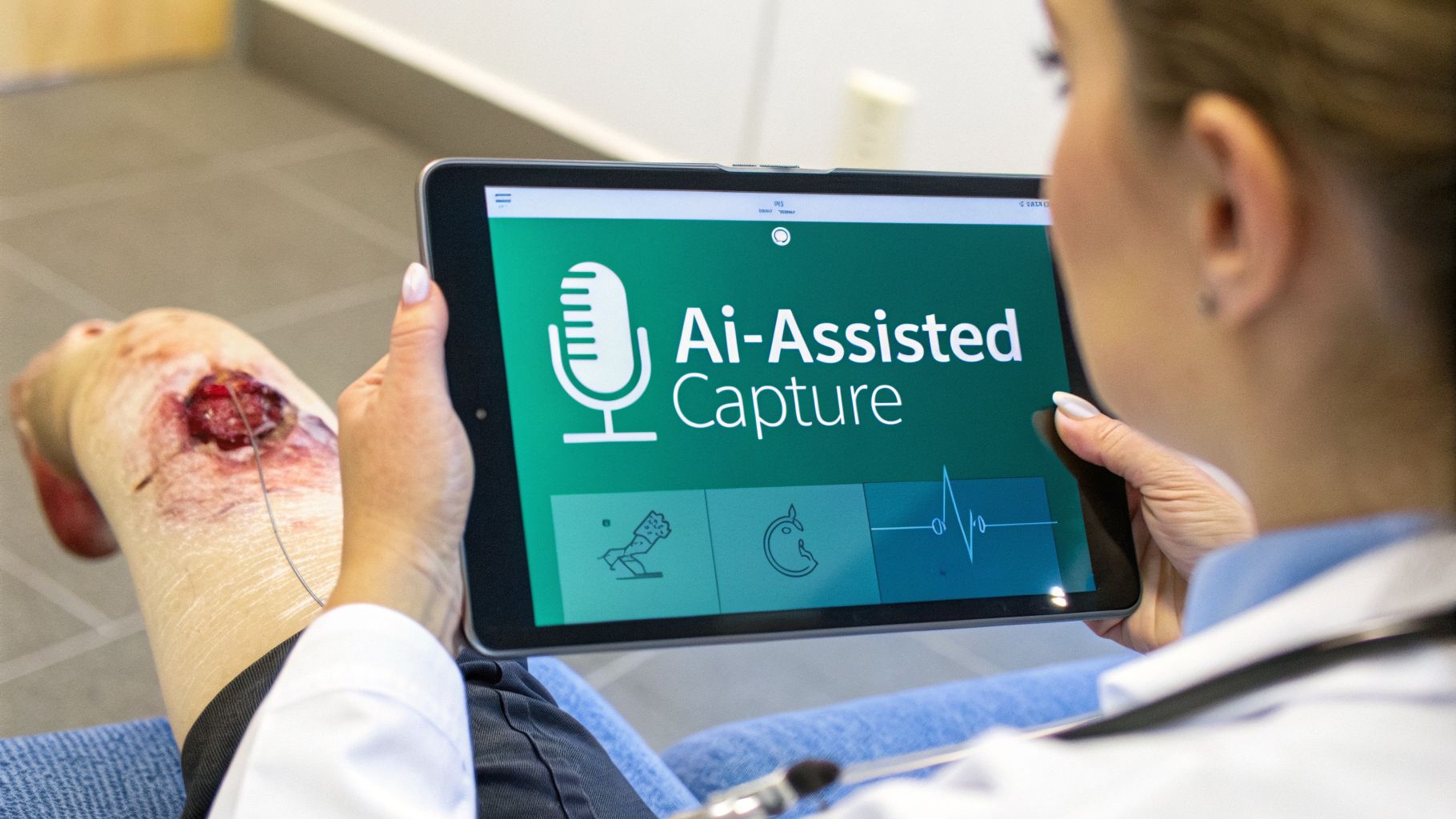
This is where technology is stepping in to make a real difference. Think about trying to measure the surface area of a sprawling, irregularly shaped venous ulcer. Doing it by hand with a paper ruler is a time-consuming guess at best. Now, with modern digital tools, you can just snap a picture with a tablet. The system uses computer vision to give you precise measurements and calculates the total surface area instantly, completely removing the guesswork and inter-rater variability.
This move toward precise, automated data is more than just a convenience. The objective in a SOAP note is becoming a critical piece of the puzzle in healthcare's shift toward AI-driven standards, especially with new interoperability rules and value-based care models on the horizon. Structured, reliable data is the new currency in healthcare.
The Role of AI in Objective Documentation
Artificial intelligence takes this a giant leap further. AI-powered platforms can now look at a wound image and do the heavy lifting for you, instantly identifying and annotating the different tissue types. Instead of you estimating percentages based on what you see, the AI gives you a data-backed breakdown. This not only saves time but also provides a more accurate and consistent assessment over the life of the wound.
For instance, an AI can analyze an image and immediately tell you:
- Granulation Tissue: 72%
- Slough: 18%
- Eschar: 10%
This creates a consistent, unbiased record that's far more reliable than what even the most experienced clinician can estimate alone. This level of detail is a game-changer for tracking healing progress and justifying procedures like debridement. If you're looking to bring this capability into your practice, checking out modern wound assessment tools for nurses is a great place to start.
From Natural Conversation to Structured Data
Another exciting development is ambient voice technology. This lets you perform an exam and simply speak your findings out loud, as you naturally would. No more stopping to type notes into an EHR or scribbling on a notepad that gets lost or is hard to decipher later. You can maintain eye contact with the patient and focus on the physical exam.
The AI listens in, pulls out all the relevant objective facts from the conversation, and neatly structures them into the SOAP note for you to review. It's the future of charting—efficient, accurate, and incredibly intuitive.
This "voice-to-data" workflow saves a massive amount of time and drastically improves the consistency and accuracy of the objective in SOAP note documentation. For busy clinicians, it means less time buried in paperwork and more time focused on the patient. By automating the tedious parts of documentation, this technology helps you build a stronger, more defensible clinical record with a lot less effort.
Connecting Objective Data to Your Revenue Cycle
The objective section of your SOAP note does more than just track patient progress—it’s the backbone of your revenue cycle. Think of it as the evidence you present to payers to prove that the care you delivered was medically necessary. This is where your hard, measurable data makes the leap from clinical observation to a payable claim. A weak objective section directly translates to a weak revenue stream.
Without solid objective findings, getting reimbursed properly can feel like an uphill battle. Vague documentation is practically an invitation for claim denials, downcoding, and time-consuming audits. Payers need facts and figures, not just your interpretation, to sign off on claims. They operate on a simple principle: if it wasn't documented, it wasn't done.
Justifying Medical Necessity with Objective Facts
Every single CPT and ICD-10 code you bill must be supported by the evidence in your note. The objective section is where you draw that direct line, creating a clear link between your findings and your billing. Your documentation must paint a picture of a patient who requires the level of service you are billing for.
Take a debridement procedure, for instance. To justify it, you have to prove non-viable tissue was present.
- Weak Note: "Debrided the wound." This is a classic recipe for a denial. It provides no rationale.
- Strong Note: "Objective: Wound bed contains 40% adherent yellow slough and 10% black eschar at the wound margins. Debridement was performed to remove non-viable tissue and promote a healthy wound bed."
See the difference? The second example is packed with specific data that leaves no room for interpretation. It clearly shows the procedure was essential based on what you could see and measure. It tells the auditor precisely why the debridement was medically necessary. If you want to dive deeper into how this documentation affects billing, our guide on understanding what an E/M code is is a great next step.
How Objective Data Maps to Specific Codes
The level of detail in your objective section directly impacts which codes you can use. Precise measurements and descriptions can mean the difference between billing a lower-level code and a higher-level one, which has a real effect on your bottom line. Capturing the full complexity of the patient's condition is key to accurate reimbursement.
Here’s how it plays out in practice:
- Wound Dimensions: Documenting a particularly large or complex wound (e.g., total surface area > 100 sq cm) justifies codes for more intensive management and higher-level E/M services.
- Tissue Type: Identifying necrotic tissue like slough or eschar is often a strict prerequisite for billing any debridement codes (e.g., CPT 97597/97598). Without documenting the percentage of non-viable tissue, these codes are indefensible.
- Infection Signs: Noting objective signs of infection—like purulent drainage, periwound erythema, and malodor—provides the necessary support for diagnoses (ICD-10) and treatments related to infection, which can also affect the E/M level.
Your objective note is your financial defense. It proves you performed the services you billed for and that those services were essential for the patient's care. Meticulous objective notes lead to fewer denials, faster payments, and a healthier revenue cycle.
This is where modern AI-powered platforms are changing the game. By analyzing the objective data you capture—from wound photos to your dictated findings—these systems can automatically suggest the most accurate CPT and ICD-10 codes for the encounter. This provides real-time coding assistance, reducing the chance of under-coding or making compliance errors.
This helps close the loop from your voice to the final claim, cutting down on manual coding mistakes and making sure your billing truly reflects the complexity of the care you provided. It’s a powerful example of how investing in better, more detailed documentation pays for itself many times over.
Answering Your Top Questions About Objective Notes
Even when you know the rules, documenting the objective section of a SOAP note can feel tricky. You're often navigating the gray area between what a patient tells you and what you can actually see and measure. Let's clear up some of the most common questions that come up in practice.
Think of this as a quick chat to sharpen your documentation skills with some practical, real-world advice. Getting these details right consistently is what separates good clinicians from great ones.
Where Do I Document a Patient's Pain Score?
This is a classic one. A patient tells you, "My pain is an 8 out of 10." Since that’s their personal, self-reported experience, it's subjective. That number belongs squarely in the 'S' (Subjective) section of your note. It’s part of their story. It is a quote or a paraphrase of what the patient told you.
Your job in the 'O' (Objective) section is to document what you observe that backs up (or sometimes contradicts) their report. These are the verifiable facts that another person could witness.
- Subjective ("S"): Patient states "sharp, shooting pain at a 7/10" in the right lower leg during dressing changes. Reports taking prescribed pain medication 30 minutes prior to visit with minimal relief.
- Objective ("O"): "Patient winces and guards the right lower extremity upon palpation of wound margins." or "Observed facial grimacing and audible gasp during removal of secondary dressing. Heart rate increased from 88 to 105 bpm during procedure."
Getting this right is so important. The subjective note captures their feeling, while your objective note captures the physical evidence. Together, they paint the full clinical picture and justify your pain management plan.
How Can I Document Faster Without Losing Detail?
We all feel the pressure to be more efficient, but speed can't come at the cost of accuracy. The key isn't just to go faster—it's to be more methodical. This comes down to having a system and the right tools. Sacrificing detail for speed is a recipe for clinical and financial disaster.
First, create a consistent workflow for your wound assessments. Whether it's a mental checklist or a digital template, always evaluate in the same order. It becomes muscle memory. A systematic approach ensures you don't skip a crucial element.
- Vital Signs & General Exam
- Location & Type
- Dimensions (L x W x D)
- Undermining/Tunneling
- Wound Bed Composition (%)
- Exudate (Amount, Type, Odor)
- Periwound Skin Condition
A structured approach like this is your best defense against missing a critical detail when you're in a hurry. You can create dot phrases or macros in your EHR to build a template.
Second, look at technology that’s actually built for the job. Basic voice-to-text is a start, but modern ambient AI platforms are a game-changer. These tools can listen to your natural patient encounter and automatically populate the objective data into the EHR for you, saving an incredible amount of time while ensuring nothing gets missed. This allows you to focus on the patient, not the computer screen.
A patient's self-reported pain score is always subjective. Your observation of their reaction to that pain—like guarding or wincing—is the objective data. Documenting both in their correct sections tells the complete clinical story.
What Is Wrong With Saying a Wound "Improved"?
Here’s a documentation habit to break immediately. The word "improved" is a judgment call, not an objective fact. It’s your interpretation, and the objective section is no place for interpretations. A phrase like "the wound has improved" is clinically weak because it doesn't give anyone the measurable data they need to track progress, justify care, or get you paid. An auditor will immediately flag this as insufficient evidence.
Your job is to show, not just tell. Instead of using a vague word like "improved," just state the data points that led you to that conclusion. Present the evidence and let the data speak for itself.
- Don't write: "Wound has improved since last week."
- Do write: "Wound dimensions decreased from 4.2 cm x 3.5 cm to 3.8 cm x 3.2 cm. Granulation tissue has increased from 60% to 80% of the wound bed. Serosanguinous drainage is now scant, previously moderate."
See the difference? The second example is a defensible, undeniable record of progress. Any colleague, specialist, or auditor can look at that note and know exactly what happened. It’s the difference between an opinion and a fact. Mastering this distinction is fundamental to mastering the objective in soap note documentation.
Ready to eliminate documentation headaches and capture perfect objective notes every time? Ekagra Health AI uses advanced voice and image recognition to automatically structure your clinical findings, suggest accurate codes, and streamline your entire workflow from voice to claim. Discover how you can reduce charting time by up to 70% and get back to focusing on your patients.
