
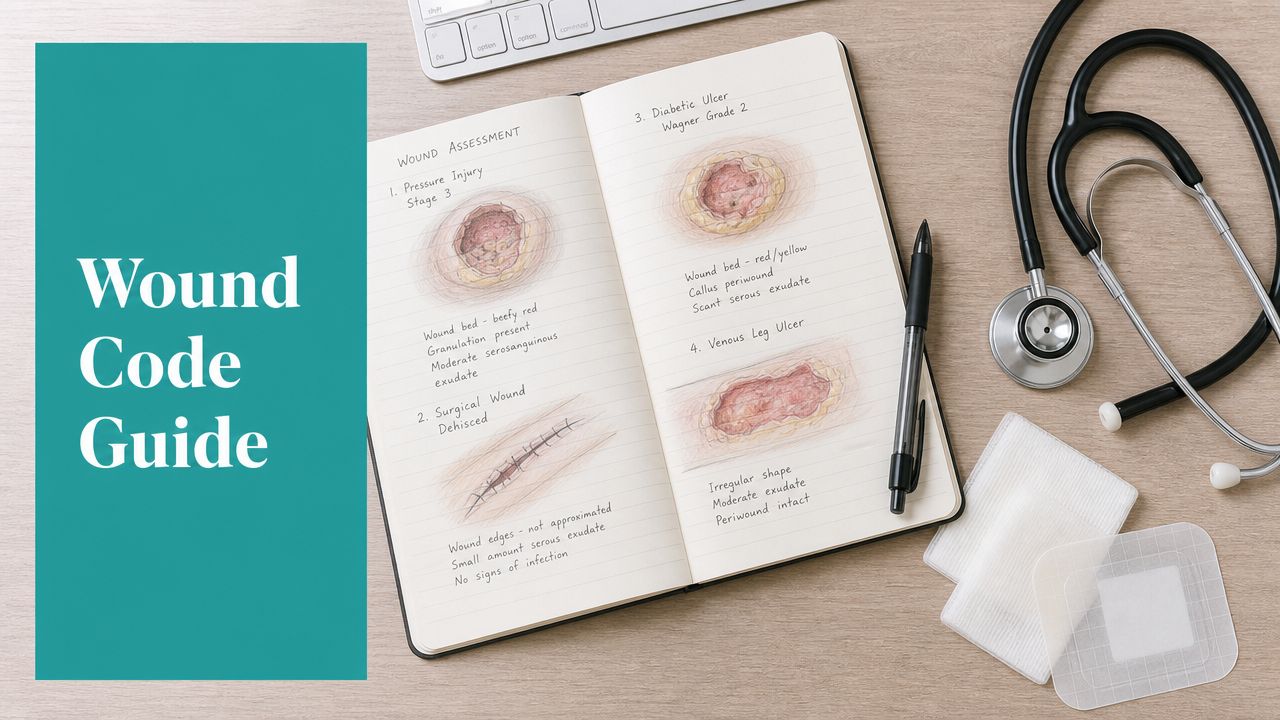
You've probably already seen the pattern. The visit was appropriate. The wound was real. The debridement was necessary. Then the claim comes back denied because someone used a vague diagnosis code, or worse, a dressing-change code with no underlying etiology attached.
That isn't a billing nuisance. It's a documentation failure.
In wound care, your note has to do two jobs at once. It has to tell the next clinician what you saw, and it has to tell the payer why you were justified in doing what you did. If either side is weak, you get denials, audits, and endless rework. New PAs and NPs usually learn the clinical side first. The coding side feels administrative until the first batch of rejected claims lands on your desk.
The fix is simple in principle and unforgiving in practice. Stop thinking of the diagnosis code for wound care as a box to fill. Treat it as the compressed summary of your bedside exam. If your exam says “left foot ulcer with exposed tissue, moderate serosanguinous drainage, no undermining,” your code should reflect that level of specificity. If your exam says “wound check,” you haven't given billing anything usable.
Why Your Wound Care Diagnosis Code Keeps Getting Denied
A common miss happens like this. A patient comes in with a chronic lower extremity ulcer. The wound is assessed, cleaned, and debrided. The procedure note is decent. The claim goes out with a generic follow-up diagnosis or an unspecified wound code. Payment stalls.
I've seen this with dressing-change encounters coded as Z48.00 when the patient clearly has an active ulcer that should have been tied to the underlying wound diagnosis. I've also seen providers document “ulcer stable” while billing a debridement code that only makes sense if the note describes current tissue involvement. Payers read that mismatch as weak medical necessity.
The bigger issue is that a denied wound claim usually isn't denied for one isolated reason. It's denied because the diagnosis, the physical exam, and the CPT code don't tell the same story. One part says chronic ulcer. Another says wound check. Another bills for deep debridement. That's how charts get flagged.
What payers are really rejecting
They're not rejecting your effort. They're rejecting ambiguity.
The ICD-10-CM wound care set is large. It contains over 1,800 distinct diagnosis codes for chronic ulcers, pressure injuries, and open wounds, and the L89 and L97 series account for approximately 45% of all wound care billing encounters in the United States outpatient setting as of 2024. The practical takeaway is that payers expect specificity because the code set was built for specificity. A code like L89.213 identifies a Stage 3 pressure ulcer on the right buttock. L97.522 identifies an ulcer on the left foot with tissue exposed and requires documentation details like depth, exudate type, and surrounding skin status to support reimbursement. Misclassifying a surgical wound complication such as T81.31XA as a routine dressing encounter such as Z48.00 can trigger immediate denials under Medicare wound coverage policy, especially when the underlying etiology isn't linked.
Practical rule: If your diagnosis code could describe ten different wounds, it's probably too vague to defend your claim.
The unwritten rule in clinic
Don't let your assessment be less specific than your procedure.
If you bill debridement, your diagnosis has to say what required debridement. If you bill active wound management, your diagnosis has to reflect the current wound state, not a historical label copied forward from last month's note. Good coding starts with a disciplined exam. Clean claims follow that.
The Anatomy of a High-Specificity Wound Diagnosis Code
Most coding mistakes start before the code is chosen. The clinician didn't fully classify the wound at bedside, so the chart gets padded with generic language and the coder has to guess.

Read the code as a clinical sentence
Take L97.522. Don't memorize it as a billing artifact. Read it as a compact wound description.
- L97 tells you this is a non-pressure chronic ulcer
- The remaining characters narrow the wound to anatomic site
- They also specify laterality
- The final character pattern communicates severity or tissue involvement
That's why a good wound diagnosis code feels almost like a shorthand version of your objective exam. If your note doesn't establish site, side, and depth, you haven't earned the code.
A similar rule applies to traumatic wounds. For wound care billing, the diagnosis code must specify the exact type of open wound, its anatomical site, and whether a foreign body is present. S71.111 for a right thigh laceration without foreign body is required over S71.10 for an unspecified open thigh wound to avoid denial for insufficient specificity, as outlined in this wound care billing specificity reference.
What belongs in your bedside exam
A high-specificity code comes from a high-specificity note. At minimum, document:
- Etiology such as pressure, venous, arterial, diabetic-related, traumatic, or post-surgical
- Exact location such as right heel, left lateral foot, sacrum, or right buttock
- Current depth such as skin breakdown, fat layer exposed, muscle involvement, or bone exposure
- Wound characteristics such as exudate type, slough, granulation, undermining, tunneling, odor, and periwound condition
Here's what doesn't work:
“Left foot wound. Stable. Continue care.”
Here's what does:
“Left plantar foot ulcer with exposed tissue, moderate serosanguinous exudate, adherent slough at base, no tunneling, no undermining, periwound maceration present.”
That second version gives coding enough to support a precise diagnosis and gives the procedure note a reason to exist.
The trade-off clinicians need to accept
Specificity takes an extra minute. Denials cost far more than a minute.
When clinicians resist documenting details like exudate character or periwound skin status, they usually think they're saving time. In reality, they're pushing work downstream to billing, appeals, and chart addenda. The fastest chart is the one you only have to write once.
Mapping Common Wound Types to Correct ICD-10 Codes
You need a mental sorting system before you ever touch the diagnosis field. At the bedside, ask one question first. What kind of wound is this clinically? Once you answer that, the code family usually becomes obvious.
The code family matters more than the memorized code
A venous leg ulcer, a pressure injury, a diabetic foot ulcer, and a traumatic laceration may all look messy, but they don't live in the same ICD-10 neighborhood. If you start with appearance alone instead of etiology, you'll drift toward unspecified coding.
The code set has also moved steadily toward more granularity. Between 2019 and 2024, CMS updated the ICD-10-CM wound care code set four times, adding 127 new codes and modifying 89 existing ones to improve specificity for wound severity, location, and complication status. The FY 2027 ICD-10-CM update, effective October 1, 2026, introduces 14 new codes for post-surgical fistulas and wound disruptions, including T81.83XA for ongoing post-surgery fistula on first encounter. Historically, the introduction of the L97 series in 2015 replaced the vague L98.4 code for non-healing ulcers and reduced diagnostic ambiguity. For lower extremity ulcers, CMS analytics reported a 22% increase in reimbursement accuracy in the first year after implementation when the newer structure replaced the old vague code set.
ICD-10 code series for common wound types
| Wound Type / Etiology | Primary ICD-10 Series | Key Coding Requirements |
|---|---|---|
| Pressure injury | L89.xxx | Document exact site, laterality when applicable, and current stage |
| Non-pressure chronic ulcer | L97.xxx | Document site, side, and current tissue involvement |
| Diabetic ulcer | E-code plus L97 | Link diabetes diagnosis to the ulcer and specify ulcer site and depth |
| Traumatic open wound | S-codes | Identify type of wound, anatomic site, laterality, and foreign body status |
| Surgical wound complication | T81-series | Distinguish disruption, infection, fistula, or other post-procedural complication |
| Dressing change only | Z48.00 | Use only when the encounter is truly for nonsurgical dressing change and not active wound treatment |
What to look for at bedside
Pressure injuries
Pressure injuries live in the L89 family. These are driven by pressure, shear, tissue ischemia, and staging. Your exam has to identify the current stage based on present findings, not a copied-forward history.
If the wound improved from a prior severe stage, code the current stage. Don't memorialize the worst stage forever. That's a documentation trap.
Non-pressure chronic ulcers
Such cases are a primary focus for lower extremity wound clinics. Venous, arterial, mixed, and many chronic ulcers land in L97 once you've established that they are non-pressure and chronic.
This family rewards detailed exam language. “Right calf ulcer with skin breakdown” and “left foot ulcer with tissue exposed” are not interchangeable. They lead to different coding and different medical necessity logic for procedures.
Diabetic ulcers
Diabetic ulcers are where new clinicians often under-code. The ulcer usually needs both the diabetes-related diagnosis and the ulcer diagnosis. Don't collapse the whole problem into “diabetic foot wound.”
If you want a deeper breakdown of how diabetes-related foot diagnoses connect to ulcer coding, this ICD-10 code for diabetic foot infection overview is a useful clinic-side reference.
Traumatic wounds and post-surgical wounds
A fresh laceration belongs with S-codes. A wound that opened after surgery belongs in the T81 complication family, not in a generic chronic ulcer bucket. That distinction matters because payers treat acute trauma, chronic ulceration, and post-procedural complications very differently.
If the wound started in the operating room, look hard before you code it like a community-acquired ulcer.
Documentation Rules That Prevent Payer Audits
Most audit trouble comes from copied-forward notes, template staging errors, and lazy assessment language. The wound exam is current-state medicine. Your diagnosis has to be current-state coding.

Stage the wound you see today
For pressure ulcers in the L89.xxx category, the sixth character must denote the current clinical stage and match the most recent physical exam, not the historical worst stage. Coding the prior severe stage after improvement constitutes fraud and can trigger Medicare audits. Stage mismatch accounts for 38% of initial wound care claim denials, according to this pressure-ulcer billing guidance.
That number should get your attention, but the practical lesson matters more. If the chart says Stage 3 and the code says Stage 2 because an old template auto-filled the assessment, you own that inconsistency.
Surveyors look for internal consistency
They compare the objective wound description to the diagnosis and the billed service. If any part conflicts, they assume the documentation is unreliable.
Three things I tell every new clinician:
- Describe tissue accurately. If tendon, muscle, or bone isn't exposed, don't imply it with vague wording.
- Name the periwound findings. Maceration, dermatitis, erythema, and induration aren't decoration. They affect code selection and necessity.
- Retire “wound check.” That phrase means almost nothing in an audit.
When documenting periwound changes from bodily fluids, use L24A0 for irritant contact dermatitis related to unspecified bodily fluids instead of unrelated dermatitis codes when that's what you observed. Surveyors reject claims when the e-code logic doesn't match the clinical scenario.
Phrases that help and phrases that hurt
Use wording that ties the diagnosis to present findings:
Better wording
- Current stage confirmed: “Right hip pressure injury, Stage 3 on today's exam, full-thickness skin loss present.”
- Depth stated clearly: “Ulcer extends into subcutaneous tissue. No exposed tendon, muscle, or bone.”
- Periwound documented: “Periwound maceration with mild erythema. No fluctuance.”
Wording that causes problems
- Historical carry-forward: “Previously Stage 4, remains Stage 4” when today's findings don't support it
- Generic assessment: “Chronic wound, stable”
- Procedure without pathology: “Debridement performed” with no tissue type or depth described
“The note has to let an outside reviewer reconstruct the wound in their head. If they can't picture it, they won't trust the code.”
Your templates need governance
Templates help until they start lying for you. Any smart workflow should force review of stage, depth, laterality, and periwound findings before sign-off. If your clinic is tightening documentation controls across devices and staff, this resource on HIPAA compliant solutions for SMBs and schools is useful for thinking through secure workflows around wound records and communication.
For teams trying to reduce denials, I'd also make everyone review this framework on medical necessity documentation. It aligns well with how wound claims are scrutinized.
Linking Diagnosis to Procedures for Clean Claims
A clean wound claim depends on one simple principle. The diagnosis explains why the procedure had to happen. If that link is weak, the CPT code won't survive review.
Think like the payer
The payer asks two questions.
First, does the diagnosis describe a wound severe enough to justify the billed intervention?
Second, does the note document findings that match both the diagnosis and the CPT depth?
That's why debridement claims fail so often when clinicians choose the CPT based on what they intended to do rather than what they documented. Each debridement CPT procedure, 11042 through 11047, must be linked to a diagnosis code that accurately reflects the wound's depth, location, and stage. For example, debridement involving exposed bone with 11047 requires a diagnosis such as L97.211 with documentation of bone exposure to establish medical necessity, as outlined in this debridement coding reference.
A practical matching model
Use this mental sequence before you sign the note:
Diagnosis first
- What is the wound?
- Where is it?
- How deep is it now?
Procedure second
- What tissue was debrided?
- How deep did you go?
- Did the procedure note say that plainly?
Medical necessity last
- Does the diagnosis make the procedure believable?
- Would an auditor see the same logic without calling you?
Here's a common mismatch:
- Diagnosis says skin breakdown only
- Procedure billed suggests deep debridement
- Objective exam doesn't mention exposed structures
That claim is unstable before it ever leaves your office.
What works better in practice
Good notes pair objective findings with the procedure naturally:
- Diagnosis supports subcutaneous debridement
- Exam documents fat layer exposure, slough, and devitalized tissue
- Procedure documents debridement to subcutaneous tissue
- Diagnosis supports active wound management
- Exam documents persistent devitalized tissue or nonviable surface material
- Plan supports selective management rather than deeper debridement
The diagnosis code for wound care isn't separate from the CPT logic. It's the foundation under it.
Example SOAP Notes That Support Your Codes
Templates are helpful only if they teach you what a defensible note sounds like. Here are two common before-and-after examples.

Example one with an ulcer debridement
Before
- S: Follow-up for foot wound
- O: Wound present on left foot. Drainage noted. Debrided today.
- A: Chronic ulcer
- P: Continue wound care. Debridement performed.
This note is weak everywhere that matters. No depth. No tissue type. No periwound description. No reason the procedure was necessary.
After
- S: Patient reports ongoing drainage and discomfort with ambulation. No new systemic symptoms reported.
- O: Left foot ulcer with exposed tissue, moderate serosanguinous exudate, adherent slough in wound bed, no undermining or tunneling, periwound maceration present. Devitalized tissue sharply debrided to the documented level during today's visit.
- A: Non-pressure chronic ulcer of left foot consistent with current documented tissue exposure.
- P: Debridement performed and dressing plan updated. Return for reassessment of exudate burden, tissue quality, and periwound status.
That version gives coding and billing something they can use. It also tells the next clinician exactly what changed.
Example two with dressing change only
Before
- S: Seen for dressing change
- O: Wound improving
- A: Surgical wound
- P: Dressing changed
Here, people misuse follow-up codes.
After
- S: Patient returns for routine nonsurgical dressing change. No debridement performed today.
- O: Dressing removed and replaced. Wound inspected. No active tissue removal, no planned postprocedural closure, and visit is not a post-treatment surveillance encounter.
- A: Encounter for change or removal of nonsurgical wound dressing
- P: Continue ordered dressing regimen and routine follow-up
For routine wound dressing changes without debridement, Z48.00 is the appropriate diagnosis code. It's excluded when the encounter involves planned postprocedural closure under Z48.1 or follow-up after completed treatment under Z08-Z09, as clarified in this AAPC reference for Z48.00.
A simple habit that improves notes fast
Review your objective section before finalizing the assessment. If the assessment contains details that the exam doesn't prove, rewrite the assessment. If the procedure is deeper than the exam suggests, fix the exam or fix the code.
For more note-building examples clinicians can adapt in practice, this collection of SOAP notes examples is worth bookmarking.
EkagraHealth AI helps wound care teams turn bedside findings into defensible SOAP notes, matched ICD-10 and CPT coding, and cleaner claims without adding more charting burden to the visit. If your practice wants tighter documentation, faster coding, and less rework after denials, take a look at EkagraHealth AI.
