
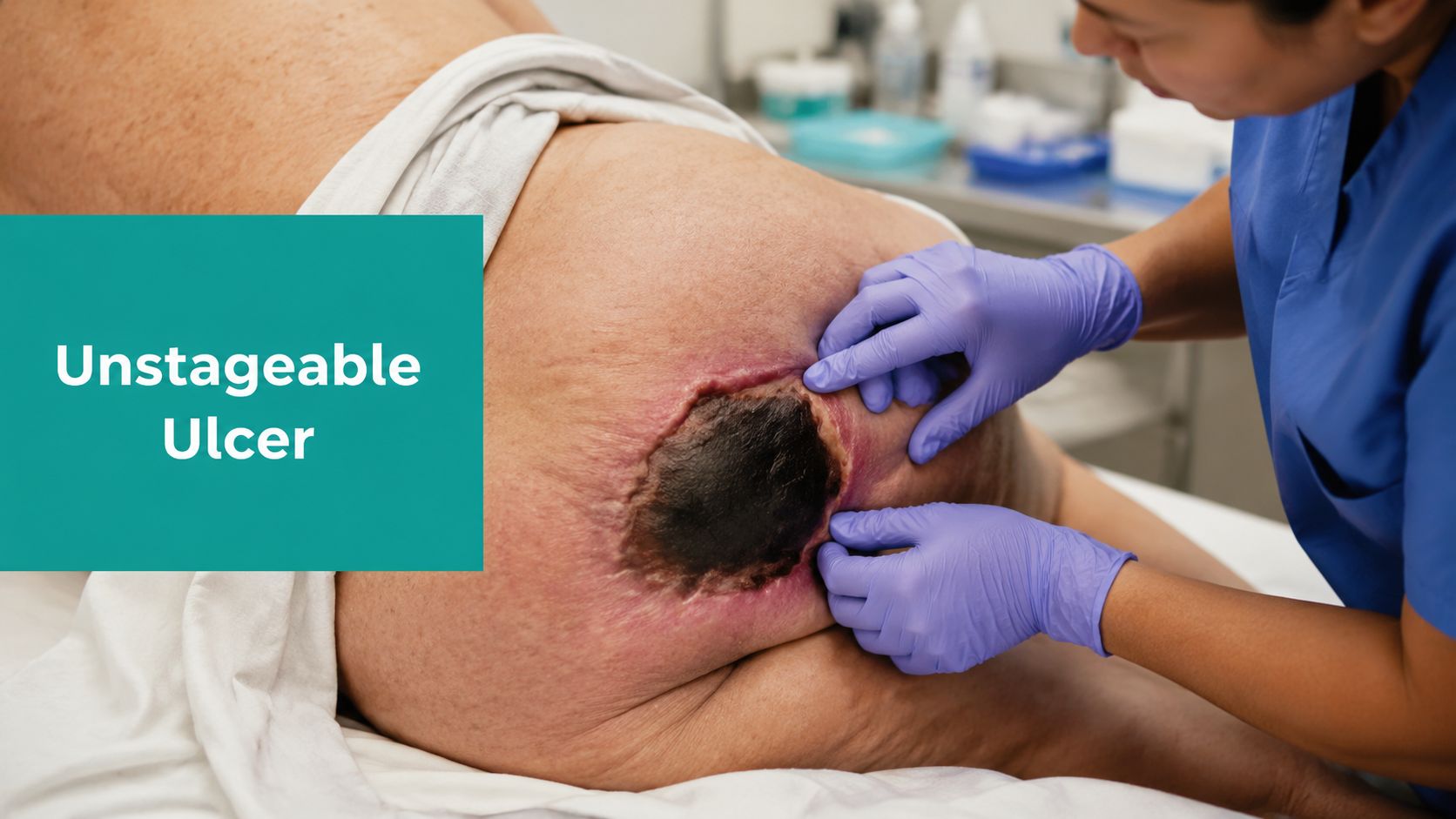
You get called for a “sacral wound,” and the chart already has the damage done. Someone typed “scab.” Someone else copied it forward. By the time the consult hits your list, the bedside problem has already become a coding problem.
What you find is dry, black, leathery tissue over a pressure area. No one can see the base. No one can tell whether this is sitting at subcutaneous tissue or dropping into muscle. If you document it loosely, treatment drifts, coding drifts, and the bill drifts straight into denial territory.
This is the core issue with an unstageable pressure ulcer. It isn't just a hard wound. It's a wound where bedside assessment, debridement decisions, ICD-10-CM staging, CPT selection, POA status, and survey exposure are all tied together. Miss one piece and the whole chain breaks.
That Black Eschar Is a Liability Not a Scab
A new nurse sees a round patch of black tissue over the sacrum and calls it a scab because that's what it looks like from the door. At the bedside, that kind of shortcut is expensive. Black, adherent eschar over a pressure point is not casual skin crust. It may be the only thing hiding the actual depth of a severe pressure injury.
The clinical risk is obvious. You can't assess the base, can't define the true tissue loss, and can't build a real treatment plan off a guess. The administrative risk shows up a few days later when the documentation says one thing, the debridement note says another, and billing has to decide whether this was selective debridement or surgical debridement. That's where bad wording turns into bad claims.
According to Accora's review of unstageable pressure ulcer identification and treatment, hospital-acquired pressure injury rates plateaued between 2.6% and 2.9% from 2015 to 2019, acute care prevalence reached 8.97%, and critical care had the highest prevalence at 14.32%. The sacrum and coccyx are common locations, but heel wounds are more likely to be unstageable because of deep eschar formation. The same review notes that without timely debridement, these wounds often progress to more severe injury, and benchmark healing after 6 months drops from 70% for Stage 2 to 50% for Stage 3 and 30% for Stage 4.
The wound doesn't care what the referral says. Chart what you see, not what got copied into the consult order.
At the bedside, start with plain language. Is the tissue dry or boggy? Adherent or lifting? Any odor, drainage, fluctuance, warmth, erythema, pain, crepitus, or periwound maceration? If you're not precise about what's covering the wound bed, everything downstream gets weaker. If you need a quick refresher on how healthy tissue differs from devitalized tissue, this review of granulation tissue color is useful because it sharpens what belongs in the wound-bed description and what does not.
What Unstageable Actually Means
An unstageable pressure ulcer is not a “really bad stage.” It's a visibility problem with major consequences. The wound is full-thickness skin and tissue loss, but the base is hidden by slough or eschar, so you can't assign the true stage yet.

The covered manhole problem
Consider a covered manhole in the street. You know there's a hole under it. You do not know whether it's shallow or deep until the cover comes off. Same wound logic here.
Healogics' explanation of unstageable pressure ulcers puts it plainly: “An unstageable pressure ulcer represents full-thickness skin and tissue loss where the wound base is completely obscured by slough or eschar, preventing any assessment of depth until debridement is performed. Without removal of the obscuring material, wound care teams cannot differentiate between a Stage 3 versus Stage 4 injury.”
That distinction matters because Stage 3 and Stage 4 don't carry the same prognosis, treatment intensity, coding specificity, or debridement implications. If you pretend you know the depth before the bed is visible, you're documenting fiction.
What it is not
This gets mixed up all the time:
- Not a Stage 1: If the bed is obscured by slough or eschar, you're not looking at a superficial pressure area.
- Not a deep tissue pressure injury with intact skin: A DTI is a different presentation. Don't cross-map them.
- Not always “remove all black tissue immediately”: Stable, dry heel eschar is a separate judgment call and needs context.
The clinical documentation guidance on pressure ulcers warns that an unstageable pressure ulcer is strictly a wound where the bed is completely obscured by slough or eschar, and mis-mapping it to a Stage 1 ulcer or using DTI logic is a serious documentation error that can understate severity and create POA uncertainty.
What belongs in your wound description
Before anyone reaches for a blade or an enzyme, the note needs to stand on its own.
- Describe the obscuring material: black eschar, yellow slough, mixed necrotic burden, dry versus moist, adherent versus loose.
- Describe the edges and periwound: rolled edge, maceration, erythema, induration, callus, moisture damage.
- Describe what you cannot assess: depth not visible, deepest tissue layer not visualized, true stage cannot be determined until debridement.
If your team needs a tighter framework for these descriptions, this page on wound bed descriptions is the kind of checklist-style reference that helps keep bedside language consistent.
Debridement Triggers and CPT Code Selection
Once you've confirmed the wound is unstageable, the next job is deciding whether debridement should happen now, later, or not at all. That decision is clinical first. But if your note doesn't line up with the tissue removed, the CPT line won't survive review.
When debridement earns its place
Sometimes the reason is simple. You need the bed exposed so the wound can be staged and managed correctly. Other times the trigger is infection concern, advancing necrosis, foul odor, increased drainage, undermining that can't be assessed, or a wound that isn't moving in the right direction.
The NCBI wound care review notes that 70% of Stage 2 pressure injuries resolve within 6 months, Stage 3 at approximately 50%, and Stage 4 at 30%, and because unstageable ulcers ultimately reveal Stage 3 or Stage 4 pathology, their prognosis tracks with those lower healing rates. The same review highlights warning signs that should push you toward specialist involvement, including increasing wound size, new areas of breakdown, fever, foul odor, or failure to show expected healing within 2–4 weeks of standard care.
That's why “let's just watch it” is often the wrong move when the wound has necrotic burden and the patient is medically able to tolerate debridement. Waiting can preserve ambiguity. Ambiguity kills care plans and claims.
Practical rule: Debridement is not just treatment here. It is also the step that converts a vague wound into a stageable, billable, defensible diagnosis.
When not to force it
There are real trade-offs.
- Stable heel eschar may be left alone if it's dry, adherent, and not showing signs that demand intervention.
- Goals of care matter. In a comfort-focused patient, the best plan may prioritize odor, drainage, and pain control over aggressive tissue removal.
- Setting matters. If the patient needs operative debridement or urgent escalation, don't fake a bedside solution that won't hold up clinically.
A bad debridement decision causes two kinds of trouble. One is patient harm. The other is documentation that says “subcutaneous debridement” when all you really removed was loose surface material.
CPT depends on depth removed, not what you hoped was underneath
This point often causes confusion. CPT for debridement is based on the deepest level of tissue removed, not on the presumed wound stage and not on the diagnosis label from the referral.
If your procedure reaches viable subcutaneous tissue after removing necrotic burden, that's one code family. If you remove tissue down to muscle or fascia, that's another. Bone is another again. Your note has to say what tissue was debrided, how it was done, and what remained after the procedure.
For clinicians who want a clearer feel for exam coding logic more broadly, this piece on deciphering physical examination codes is a useful side read because it reinforces the same principle: the documentation has to support the service level, not the other way around.
CPT Debridement Codes by Depth
| CPT Code | Tissue Depth Removed | Clinical Example |
|---|---|---|
| 11042 | Subcutaneous tissue | Sharp excisional debridement of sacral pressure ulcer with removal of necrotic subcutaneous tissue after eschar is lifted |
| 11043 | Muscle and/or fascia | Debridement of unstageable ulcer where removal extends through necrotic tissue into muscle/fascial layer |
| 11044 | Bone | Debridement of pressure ulcer with necrotic tissue removal extending to bone |
| 11045 | Each additional 20 sq cm, subcutaneous | Add-on when subcutaneous debridement area exceeds base code threshold |
| 11046 | Each additional 20 sq cm, muscle/fascia | Add-on for larger muscle/fascial debridement area |
| 11047 | Each additional 20 sq cm, bone | Add-on for larger bony debridement area |
What gets claims denied
Three common mistakes show up over and over:
- Calling it debridement without depth: “Necrotic tissue removed” is not enough.
- Using the wound's presumed severity instead of tissue removed: Stage 4 suspicion does not automatically support muscle or bone debridement CPT.
- Ignoring surface area and instruments: If you performed sharp excisional debridement, document the method, tissue depth, total area, hemostasis, and tolerance.
For code pairing and cleaner handoff to billing, keep a coding reference close. This resource on ICD-10 and CPT codes is useful when you want the clinical procedure note to line up with the charge before the claim leaves the building.
Post-Debridement Wound Management
The eschar comes off. The bed is visible. Now the wound has a real stage and a real management plan. Some teams, however, lose momentum at this point. They were focused on getting the dead tissue off, but they don't pivot fast enough to treating the wound they uncovered.
Retire the old label
Once debridement exposes the bed and the true stage is visible, the word “unstageable” belongs to the pre-debridement state, not the ongoing plan for that same site. From that point forward, your dressing choice, offloading plan, and follow-up schedule should reflect the newly revealed wound characteristics.
If the bed is granular with moderate exudate, your priorities are different than they are for a deep cavity with slough remnants, tunneling, and heavy drainage. Don't keep writing generic wound care orders when the wound now gives you enough information to be specific.
Dress the wound you have
A practical way to explain it:
- Heavy exudate: alginate or other absorptive dressing strategies make sense when drainage control is the immediate problem.
- Cleaner granular bed: collagen-based support may fit when the goal is to encourage healthy tissue progression.
- Depth, undermining, or tunneling: packing approach and frequency need to match the anatomy, not just the wound label.
- Large Stage 3 or Stage 4 defects: negative pressure wound therapy may become appropriate if the wound characteristics and overall patient plan support it.
If your note says “continue local care,” expect confusion. Local care is not a plan. It's a placeholder.
Reassess the whole wound, not just the center
After debridement, the periwound often tells you what's going wrong. Maceration means you're losing the moisture balance battle. Rolled edges may signal stalled progression. Increased warmth, odor, or sudden pain can suggest infection or deeper involvement.
A good post-debridement assessment includes:
- Exudate type: serous, serosanguineous, purulent, thick, thin, malodorous.
- Wound architecture: undermining, tunneling, exposed structures, cavity depth.
- Periwound condition: blanching, erythema, denudement, callused margin, edema.
The treatment plan also has to include pressure redistribution, turning schedule, heel suspension when relevant, moisture management, and nutrition support. Dressing choice without offloading is just expensive decoration.
Documentation and Coding That Gets You Paid
If the bedside care was right but the note was weak, the payer never sees your good medicine. They see unsupported staging, mismatched procedure depth, vague medical necessity, and POA confusion.
The note has to prove why the wound was unstageable
At minimum, your initial documentation should establish:
- Location: sacrum, coccyx, heel, ischium, trochanter, device-related site.
- Why it was unstageable: bed completely obscured by slough, eschar, or both.
- What you could and could not assess: dimensions if possible, but true depth and stage not determinable before debridement.
- Clinical context: drainage, odor, signs of infection, pain, surrounding tissue changes, offloading failures, immobility risk.
If you leave out the phrase that the bed is obscured, coders are left trying to defend an unstageable diagnosis without the one element that defines it.
CMS wants the code changed after debridement
This rule gets missed more than it should. The CMS ICD-10-CM coding guidance summarized by HIAcode states that if debridement exposes the wound bed and reveals the true stage, the unstageable code must be discarded and replaced solely with the newly revealed stage code for that same site.
That means you don't keep both for the same wound after the stage is known. If your chart still carries the unstageable diagnosis in active form after the debridement revealed Stage 4, you've set up a coding contradiction.
Sample phrases that hold up better
Here's the kind of wording that helps both clinical review and billing review:
Sacral pressure ulcer present with wound base completely obscured by adherent black eschar. True depth and deepest tissue involvement cannot be visualized. Ulcer classified as unstageable pending debridement.
Sharp excisional debridement performed using sterile instrument. Necrotic tissue removed to the level of subcutaneous tissue. Post-debridement wound bed visible and consistent with Stage 3 pressure ulcer. Unstageable designation retired for this site.
Heel ulcer covered by stable, dry, adherent eschar without surrounding erythema or fluctuance. No debridement performed at this encounter due to current wound characteristics and overall treatment goals.
POA and SNF compliance are where weak records get exposed
SNF documentation is especially messy when an unstageable ulcer is found early in the stay but can't be definitively staged until debridement. The discussion of Section M workflow and POA confusion points out a real gap: clinicians often document these wounds as POA in ways that don't line up with how staging is established after debridement, which can lead to denials and prior authorization trouble.
Surveyors are not looking for pretty notes. They're looking for whether the facility met the standard. Under CMS Tag F686 guidance, a pressure ulcer is only considered unavoidable if the facility did all four of the following: fully evaluated clinical condition and risk factors, implemented interventions consistent with recognized standards, monitored impact, and revised interventions as appropriate. Miss one leg of that stool and the ulcer becomes avoidable in the survey narrative.
For teams trying to tighten prior auth workflow around wound care, this guide for prior authorization companies is worth reading because it highlights how incomplete clinical packets stall approval even when the care itself is appropriate.
One more financial pressure point
Under the August 28, 2024 CMS Final Rule discussion of the Hospital Harm measure, the inpatient quality measure now explicitly includes new Stage 2, 3, 4, deep-tissue, and unstageable pressure injuries developed during hospitalization, and failure of the metric in 2025 carries a one-fourth reduction in the hospital's annual Medicare Payment Update. That's not abstract quality language. That's revenue.
Putting It All Together
An unstageable pressure ulcer starts as an obscured wound and quickly becomes a test of whether your team can think clinically and document like grownups. The black eschar or thick slough is not just a bedside finding. It blocks staging, complicates treatment decisions, and sets up coding errors if the chart gets sloppy.
The sequence matters. Identify the wound correctly. Describe why the base cannot be assessed. Decide whether debridement is appropriate for that patient in that setting. Document the tissue removed. Then stop using the unstageable label for that site once the true stage is visible.
The bigger point most teams miss
This isn't only about healing trajectory. It's also about acuity and risk. The long-term outcomes review in Wounds reports that the 6-month mortality rate for nursing home residents with pressure ulcers reaches 77.3%. In SNF practice, that means an unstageable ulcer is often a marker of serious systemic decline, not just a chronic skin problem.
That's why soft documentation is dangerous. If your note treats the wound like a routine dressing issue, you understate the patient's condition, weaken medical necessity, and make it harder to justify the resources the patient may need.
What works and what doesn't
What works:
- Specific wound-bed language
- Clear debridement depth
- Accurate stage conversion after debridement
- Periwound and exudate detail
- Risk-factor documentation tied to the care plan
What doesn't:
- “Scab”
- “Continue wound care”
- Keeping unstageable and Stage 4 active for the same site
- Guessing POA without a defensible admission assessment
- Procedure notes that never state what tissue was removed
If you want fewer denials, fewer coder queries, and fewer ugly chart audits, start at the bedside. The claim gets paid or denied based on what the wound note proves.
EkagraHealth AI helps wound care teams turn bedside assessment into clean documentation and cleaner claims. It drafts SOAP notes during the visit, maps CPT and ICD-10-CM codes, supports wound image analysis, and keeps prior auth and billing workflow from bogging down your day. If your practice is tired of fixing documentation after the fact, take a look at EkagraHealth AI.
