
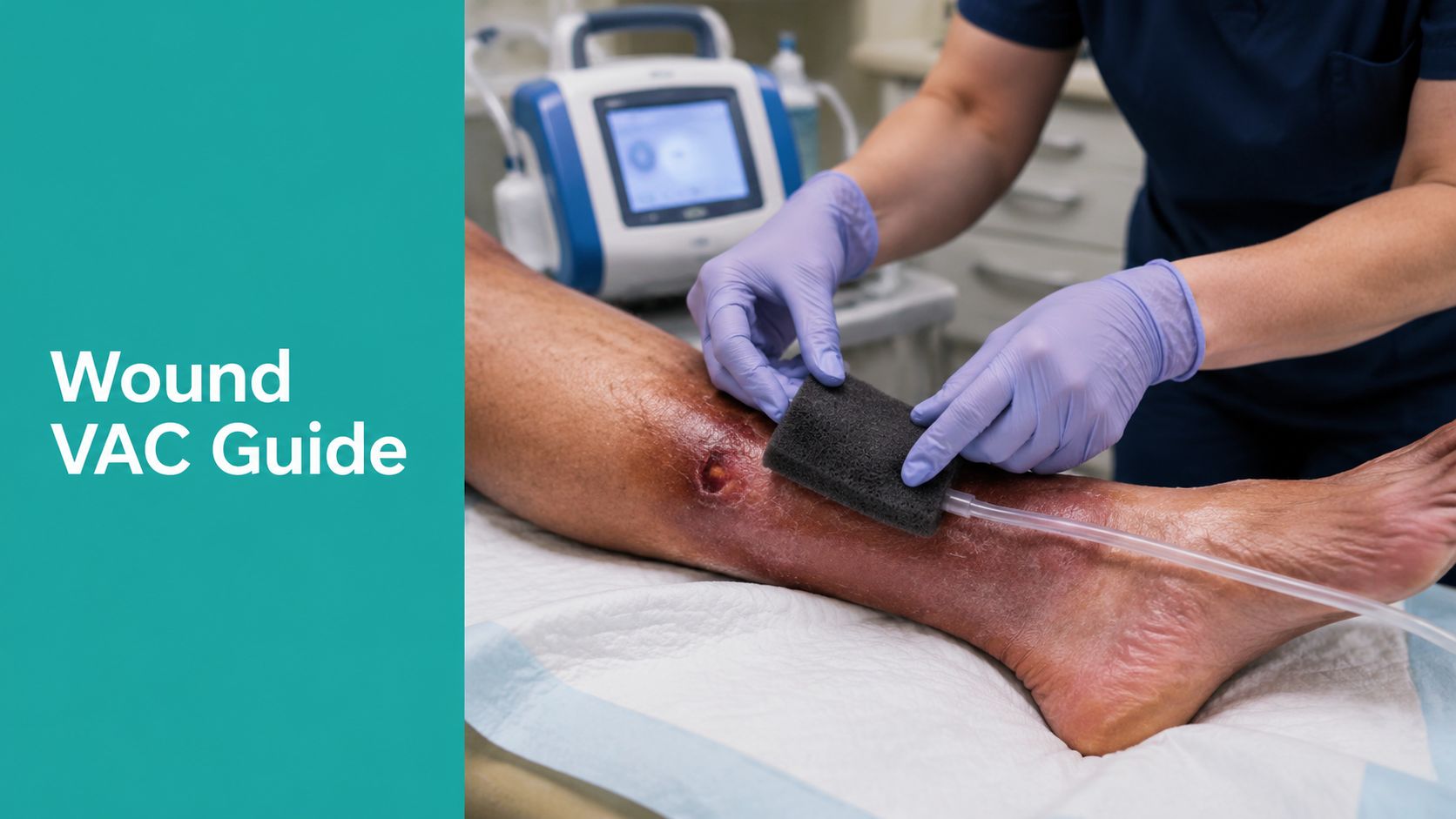
You debrided the wound, got a clean seal, watched the foam collapse exactly the way it should, and the patient finally has a therapy plan that makes sense. Then the claim comes back denied because the note reads like you applied a dressing instead of performing negative pressure wound therapy.
That happens more than it should. Wound vac placement is one of those procedures where the clinical work and the billing work are tightly linked. If your assessment is thin, your seal is sloppy, or your note leaves out the why behind the therapy, you can end up with a clinically successful visit that turns into a financial write-off.
Residents usually learn the mechanics first. That's fine. But in practice, surveyors, coders, and payers care about the mechanics too. They want to see that the wound was appropriate for NPWT, that the application was technically sound, and that your documentation supports the code set you chose. If any one of those pieces is weak, the whole encounter gets shaky.
Indications and Pre-Placement Assessment
The wrong time to decide whether NPWT is appropriate is after the kit is open. Start at the wound bed.

Know your go signals
NPWT earns its keep in wounds that need help managing exudate, maintaining a controlled environment, and building granulation. NPWT has transformed wound care, with data showing it reduces the need for major plastic surgical procedures by up to 50% in cases of large cavity wounds and exudative injuries (clinical NPWT outcome summary). That's why it's become standard in many stalled diabetic ulcers, dehisced surgical wounds, and other hard-to-close defects.
Before placement, I want four things clearly documented:
- Wound type and context: Wagner grade, post-op dehiscence, traumatic wound, pressure injury, venous ulcer, graft site.
- Exudate pattern: low, moderate, high, serous, serosanguinous, thick drainage, or foul output if infection is part of the differential.
- Wound bed quality: granulation, slough burden, exposed structures, undermining, tunneling, and whether debridement was just performed.
- Periwound condition: maceration, fragility, edema, denudement, adhesive intolerance.
If your wound descriptions are vague, your medical necessity will be vague too. Tighten that part of your note. A structured approach to wound bed descriptions usually fixes half the downstream coding problems.
Know your hard stops
Some contraindications are not gray areas. If there's malignancy in the wound, untreated osteomyelitis, or a non-enteric and unexplored fistula, stop and reassess the whole plan. NPWT is not your workaround for poor wound selection.
Then there are yellow flags. Anticoagulated patients, friable periwound skin, painful ischemic wounds, or wounds near vulnerable structures may still be candidates, but your margin for error is small. In those cases, document the risk, the rationale, and the safeguards you used.
Practical rule: If the chart doesn't explain why this wound needs suction instead of a conventional dressing, expect trouble later.
Build medical necessity before the first piece of foam
A short pre-placement note should answer three things:
- Why this wound needs NPWT now
- Why simpler dressings aren't enough
- What you expect NPWT to accomplish, such as exudate control, granulation support, or temporary management of a complex cavity
That's not billing fluff. It's the clinical logic behind the encounter. When that logic is missing, payers often treat the service like a dressing change with a machine attached.
The Core Wound Vac Placement Technique
Most failed placements don't fail because the wound was impossible. They fail because someone rushed the seal.

Prep the edges like they matter
They do. If the periwound skin is moist, fragile, or already macerated, your drape won't hold. Clean and dry the area well. Use skin protectant on vulnerable edges before the drape goes down.
The drape must extend at least 5 cm beyond the wound margin onto intact periwound skin, and failing to use skin protectant on fragile edges leads to seal breakdown in 40% of cases within 24 hours (NPWT technical application data). That's not a minor issue. A broken seal means interrupted therapy, patient frustration, and a note that may not support what you billed.
Size the filler correctly
The foam or gauze has to fit the wound cavity without overpacking. Overpacking increases pressure in the wound bed and compromises perfusion. Underfilling leaves dead space where exudate pools instead of moving through the dressing.
A few habits separate a clean placement from a bad one:
- Cut away from the wound: Never trim foam directly over the wound bed. Loose particles don't belong in tissue.
- Match the wound contours: Fill the cavity completely, but don't stuff it tight.
- Respect the depth: Deep wounds need thoughtful layering, not force.
A foam piece that “almost fits” usually becomes the foam piece that leaks, bridges badly, or traumatizes the bed on the next change.
Get the drape and port right
Many first-time applications fail at this stage. A 2.5 cm circular hole should be cut in the drape for the pad interface, not a slit and not an oversized opening (technical seal requirements for NPWT). Too small and the interface won't seat. Too large and the seal weakens.
Use a deliberate pinch-pull-cut motion so the opening stays round and controlled. Then apply the pad flat over the hole. No lift. No tension at one edge.
When you start therapy, the dressing should visibly collapse. It should wrinkle. It should look like the system has engaged the wound bed. If you hear a hiss, you have a leak. That kind of air leak accounts for roughly 30% of NPWT interruptions in outpatient settings in the same technical data above.
Pressure and dwell time aren't optional details
For most acute and chronic wounds, the standard setting is 125 mmHg of continuous negative pressure. Lower settings are used in specific circumstances, including 75 mmHg for skin grafts and 50 mmHg for chronic non-healing venous ulcers as reflected in the verified application standards. Dressings are usually left in place for 48 to 72 hours.
Those details belong in the note. They aren't trivia. If your documentation skips the pressure setting, type of filler, or dressing interval, you've left out the technical proof that the therapy was delivered as ordered.
Dressing Selection for Complex Wounds
Simple crater wounds are easy. The hard cases are the ones with tunnels, bridges, undermining, exposed structures, and anatomy that doesn't forgive shortcuts.
Tunnels and bridges
The most common dangerous mistake in complex architecture is pushing foam into a blind space because it seems faster. It isn't. Inserting foam into blind, unexplored tunnels can lead to abscess formation, and approximately 25% of NPWT failures in mobile wound practices are attributed to inadequate tunnel filling or bridge management (complex wound bridge and tunnel management data).
For tunnels deeper than 2 cm, use a slit or bridge technique. The point is to let negative pressure reach the space without obstructing drainage or burying material where you can't safely account for it later.
What works:
- Bridge when access is awkward: A separate bridge segment can move the suction interface away from pressure-prone or anatomically difficult spots.
- Fill with intention: The tunnel needs contact, not force.
- Document the architecture: Depth, direction, and how you addressed it should all be in the procedure note.
What doesn't work:
- Stuffing foam into an unexplored tract
- Ignoring undermining because the surface opening looks small
- Cutting filler over the wound bed and dropping fragments into tissue
Sensitive beds and exposed structures
Not every wound tolerates the same contact layer. Denser, less adherent filler may be the better choice when the wound bed is sensitive or when tunnels need more controlled placement. The broader point is simple: filler choice should match tissue tolerance and wound geometry, not habit.
If there's exposed tendon, hardware, or a vulnerable structure, don't treat the wound like a generic diabetic ulcer. Protect what needs protection. Keep direct suction from creating trauma. Document exactly what was exposed and how you isolated it.
For teams trying to standardize these choices, a practical review of wound healing dressings helps connect filler selection to wound behavior rather than brand preference.
If you can't explain why you chose that dressing material for that wound shape, you probably chose it out of convenience.
Fistulas need discipline
A fistula changes the entire conversation. If it's unexplored or non-enteric, NPWT may be the wrong move. Don't improvise around that. Surveyors and auditors both notice when the note glosses over anatomy that should have changed the treatment plan.
Troubleshooting Alarms and Common Pitfalls
When the device alarms, don't start by blaming the machine. Start at the dressing, then the tubing, then the canister, then the settings.
Common Wound Vac Alarm Troubleshooting
| Alarm | Likely Cause | First Action |
|---|---|---|
| Air leak | Drape edge lift, poor pad seal, gap near uneven periwound skin | Check the seal edge by edge, listen for hissing, patch or reapply the weak point |
| Canister full | High exudate output or delayed canister change | Replace the canister and reassess whether the wound output is exceeding the current setup |
| Therapy paused or occlusion | Kinked tubing, clogged tubing, collapsed tubing path, device paused too long | Trace the tubing from dressing to canister, straighten or clear the line, restart promptly |
The two problems that matter most
First, know your pressure target. The standard therapeutic pressure is 125 mmHg continuous for most wounds, but drops to 75 mmHg for skin grafts. Dressings are typically changed every 48 to 72 hours. If therapy is paused for more than 2 hours, the risk of infection increases, and treatment efficacy is compromised, which can also complicate support for codes such as 97605 (NPWT pressure and change interval standards).
Second, a pause in therapy isn't just a device issue. It's a care issue. If the patient sat disconnected too long, or the dressing was leaking for hours before anyone addressed it, that interruption belongs in the chart along with the corrective action.
A practical sequence that saves time
Use the same sequence every time:
- Look at the dressing first: Is it collapsed or ballooned?
- Listen next: A hiss usually beats a visual clue.
- Follow the tubing: Kinks and dependent loops are common.
- Check output: Thick drainage can slow movement and trigger trouble.
- Confirm settings: Wrong pressure means the rest of the troubleshooting may be wasted.
A dressing that never fully collapsed at initiation was never really working. Charting “NPWT in place” doesn't fix that.
Documentation and Coding for Reimbursement
The vac can be placed perfectly and still turn into a write-off by the time the claim hits the payer. That usually happens after a same-day debridement, when the note reads like routine dressing care instead of a separate negative pressure wound therapy service.
Same-day debridement is where denials start
If debridement and NPWT happen in the same encounter, document them like two distinct procedures with two distinct purposes. Payers bundle vague notes without hesitation. A line such as "wound dressed with vac" hands them the argument.
The chart has to show what changed after debridement and why NPWT was medically necessary at that point. I tell residents to write the debridement note first, then pause and document the vac as its own therapeutic work. If you cannot explain why moisture control, cavity management, bolstering granulation, or management of a complex open defect required negative pressure after debridement, the claim is exposed.
Document these points clearly:
- Debridement details: wound location, tissue removed, depth, measurements, instrument used, bleeding and hemostasis
- Medical necessity for NPWT after debridement: ongoing exudate, dead space, undermining, graft or flap support, difficulty maintaining a standard dressing
- Technical work performed for NPWT: filler type, number of pieces when relevant, drape placement, track pad or interface location, pressure setting, mode, and confirmation of seal
Shortcuts cause trouble. "Vac applied" is a shortcut. "Black foam placed into 4 cm x 3 cm x 2 cm sacral wound with 1.5 cm undermining from 9 to 12 o'clock, occlusive drape secured, therapy initiated at prescribed pressure with seal confirmed and no leak alarm" gives a reviewer something to defend.
Placement versus ongoing management
A second claim problem shows up later. The wound improves, the care becomes more routine, but the documentation keeps sounding like day-one placement.
That is a coding error first and a workflow error second.
Your follow-up notes need to mark the transition from initial placement work to ongoing NPWT management. Do not rely on habit language copied forward from the first encounter. Document what is different now: wound bed cleaner, exudate reduced, granulation increased, cavity smaller, periwound skin tolerating therapy, fewer seal problems, less technical work to maintain therapy. If the wound has moved into maintenance, the note should say that in plain language and support the code choice.
What the note must prove
A defensible NPWT note proves three separate things.
| Note element | Why it matters | Common failure |
|---|---|---|
| Medical necessity | Explains why NPWT was used instead of standard dressing care | Wound described in generic terms with no reason standard care was inadequate |
| Technical performance | Shows the service was performed and delivered | Missing pressure, filler material, wound dimensions, seal confirmation, or therapy start |
| Coding distinction | Separates debridement, NPWT placement, and later maintenance work | Documentation blends everything into one dressing change narrative |
Surveyors and auditors look for internal consistency. If the wound is described as superficial and dry, but the claim supports advanced negative pressure therapy, expect questions. If measurements are missing, the payer may decide the service was not described well enough to support the code. If debridement is billed and the NPWT note never explains separate therapeutic intent, bundling is the predictable outcome.
Use diagnosis coding with the same level of precision. Etiology, laterality, depth, complication status, and any relevant surgical context all need to line up with the procedure note. This guide on wound vac ICD-10 coding is a useful reference when your team is trying to match the wound story to the claim.
Groups that want fewer denials usually need tighter intake and note extraction, not just better coder cleanup at the end of the week. The same logic behind IDP for efficient data extraction applies here. Capture the wound facts once, capture them accurately, and carry them through the claim without dropping the details that justify payment.
The payer never sees the wound. The payer sees your note.
The Clinician's Final Checklist
Before you start, run a quick mental timeout.
Bedside check before placement
- Confirm the wound is appropriate: no hidden contraindication, no anatomy you're glossing over, no untreated issue that makes NPWT a bad choice.
- Assess the bed and edges: exudate, tissue quality, periwound fragility, tunnels, undermining, exposed structures.
- Prep the skin well: dry field, protected edges, enough intact skin to hold a seal.
- Size the filler carefully: fill the cavity without overpacking and never cut directly over the wound.
- Create a true seal: round drape opening, flat interface, visible collapse when therapy starts.
- Set and chart the therapy correctly: pressure, mode, dressing material, wound measurements, and dressing plan.
- Document the billing logic: if debridement happened, explain why NPWT is separate therapeutic work. If this is follow-up care, make sure you're not still charting it like day one.
Good wound vac placement is technical, but expert practice is broader than that. The clinicians who get consistent outcomes and cleaner claims are usually the same people. They're careful before they start, precise while they apply, and disciplined when they document.
EkagraHealth AI helps wound care teams capture the details that usually get missed at the point of care, from wound measurements and SOAP note drafting to CPT and ICD-10 support for cleaner claims. If your practice is tired of losing revenue on technically solid work, EkagraHealth AI is built for that exact problem.
