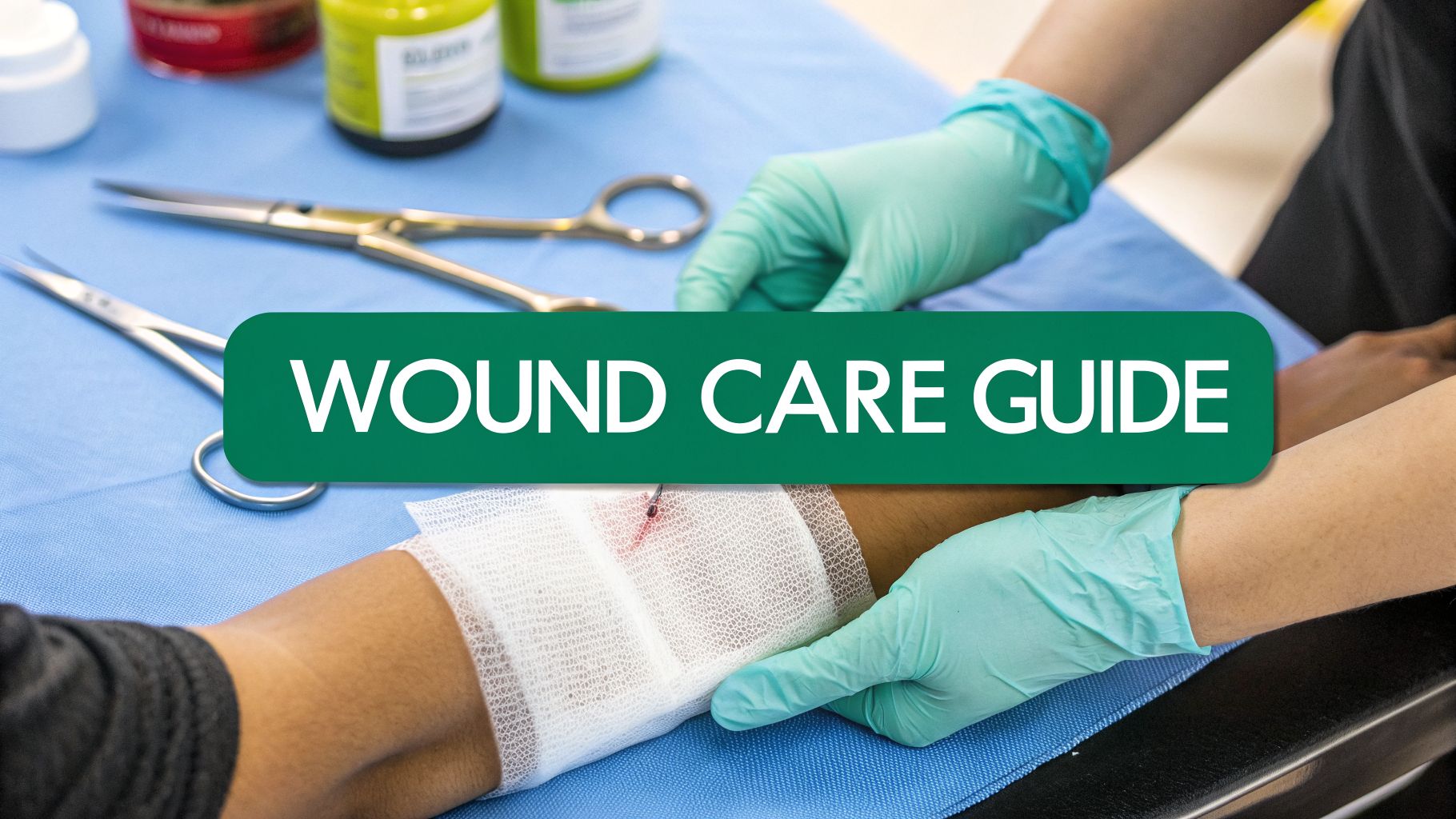
True wound care education for patients isn't about just giving instructions; it’s about building a partnership. It's how we move patients from being passive recipients of care to active participants in their own healing. When done right, we provide clear, personalized guidance that empowers them to manage their wound, spot trouble early, and feel confident in their role. This is what truly improves outcomes and prevents the dreaded cycle of non-compliance.
Moving Beyond the Standard Handout
For years, the standard approach to patient education has been transactional. We diagnose a wound, hand over a generic brochure on the way out the door, and check a box. But we have to ask ourselves: does the patient actually understand? From my experience, the answer is often a resounding no.
Those standard handouts, dense with medical jargon, frequently lead to confusion, frustration, and ultimately, poor healing. We forget that patients aren't just managing a wound. They're trying to absorb a flood of clinical information while grappling with pain, anxiety, and the stress of a new, complicated routine. This disconnect between information provided and information understood is a critical failure point in modern healthcare.
The Real Challenges Patients Face
The problem is much deeper than a badly designed brochure. Once patients get home, they run into very real, practical obstacles.
- Information Overload: A multi-page document is just intimidating. Key details, like the subtle signs of an infection or the correct way to apply a dressing, get lost in a wall of text. The sheer volume of information can be paralyzing, causing patients to miss or ignore crucial instructions.
- Health Literacy Gaps: We can't assume every patient understands medical terminology. What seems simple to us—terms like "exudate" or "debridement"—can be completely mystifying to someone without a clinical background. This gap can lead to dangerous misinterpretations of care instructions.
- Lack of Personalization: A one-size-fits-all handout for a diabetic foot ulcer doesn't consider the patient's actual life—their home environment, their job, or whether they have anyone to help them. This approach simply doesn't work. True education must adapt to the individual's social context, physical abilities, and personal support system.
When education fails, the patient isn't the only one who suffers. It puts a significant strain on the entire system, leading to more clinic appointments, ER visits, and costly hospital readmissions.
To truly make a difference, we need to shift our mindset. The table below illustrates the stark contrast between the old way of doing things and a modern, more effective approach.
Traditional vs Modern Patient Education Approaches
| Characteristic | Traditional Approach (Less Effective) | Modern Approach (More Effective) |
|---|---|---|
| Delivery Method | Passive (handouts, brochures) | Active & Interactive (teach-back, demos) |
| Content | Generic, one-size-fits-all | Personalized to patient's life & wound |
| Communication | One-way (clinician to patient) | Two-way dialogue, ongoing conversation |
| Goal | Information transfer | Confirmed comprehension & confidence |
| Tools | Primarily print materials | Multimedia (videos, apps), hands-on practice |
| Follow-up | Assumed; often non-existent | Structured, planned check-ins |
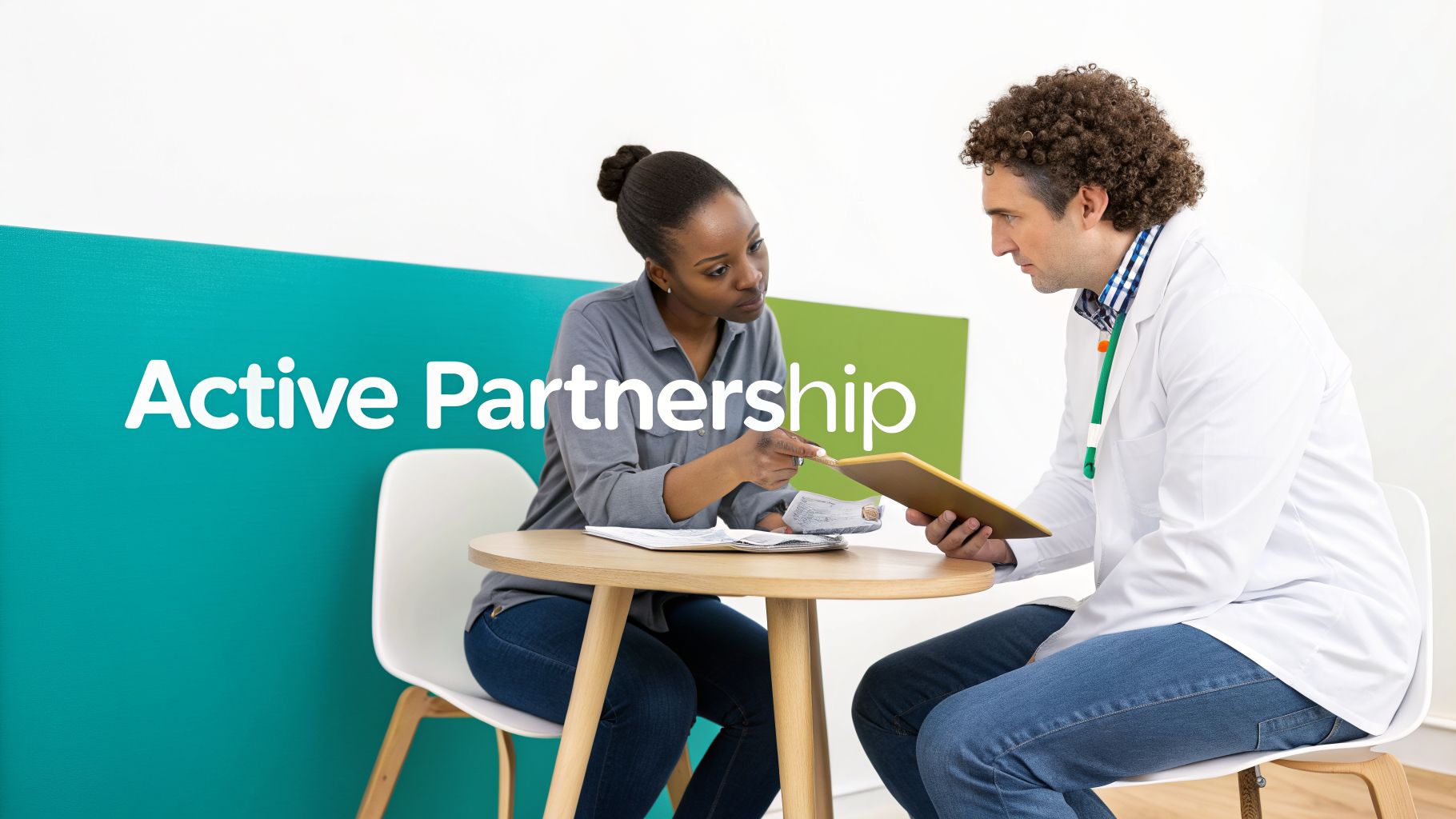
This shift from a passive handout to an active partnership is what builds real patient confidence and ensures they can actually follow the plan at home.
Effective wound care education is an active partnership, not a one-time transaction. It requires a shift from passively giving information to actively ensuring comprehension and building patient confidence.
A Clinical and Economic Priority
Improving wound care education isn't just a "nice-to-have"—it's a clinical and economic must. The financial weight of chronic wounds is staggering. In fact, the global wound care market was valued at USD 25.6 billion in 2024 and is projected to hit USD 42.53 billion by 2033. You can explore the full wound care market analysis to see just how fast this is growing.
This trend underscores an urgent need for smarter management strategies, and patient education is at the very top of that list. Studies consistently show that well-educated patients experience fewer complications, leading to a significant reduction in overall healthcare costs. The investment in robust educational programs pays for itself through decreased rates of infection, amputation, and hospitalization.
By investing in structured, personalized education, we can start to turn this tide. When patients genuinely understand their care plan, they become our best allies in their healing. This leads to better adherence, fewer complications, and measurably improved outcomes. Platforms that build teaching directly into the clinical workflow are now making this possible. By exploring modern patient engagement strategies in healthcare, we can transform education from an afterthought into one of the most powerful tools in our clinical arsenal.
Building Your Foundational Education Framework

Great wound care education for patients isn't something that just happens. It’s built on a deliberate, consistent framework that guarantees every patient gets the same essential information, no matter which clinician they see. This is your first and most critical step in creating a program that actually improves outcomes and can scale across your entire organization.
Think of this framework as your practice's playbook. It lays out the non-negotiable information your team delivers, creating one clear, unified voice. By standardizing the "what," you give your team the freedom to get creative with the "how." This structured approach is essential for any high-performing clinical practice aiming for excellence in patient care and outcomes.
Establish Your Core Curriculum
So, where do you begin? Start by outlining the core topics every single patient with a wound absolutely must understand. These modules become the very backbone of your education plan. Keep them focused and zero in on what’s most vital for at-home care.
At a minimum, your foundational topics should cover:
- Understanding the Wound: Explain what kind of wound they have (e.g., venous ulcer, pressure injury, surgical incision) in plain language, avoiding clinical jargon. Use analogies they can relate to. For example, explain a pressure injury as a "bruise that broke the skin because the tissue underneath didn't get enough blood."
- Spotting Trouble: Give them a clear, unmistakable list of warning signs for infection or other complications. Think increased redness, new warmth, a foul odor, or changes in drainage. Provide visual aids, like photos of what "normal" redness looks like versus "concerning" redness.
- Dressing Change Protocol: Walk them through the exact steps for their specific dressing change, from hand washing before they start to how to dispose of the old dressing. This should be a hands-on demonstration, not just a verbal explanation.
- Fueling the Heal: Briefly explain why protein, vitamins, and staying hydrated are so important for healing, and offer a few simple food suggestions. Connect it directly to their wound: "Your body is building new skin, and protein is the building block it needs."
This structure is your safety net. It ensures that critical information is never missed and empowers everyone—from physicians to MAs—to reinforce the same life-saving messages. That kind of consistency is what builds a patient's confidence and competence.
Get Everyone on the Same Page
We’ve all seen it happen. The MA tells a patient to clean their wound with soap and water, but a few minutes later, the nurse says to use saline only. The patient is left confused, anxious, and less likely to trust the care plan.
A unified framework stops this from happening. When you have standard educational modules, the person rooming the patient, the nurse changing the dressing, and the provider doing the exam are all singing from the same sheet of music. This interdisciplinary alignment is crucial for building trust and ensuring the patient receives a clear, consistent message at every touchpoint.
Every interaction with a patient is a chance to teach. When the whole team is aligned on the core message, that education becomes incredibly powerful and much more likely to stick.
As you build out your wound care education, make sure you're weaving in patient-centered care principles. This ensures your standardized information is delivered in a way that respects the patient's individual needs, making it feel personal and relevant.
The Elephant in the Room: Provider Gaps
Here's a tough truth: one of the biggest roadblocks to effective patient education is often the knowledge gap among providers themselves. Study after study points to inadequate training as a major hurdle to delivering good wound care. Many of us learned on the job without a formal curriculum, and that inconsistency trickles down directly to the patient.
This is exactly why a foundational framework is so valuable. It’s not just for the patient; it’s an internal training tool that raises the bar for your entire team. It creates a reliable standard that fills in the gaps from varied clinical experience, ensuring every patient gets high-quality, consistent education. Get this foundation right, and you're ready for what comes next.
Mastering the Teach-Back Method
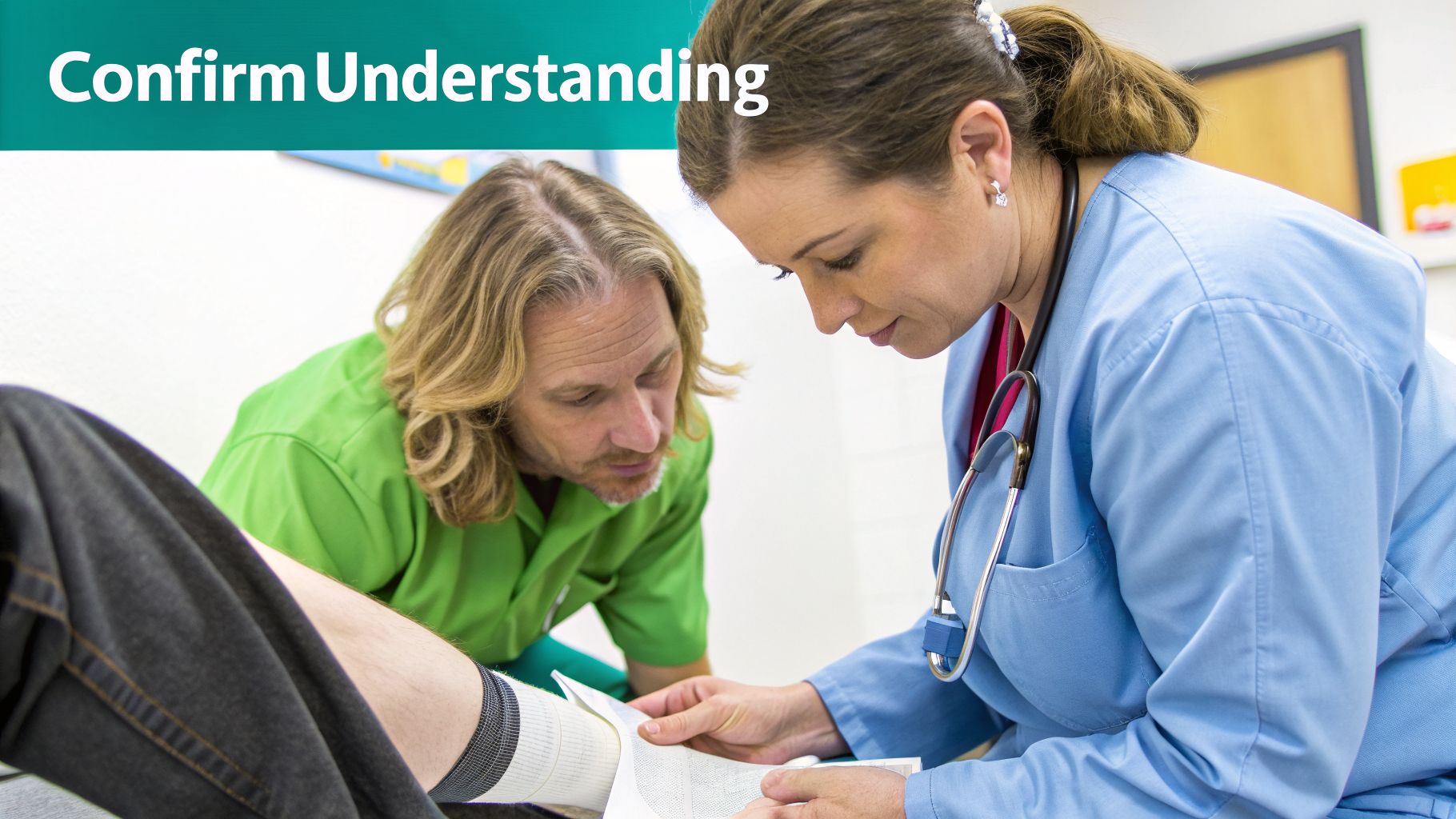
Even the best educational materials fall flat if the delivery is off. We’ve all been there—we finish a detailed explanation and ask, "Any questions?" only to be met with a quick "nope." But that "nope" can hide a world of confusion. Patients might be overwhelmed, feel embarrassed to admit they're lost, or simply not know what they don't know.
That’s why the teach-back method is the gold standard for real-world wound care education for patients. It completely flips the script. Instead of asking if you were understood, you find out what was understood. It's a simple, respectful way to confirm comprehension by asking patients to explain, in their own words, what they need to know and do.
Moving Beyond "Do You Understand?"
The power of teach-back is all in the framing. It's not a quiz for the patient; it’s a report card on how well you explained things. This subtle shift turns a one-sided lecture into a collaborative conversation, making patients feel like partners in their own care.
Think about the difference here.
You could ask, "Do you understand how to change your dressing?" This question invites a simple yes or no.
Or, you could try this: "We've covered a lot just now. To make sure I did a good job explaining everything, could you walk me through how you'll change the dressing once you get home?"
See the difference? The second approach takes the pressure off the patient and places the responsibility squarely on your teaching. It’s your single most effective tool for catching misunderstandings before they walk out the door. It transforms the interaction from a passive reception of information to an active confirmation of learning.
Practical Teach-Back Scripts for Wound Care
Getting comfortable with teach-back is all about having a few go-to phrases in your back pocket. The key is to always sound collaborative, not confrontational.
Here are a few scripts I've found work well in common wound care scenarios:
For Dressing Changes:
- "I want to be sure I was clear. Can you show me with this sample dressing how you’ll put the new one on after cleaning the wound?"
- "There are a few key moments in this process. In your own words, what are the top two things to remember when you take off the old bandage?"
For Identifying Infection:
- "We talked about some red flags. What are three things you’ll look for on the skin around your wound that mean you should call us right away?"
- "Let’s make sure we're on the same page. If you were explaining this to a family member, how would you describe the signs of infection we just went over?"
For Nutrition and Healing:
- "I know we went over some food ideas. What was your main takeaway on what you can add to your meals this week to help your wound heal?"
Open-ended questions like these force the patient to process the information and spit it back out, giving you a perfect window into their understanding.
Teach-back isn’t just about verifying comprehension; it's an active process of co-creating understanding with the patient. It’s where education becomes a two-way street.
Responding to Gaps in Understanding
So, what happens when a patient's teach-back shows they've missed something? This is where the real work begins. The goal is to correct the mistake without making them feel like they failed.
When you spot a gap, try a new approach. Start by saying something like, "That's a great start, but I think I might have made that last part confusing. Let me explain it a different way."
From there, you can:
- Bring in Visuals: If you only used words the first time, grab a diagram, show them a sample product, or pull up a short video on a tablet. For many people, seeing is believing. Visual learning reinforces verbal instruction.
- Simplify and Focus: Break the concept down into smaller, bite-sized pieces. Tackle just the point of confusion before you try to cover everything again. Isolate the single most important step they missed.
- Try the Teach-Back Again: After you've re-explained, circle back. "Okay, let's try that one more time. How are you feeling about that step now?"
This cycle of teaching, checking, and re-teaching is the heart of the method. And don't forget to document your success. A quick note in the chart— "Patient correctly demonstrated dressing change technique via teach-back"—provides a clear record of their competency, which is vital for both compliance and continuity of care.
Using Digital Tools for Continuous Support
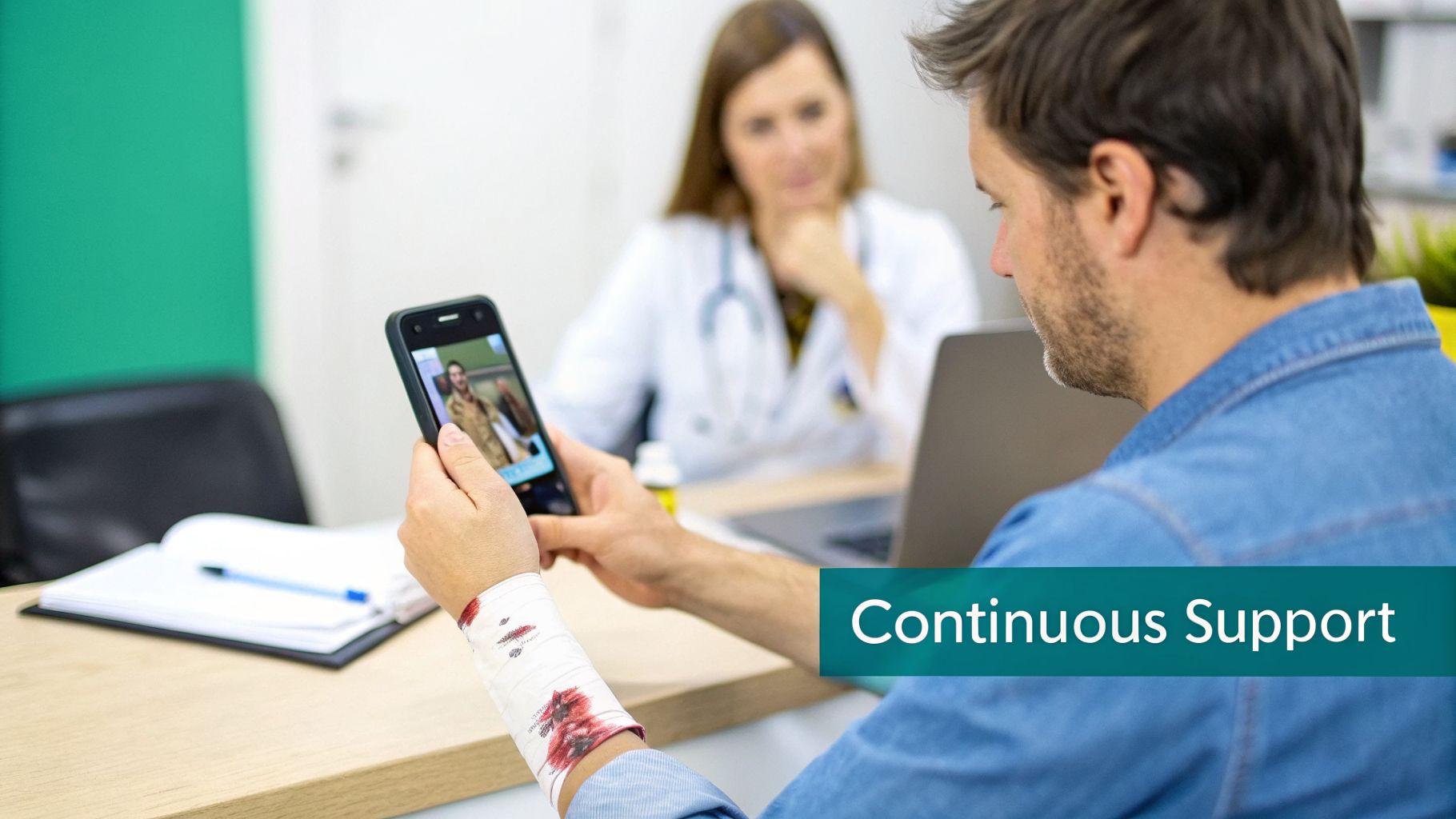
We all know that real healing doesn’t happen in the clinic. It happens at home, in the days and weeks between appointments. That's also when patients often feel most alone with their questions and anxieties. Closing this gap is one of the toughest parts of wound management, but today's digital tools give us a way to stay connected without burning out our teams.
This isn't about replacing the crucial face-to-face time we have with patients. Instead, it’s about using technology to reinforce what we’ve taught and being there for them when they need a quick bit of guidance. The idea is to make your expert advice a steady, accessible presence in their daily life.
Extending Education Beyond the Clinic
Think about the impact of a simple, automated text message sent to a patient at 7 PM: "Just a reminder for your evening dressing change! Don't forget to wash your hands first." That small nudge can be the difference between a patient staying on track and a missed opportunity for healing.
This is where digital tools really shine. They let us turn one-time instructions into an ongoing educational support system that walks with patients through their recovery.
Here are a few ways we’ve seen this work in practice:
- Automated Reminders: Set up texts or app notifications for key care tasks like changing a dressing, taking medication, or performing prescribed exercises. Consistency is key in wound care, and these reminders help build healthy habits.
- Educational "Drips": Send bite-sized content to a patient’s phone every few days. Maybe it’s a 30-second video on spotting signs of infection on Monday, followed by a simple graphic about protein-rich foods on Wednesday. This micro-learning approach prevents information overload.
- Secure Messaging: Give patients a HIPAA-compliant channel to ask quick questions. This keeps them from consulting "Dr. Google" and saves your staff endless games of phone tag over minor issues.
Technology is a tool to extend your clinical reach, not replace your clinical judgment. The real win is using it to boost patient adherence and make your expertise more available between visits.
Empowering Patients with Remote Check-Ins
Remote check-ins are one of the most practical applications of digital care. The COVID-19 pandemic threw this into sharp relief, especially for our patients with chronic wounds. We saw firsthand how visits to wound centers dropped by as much as 40%, which unfortunately led to more severe complications down the road.
Telehealth gives us a vital lifeline to these patients. For example, you can create a simple workflow where an automated message asks a patient to securely upload a photo of their wound each week. This gives you a quick visual update without needing a full-blown appointment. You can track progress, identify potential issues early, and provide reassurance or intervention as needed.
This kind of visual check-in lets you offer timely feedback right from your desk or tablet, strengthening the partnership that is so essential for good wound care outcomes.
Making Digital Engagement Scalable
For any busy practice, the thought of adding more communication can feel overwhelming. The secret to making this manageable is integration. When your patient engagement tools are built right into your EMR or a dedicated wound care platform, the whole process becomes remarkably efficient.
An integrated system lets your team:
- Automate Outreach: You can set up educational sequences that are automatically assigned based on a patient's diagnosis or a specific procedure they've had. This ensures consistency without manual effort.
- Centralize Communication: Every patient message, photo, and video call is logged directly into their chart. No more hunting for information—it’s all in one place, creating a complete longitudinal record.
- Simplify Workflows: A nurse can review a patient's submitted photo and send back a reassuring message in just a couple of minutes, a task that used to involve a chain of phone calls.
This kind of smart integration makes continuous support a practical reality, not just a nice idea. For clinics wanting to dig deeper into this, exploring the benefits of clinical decision support systems shows how technology can help guide better care decisions. By automating the routine tasks and simplifying remote communication, you free up your skilled clinicians to focus on the complex problems that truly need their expertise.
Measuring the Impact of Your Education Program
So, you’ve built a fantastic patient education program. But how do you know if it's actually working?
Too often, wound care education for patients gets treated like a "soft skill"—a nice-to-have, but not a measurable clinical intervention. That’s a mistake. If you aren’t measuring your educational efforts, you can't prove their value, and you certainly can't improve them. It's time to move past anecdotal feedback and start tracking the data that matters.
Key Performance Indicators to Monitor
Choosing the right metrics is everything. You need to focus on key performance indicators (KPIs) that draw a straight line from your teaching to tangible patient outcomes and operational wins. Don't get bogged down tracking fuzzy concepts; focus on the hard data that tells the real story.
From my experience, these are the metrics that truly show the impact of a strong education program:
- Wound Infection Rates: This is your north star. When patients truly understand and follow sterile dressing techniques and hygiene protocols, you'll see a direct drop in infection rates. This is a powerful indicator of educational effectiveness.
- Hospital Readmission Rates: Are patients coming back to the hospital for wound-related complications? Fewer readmissions are a clear sign they’re managing their care effectively at home and know when to seek help before it becomes an emergency.
- Patient Adherence Scores: Digital tools give us an incredible window into this. Track whether patients are actually watching the videos you send, acknowledging dressing change reminders, or logging their daily progress. High engagement correlates with better outcomes.
- Emergency Department Visits: A decline in ED visits for things like a dislodged dressing, uncontrolled pain, or a suspected infection tells you patients are feeling more confident and equipped to handle minor issues themselves.
These aren't just numbers for a spreadsheet. They represent fewer complications, safer patients, and a higher quality of life. This is the evidence you need to justify and grow your program.
Connecting Data to Healing Progress
This is where it gets really powerful. The story your data tells should always connect back to the wound itself. Modern wound care platforms let you overlay your educational metrics with clinical healing data—think wound measurements, tissue type changes, and exudate levels.
Imagine pulling up a patient's chart and seeing that their consistent engagement with educational content directly correlates with a steady decrease in wound size. That's a powerful feedback loop. You can immediately see which resources are driving results and which patients might need a different approach. This data-driven strategy allows for continuous quality improvement.
A six-year quality improvement initiative demonstrated that implementing structured patient education and evidence-based cleansing protocols resulted in a wound infection rate reduction from a baseline of 3% down to 2.3%, a 68.4% improvement. This proves the direct link between comprehensive education and measurable clinical outcomes.
This level of insight is a game-changer. For those who want to dig even deeper, it’s worth decoding analytics for data-driven decisions to better understand patient progress and fine-tune your program.
From Soft Skill to Clear ROI
When you can walk into a meeting and show that your new video series on offloading contributed to a 20% decrease in infection rates for diabetic foot ulcers, you completely change the conversation.
Suddenly, patient education isn't a cost center. It's a strategic asset with a clear return on investment (ROI), one that actively reduces costly complications and boosts your organization's reputation for quality care. The ability to demonstrate quantifiable improvements in patient outcomes and operational efficiency makes a compelling case for continued investment in these programs.
Documenting this success is just as important. Tying your educational activities to specific patient outcomes is vital for everything from compliance to demonstrating value to leadership. For a look at how to structure your notes to support this, these wound documentation examples are a fantastic resource. By measuring what matters, you prove that great patient education is one of the most powerful healing tools you have.
Frequently Asked Questions
Whenever we talk about building a better wound care education program, the same practical questions and potential roadblocks always surface. Getting ahead of these concerns is the key to a smooth rollout, so let's tackle some of the most common questions we hear from clinicians and practice managers on the ground.
How Can Our Busy Clinic Find Time for Comprehensive Patient Education?
This is, without a doubt, the number one question I hear. The answer isn't about finding an extra 15 minutes you don't have. It’s about weaving education into the moments that are already part of the patient visit. It’s about working smarter.
Think about all the small pockets of time in an appointment. While you're prepping the room, grabbing supplies, or applying a fresh dressing—these aren't dead time. They are prime opportunities for a running dialogue.
The only way this works is by building education directly into your existing workflow, not tacking it on at the end.
- Turn 'wait time' into 'teach time'. Use the small gaps in the visit for quick teaching moments. A 30-second explanation while you’re unwrapping a bandage is often more memorable than a rushed 5-minute lecture at the door.
- Let technology do some of the heavy lifting. Not every lesson has to be delivered face-to-face. You can send a quick video link on dressing changes or set up automated text reminders after the visit. This takes a huge load off your in-person time.
- Make it a team sport. Delegate specific roles. A Medical Assistant can cover the basics, like why nutrition is so important for healing. The nurse or provider can then focus on confirming the patient really gets it using the teach-back method.
When education becomes a natural part of every touchpoint, it stops feeling like a separate, time-sucking chore.
Real efficiency isn't about finding more time. It's making every minute you do have count for more. When your education is integrated, you can teach naturally while the system documents in the background, which gets rid of the 'double work' of teaching and then charting.
What Is the Best Way to Handle Patients with Low Health Literacy or Language Barriers?
This is where a one-size-fits-all approach completely falls apart. For these patients, you need a strategy that puts clarity and accessibility above all else.
First, make everything simple. Your patient handouts should be written at a 5th-grade reading level. Use large, clean fonts, and choose simple pictures over walls of text. A good diagram can explain a complex concept far better than a paragraph ever could.
For this group, the teach-back method is absolutely non-negotiable. It’s the only way to know for sure that they've understood, moving beyond a simple nod or an automatic "yes."
Technology can be a game-changer here, too.
- Always use professional interpreters. Please, never rely on family members. They might not know the right medical terms or could accidentally filter critical information. A professional medical interpreter is essential for patient safety.
- Find content in their language. Look for platforms that offer educational materials in multiple languages. A short video demonstrating a dressing change in a patient's native language can break down both literacy and language barriers at once.
When you meet patients where they are, you build the trust needed for them to succeed with their care at home.
How Do We Document Patient Education for Compliance and Billing?
Vague notes are a major liability. Simply writing "patient educated on wound care" is useless for an audit, doesn't help the next clinician, and won't support your billing.
Your documentation has to be specific and show what happened. It needs to paint a clear picture of what you taught and, just as importantly, what the patient proved they understood.
Here’s what good documentation looks like:
Instead of: "Educated on infection signs."
Write: "Patient verbalized 3 signs of infection to monitor (increased redness, foul odor, new warmth) via teach-back. Stated they would call the clinic if any are observed."
Getting this level of detail is critical. AI-powered platforms can make this much easier by capturing the important parts of your conversation and populating the chart for you. A smart system can also connect this activity to the right CPT codes for patient education (like 98960-98962), making sure you’re paid for your time without creating more charting work.
What Kind of ROI Can We Expect from Investing in a Better Education Program?
The return on investment you get from a solid patient education program shows up in both your clinical outcomes and your finances. Clinically, you'll see faster healing, lower infection rates, and fewer hospital readmissions from complications. This doesn't just improve your patients' lives; it builds your practice's reputation for high-quality care.
On the financial side, the returns are just as real and come from a few key areas:
- Lower Costs: Fewer complications means spending less on antibiotics, extra procedures, and expensive hospital stays.
- Better Patient Retention: Patients who feel confident and see good results stick with your practice.
- Accurate Billing: By properly documenting and coding for the time you spend on education, you capture revenue that often gets missed.
- More Efficient Staff: When patients know what to do, they require less hand-holding over time. This frees up your clinical team to focus on more complex cases.
An integrated system makes this financial return much more direct and easy to track. It proves that good education isn't an expense—it's a high-yield investment in better outcomes and a healthier bottom line.
Ready to bring your documentation, billing, and patient education into a single, intelligent workflow? Ekagra Health AI offers an end-to-end wound care platform that can cut documentation time by up to 70%, simplify coding, and empower patients with built-in educational tools. See how our voice-first, AI-powered system can change your practice by visiting Ekagra Health to learn more.
