
You've just finished a dressing change and a debridement on a wound that's been hanging around for weeks. The patient is tired, clinic is running behind, and the EHR is waiting. This is the moment when a lot of good care gets weakened by a bad note.
In wound care, the chart isn't a summary. It's the proof. If your note doesn't show what you saw, why you acted, and why the wound still needs skilled care, the payer has every opening to deny it and the auditor has every reason to question it. That's why wound care documentation for nurses has to function as both a clinical record and a reimbursement defense.
More Than Just a Note It Is a Justification for Care
A vague note usually sounds harmless in the moment. “Wound cleansed. Dressing applied. Tolerated well.” That may be true, but it doesn't justify frequency, product selection, debridement, or continued treatment. It also doesn't help the next clinician understand wound trajectory.
The risk isn't theoretical. In an acute wound care documentation audit, 75% of patients had no recorded documentation of wound margins, and over 50% lacked documentation of wound dimensions, exudate type, or wound bed characteristics according to this acute wound documentation audit. That's not a minor charting gap. It means the record is missing the exact details needed to support ICD coding, dressing choice, and ongoing medical necessity.
I've seen this play out in real clinic flow. The wound looked worse, the exudate had changed, the periwound had become fragile, and everyone in the room knew the patient still needed close follow-up. But the note from the prior visit didn't capture measurements, tissue percentages, or drainage in a way that made deterioration obvious. Once that happens, you're not just treating the wound. You're rebuilding the story.
What the note has to prove
Your note should answer four practical questions:
- What exactly was present at the bedside, in objective language
- Why the treatment was reasonable for that wound on that day
- Whether the wound is improving, stalled, or worsening
- Why continued skilled care is still medically necessary
Practical rule: If another clinician can't visualize the wound from your note, the chart is too thin.
That's why I treat documentation as part of the intervention itself. The dressing supports healing. The note supports the care plan. If you need a stronger framework for building that case, this page on medical necessity documentation is worth reviewing in a wound care context.
What doesn't work
Some chart habits create trouble fast:
- Vague improvement language like “looks better” without measurements or tissue detail
- Generic drainage descriptions like “draining” without type or amount
- Missing wound edge and margin findings when expansion or infection risk is part of the concern
- Procedure notes that skip tissue type and depth, especially after debridement
A wound note should read like a defense file. Clear facts. Direct reasoning. No guessing.
The Bedside Assessment A Systematic Approach
Good notes start before you touch the keyboard. If your bedside assessment is sloppy, the chart will be sloppy. The fastest way to tighten wound care documentation for nurses is to use the same observational sequence every time.
Per compliance expectations, wound measurements must be documented in centimeters as length × width × depth at every visit, with tunneling or undermining location and depth, plus tissue type percentages such as granulation, slough, epithelial, and eschar to support ICD-10-CM coding and show progress, as outlined in this wound care compliance reference.
Start with precise location and wound identity
Document the exact anatomical site. Not “leg wound.” Not “foot ulcer.” Write the location so another clinician can find the wound without hunting for it.
Include the wound type and relevant clinical framing when known. In practice, that may include a pressure injury, diabetic foot ulcer, venous leg ulcer, surgical wound, or traumatic wound. If the wound has a recognized severity framework such as Wagner grading, record that when applicable and make sure the rest of the note matches the severity you're implying.
Read the wound bed, not just the size
Size matters, but wound bed composition tells the story. Record the visible tissue types and estimate percentages. If you write “mixed wound bed,” you haven't said enough. A note that says “60% granulation, 30% slough, 10% eschar” is clinically useful and billing-relevant.
That level of detail matters because debridement, dressing selection, and progress all hinge on what is in the wound.
| Observation | What to Record | Clinical/Billing Implication |
|---|---|---|
| Wound location | Exact anatomical site and laterality | Supports wound identification and ICD-10-CM specificity |
| Dimensions | Length × width × depth in cm | Shows baseline and serial progress |
| Wound bed | Tissue types with percentages | Supports treatment selection and debridement justification |
| Tunneling or undermining | Depth and clock-face location | Strengthens severity description and coding support |
| Exudate | Type and amount | Supports dressing choice and visit frequency |
| Periwound skin | Maceration, erythema, edema, denudement, intactness | Shows risk, response to drainage, and possible complication |
Exudate and periwound findings drive treatment logic
Exudate documentation should be specific enough to justify what you put on the wound. Record type such as serous, sanguineous, serosanguineous, or purulent. Record amount in plain clinical terms such as minimal, moderate, or heavy if that's your facility standard. If there's odor, describe it after cleansing, not before.
Periwound assessment is where many newer nurses under-document. That's a mistake. Periwound maceration can support the need for absorbent coverage. Erythema and warmth can support concern for infection or irritation. Fragile skin changes your dressing plan and your securement choices.
The dressing should make sense after reading the assessment. If it doesn't, the note is incomplete.
Build a repeatable bedside workflow
I teach nurses to follow the same order each time:
- Identify the wound clearly by site, type, and laterality.
- Measure it in centimeters before you start narrating progress.
- Describe the wound bed with tissue percentages.
- Characterize exudate by type and amount.
- Inspect edges and periwound for attachment, maceration, erythema, callus, or breakdown.
- Record pain and tolerance if pain affects care delivery or measurement.
- Tie findings to intervention so the note supports what was done.
That consistency saves time. It also makes it easier to compare visits without guessing. For teams trying to standardize collection at bedside, these wound assessment tools for nurses can help organize the required elements into one repeatable workflow.
Mastering Measurement and Clinical Photography
Measurement errors create noise in the chart. Once your serial measurements look inconsistent, the payer starts to wonder whether the wound changed or the technique changed. That doubt hurts claims.
According to this clock-method wound documentation reference, the patient's head should be oriented to 12:00 and feet to 6:00, with length measured on the 12:00 to 6:00 axis and width measured on the 3:00 to 9:00 axis. That same source notes that inconsistent measurement contributes to up to 30% of coding denials in wound care billing, and missing tunneling or undermining direction and depth can reduce prior authorization success rates by 45%.

Use one method every single visit
The linear clock method is simple, but only if everyone uses it the same way.
- Length: Measure from 12:00 to 6:00 along the longest axis
- Width: Measure from 3:00 to 9:00 at the widest point
- Depth: Insert a cotton-tip applicator into the deepest area and measure against a ruler
- Undermining: Record depth and clock location
- Tunneling: Record depth and clock location
“Some tunneling present” is not defensible documentation. “Tunnel at 4:00 to 2.1 cm” is.
Common measurement mistakes
The biggest problems I see are predictable:
- Changing orientation visit to visit
- Using inches in one setting and centimeters in another
- Estimating depth without measuring
- Documenting undermining without direction
- Comparing photos taken from different angles as if they were equivalent
Consistency is what makes progression believable. Not just to you. To the payer reading the chart months later.
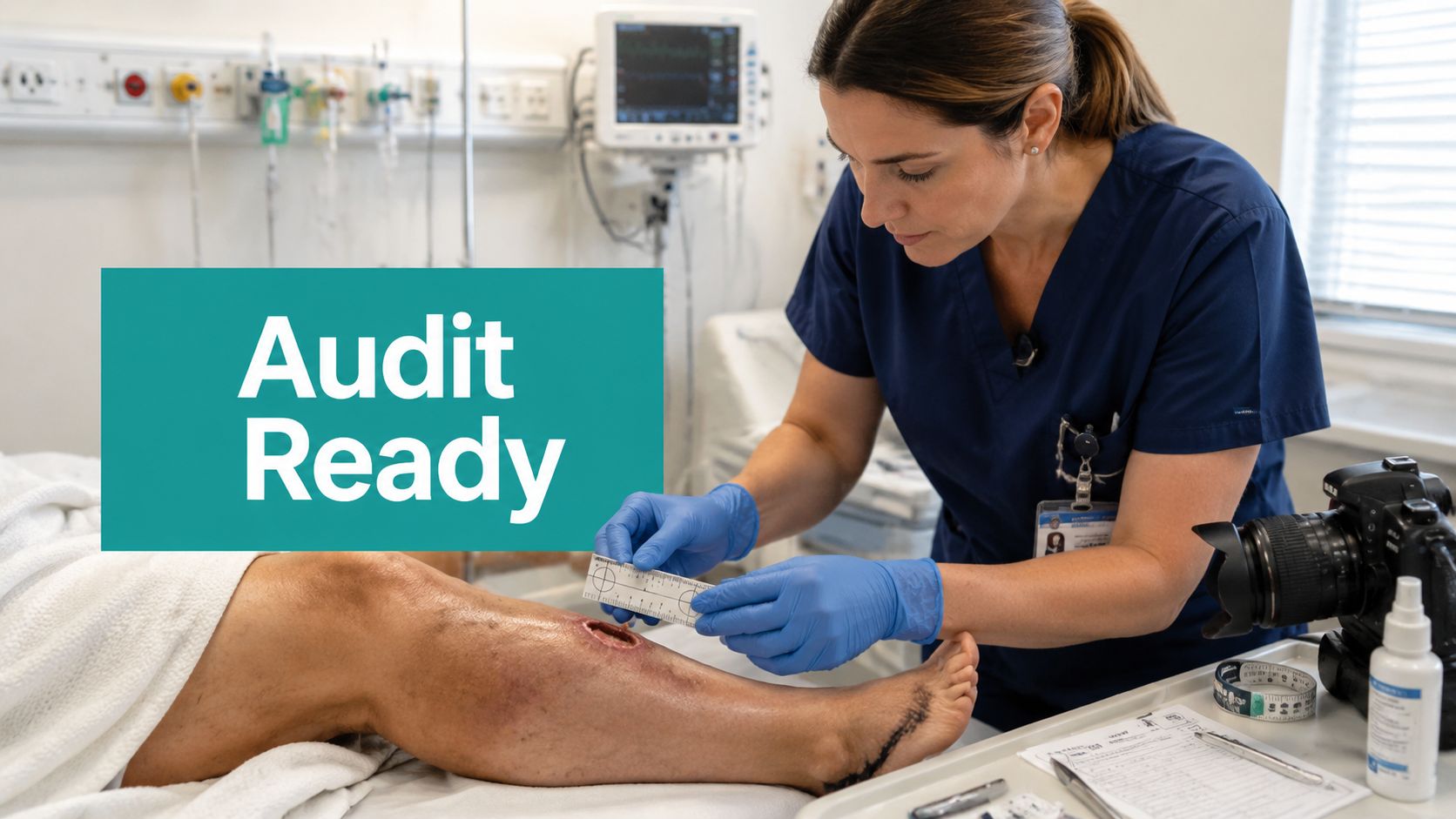
Clinical photos help when they're standardized. Keep lighting consistent. Include a measurement ruler in frame if your policy allows. Use the same distance and angle for serial images. Label and store the files securely because wound photography is still protected health information. If your team shares image files outside the EHR workflow, basic professional file protection practices matter.
For nurses who want examples of how measurements should appear in actual notes, these wound measurement examples are useful as a calibration tool.
Translating Assessment into an Audit-Proof Chart Note
A strong note is structured. Free-text narratives often leave out the one fact that ends up deciding the claim. Standardization helps because it forces you to include what auditors and coders need, not just what feels memorable.
A standardized wound record intervention significantly improved the informativeness and completeness of documentation, and the standardized format required documentation of tissue percentages, drainage volume, and pain intensity, all of which support revenue cycle integrity because debridement claims need clear tissue type, wound depth, and size documentation, according to this standardized wound record study.
SOAP works when the content is specific
You don't need fancy prose. You need a note format that holds up. SOAP is still one of the most practical frameworks for wound care.
Subjective
Patient-reported symptoms belong here. Keep it focused.
Examples:
- Patient reports increased pain during cleansing and weight-bearing.
- Patient states drainage has increased since last dressing change.
- Caregiver reports dressing saturation before scheduled change.
Pain matters here because it affects tolerance, measurement, procedure planning, and sometimes the ability to perform complete care.
Objective
This section carries the weight. It transforms your bedside assessment into defensible evidence.
Include:
- Exact location
- Length × width × depth in cm
- Tunneling or undermining with clock location and depth
- Tissue types with percentages
- Exudate type and amount
- Periwound findings
- Odor after cleansing if present
- Relevant photo capture if your workflow supports it
Example wording:
Right plantar forefoot diabetic ulcer, Wagner grade consistent with full-thickness tissue involvement. Measures 2.4 cm × 1.8 cm × 0.6 cm. Undermining 0.8 cm at 2:00. Wound bed 50% granulation, 40% slough, 10% eschar. Moderate serosanguineous drainage. Periwound mildly macerated at distal margin with surrounding callus. Tender with probing.
That's a note a coder can use. It's also a note another clinician can act on.
Assessment and plan have to match
The assessment should interpret the findings, not just repeat them. If the wound is stalled, say it. If there are local signs concerning for infection, state the concern in clinical language. If the wound improved in one dimension but worsened in drainage or periwound condition, document that mixed trajectory.
Examples:
- Assessment: Chronic diabetic foot ulcer, stalled healing with persistent non-viable tissue and increased drainage.
- Assessment: Pressure injury with improving granulation but ongoing undermining requiring continued skilled management.
Then make the plan logically follow:
- Continue current dressing because exudate remains moderate and periwound requires moisture control
- Change topical approach due to rising slough burden
- Offloading reinforced
- Follow-up interval maintained due to stalled progression
- Debridement performed based on non-viable tissue burden
Language that helps and language that hurts
Use phrases that describe what you observed and why you acted.
Better wording
- “Non-viable slough remains in wound bed, impairing progression and supporting continued sharp debridement.”
- “Moderate serous drainage with periwound maceration supports ongoing absorptive dressing use.”
- “Wound dimensions stable, but tissue quality and drainage pattern indicate no meaningful healing progression.”
Weak wording
- “Looks better”
- “About the same”
- “Dressing changed as ordered”
- “Healing slowly” without objective support
A strong note reads like a chain of reasoning. Findings, interpretation, action.
Documenting Procedures to Justify CPT and ICD-10 Codes
Procedure notes are where a lot of reimbursement gets lost. Nurses and clinicians often document the act of debridement but not the details that support the code. If the note doesn't specify what tissue was removed and how deep the debridement went, the billed CPT code is exposed.
Per this debridement documentation reference, CPT codes 11042–11047 require documentation of the specific tissue type removed, such as slough or eschar, and the depth of debridement, such as skin, subcutaneous tissue, muscle, or bone. For deeper tissue or bone debridement, including a pathology report is strongly encouraged to support depth and avoid payer denials.

What the procedure note must include
A defensible debridement note should capture:
- Procedure type such as sharp excisional debridement
- Anatomical site and wound identity
- Tissue removed such as slough, eschar, fibrinous non-viable tissue
- Depth reached to skin, subcutaneous tissue, muscle, or bone
- Instrument used such as curette, scalpel, or scissors
- Pre- and post-debridement dimensions if your workflow requires both
- Hemostasis and tolerance
- Post-procedure wound bed appearance
- Clinical reason the debridement was necessary
Code support comes from exact words
If you bill in the 11042 to 11047 family, your note has to map directly to that service. “Debrided wound” won't carry it. “Sharp debridement performed with curette, removing non-viable slough and eschar to subcutaneous tissue” is much stronger because it names the tissue and the depth.
Here's the practical point. Billing logic follows clinical detail. If the note supports superficial tissue only, don't expect a deeper debridement code to survive review. If bone is involved, the documentation burden is higher, and pathology support becomes especially valuable.
A payer can't infer depth from your intent. The chart has to say it.
Dressing choice and diagnosis support matter too
The same principle applies to ICD-10-CM diagnosis support and supply justification. If you document heavy exudate, your dressing plan should reflect absorption needs. If the wound has callus, undermining, or diabetic etiology, your diagnosis coding and offloading plan should make clinical sense together.
For teams that need staff education on how code language and note language align, a neutral RiverAxe CPT code counseling resource can be helpful as a training reference.
Common Pitfalls and Advanced Documentation Scenarios
The hardest notes aren't the straightforward healing wounds. The hard ones are the painful wounds you can't fully measure, the device-obscured wounds, and the chronic wounds that aren't responding despite appropriate care. That's where shortcuts turn into audit problems.
One documentation challenge comes up constantly: a wound that isn't improving. Nurses often struggle to phrase “wound is not improving despite standard care” in a way that supports renewed authorization instead of denial. This wound documentation risk article also notes that failing to document the rationale for not changing a failing treatment plan is a top audit risk, and 40% of nurses report inadequate tools as a primary barrier to consistent documentation.
Better ways to chart difficult situations
Don't write “unable to measure” and stop there. Document the barrier and your mitigation.
Examples:
- Pain-limited measurement: Measurement limited by patient-reported pain with probing of wound depth. Visible surface dimensions obtained. Depth reassessment planned after pain control measures.
- Device obstruction: Full wound margin visualization limited by offloading device position. Exposed wound bed assessed and documented. Complete measurement deferred until safe device removal.
- Stalled wound: Wound dimensions unchanged, with persistent slough burden and continued drainage despite current regimen. Continued skilled care required due to lack of meaningful progress and ongoing need for reassessment of local wound management.
What to avoid in non-healing wound notes
These phrases usually hurt more than they help:
- “No change” without interpretation
- “Continue same treatment” without clinical rationale
- “Patient noncompliant” without documenting the specific barrier
- “Wound worsening” without objective findings showing how
If you're keeping the same plan, explain why. If you're changing the plan, connect it to a documented wound feature. That's the difference between charting and defending care.
One practical option for handling these higher-friction scenarios is EkagraHealth AI, which can capture the visit, draft a SOAP note, map CPT and ICD-10 codes, and keep wound images and documentation tied together in the same workflow. Used correctly, that kind of structure helps teams document difficult reasoning more consistently without leaving key support behind.
Good wound care can still get denied if the note doesn't prove medical necessity, procedure detail, and wound trajectory. EkagraHealth AI is built for wound care teams that need tighter SOAP notes, cleaner coding support, connected image documentation, and fewer gaps between bedside care and the claim.
