At its core, a wound assessment tool is any standardized method a nurse uses to objectively measure, document, and track how a wound is healing. These aren't just fancy gadgets; they can be anything from simple sterile rulers and validated scales like the PUSH Tool to sophisticated AI-powered imaging platforms that streamline the entire process.
The fundamental goal is to move away from subjective guesswork and toward consistent, accurate data that drives better clinical decisions and demonstrably improves patient care. Without a common language and objective metrics, care teams risk fragmented communication, delayed interventions, and suboptimal healing outcomes.
Why Standardized Wound Assessment Is Non-Negotiable
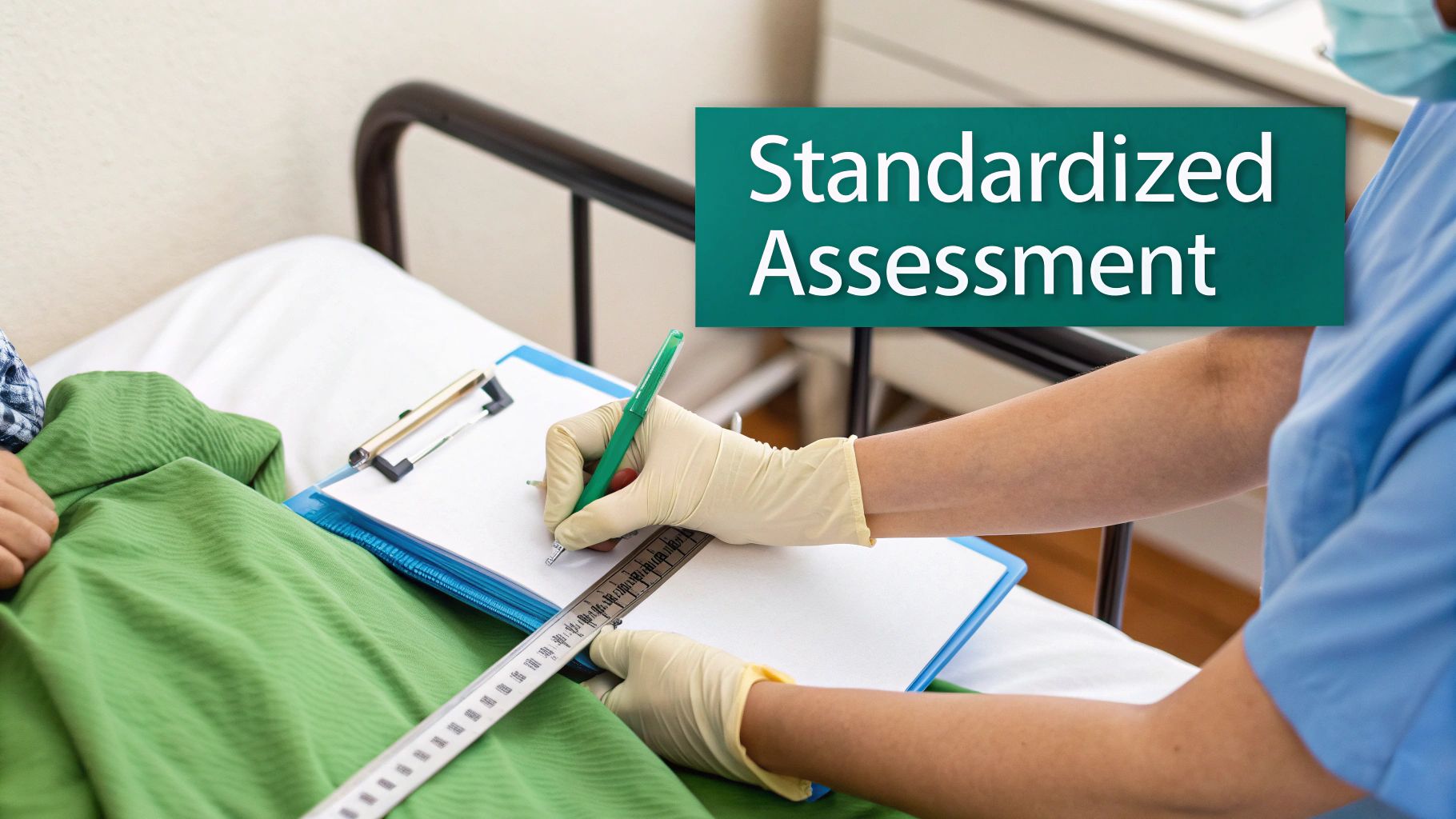
Whether you’re in a bustling hospital ward, a specialized outpatient clinic, or making a home health visit, effective wound management is a constant and critical challenge. For many years, assessment often relied heavily on a nurse's experienced "eyeball test." But let's be honest—what one clinician describes as "moderate drainage," another might chart as "light." This kind of subjectivity and inconsistency is not just a documentation nuisance; it's a significant clinical risk.
Making the switch from subjective, descriptive notes to standardized wound assessment tools for nurses isn't just about creating neater paperwork. It's a fundamental shift required for modern, evidence-based care. These tools provide the entire care team—from nurses and physicians to specialists and therapists—with a common, unambiguous language, ensuring everyone is operating from the same objective playbook. This alignment is crucial for continuity of care, especially during shift changes or patient transfers between different care settings.
The Dangers of Inconsistent Assessments
When we lack a structured, methodical approach to wound assessment, critical details get missed, and the consequences can be severe. Consider a patient whose wound is only tracked with free-text descriptive notes. A subtle 5% increase in size or a minor change in tissue color could easily go unnoticed between shift changes or weekly visits, delaying the crucial intervention needed to halt a developing infection or address stalled healing.
Inconsistent assessments lead directly to a cascade of preventable problems:
- Delayed Healing: Small but significant signs of trouble, like a slight increase in malodor or periwound maceration, are overlooked, preventing timely adjustments to the treatment plan. This can extend healing times, increase patient suffering, and drive up healthcare costs.
- Communication Breakdowns: Vague descriptions like "looks better" or "more drainage" between nurses, doctors, and specialists create confusion and lead to fragmented, uncoordinated care. Without objective data, it's impossible to have a meaningful discussion about treatment efficacy.
- Critical Documentation Gaps: Without solid, quantifiable data, it’s nearly impossible to defend clinical decisions in the event of an adverse outcome or to prove medical necessity for reimbursement from payers like Medicare. Poor documentation can result in denied claims and significant financial losses for healthcare organizations.
This isn't a minor administrative issue. Research indicates that while approximately 3.5 patients per 1,000 individuals have an active wound, nurses often aren't performing the kind of detailed, systematic assessments that are required for optimal care. This gap highlights the real-world struggle of integrating evidence-based tools into the demanding reality of everyday nursing practice. You can discover more about the impact of inconsistent wound documentation in this in-depth report.
To put this into perspective, let's examine the essential data points that a standardized assessment should always capture.
The Core Elements of a Comprehensive Wound Assessment
This table breaks down the fundamental data points every nurse must capture for accurate, reliable, and effective wound documentation. It represents the baseline for consistent, high-quality care and forms the foundation of any robust wound management program.
| Assessment Component | What to Document | Why It Matters for Patient Care |
|---|---|---|
| Location & Anatomy | Precise body location (e.g., left medial malleolus) using correct anatomical terms. | Guides dressing selection, offloading strategies, and helps identify underlying etiologies like pressure or venous insufficiency. |
| Wound Dimensions | Length, width, and depth in centimeters. Calculate surface area. Note any undermining or tunneling. | Provides objective, quantifiable evidence of healing progression or deterioration over time. Essential for tracking treatment efficacy. |
| Tissue Type | Percentage of granulation, slough, eschar, and epithelial tissue in the wound bed. | Determines the need for debridement, indicates the current phase of healing, and helps guide topical therapy choices. |
| Exudate (Drainage) | Amount (scant, minimal, moderate, copious), color (serous, sanguineous, purulent), and consistency. | Helps identify infection, assess moisture balance within the wound, and guides the selection of appropriate absorptive dressings. |
| Periwound Skin | Condition of the surrounding skin (e.g., maceration, erythema, induration, dryness, callus). | Allows for early detection of infection, moisture-associated skin damage, or advancing pressure injury that can complicate healing. |
| Pain Level | Patient-reported pain score (e.g., 0-10 scale) during assessment, at rest, and with dressing changes. | Informs pain management strategies and can be an early indicator of infection, procedural issues, or the need for different dressing types. |
| Signs of Infection | Local signs like increased redness (erythema), warmth, swelling (edema), and foul odor. | Triggers timely intervention with antimicrobial treatments or systemic antibiotics to prevent sepsis and other severe complications. |
Capturing these elements consistently with a standardized tool transforms a subjective observation into an objective, data-driven assessment that truly moves the needle on patient outcomes and protects both the patient and the clinician.
From Rulers to Intelligent Platforms
The evolution of wound assessment tools tells a compelling story of a journey toward greater objectivity and precision. It all started with simple sterile rulers for measuring length and width, a method that, while foundational, was prone to inter-rater variability.
Standardized tools transform wound assessment from an art based on individual interpretation into a science based on reproducible data. They are the foundation for clinical decision-making, ensuring every patient receives the highest standard of care based on objective evidence.
Validated scales later introduced a more structured method for scoring wound characteristics, but the biggest leap forward has come from digital and AI-powered platforms. These advanced systems deliver automated, highly accurate measurements and sophisticated tissue analysis, all but eliminating the potential for human error and subjective variability.
They are setting the stage for a new era in wound management—one where rich data drives every clinical decision, streamlines documentation, and frees nurses to focus on what matters most: direct, hands-on patient care. In this guide, we’ll explore the full spectrum of these essential instruments, from the traditional to the cutting-edge.
Mapping the Nurse's Toolkit: From Rulers to AI
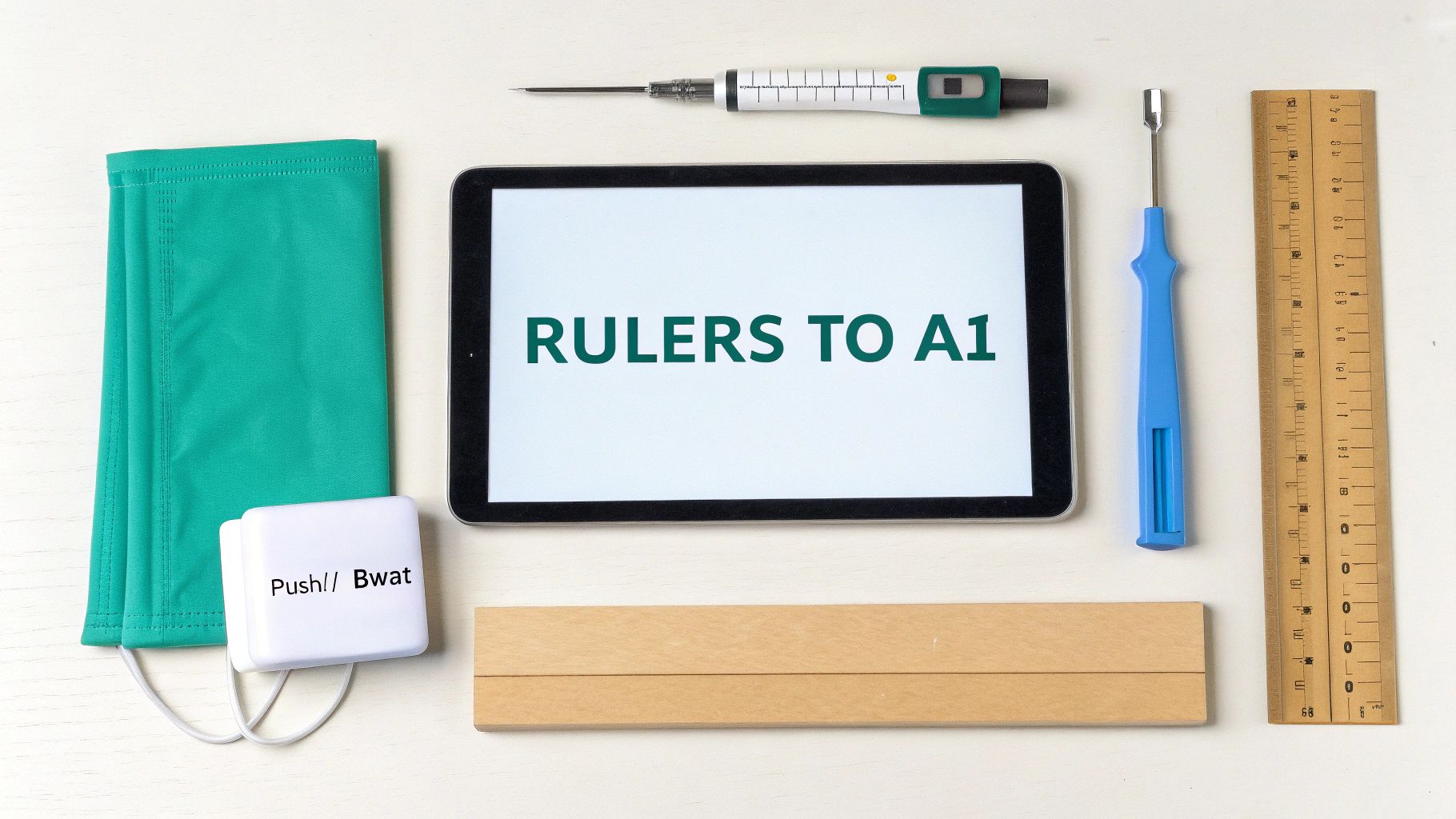
The history of wound assessment tools for nurses is a perfect microcosm of medicine's own journey. It’s a story of moving from hands-on, analog methods that relied heavily on individual skill toward incredibly precise, data-rich systems that standardize excellence. I like to think of a modern nurse's toolkit as having three distinct layers, with each layer building on the last to solve a new, more complex clinical problem.
First, you have the foundational layer. These are the classic, hands-on instruments that have been fixtures at the bedside for decades, forming the bedrock of any physical wound examination. They are the essential starting point for gathering basic dimensional data.
Next up is the layer of structured frameworks. These are the validated scales and scoring systems meticulously designed to turn visual observations into standardized, shareable data. They were a revolutionary step, creating a common language for everyone involved in a patient's care journey.
And finally, the top layer is all about digital intelligence. This represents the most significant leap forward, where technology automates measurement, analyzes tissue with superhuman consistency, and simplifies the entire workflow from assessment to documentation. This layer gives nurses a powerful new partner in care, enhancing their skills rather than replacing them.
The Foundation: Traditional Manual Tools
The starting point for any wound assessment has always been getting the basic physical measurements. For years, that meant relying on simple, yet effective, manual tools to capture the wound's dimensions.
- Sterile Rulers: Those disposable paper or plastic rulers are the old-school, tried-and-true method for measuring a wound’s length and width at its longest and widest points. It's a quick, no-fuss method for documenting surface area.
- Cotton-Tipped Applicators: To determine wound depth, tunneling (a narrow channel extending from the wound), or undermining (tissue destruction under the wound edge), a nurse gently places a sterile applicator into the deepest part or channel. They then mark the applicator at the wound edge and measure that portion against a ruler. It remains a go-to technique for assessing these critical third dimensions.
But as essential as these manual tools are, they have inherent limitations. Let’s be honest—measurements can vary quite a bit from one nurse to the next depending on the exact points they choose to measure from, introducing a level of guesswork and inconsistency into the patient's longitudinal record. Furthermore, the multi-step process of measuring, jotting down the numbers on a piece of paper, and then manually transcribing them into a digital chart is slow, inefficient, and opens the door to costly transcription errors.
Adding Structure: Validated Assessment Scales
To tackle that pervasive inconsistency problem, the clinical world developed validated assessment scales. These tools provide nurses with a clear, structured framework to evaluate and score various wound characteristics, ensuring the entire care team is speaking the same clinical language and evaluating wounds in a consistent manner.
Think of these scales as a clinical checklist with a scoring rubric. They guide your eyes to specific, important details and help translate complex visual observations into a simple, objective score. That standardization is absolutely critical for tracking whether a wound is actually healing, stagnating, or deteriorating over time.
Two of the most common and widely respected scales you’ll see in practice are:
- The PUSH Tool (Pressure Ulcer Scale for Healing): Developed specifically for pressure injuries, this tool scores a wound on three key parameters: surface area, exudate (drainage) amount, and tissue type. A total score that decreases over time is a clear, objective indicator of healing.
- The Bates-Jensen Wound Assessment Tool (BWAT): This scale is far more detailed and comprehensive. The BWAT evaluates 13 distinct wound characteristics, from depth and edges to necrotic tissue type and the condition of the surrounding periwound skin. Its thoroughness makes it a robust choice for all sorts of complex, chronic wounds beyond pressure injuries.
These scales brought much-needed order and objectivity to wound documentation, but they still depend on a nurse’s manual measurements and personal judgment to assign scores, leaving some room for variability. And, of course, they still represent a manual documentation process that takes time away from patient care.
The Next Frontier: Digital and AI-Powered Platforms
The latest and most transformative step in the evolution of wound assessment leverages digital imaging and artificial intelligence to blow past the limitations of older methods. Integrated platforms like the Ekagra Health AI solution are completely changing the game by using a device every nurse already carries: a smartphone or tablet.
Instead of fiddling with rulers and applicators, a nurse simply takes a photo of the wound. That’s it. The AI algorithm instantly and automatically calculates precise measurements for length, width, depth, and surface area with sub-millimeter accuracy. It can even analyze the pixels in the image to classify and quantify the percentages of different tissue types (granulation, slough, eschar) within the wound bed.
This groundbreaking approach yields objective, perfectly repeatable data every single time. It effectively removes human variability from the measurement process, making patient care not just more accurate, but also significantly more efficient and data-rich.
Choosing the Right Wound Assessment Scale
Picking the right tool for wound assessment is a bit like a mechanic choosing the right socket for a specific bolt. You wouldn't grab a massive wrench for a tiny, delicate screw. In the same way, the best wound assessment scale depends entirely on the clinical situation, the specific type of wound, and the primary goal of your assessment. Are you tracking simple progress, or are you conducting a deep diagnostic evaluation of a non-healing wound?
A one-size-fits-all approach just doesn't cut it in the nuanced world of wound care. The real goal is to thoughtfully match the tool to the patient's specific needs to generate the most accurate and useful data for their care plan. This is where sharp clinical reasoning comes in—it’s about moving beyond simply filling out a form and toward a targeted, effective assessment strategy that informs treatment decisions.
PUSH Tool for Tracking Pressure Injury Healing
When your main focus is tracking how a pressure injury is healing over time, the Pressure Ulcer Scale for Healing (PUSH) Tool is one of the best and most efficient tools in your kit. It was developed by the National Pressure Injury Advisory Panel (NPIAP) specifically to be straightforward, quick to use, and easy for the entire interdisciplinary team to understand.
The PUSH tool keeps it simple, evaluating just three key healing characteristics:
- Wound Size: This score is based on the wound's surface area, which is calculated by multiplying its greatest length and greatest width.
- Exudate Amount: It classifies drainage simply as none, light, moderate, or heavy, based on observation of the wound bed and the soiled dressing.
- Tissue Type: This identifies the dominant tissue in the wound bed—whether it’s healthy closed/epithelialized tissue, granulation, slough, or necrotic eschar.
Each of these categories receives a score, and the total provides a quick, numerical snapshot of the wound’s status. As the wound improves, that total score should decrease. This clear, easy-to-follow scoring system makes it incredibly simple to spot healing trends at a glance, which is a lifesaver in busy long-term care facilities and hospitals where you need quick, consistent updates on many patients.
However, that elegant simplicity is also its biggest limitation. For a more detailed look into complex wound care, you might be interested in our guide on pressure injury staging for accurate assessment. The PUSH tool is perfect for tracking progress but isn’t designed to capture all the subtleties of more complicated or atypical wounds.
Bates-Jensen Wound Assessment Tool (BWAT) for Comprehensive Evaluation
For those wounds that are more complex than a standard pressure injury—think chronic venous ulcers, diabetic foot ulcers, or non-healing surgical sites—you need a more powerful and granular instrument. This is exactly where the Bates-Jensen Wound Assessment Tool (BWAT), sometimes known as the Pressure Sore Status Tool (PSST), truly shines.
The BWAT is far more detailed, asking the clinician to evaluate 13 different wound characteristics on a sliding scale. This comprehensive approach gives you a much deeper, more nuanced understanding of the wound's overall condition and identifies specific barriers to healing.
Think of the PUSH Tool as a quick check-up for monitoring known progress, and the BWAT as a full diagnostic workup for complex cases. The BWAT provides the granular data needed to manage challenging wounds that aren't responding to standard treatments, helping you pinpoint exactly what needs to change in the care plan.
Its detailed nature makes it the go-to choice for specialized wound care clinics, home health nurses managing complex cases, clinical research, and any situation where a thorough, multi-faceted assessment is critical to guide advanced treatment decisions.
The Challenge of Finding the Perfect Tool
While validated scales like PUSH and BWAT bring much-needed structure to our assessments, the reality is that no single manual tool is perfect for every situation. A detailed evaluation study that reviewed multiple wound assessment tools for nurses found that none managed to fully meet all the criteria for optimal clinical utility. The study pointed out that many tools fell short in areas like guiding specific clinical practice decisions, tracking healing effectively across all wound types, and facilitating clear, unambiguous team communication. You can read the full research about these findings to get a better sense of the gaps that still exist between traditional tool design and real-world nursing needs.
This research underscores how important it is to not just pick a tool, but to truly understand its specific strengths and weaknesses within your own clinical environment. To help with that critical decision, the table below offers a direct comparison of several common scales.
Comparing Common Wound Assessment Scales
This side-by-side comparison is designed to help nurses quickly see which tool might be the best fit based on the wound type and what you need to accomplish with your assessment—whether it's risk assessment, severity staging, or progress tracking.
| Tool Name | Best For Tracking | Key Assessment Areas | Ideal Clinical Setting |
|---|---|---|---|
| PUSH Tool | Pressure injury healing over time | Wound size, exudate amount, tissue type | Hospitals, long-term care, skilled nursing facilities |
| BWAT | Complex and chronic wound severity | 13 characteristics, including edges, undermining, tissue types | Wound clinics, home health, research settings |
| Braden Scale | Pressure injury risk assessment | Sensory perception, moisture, activity, mobility, nutrition, friction/shear | Hospitals, long-term care (preventative focus) |
| Wagner Scale | Diabetic foot ulcer severity and depth | Depth of tissue involvement and presence of ischemia or gangrene | Podiatry clinics, diabetes care centers, vascular surgery |
Ultimately, choosing the right scale is all about aligning its specific capabilities with your patient's wound etiology and the clearly defined goals you’ve set out in your care plan.
Integrating Wound Assessment into Your Daily Workflow
Let's be honest—the reality of a nursing shift is a constant, high-stakes juggling act. When you’re bouncing from patient to patient, each with their own complex needs, the sheer volume of tasks makes it tempting to rush through wound assessments or, even worse, put off charting until the end of an already exhausting day.
But here’s the crucial mindset shift: weaving consistent, high-quality wound assessment into your day isn't about adding another burden to your to-do list. It’s about building a smart, efficient, and standardized process that feels like a natural part of your clinical rhythm, ensuring no critical details ever fall through the cracks.
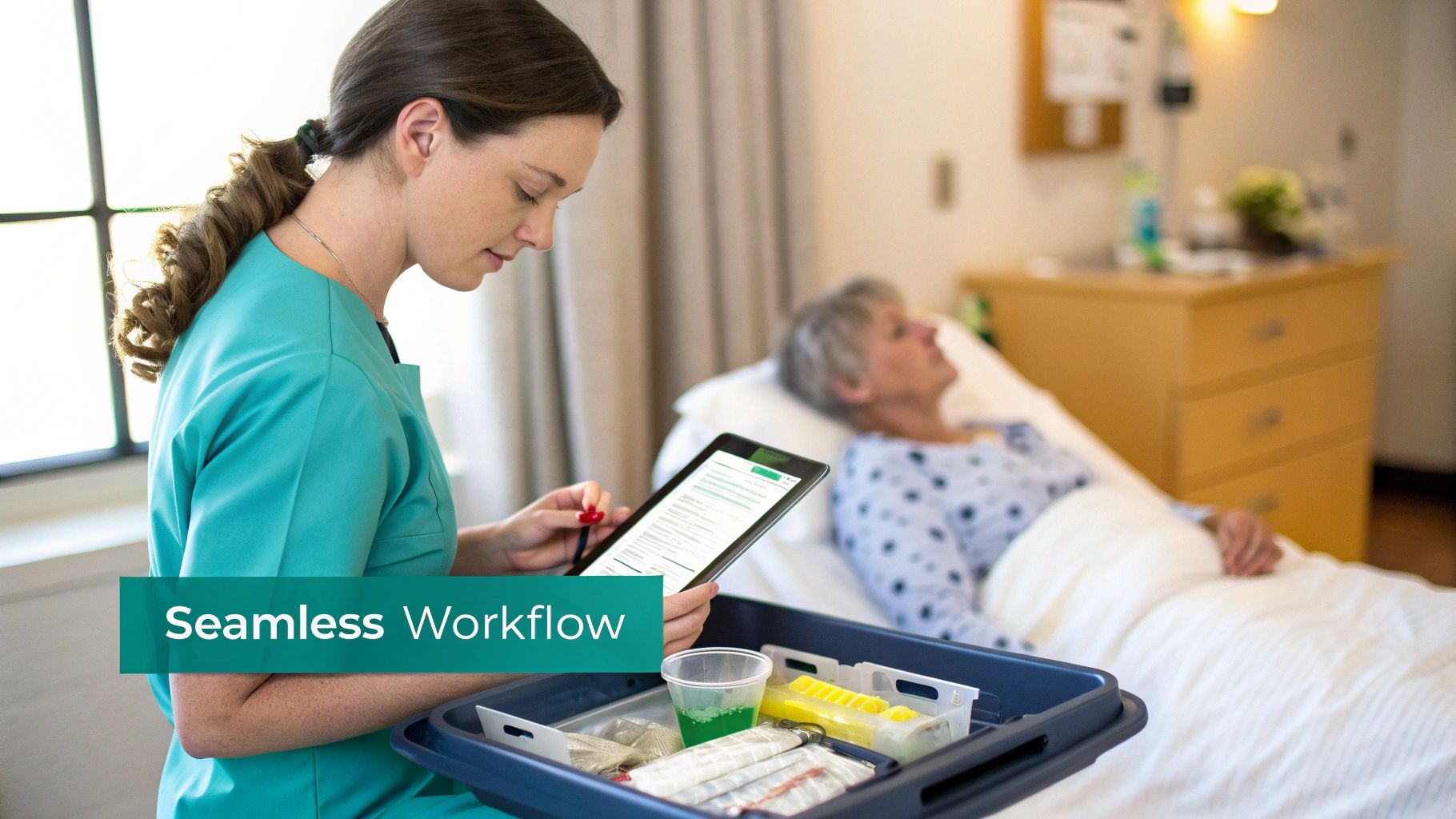
Preparing for a Seamless Assessment
The secret to an efficient and accurate assessment? It all happens before you even step into the patient's room. A few minutes of thoughtful preparation can easily cut your assessment time in half and prevent you from forgetting a crucial step or supply. It turns a potentially chaotic process into a smooth, focused, and professional interaction.
Before you start, get everything you need in one place. Think of it as creating your go-to "wound care kit" that's always stocked and ready for action.
- Essential Supplies: This means clean gloves, sterile measuring tools (like a disposable ruler or cotton-tipped applicators), saline or wound cleanser, and all the dressing materials you'll need for the new dressing.
- Documentation Tools: Have your tablet, phone, or charting device ready to go at the bedside. Waiting to enter data later is a well-known recipe for memory-based errors and omissions.
- Good Lighting: This one is huge and often overlooked. Never underestimate the power of a good light source. A simple penlight or the flashlight on your phone can be the difference between guessing at tissue types and accurately identifying them.
Having these items on hand saves you from those time-wasting trips back and forth to the supply room, making the entire workflow feel less stressful, more organized, and more predictable.
Performing a Systematic Evaluation
Once you're prepped and at the bedside, the assessment itself should follow the same logical sequence every single time. It's just like a head-to-toe physical assessment, but zeroed in on the wound and its surrounding environment. This structured approach helps you capture all the necessary data points efficiently without second-guessing yourself.
Here’s a practical, step-by-step method that works:
- Patient Comfort and Privacy: Always start here. Explain what you're doing in simple terms, make sure the patient is comfortable and adequately medicated for pain if needed, and ensure their privacy is protected. A relaxed and informed patient makes for a much smoother assessment.
- Remove Old Dressing: As you carefully remove the old dressing, observe it. Note the type and amount of drainage on the dressing—it’s your first objective clue about the wound’s exudate level.
- Cleanse the Wound: Gently clean the wound according to your facility's protocol. This not only reduces the bioburden but also gives you a clear, unobstructed view of the wound bed for an accurate evaluation.
- Measure and Document: Now, grab your wound assessment tools. Systematically measure length, width, and depth. Use a sterile applicator to gently probe for any undermining or tunneling. If you're using a digital tool, this is the perfect time to capture your images.
- Assess the Wound Bed: Look closely at the wound bed and estimate the percentage of different tissue types you see—is it healthy pink/red granulation, yellow/tan slough, or black/brown eschar?
- Evaluate Periwound Skin: Don’t stop at the wound's edge. Carefully examine the surrounding skin for redness, maceration (moisture damage), warmth, or induration (hardness). These are often the first signs of spreading infection or other complications.
Following these steps in order creates a mental checklist that quickly becomes second nature. With practice, you’ll be able to perform a thorough, confident, and highly efficient evaluation in no time.
Overcoming Documentation Fatigue
We all know it: documentation is often cited as the single biggest workflow killer in nursing. It’s repetitive, it’s time-consuming, and it’s a massive contributor to clinician burnout. For a nurse managing multiple patients with complex wounds, the thought of manually charting every last measurement, tissue percentage, and observation is simply draining.
Documentation shouldn't be a separate, dreaded task you save for the end of your shift when you're already tired. The goal is to make it a seamless, real-time extension of the assessment itself, capturing accurate data right at the point of care to eliminate recall bias.
This is where modern digital tools completely change the game. Instead of scribbling notes on a glove to type up later, you can input data directly into a tablet at the bedside. Better yet, AI-powered systems are taking it even further by automating the most tedious parts of the process.
Imagine just speaking your observations out loud as you assess the wound, and having a tool that listens, understands, structures that data for you, and even drafts the narrative portion of your note. That kind of technology turns documentation from a chore into a natural part of the clinical conversation, dramatically slashing your charting time. Juggling multiple software systems just adds to the headache; you can learn more about the hidden costs of software sprawl in wound care and why a single, unified platform is the answer. When you have tools that work with you, not against you, you get precious time back to focus on what actually matters—your patients.
How AI Is Changing the Game for Nurses in Wound Care
The idea of artificial intelligence in wound care might seem futuristic, but it's already at the bedside and making a tangible, positive difference in daily nursing practice. Think of AI less like a robot taking over your job and more like a highly trained, incredibly efficient assistant. It's the partner who expertly handles the tedious, repetitive tasks, freeing you up to focus on the uniquely human aspects of nursing—critical thinking, patient education, and compassionate care.
AI isn't here to replace your clinical judgment; it's here to augment and supercharge it with objective data.
At its heart, AI brings a level of precision and consistency that manual methods simply cannot deliver. Using advanced computer vision algorithms—similar to the technology in a self-driving car—it analyzes a wound image with incredible accuracy. This systematically removes the guesswork and human variability that so often creep into traditional assessments, leading to a more reliable patient record.
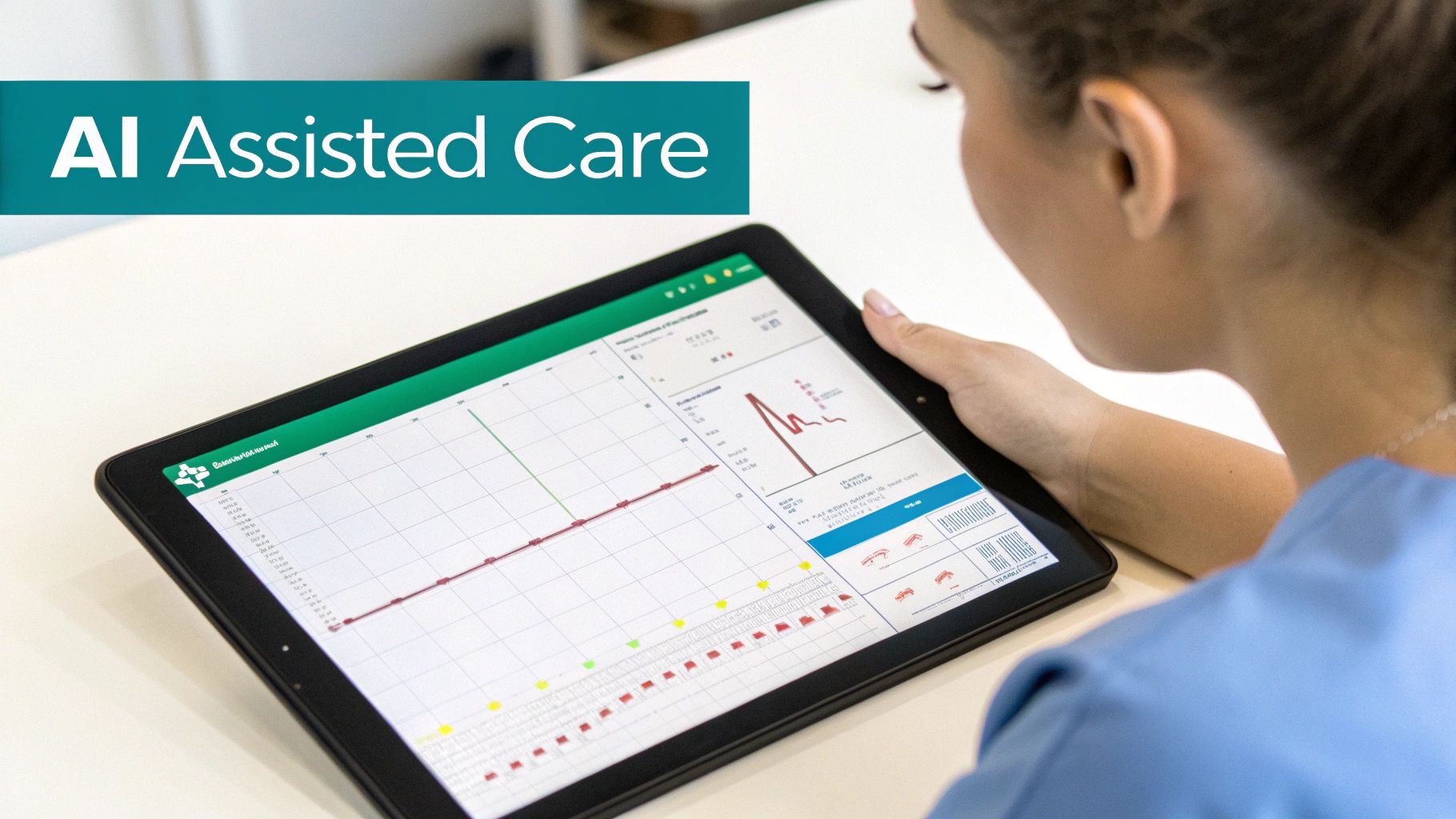
Objective and Repeatable Measurements
We’ve all been there. Trying to get a consistent measurement with a ruler and a cotton swab can be challenging. A slight shift in your angle, a different point of reference, or a little too much pressure while probing for depth can throw off the numbers. Even worse, your measurement might be slightly different from what your colleague recorded on the last shift, making it difficult to determine the true healing trajectory.
AI puts a definitive end to that ambiguity.
With just a quick, non-contact photo from a smartphone or tablet, an AI-powered platform can:
- Automate Dimensions: Instantly and accurately calculate a wound's length, width, surface area, and even depth with sub-millimeter accuracy, far surpassing the precision of the naked eye.
- Guarantee Consistency: The algorithm applies the exact same mathematical method to measurement every single time, regardless of which clinician is taking the photo. This creates a trustworthy, objective record of how the wound is (or isn't) progressing.
- Track Trends Over Time: All of this consistent data feeds into easy-to-read charts and graphs that show you the healing trajectory at a glance, making it simple to spot a stalled or deteriorating wound long before it becomes a major problem.
This process transforms a subjective observation into a hard, scientific measurement. It gives the entire care team a solid, data-driven foundation to stand on when making clinical decisions.
High-Accuracy Tissue Classification
Accurately identifying and quantifying tissue types—granulation, slough, eschar—is a refined clinical skill. It takes years of experience to get right, and even then, it can be subjective. Is that patch in the wound bed 20% slough or 30%? Two experienced nurses might reasonably disagree. AI brings a powerful, analytical eye to this critical part of the assessment.
AI computer vision doesn't guess. It analyzes the individual pixels in a wound photo, evaluating color, texture, and other properties to classify tissue types and calculate their exact percentage within the wound bed. This gives you an unbiased, data-backed foundation for making key decisions, like whether debridement is necessary.
This is a true game-changer. It gets everyone on the care team speaking the same precise language. Instead of vague descriptions like "it looks like there's more slough," you get objective data: "Slough has decreased from 65% to 48%; granulation has increased from 35% to 52%." That level of detail makes it far easier to justify your treatment plan and demonstrate its effectiveness with solid evidence.
Putting an End to Workflow Friction
Perhaps the most immediate and profound relief nurses feel when adopting AI tools is the massive reduction in administrative burden and paperwork. The old routine—measure, scribble notes, then spend hours at the end of a shift transcribing it all into the EHR—is a huge contributor to documentation fatigue and burnout.
Modern wound assessment tools for nurses are built from the ground up to crush that friction. Instead of juggling a ruler, a notepad, and a camera, you can perform the entire assessment and documentation process in one smooth, integrated motion at the bedside.
Here’s what that looks like in the real world:
- A home health nurse snaps a photo of a patient’s wound with their agency-issued tablet.
- The AI platform instantly analyzes the image, capturing all measurements and tissue data automatically.
- The nurse adds their clinical observations, perhaps even using voice-to-text to dictate notes while keeping their hands free to continue caring for the patient.
- All of this structured data is automatically compiled into a complete, compliant, and professional-looking chart note, ready for a quick review and sign-off.
This isn't just about saving time; it's about eliminating the risk of transcription errors and giving you more valuable face-to-face time with your patients. When we automate the most frustrating and time-consuming parts of the job, we actively fight burnout and get back to the human side of healing. If you're interested in the data behind this impact, you can learn more about how AI-powered documentation reduces clinician burnout by 50% in our detailed breakdown. At the end of the day, AI helps you deliver more efficient, more accurate, and more patient-focused care.
The Future of Wound Assessment Is Smart and Seamless
Looking back at the evolution of wound assessment tools for nurses, you can see a clear and logical progression. We started with simple rulers and subjective notes, then moved to structured scales that finally gave us a shared clinical language. Now, we’re on the cusp of a truly transformative era—a time of intelligent platforms that don’t just measure, but actively guide our clinical judgment with data-driven insights.
If there's one key takeaway from this guide, it's this: the right tool doesn't just collect data; it empowers nurses to provide safer, more effective, and more consistent care. It takes the tedious, error-prone parts of our job and transforms them into a smooth, data-driven workflow. This, in turn, frees us up to focus on what truly matters most—the person in front of us.
A Vision for Connected Care
The best assessment approach is never one-size-fits-all. It always comes down to the clinical setting, the patient’s specific needs, and your organization’s overarching goals. A straightforward Stage 2 pressure injury in a long-term care facility might only require the PUSH Tool for tracking, but a complex, non-healing diabetic foot ulcer needs a much deeper, more detailed analysis to guide its care.
The future isn’t about picking just one tool, though. It’s about seamlessly connecting them within a single, intelligent ecosystem.
Imagine a world where smart, AI-powered solutions like the Ekagra Health AI platform are simply the way things are done. In this near future:
- Assessment is effortless: A nurse snaps a quick picture, and AI instantly returns objective measurements and tissue analysis. No more guesswork or inter-rater variability.
- Documentation is automatic: While you assess the wound and talk to the patient, voice-activated listening captures the important clinical details and intelligently organizes them into a compliant, well-structured chart entry.
- Collaboration is real-time: That objective data is immediately synced and available to the entire care team—from the primary physician to the off-site wound specialist—ensuring everyone is working from the same, up-to-the-minute playbook.
- Billing is built-in: The system recognizes the work you’ve done, the supplies you've used, and the complexity of the visit, then automatically suggests the right CPT and ICD-10 codes, linking clinical care directly to the revenue cycle to ensure proper reimbursement.
The ultimate goal is to build a truly connected ecosystem where bedside assessment flows seamlessly into documentation, team huddles, specialist consults, and even billing—all from a single, intuitive platform that understands the nursing workflow.
Elevating Your Practice for Better Outcomes
This isn't some far-off science fiction vision; the technology to accomplish all of this is here today. That makes this the perfect time for every healthcare organization to take a hard, honest look at its current wound assessment protocols. Are your tools creating more administrative headaches than they solve? Are you still relying on subjective, variable data when you could have objective, undeniable proof of healing?
When you start exploring how modern tools can elevate your practice, you’re doing more than just adopting new technology. You're making a direct investment in better patient outcomes, reduced legal risk, improved financial health, and a more sustainable, less frustrating workflow for your entire clinical team.
Frequently Asked Questions
As wound care technology continues to evolve, it's only natural to have questions. You're not alone. Let's tackle some of the most common things nurses ask when they're figuring out how to best use wound assessment tools for nurses in their day-to-day work.
How Do I Choose the Right Tool for My Practice?
The honest answer? It really boils down to your specific clinical setting and the patient populations you see most often. You have to match the tool to the job at hand.
Think of it this way: if you’re primarily tracking pressure injuries in a long-term care facility where speed and consistency are key, a straightforward tool like the PUSH scale is a fantastic, no-fuss choice. But, if you’re in a specialized outpatient clinic dealing with complex, non-healing wounds that need a much deeper diagnostic look, the Bates-Jensen Wound Assessment Tool (BWAT) gives you that comprehensive horsepower.
And for organizations that need to standardize their wound care protocols across a mix of settings—home health, outpatient clinics, and inpatient hospitals—an AI-powered platform becomes the clear winner. It takes the guesswork out of measurements, standardizes everyone's notes, and offers longitudinal data insights that are nearly impossible to catch with manual charting.
What Are the Biggest Mistakes in Wound Assessment?
The most common and consequential slip-ups almost always circle back to two core issues: inconsistency and incomplete documentation. We've all seen it in practice—different nurses measuring a wound in slightly different ways, someone confusing slough for granulation tissue, or forgetting to document the state of the critical periwound skin.
Another big one is not performing assessments frequently enough to detect changes in a timely manner. When checks are too spread out, you can easily miss the subtle, early signs that a wound isn't healing or is developing an infection, which delays getting the patient the intervention they need. This is exactly where digital tools with photo documentation shine; they create an objective, time-stamped visual history that cuts through the confusion and tells a clear story of the wound's journey.
If you take away one thing, let it be this: a consistent, standardized assessment process is the single most important factor in preventing common errors. It forces the entire care team to capture and interpret data the exact same way, every single time.
How Can AI Tools Improve Team Communication?
AI platforms create a single, undisputed source of truth that the whole interdisciplinary team can get behind. Instead of passing along subjective, handwritten chart notes that one person might interpret differently from the next, everyone sees the same objective information. Nurses, physicians, wound specialists, and even off-site consultants are looking at the exact same precise measurements, quantified tissue analysis, and clear healing trend graphs.
This simple but powerful change practically eliminates the "lost in translation" moments that can occur during shift handoffs and specialist consults. The clear, visual reports generated by these platforms can be shared in an instant via secure messaging, making collaboration feel effortless and leading to smarter, more unified care plans for the patient.
Is It Hard to Learn How to Use AI Wound Assessment Tools?
Not at all. In fact, it's the complete opposite. Modern AI platforms are built from the ground up with the busy clinician in mind. They run on devices you already use every day, like a smartphone or a tablet, and feature incredibly intuitive, user-friendly interfaces. Think simple point-and-click actions to snap a photo or even using your voice to guide the assessment and dictate notes.
The whole point of these advanced tools is to reduce complexity and give you time back, not to add another technological headache to your workflow. The learning curve is surprisingly short—most nurses feel completely comfortable and confident with the system after just a little bit of hands-on training and a few uses at the bedside.
Ready to bring clarity, consistency, and efficiency to your wound care practice? Ekagra Health AI offers a single, voice-powered platform that automates documentation, standardizes assessments with AI-driven measurements, and streamlines billing from voice to claim. Learn how you can reduce documentation time and improve patient outcomes by exploring the platform.
