
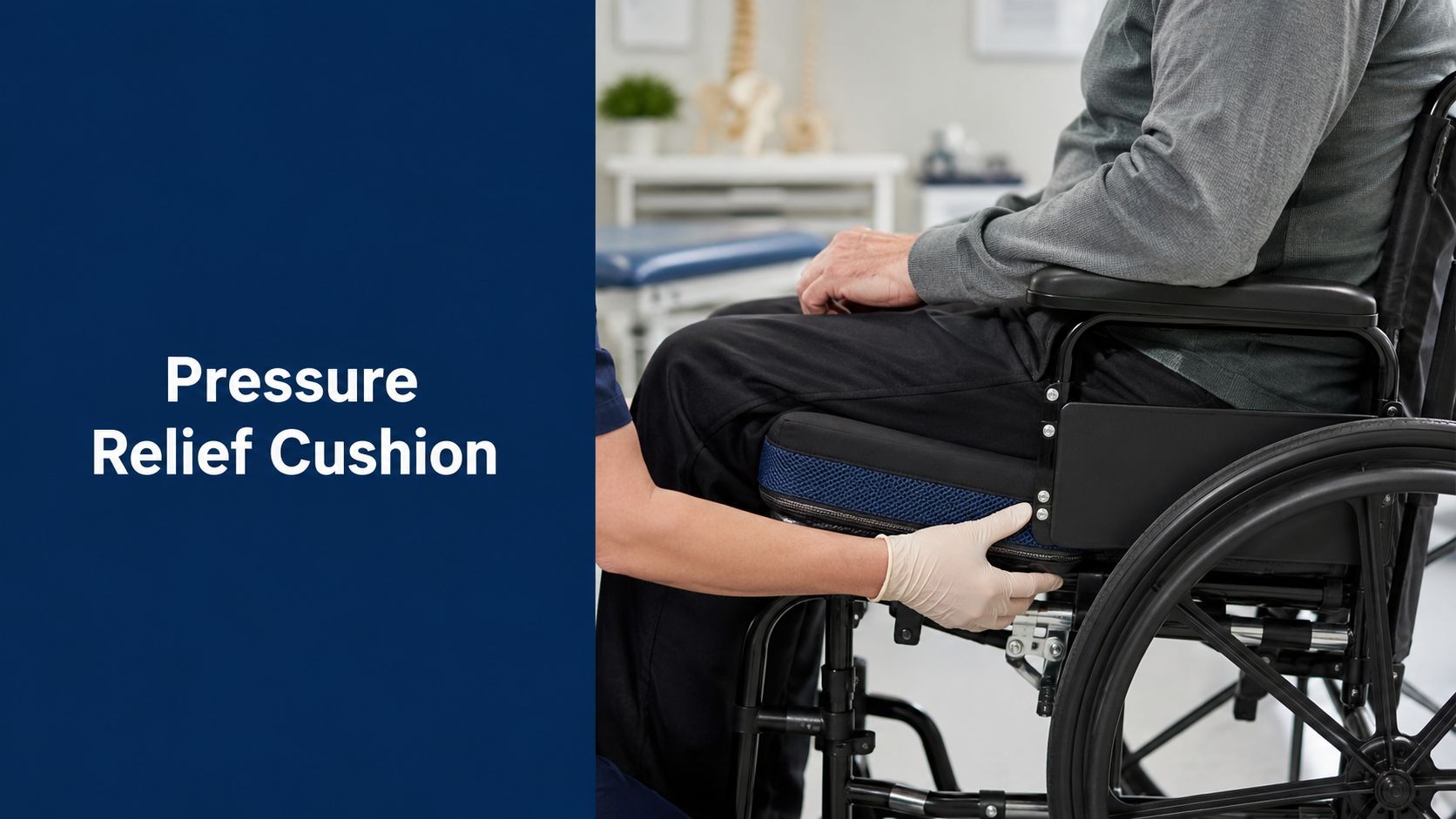
The patient already has a cushion. The family says it was expensive. Nursing says he's “off-loaded when seated.” Yet the coccygeal wound still looks angry, the periwound is macerated, and every visit starts with the same story: he sits most of the day, slides into posterior pelvic tilt, and no one has checked what happens between his pelvis and the actual chair surface.
That's the problem with most advice about a seat cushion for pressure sores. It treats the cushion like a retail category instead of a clinical intervention. Once a wound is open, especially over a loaded bony prominence, the work changes. You're no longer shopping for comfort. You're trying to redistribute force, reduce shear, preserve function, and document medical necessity tightly enough that the right equipment secures coverage.
Beyond Generic Advice for Existing Pressure Sores
A patient with an existing Stage 2, Stage 3, or Stage 4 pressure injury doesn't need generic “pressure relief.” They need targeted off-loading of the actual problem area. That might be the ischial tuberosity in a wheelchair user, the coccyx in a sacral sitter, or one trochanter in a patient with pelvic asymmetry. If the cushion doesn't address that specific loading pattern, it's not therapeutic. It's upholstery.
The biggest prescribing mistake is assuming material category tells you enough. It doesn't. Foam, gel, air, and hybrid surfaces all have roles, but the literature on seating for existing wounds is clear on the practical point: effective management depends on skilled fitting, palpation, pressure mapping, and patient training, because a cushion that feels soft can still increase focal pressure or shear in the wrong patient (clinical seating literature on off-loading the actual bony prominence).
What usually goes wrong
Most failed cushion setups share the same pattern:
- The wound is treated in isolation. The note has wound length, width, depth, exudate type, and periwound description, but nothing about pelvic posture, transfer mechanics, or the chair itself.
- The cushion is prescribed by category alone. “Pressure cushion ordered” is not a plan.
- No one validates the fit in the patient's real seated posture. A sacral sitter can overwhelm a technically good cushion in minutes.
- Caregivers hear “pressure relief” and translate it into “safe to sit as usual.” That's where healing stalls.
Practical rule: When a pressure sore already exists, stop asking which cushion is “best” in general. Ask which setup off-loads this patient's wound location without causing a new hotspot or destabilizing posture.
Reframe the clinical target
For an existing wound, the patient-seating interface is the treatment target. That includes:
- Where the wound sits relative to load
- How the pelvis is positioned
- Whether the thighs are supported or overloaded
- How the patient transfers, leans, and repositions
- What chair or wheelchair frame the cushion is sitting on
That reframe matters in practice. A coccygeal wound that isn't improving on a “good cushion” often isn't a cushion failure. It's a failure of matching, fitting, or follow-up.
Patient Assessment Beyond the Wound Bed
Wound measurements matter. They're also not enough.
For seating decisions, I want the same discipline I use when I'm deciding whether sharp debridement supports the plan of care or whether a heavy serous drain pattern means I need to rethink moisture balance. A seat cushion for pressure sores should be prescribed from a posture and function assessment, not from a catalog description.

About 47% of pressure ulcers occur over the ischial tuberosities or sacrum, and in a trial of elderly nursing-home residents, appropriate skin-protection cushions were associated with 7% incidence of sitting-acquired pressure ulcers versus 20% with standard foam cushions (wheelchair-cushion trial and seating anatomy data). That's why the seated exam can't be an afterthought. These are exactly the areas patients load all day.
What to assess before you order anything
Start with the wound, but don't stop there. I document:
- Wound location under seated load. Is the ulcer sacral, coccygeal, ischial, or mixed? A “sacral” label often hides sitting-related coccygeal loading.
- Stage and tissue status. Granulation, slough, exposed structures, undermining, tunneling, odor, exudate amount and character, and periwound findings such as maceration, callus, blanching, or shear injury.
- Pelvic posture. Posterior pelvic tilt, obliquity, rotation, or fixed asymmetry.
- Trunk control. Can the patient maintain midline without using one arm for support?
- Transfer pattern. Sliding board, pivot, dependent lift, or repeated shear-heavy scooting.
- Sitting tolerance in practice. Not what's prescribed. What happens.
- Seat base. Sling wheelchair seat, rigid base, recliner, transport chair, lift chair, car seat, office chair.
- Lower-extremity position. Thigh support, femoral alignment, foot support, and whether the seat edge is creating distal pressure.
- Moisture and microclimate issues. Incontinence, sweating, occlusive covers, prolonged sitting in damp garments.
Red flags that change cushion choice
Some findings should immediately narrow your options:
- Sacral sitting pushes load posteriorly and increases shear. If the patient slides, don't pretend a cushion alone will fix it.
- Fixed pelvic obliquity means a symmetric surface may still create focal loading on one side.
- Poor sitting balance can make a highly immersive surface unsafe if it sacrifices stability.
- High transfer shear will defeat a pressure-redistributing surface if caregivers drag instead of lift.
- Soft home seating often changes everything. A cushion that behaves on a clinic chair may collapse differently on a recliner.
If you need a quick wound-location refresher while documenting staging accurately, the pressure injury staging guide is a useful clinical reference.
A wound note without seated posture findings is incomplete when the patient spends most of the day in a chair.
Build the note for the later prior auth
I don't separate assessment from reimbursement. The same findings that improve care also support coverage:
- Functional deficit tied to immobility
- Anatomic risk tied to wound location
- Failed conservative setup tied to current seating
- Need for a specific cushion property tied to objective findings
That's the foundation of a defensible LMN. Without it, the chart reads like preference. Payers deny preference.
Matching Cushion Technology to Clinical Need
Consequently, clinicians tend to oversimplify. Foam for low risk. Air for high risk. Gel for comfort. That kind of shorthand causes bad fits and bad denials.
The right seat cushion for pressure sores depends on what you're trying to accomplish mechanically. Immersion, envelopment, stability, moisture handling, and setup tolerance all matter. You're balancing off-loading against posture control.
Air-cell cushions often provide the strongest pressure redistribution, but they're also the most technique-sensitive. In one study, air cushions could be the best option for off-loading, yet small changes in inflation, posture, or chair surface changed the pressure map, including a trade-off of lower pressure at the hip and higher pressure under the thighs (air-cushion fitting trade-offs and individualized support).
What each technology tends to do well
Air-cell designs
These are often the first choice when you need maximum immersion and better pressure redistribution around the pelvis.
Best fit:
- Patients with high risk over the ischial region
- Existing sitting-related wounds where off-loading is the primary goal
- Users with access to skilled follow-up and caregiver training
Common failure points:
- Incorrect inflation
- Bottoming out
- Instability during transfers
- Thigh overload from shifted pressure
- Poor tolerance in patients with weak trunk control
Foam and contoured foam
These generally offer better stability and can be easier for caregivers to manage consistently.
Best fit:
- Patients who need postural support as much as skin protection
- Users who transfer frequently
- Patients who become unsafe on highly unstable surfaces
Common failure points:
- Inadequate immersion
- Compression over time
- A “soft feel” that hides focal pressure under the pelvis
Gel or gel-infused surfaces
These can help with load distribution and may feel more stable than highly immersive air systems, depending on the design.
Best fit:
- Patients who need a middle ground between support and pressure redistribution
- Situations where maintenance burden needs to stay low
Common failure points:
- Heat and moisture depending on cover and environment
- Weight and handling issues
- False assumption that gel automatically means better off-loading
Hybrid designs and matrix surfaces
These can be useful when you need more than one property at once, especially a stable base with better immersion than simple foam alone.
Best fit:
- Mixed posture and skin-protection needs
- Patients who need functional stability for ADLs while still reducing pelvic loading
Common failure points:
- Overconfidence in the “hybrid” label
- Poor fit to the actual seat dimensions
- Inadequate reassessment after setup
Cushion Technology Selection Guide
| Patient Factor / Risk | Recommended Cushion Property | Primary Technology Options |
|---|---|---|
| Existing ischial or coccygeal wound with high seated load | High immersion and pressure redistribution | Air-cell, hybrid off-loading designs |
| Poor trunk control or unsafe lateral instability | Greater postural stability with controlled immersion | Contoured foam, stable hybrid surfaces |
| Pelvic obliquity or asymmetry | Accommodative fit with individualized setup | Air-cell with skilled fitting, selected hybrid systems |
| Recurrent shear during transfers | Stable surface plus transfer training and seating adjustments | Contoured foam, stable gel or hybrid options |
| Moisture concerns and prolonged sitting | Surface and cover choices that manage heat and dampness | Technology varies, but cover and microclimate features matter |
| Home chair use across multiple seating surfaces | Predictable performance with in-home validation | Usually stable foam, gel, or hybrid before highly technique-sensitive options |
For clinicians trying to educate families on the basics of comfortable wheelchair seating, it helps to show them the range of cushion categories while making clear that comfort language is not the same as clinical off-loading.
Don't prescribe to the marketing term. Prescribe to the loading problem.
What doesn't work
What fails most often is chasing one property and ignoring the rest. A cushion can off-load beautifully and still be wrong if the patient can't balance, transfers unsafely, or slides into shear every hour. The reverse is also true. A stable surface that preserves posture can still fail if it leaves the wound sitting on a focal hotspot.
The Art of the Fit and Follow Up
A well-chosen cushion can still fail on day one if it's fitted on the wrong chair, at the wrong inflation level, or under a patient whose posture changes the moment they fatigue.
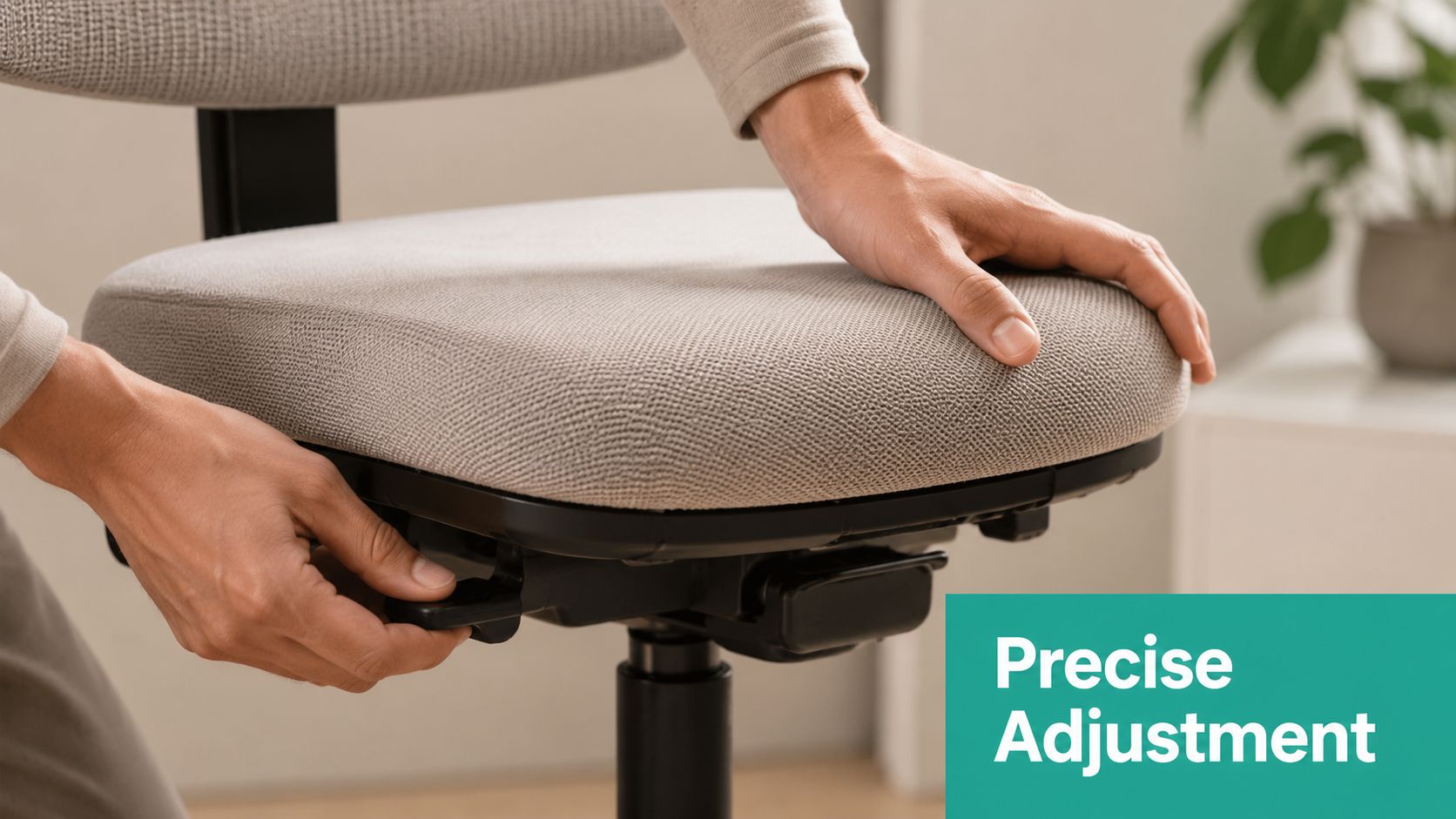
A pilot study found that cushion performance is highly dependent on the seating surface. Some cushions that reduced interface pressure on a firm chair performed worse on a soft armchair, and no tested cushion reduced interface pressure below 32 mmHg, reinforcing that the goal is risk reduction, not elimination of pressure (real-world seating surface validation and position-dependent pressure maps).
Fit the cushion to the actual seat
Do the fitting where the patient sits most. Not just in clinic.
Check these in order:
Seat dimensions
The cushion has to match width and depth. Too small and the patient perches. Too large and the edges distort support.Pelvic contact and immersion
Confirm the pelvis is immersed without bottoming out. With air systems, use the manufacturer-recommended setup and then verify by hand check under the loaded area.Thigh support
Look for even support under the thighs without creating a distal pressure ridge or pushing the pelvis backward.Postural alignment
Watch what happens after several minutes, not just the first minute. Fatigue exposes the actual posture.Functional use
Have the patient reach, eat, self-propel, or transfer. A cushion that only works while sitting perfectly still isn't enough.
Teach what the cushion can't do
Patients and caregivers need blunt education. The cushion reduces risk. It doesn't create permission for unrestricted sitting.
I usually spell out the home plan in plain language:
- Repositioning still applies. Weight shifts, assisted leans, tilt, or transfer back to bed all still matter.
- Skin checks remain mandatory. New erythema, darkening, heat, or moisture damage over loaded areas needs action the same day.
- Wound status controls sitting progression. More drainage, periwound maceration, or increased pain means reassess.
- Chair changes matter. The setup on a wheelchair may not translate to a recliner or car seat.
For patients who also need lower-extremity off-loading guidance, the off-loading shoe overview helps frame the larger point that support surfaces work best when the full pressure-management plan is coordinated.
If the family says, “He does fine on it in the wheelchair but sinks in the recliner,” believe them. Then test the recliner.
Follow-up is part of the prescription
The first follow-up should answer practical questions:
- Is the wound less loaded when seated?
- Has the patient developed a new hotspot under the thighs or trochanter?
- Is the cushion being used on the intended chair?
- Has inflation, cover placement, or seat angle drifted?
- Are caregivers performing the repositioning plan as taught?
A cushion order without follow-up is only half a treatment plan.
Documentation That Gets Cushions Approved
Good seating work dies in bad documentation.
If your note says “pressure cushion recommended for comfort and prevention,” expect trouble. Payers don't cover comfort. Auditors won't accept vague language. Surveyors want to see the link between wound status, immobility, seating assessment, and the selected equipment.
Pressure-measurement studies support the framing that specialized cushions are a risk-reduction tool, not a cure-all. In one trial summarized by SCIRE, incidence dropped from 4% to 2.6% with a pressure-redistributing cushion approach, but no cushion eliminates pressure entirely (seated surface evidence and payer-relevant framing). That's the language to use in your chart.
What a strong note actually says
Your documentation should connect four things clearly:
The medical problem
Existing pressure injury, wound stage, location, drainage, tissue status, periwound condition, pain, recurrence, or nonhealing trajectory.The functional cause
Immobility, inability to perform independent pressure relief, seated dependence, poor trunk control, pelvic obliquity, transfer-related shear, incontinence, or prolonged time in chair.The failed or insufficient current setup
Standard cushion, worn surface, poor fit to chair, unstable setup, worsening skin findings, inability to maintain pelvic position, or persistent loading over wound site.The equipment rationale
Specific cushion properties required to reduce focal pressure and shear while preserving posture and safe function.
Phrases that help and phrases that hurt
Use language like this:
Medical necessity language: Patient has an existing pressure injury over a seated bony prominence with ongoing risk from prolonged chair dependence, impaired repositioning, and abnormal pelvic loading. A pressure-redistributing seat cushion is required as part of the off-loading plan to reduce focal pressure and shear at the wound site while maintaining functional seated posture.
Avoid language like this:
- “Patient would benefit from nicer cushion”
- “For comfort”
- “To prevent soreness”
- “Family requests upgraded seat”
- “Cushion provided due to pain with sitting” without tying pain to wound and pressure risk
Documentation elements that prevent denials
A practical checklist for LMNs, progress notes, and DME support documentation:
- State the exact wound location and whether it is loaded in sitting
- Document stage and current clinical findings such as exudate type, periwound maceration, undermining, or recurrent breakdown
- Describe seating posture including pelvic tilt, obliquity, or rotation
- Describe current seat surface and why it's inadequate
- Document inability or inconsistency of independent pressure relief
- Tie the selected cushion property to the assessment
- Include caregiver education and follow-up plan
- Make clear that the cushion is one part of a broader off-loading program
If your team is charting at volume, templates matter. The trick is avoiding generic text blocks that strip out the clinical logic. A structured wound care documentation template can help standardize the right fields without flattening the medical necessity narrative.
For clinicians who spend long hours documenting and feel the physical strain of repetitive keyboard use, this piece on combatting wrist pain through voice technology is worth a look. Less hand fatigue usually means better end-of-day chart quality.
Where wound care and billing need to line up
If you're billing debridement, your seating note should still support the full plan of care. A Stage 3 ischial pressure injury debrided with CPT 11042 or deeper tissue work captured with 11043-11047 still won't progress if the patient returns to the same unaddressed seating load. The note should show that pressure redistribution was assessed and managed, not treated as an afterthought.
That's also what surveyors pick up. They look for consistency between wound trajectory, off-loading orders, nursing education, and equipment use. If the wound worsens and the chart never explains the seating interface, the record looks incomplete.
From Reactive Treatment to Proactive Seating Management
The patient's favorite question is, “How long can I sit on this?”
The honest answer usually isn't a number. It's a monitoring process.
There's a real gap between vendor-style messaging that suggests users can sit for long periods on certain cushions and the rehabilitation literature, which still treats seating as only one part of off-loading and continues to emphasize frequent repositioning and skin checks, especially for Stage 3 or deep pressure injuries. That gap is where clinicians have to be firm.
What proactive seating management looks like
A good workflow is simple, but not casual:
- Assess the wound and the seated body together
- Match cushion properties to the loading problem
- Fit on the actual chair
- Teach repositioning and skin inspection
- Reassess after the patient lives on it for a bit
- Revise when the wound, weight, function, or seating environment changes
The right answer to sitting tolerance is, “As long as the wound, skin, and posture remain stable under the plan you can actually follow at home.”
That mindset changes practice. You stop reacting to nonhealing wounds with repeated dressing changes alone. You start managing the mechanical causes with the same discipline you bring to staging, debridement, moisture balance, and infection surveillance.
A seat cushion for pressure sores isn't a one-time order. It's part of an evolving pressure-management strategy. Treat it that way, and your wound outcomes, your documentation, and your denials all improve.
If your team is tired of rebuilding this medical-necessity story from scratch on every visit, EkagraHealth AI helps turn wound assessments, staging details, and seating-related findings into cleaner documentation, better coding support, and fewer gaps between the clinical plan and the claim.
