

When you see purulent drainage, the wound is trying to tell you something important. The specific color—be it yellow, green, or brown—offers a vital clue about what’s happening beneath the surface, especially which bacteria might be causing trouble. This thick, cloudy fluid is one of the classic signs of infection, and learning to interpret what each purulent drainage color means is a non-negotiable skill for any clinician in wound care. As a critical diagnostic marker, understanding the nuances of purulent exudate is foundational to effective wound management, guiding everything from dressing selection to decisions on escalating care. It's a visual language that, once mastered, allows for faster, more targeted interventions.
Why Purulent Drainage Color Is a Critical Clinical Sign

Think of purulent drainage as a direct message from the wound bed itself. It’s more than just a sign that an infection is present; its characteristics—the color, thickness, and even the smell—give you a surprisingly detailed report. Learning to read these cues allows you to make faster, more confident decisions right at the bedside. The ability to differentiate between various types of drainage and understand their implications separates routine observation from expert clinical assessment.
This isn't just about noting an observation. It’s about translating what you see into what you do next. It's the skill that separates a basic assessment from sharp diagnostic reasoning. This interpretive skill is central to proactive wound care, enabling clinicians to anticipate needs and prevent complications before they escalate. An accurate assessment of drainage forms the bedrock of a successful treatment plan, influencing everything from local wound care strategies to systemic therapeutic decisions.
Decoding the Message in the Drainage
At its core, purulent drainage is a mix of dead bacteria, inflammatory cells (like neutrophils), and liquified tissue. Its thick, opaque appearance is what sets it apart from other, healthier types of exudate. You can find a deeper clinical definition of purulent drainage from the National Library of Medicine, but the key takeaway is that it’s fundamentally different from the clear (serous) or bloody (sanguineous) fluids you might see in a healing wound. This composition is a direct result of the body's inflammatory response to an overwhelming bacterial invasion.
Purulent drainage is never a normal finding. Its presence means the local bacterial load has overwhelmed the body’s defenses, creating an active infection that requires intervention.
This is a critical distinction. While other fluids can be a sign of a healthy, ongoing healing process, the appearance of pus signals that the process has been hijacked by infection. It is an unambiguous indicator that the wound's microenvironment has shifted from healing to pathological, necessitating a decisive clinical response to regain control and steer the wound back toward a healing trajectory.
The Impact on Clinical Decisions
Understanding what a specific purulent drainage color means directly guides your next clinical actions. For instance, your thought process might look something like this:
- Dressing Choice: You see a large amount of thick, yellow pus. Your immediate thought should be to grab a highly absorbent dressing, likely one with an antimicrobial agent to help manage the bioburden. The goal is to contain the exudate while delivering therapeutic agents directly to the site of infection.
- Wound Culture: The drainage was yellow yesterday, but today it has a distinct greenish tint and a new, foul odor. That change is a major red flag, prompting you to get a wound culture to identify the specific organism you're fighting. This shift in presentation signals a potential change in the microbial landscape, possibly indicating the emergence of a more virulent or resistant pathogen.
- Escalation of Care: You notice purulence, but you also see the redness around the wound is spreading (cellulitis) and the patient has a low-grade fever. This is no longer just a local problem. It's time to notify the physician, as systemic antibiotics are likely needed. These systemic signs indicate the infection has breached local defenses and is now a systemic threat.
When you master reading these signs, you build a solid foundation for managing even the most challenging infected wounds. It also makes you a much more effective communicator. Documenting "moderate, thick, green-tinged purulent drainage with a foul odor" gives the entire care team a clear, actionable picture of what's going on, paving the way for a targeted and effective treatment plan. This level of precision in documentation ensures continuity of care and facilitates collaborative decision-making among all healthcare providers involved.
The Color Spectrum of Purulent Drainage and What It Reveals
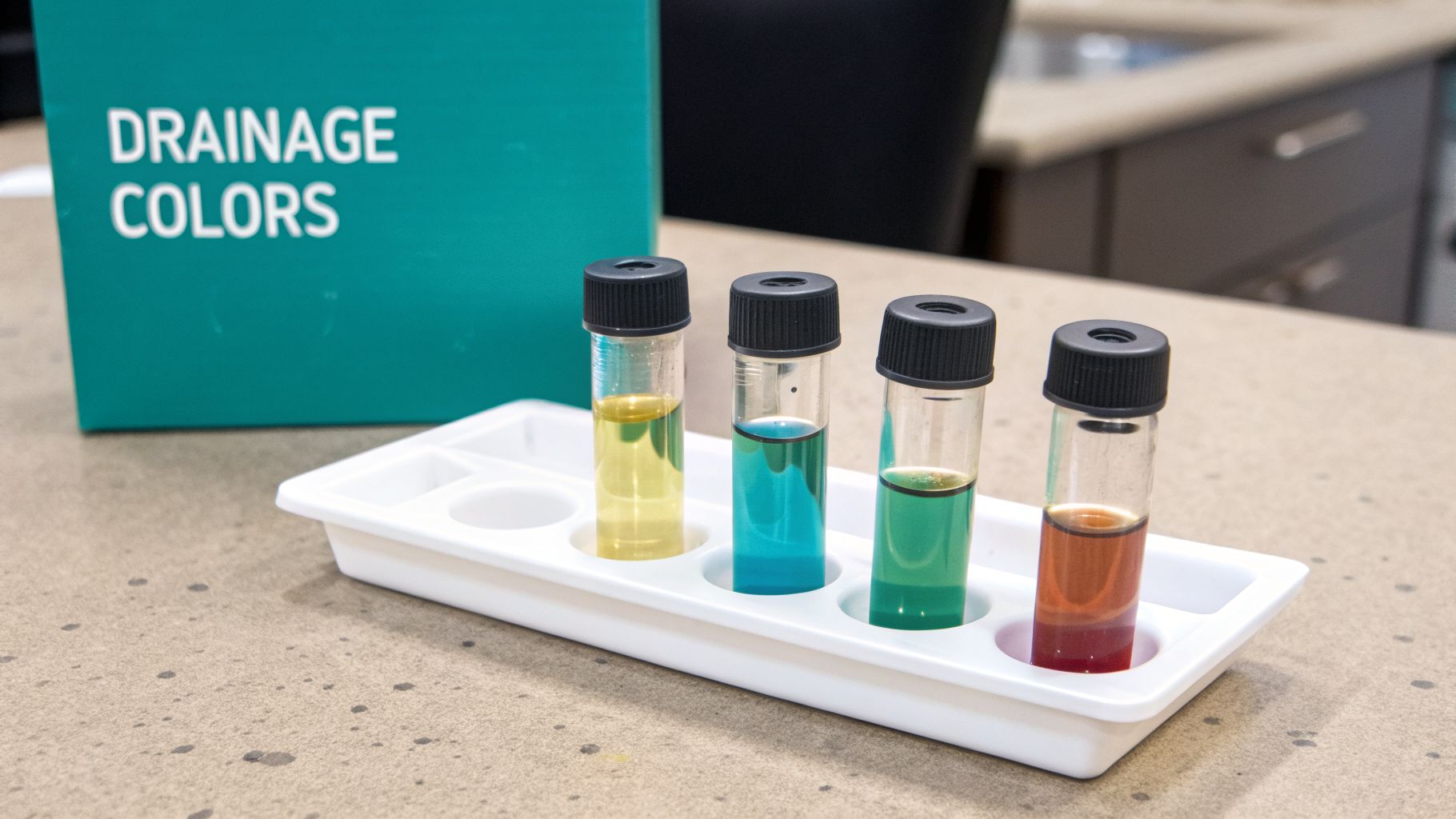
In wound care, drainage isn't just fluid; it's a language. The color, consistency, and odor of purulent exudate can tell you a remarkable story about what’s happening beneath the surface, often pointing directly to the type of bacteria causing an infection. Learning to read these visual cues is one of the most powerful assessment skills you can develop, giving you a head start long before any lab results come back. This clinical acumen is invaluable in initiating prompt and appropriate empirical treatment.
This isn't about simply noting "infection present." It’s about asking, "what kind of infection am I looking at?" Purulent drainage is essentially the aftermath of a battle, a thick, cloudy mix of dead tissue, bacteria, and the white blood cells sent to fight them. This composition is what gives it a distinct look and feel compared to healthy wound fluid. Each color variation can be thought of as a different chapter in the story of the wound's struggle against pathogenic invaders.
Creamy Yellow or White Drainage
When you pull back a dressing and find thick, creamy, or opaque white drainage, your first thought should be Staphylococcus aureus. This is the usual suspect in a huge number of skin and soft tissue infections, and its presentation is fairly consistent. It's one of the most frequently encountered pathogens in clinical practice, making this presentation a common sight.
The drainage often looks almost "milky." One misleading thing about Staph is that the odor can be minimal or even absent. Don't let a lack of a foul smell throw you off; this creamy exudate is a classic sign of a Staph infection that needs attention. The absence of odor should not provide a false sense of security.
You'll commonly see this purulent drainage color in:
- Infected post-surgical sites.
- Pressure injuries that have become colonized.
- Everyday cuts or scrapes that have taken a bad turn.
- Folliculitis and abscesses.
The thick consistency comes from the sheer volume of white blood cells that have flooded the area to combat the bacteria. Your job is to choose a dressing that can handle this heavy, viscous fluid while also delivering antimicrobial action to the wound bed. Management must address both the high bioburden and the significant exudate volume.
Green or Blue-Green Drainage
See a distinct green or even a blue-green tinge? That's the calling card of Pseudomonas aeruginosa. You can’t mistake it. This bacterium is famous for producing pigments—pyocyanin (which is blue-green) and fluorescein (yellow-green)—that mix together to create its signature hue. This unique biochemical signature makes it one of the most visually recognizable wound infections.
Even more telling is the smell. Pseudomonas infections often have a uniquely sweet, grape-like, or corn-tortilla-like odor. Once you've smelled it, you’ll never forget it. This one-two punch of a specific green color and a particular sweet smell is practically diagnostic at the bedside, often allowing for presumptive identification while awaiting culture results.
Pseudomonas loves moist environments, making it a frequent and troublesome colonizer in burn wounds, tracheostomy sites, and heavily draining chronic ulcers. It’s a major concern because it’s notoriously resistant to many standard antibiotics.
Recognizing this specific green purulent drainage color is a critical alert. It signals that you’re dealing with a tough, often multi-drug resistant organism and is a strong reason to get a wound culture to ensure the patient is put on an effective antibiotic. Immediate action is warranted to prevent the establishment of a chronic, difficult-to-treat infection.
Brown or Tan Drainage with a Fecal Odor
If the drainage is brown or tan and comes with a powerful, foul, or fecal odor, your investigation should turn to anaerobic bacteria—organisms that live without oxygen. This often points to contamination from enteric (gut) bacteria like Bacteroides or E. coli. This combination of color and odor is a strong indicator of a polymicrobial infection involving organisms from the gastrointestinal tract.
This presentation is most common in wounds near the perineal or GI tract, such as:
- Abdominal surgical wounds that have become infected, particularly after bowel surgery.
- Fistulas that have a connection to the bowel.
- Sacral or buttock pressure injuries, especially on incontinent patients.
- Diabetic foot ulcers that have deep-seated infections.
The brown color often comes from the byproducts of these specific bacteria mixed with old, broken-down blood in the exudate. That unmistakable odor is the key giveaway for anaerobic activity. These infections can be aggressive and often involve multiple types of bacteria working together (synergistically), which can make treatment a real challenge. For a closer look at the different kinds of fluids you might see, you can check out our guide on the types of wound exudates.
Interpreting the Signs at a Glance
To help you quickly connect the dots during your assessment, here is a quick-reference chart linking drainage colors to their likely culprits. This chart serves as a cognitive aid at the bedside, streamlining the process from observation to initial hypothesis.
Purulent Drainage Color Interpretation Chart
| Color | Likely Pathogen | Associated Odor | Clinical Considerations |
|---|---|---|---|
| Creamy Yellow/White | Staphylococcus aureus | Often minimal or slightly sour | Most common bacterial cause of wound infections. Thick consistency. May be MRSA. |
| Green/Blue-Green | Pseudomonas aeruginosa | Sweet, "grape-like," or "corn tortilla" | High risk of antibiotic resistance. Thrives in moist wounds. Often forms biofilm. |
| Brown/Tan | Anaerobic bacteria (Bacteroides, E. coli) | Foul, fecal, or putrid | Suggests gut flora contamination. Common in abdominal or perineal wounds. Often a polymicrobial infection. |
| Gray/Purple | Gram-positive cocci or anaerobes | Putrid | May indicate a more severe, deep-seated infection like necrotizing fasciitis. Requires urgent attention. |
Remember, this chart is a guide for your initial assessment. A definitive diagnosis always relies on a wound culture, but these visual and olfactory clues are invaluable for getting a head start on appropriate care. They allow for the initiation of empirical therapy while awaiting definitive laboratory identification and susceptibility results.
Sanguinopurulent Drainage: A Bloody Mix
Sanguinopurulent drainage is a cloudy, reddish, or pink fluid that looks like a mix of pus and blood. The name says it all: "sanguineous" (bloody) + "purulent" (pus). This tells you that an active infection is happening in a wound that is also bleeding. It indicates both infection and tissue damage leading to vascular compromise.
This can happen for a couple of reasons. The infection itself might be so aggressive that it's eroding the tiny capillaries in the wound bed, or the tissue could be so fragile that it bleeds with even minor trauma, like a dressing change. This friability is a common feature of infected granulation tissue.
While healthy healing wounds can sometimes have a faint pink tinge (serosanguineous), true sanguinopurulent drainage is opaque and thicker. It’s a red flag that the infection is causing significant tissue damage and inflammation, signaling the need for careful management to control both the bleeding and the bioburden. This finding necessitates a delicate approach to debridement and dressing selection.
How to Systematically Assess and Document Wound Drainage

Spotting the purulent drainage color is a great start, but what you do with that information is what truly matters. Excellent assessment and documentation turn a simple observation into a powerful clinical tool for the entire care team. When you have a standardized process, you ensure no critical detail gets missed. A systematic approach is the cornerstone of reliable and reproducible clinical evaluation.
Think of yourself as a detective at the bedside. You're not just writing down "pus present." You're collecting and recording specific clues—the amount, the consistency, the odor—that help build the case for what’s happening inside that wound. This meticulous record is vital for tracking healing, justifying treatments, and handing off care to the next clinician. It forms a legal and clinical record of the patient's journey.
Quantifying the Amount of Drainage
First things first, let's talk volume. Vague terms like "some drainage" just don't cut it in a clinical chart. We need standardized language that paints a clear picture for anyone who reads your note, and the best way to do that is by describing how much of the dressing is saturated over time. Objective quantification is key to tracking progress or decline.
Here's a simple and effective framework that most clinicians use:
- Scant: The wound bed is moist, but no actual drainage is visible on the dressing.
- Minimal (or Small): The drainage covers less than 25% of the dressing.
- Moderate: You're seeing drainage on about 25% to 75% of the dressing.
- Copious (or Large): The drainage has soaked through more than 75% of the dressing. Some definitions also include "strike-through," where the exudate has penetrated the secondary dressing.
Using these terms creates an objective benchmark that your colleagues can easily understand and compare against during the next dressing change. It also directly guides decisions, like what type of dressing to use and how often it needs to be changed. For instance, copious drainage necessitates a highly absorbent primary dressing and possibly a more frequent dressing change schedule.
Describing Consistency and Characterizing Odor
Once you’ve noted the amount, the next step is to describe the fluid’s physical properties. The consistency of purulent drainage gives you more clues about the infection. Is it thick like paste, or is it thin and watery? These characteristics can hint at the bacterial load and type.
Use clear, descriptive terms in your documentation:
- Thick or Viscous: This is your classic purulent drainage, suggesting a high concentration of bacteria and cellular debris.
- Thin or Watery: This might point to a mixed fluid, like seropurulent drainage, where an infection is present but less dense, or could indicate high levels of edema.
- Stringy or Tenacious: Sometimes you'll see this with specific bacteria or if a biofilm has formed in the wound bed. This consistency can make wound cleansing more challenging.
Odor is another huge diagnostic clue, but you have to assess it correctly. A smell that hits you when you first pull off an old dressing might just be from old, trapped exudate. The real test comes after you've cleaned the wound.
An odor that persists after you’ve gently cleansed the wound is a major red flag. It strongly points to an active infection, often involving anaerobes or Pseudomonas. Be sure to document it clearly with descriptors like "foul," "fecal," or even "sweet" to give the next person more specific information.
Capturing these detailed observations quickly and accurately is crucial. Many clinicians find that using specialized Dictation Software For Medical Professionals helps them record their findings in real-time, ensuring nothing gets lost between the bedside and the chart. This technology can significantly improve the efficiency and accuracy of clinical documentation.
Putting It All Together in Your Documentation
A top-tier wound note weaves all these details into one clear story. Your documentation should be a snapshot that tells the wound’s complete status at that moment. When you combine color with amount, consistency, and odor, you create an undeniable clinical picture that is both comprehensive and easy to interpret.
Just look at the difference between a lazy note like "Wound draining" and a detailed, professional one:
Example Documentation Note:
"Abdominal wound shows moderate amount of thick, creamy yellow purulent drainage on dressing changed after 24 hours. No odor noted after saline cleansing. Periwound skin is intact. Wound dimensions remain stable at 4x3x0.5 cm."
This level of detail eliminates any guesswork. It clearly communicates the wound’s status, backs up your treatment plan, and creates a solid baseline for the next clinician to assess progress. If you're looking to refine your notes, our comprehensive wound care documentation template can provide a great structural starting point.
Deciding When to Culture the Wound and Escalate Care

Observing a wound’s drainage is the first piece of the puzzle. But what you do next—your decision to culture, change dressings, or call the doctor—is what really drives a patient's outcome. This is where assessment transitions into clinical action and critical thinking.
This is where your clinical judgment comes in. Not every wound with pus needs a culture. But at the same time, missing the red flags for a serious infection can lead to major complications down the road, including sepsis and tissue loss.
Your job at the bedside boils down to one critical question: Is this infection contained in the wound bed (local), or is it starting to spread (systemic)? A local infection often responds well to focused wound care and topical antimicrobials. But if it’s spreading, you need to act fast, and that means escalating care, getting a culture, and likely starting systemic antibiotics. This distinction is paramount in triage and patient safety.
The Decision Point: When to Culture
Think of a wound culture as sending a sample to the lab with a note saying, "Tell me exactly what I'm up against." It's an indispensable tool for pinpointing the right antibiotic, especially with the rise of resistant bugs like MRSA and VRE. It moves treatment from empirical to targeted.
But you don’t need to culture every single wound. Routine culturing of clinically uninfected wounds is not recommended. You're a detective at the bedside, and you only send evidence to the lab when the clues point to a specific, hard-to-beat culprit or when the infection is not responding to initial therapy.
So, when should you get a culture?
- The wound isn't healing. If you’ve been providing appropriate care for two to four weeks and the wound is stalled or looks worse, it's time to investigate further. This is a classic sign of a critical bacterial load.
- The signs of infection are getting worse. This could be more drainage, an ominous color change (like that tell-tale green), or a new, foul odor that wasn’t there before. Any negative change warrants reconsideration of the diagnosis.
- You suspect a resistant organism. If the patient has a history of MRSA or the wound isn't responding to standard treatment, a culture is a must. This is particularly true if you see that distinct green drainage that screams Pseudomonas.
- Before starting systemic antibiotics. A culture should ideally be obtained before the first dose of antibiotics to ensure the results are not skewed.
When you do take a culture, technique is everything. First, cleanse the wound bed thoroughly with saline to remove surface contaminants. Swabbing old drainage or surface gunk will only grow colonizing bacteria, not the pathogen causing the actual infection. Use the Levine technique—press and rotate the swab firmly over a clean one-square-centimeter area of the wound bed to get a sample that truly reflects what's happening in the tissue. This method is considered the gold standard for swab cultures.
Triggers for Escalating Care Immediately
Sometimes, a culture isn't enough. Certain signs are clear signals that the infection is winning and you need to escalate to a physician or specialist right away. These are the red flags that tell you the problem is no longer just in the wound but has become a systemic issue.
If you spot any of these spreading or systemic signs, your priority shifts from manager to messenger. Your role becomes one of urgent communication.
Key Triggers for Escalation:
- Spreading Redness (Cellulitis): Erythema that creeps more than 2 cm beyond the wound's edge is a classic sign that the infection is invading the surrounding tissue. Marking the border of the redness can help track its progression.
- Systemic Symptoms: The patient suddenly has a fever, chills, new confusion (especially in the elderly), hypotension, or just feels generally unwell. These are alarm bells indicating the infection may have hit the bloodstream (sepsis).
- Increased Pain or Swelling: A sharp, sudden increase in pain, warmth, or swelling around the wound points to a rapidly worsening inflammatory process, potentially an abscess forming under the surface.
- New or Worsening Signs: The sudden appearance of undermining, tunneling, crepitus (a crackling sensation under the skin indicating gas), or a rapid increase in the amount of pus means the infection is getting aggressive and needs a provider's immediate attention.
When you see these signs, it's time to get the provider involved immediately. The patient almost certainly needs systemic antibiotics, and a delay could have serious consequences, including limb loss or death. For a deeper dive into the basics, our article answering "is pus a sign of infection?" provides excellent background.
Making the right call in these moments is what good nursing is all about. It protects your patient and ensures they get the right care at exactly the right time.
Taking Action: How to Treat Infected Wounds
So, you’ve assessed the wound and have a good idea of what the purulent drainage color is telling you. Now for the most important part: turning your assessment into action. Managing an infected wound is more than just putting a bandage on it. It’s about taking back control of the wound environment through a multi-faceted approach.
When I look at an infected wound, I have three immediate goals. I need to knock down the bacterial bioburden, get a handle on the heavy drainage, and protect the fragile skin around the wound—the periwound—from getting soggy and breaking down (maceration). This triad of goals forms the core of effective local wound management.
Choosing the Right Tools for the Job
Selecting a dressing is one of the most critical decisions you'll make. I always tell new clinicians to think of dressings as specialized tools. You wouldn't use a screwdriver to pound a nail, and you shouldn't use a one-size-fits-all approach to wound care. The dressing must be matched to the specific needs of the wound at that point in time.
For a wound with purulent drainage, your strategy needs to fight the infection and manage the fluid. This almost always means using two types of dressings: a primary dressing that sits right on the wound bed and a secondary dressing on top to soak up the excess.
Here are the workhorses you’ll find in my treatment room:
- Antimicrobial Dressings: These are your front-line soldiers. Dressings loaded with ingredients like silver, iodine (cadexomer iodine is particularly effective for sloughy, high-exudate wounds), PHMB (polyhexamethylene biguanide), or medical-grade honey release their power directly into the wound, helping to kill bacteria right where they live. The choice of agent may be influenced by suspected pathogen and local protocols.
- Highly Absorbent Dressings: When you're facing a flood of purulent drainage, you need something that can keep up. Alginates, which come from seaweed, and hydrofibers are my go-to choices. As they absorb fluid, they turn into a gel, which smartly locks the drainage away from the wound and the surrounding skin. This gelling action also helps to maintain a moist wound environment.
- Foam Dressings: Think of these as a soft, protective pillow that also happens to be incredibly thirsty. They're fantastic as a secondary dressing, absorbing a ton of exudate while providing a cushion against pressure and friction. Many come with a built-in adhesive border, which makes securing everything much easier and provides a bacterial barrier.
When selecting a dressing, the goal is to create a balanced, moist wound environment—not too wet and not too dry. An overly saturated dressing can lead to maceration (soggy, white skin), while a dry wound bed can stall the healing process entirely. The principle of moisture balance is key.
You Can't Treat What You Don't Clean
Before a new dressing even comes out of the package, the wound must be properly cleansed. This step is completely non-negotiable. Good cleansing clears out all the loose gunk, surface bacteria, and old drainage, giving your antimicrobial dressing a clean shot at the wound bed. It's a foundational step that prepares the wound for treatment.
The trick is to be thorough without being rough. Scrubbing too hard will tear up the delicate new tissue that’s trying to grow. Instead, use a gentle but firm technique with a non-cytotoxic cleanser like normal saline or a commercial wound cleanser at a safe irrigation pressure.
A solid treatment plan is a combination of things working together. You're managing the purulent drainage with the right dressings, cleaning the wound properly, and always watching for signs that the infection might be spreading. You can explore more about these treatment fundamentals to see how all the pieces fit together. This coordinated effort, often involving debridement, topical therapy, and systemic support, is what ultimately turns the tide against infection.
Matching the Intervention to What You See
Let’s walk through how this looks at the bedside. Your assessment is your road map, and the type of purulent drainage you see points you directly to the right treatment. This is evidence-based practice in action.
Here are a couple of common scenarios:
The Scenario: You find a moderate amount of thick, creamy yellow purulent drainage—a classic sign of a Staphylococcus infection—in a post-operative abdominal wound.
- The Action: Start by cleansing the wound well with saline. For your primary dressing, choose something with silver or iodine to attack the bacteria head-on. An alginate rope or hydrofiber ribbon can be packed gently into the wound space. Then, cover it with an absorbent foam dressing to handle that moderate amount of drainage and protect the incision.
The Scenario: The wound, a chronic leg ulcer, has a small bit of thin, greenish drainage that has a distinctly sweet smell, making you think of Pseudomonas. The periwound skin is slightly macerated.
- The Action: Cleanse the wound. If your facility protocol allows, a cleanser with acetic acid can be particularly effective here. Follow that with a primary dressing that works well against Pseudomonas (some silver dressings are great for this, or specific anti-pseudomonal dressings). Apply a skin barrier film to the periwound to protect it from moisture. Cover with a secondary dressing designed for light drainage, perhaps a thin foam.
By carefully matching your cleansing and dressing strategy to what the wound is showing you—especially the purulent drainage color—you create the best possible environment for healing. This isn't just about managing symptoms; it's an evidence-based approach that actively fights the infection and helps the body get back on the path to recovery.
Frequently Asked Questions About Purulent Drainage
When you're at the bedside, assessing a complex wound, practical questions come up fast. Here are some quick, clear answers to the most common queries we hear from clinicians about identifying and managing purulent drainage. These FAQs address common points of confusion and reinforce key learning objectives.
Is All Thick Wound Drainage Purulent?
That's a great question, and the short answer is no. While pus is almost always thick and opaque, not all thick, gunky drainage is pus. It's a common point of confusion, especially for novice clinicians.
You'll often see a thick, yellowish fluid that looks suspiciously like pus during autolytic debridement or if there's a good amount of slough in the wound bed. This is the body's way of cleaning house, and the "exudate" is a mixture of liquified necrotic tissue, fibrin, and white blood cells, but it isn't necessarily an infection. Another potential mimic is residual hydrocolloid dressing, which can form a gel that resembles pus.
The real tell-tale sign is opacity, combined with other signs of infection (pain, heat, redness, swelling). True purulence is so cloudy you can't see through it at all. It’s packed with white blood cells, dead bacteria, and other cellular junk—the true signs of a fight against infection that needs your attention.
Can a Wound Have Purulent Drainage Without a Bad Odor?
Absolutely. It’s a dangerous assumption to think "no smell, no problem." While some bugs are notorious for their smells—like the sickly sweet scent of Pseudomonas or the fecal odor from anaerobes—some of the most common culprits are surprisingly stealthy.
Staphylococcus aureus, for example, is a major player in wound infections. It often produces that classic creamy, yellow pus but with little to no smell. This is why relying on a single clinical sign is a pitfall.
Think of odor as just one piece of the puzzle. Its absence doesn't get you off the hook. This is exactly why you have to rely on a full visual assessment of the purulent drainage color and consistency, alongside the status of the periwound and the patient's overall condition, to get the real story.
Remember, a change in color or consistency, or a sudden increase in volume, is often a more reliable early sign of infection than odor alone. Never dismiss purulent-looking drainage just because it doesn't smell bad.
How Quickly Should Purulent Drainage Resolve with Treatment?
When you’ve got the right treatment on board—the correct systemic antibiotic (if indicated) and an appropriate antimicrobial dressing—you should start seeing a clear improvement within 3 to 5 days. Don't expect it to vanish overnight, though. The healing process is a marathon, not a sprint.
The first thing you’ll notice is a drop in the volume and thickness of the exudate. The wound will simply look less "soupy." The periwound inflammation should also begin to subside.
As the treatment continues to knock down the bacterial load, the color will begin to shift. That opaque, angry-looking fluid will thin out, becoming more translucent and seropurulent. This is a great sign that you're on the right track, as it transitions back toward healthy serous or serosanguinous drainage. If you hit day five and see zero improvement, or the wound looks worse, it’s a major red flag that your treatment plan needs a second look. This could indicate bacterial resistance, an incorrect diagnosis, or an unaddressed underlying issue.
At Ekagra Health AI, we build tools that simplify complex clinical tasks. Our AI-powered platform helps you document wound characteristics instantly, turning your voice notes into structured, coded data that accelerates everything from treatment planning to billing. Discover how to streamline your wound care workflow by visiting https://ekagrahealth.ai.
