
Think of a place of service (POS) code as the GPS coordinate for your medical claim. It’s a simple two-digit number that tells payers exactly where a patient received care, but its impact is anything but simple. Getting it right is often the difference between a fully paid claim and a costly, time-consuming denial. This isn’t just about administrative accuracy; it’s a foundational element of your revenue cycle management that directly impacts your bottom line.
In this comprehensive guide, we'll dive deep into the world of place of service codes, specifically for wound care. We will explore what these codes mean for your revenue, how to navigate the most common ones, and how to build a foolproof process for selecting the right code every single time. By the end, you'll understand not just the "what," but the "why" behind each code, empowering your practice to minimize errors and maximize reimbursements.
What Place of Service Codes Mean for Your Revenue
In medical billing, the place of service code is a cornerstone of the revenue cycle. It directly influences how—and how much—your organization gets paid. This isn't just an administrative detail; it's a critical piece of financial data that dictates the reimbursement rate. Payers, including Medicare, Medicaid, and private insurance companies, use the POS code to apply specific fee schedules that distinguish between services provided in a "facility" setting (like a hospital) versus a "non-facility" setting (like a private physician's office).
Believe it or not, the exact same wound care procedure can command vastly different payments based entirely on this two-digit code. A debridement done in a physician’s office, for instance, follows a different reimbursement structure than one provided in a hospital outpatient department. The logic is that in a non-facility setting, the physician's payment needs to cover all overhead costs—rent, staff, supplies, and equipment. In a facility setting, the hospital bills separately for those overhead costs, so the physician's professional fee is lower. Understanding this distinction is the first step toward accurate billing.
The Financial Stakes in Wound Care
The financial implications are especially high in the complex world of wound care, where patients often move between multiple treatment settings. From skilled nursing facilities to specialized outpatient clinics and even home health visits, the location of service can change frequently, and each environment has its own unique billing rules and reimbursement logic. A single mistake can lead to a cascade of problems, from an immediate denial to a prolonged appeals process that drains staff resources.
This complexity exists within a rapidly growing industry. The global market for wound care centers is projected to hit USD 63.80 billion by 2034. In 2024 alone, North America is expected to hold 45% of the market share, underscoring the sheer volume and financial significance of these services. You can discover more insights about the expanding wound care market to see the full picture. With so much at stake, precision in coding is not a luxury; it's a necessity for survival and growth.
Key Takeaway: Mastering place of service coding isn't just about compliance. It’s a fundamental strategy for protecting revenue, preventing denials, and ensuring the financial health of your wound care practice in a competitive field.
Getting a handle on these codes is the first step toward building a resilient billing process that captures every dollar you've earned. It makes sure your claims accurately reflect the high-quality care you provide, no matter where it’s delivered, and solidifies your financial foundation in an expanding market.
Navigating the Most Common Wound Care POS Codes
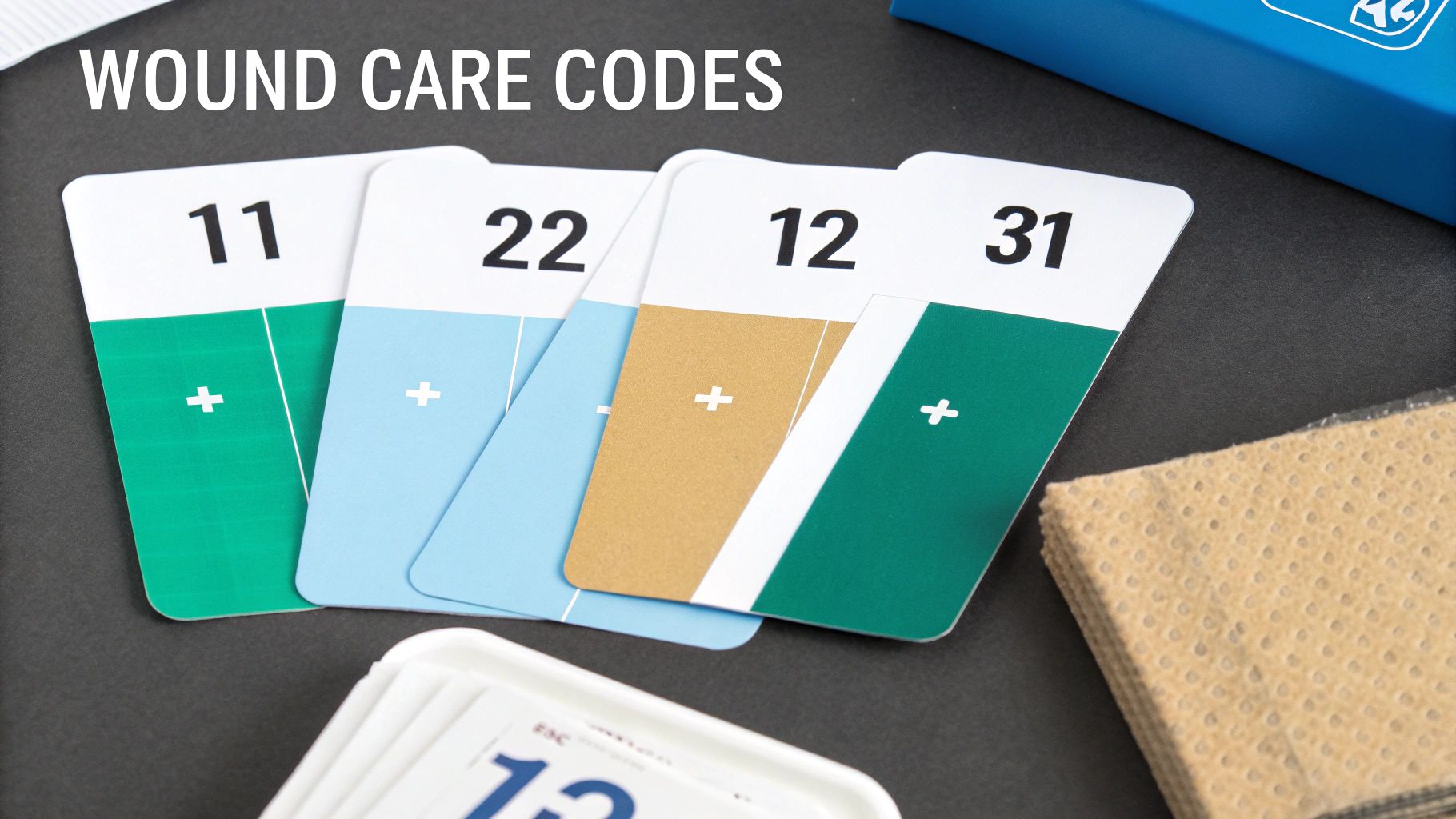
While there are dozens of Place of Service codes on the books, you'll find that a small handful pop up again and again in the world of wound care. Getting these core codes right isn't just a matter of good record-keeping; it's fundamental to getting paid correctly and on time. These codes are the language you use to communicate the context of care to payers.
Think of each code as a different chapter in the patient's story. It tells the insurance payer where the care happened, which directly influences how much you're reimbursed and which rules apply. This is especially true for wound care, which spans a wide variety of settings. Let's dig into the most common codes you'll see and what they actually mean in practice, as understanding their nuances is critical for financial success.
POS 11: The Physician’s Office
POS 11 is the bread and butter for many providers. This code signals that the service took place in a location not owned by a hospital. We're talking about a standalone podiatry clinic, a private dermatology practice, or any freestanding outpatient center where a physician or practitioner delivers care. This is the quintessential independent practice setting.
When you use POS 11, you're telling the payer you're in a “non-facility” setting. This is a critical detail. It means Medicare issues a single, global payment that covers both the professional component (the clinician's expertise) and the practice expense (think supplies, staff salaries, and rent). Because this single payment is meant to cover everything, it’s generally higher for each procedure compared to what a doctor earns in a hospital setting for the same service. For wound care, this includes the cost of dressings, debridement tools, and other consumables.
POS 22: The On-Campus Outpatient Hospital
This is where the lines can get a bit blurry and where many costly errors occur. POS 22 is used for an outpatient department that is financially and administratively part of a hospital, even if it’s in a different building on the hospital's campus. This is a classic “facility” setting. The key determinant is ownership and integration with the hospital system, not the physical address.
The billing splits in two here. The clinician submits a claim for their professional services and gets paid a lower professional fee. At the same time, the hospital submits its own facility claim (often on a UB-04 form) to cover its overhead, supplies, and staff costs. This two-claim system is a frequent source of confusion and a common reason for denials if the two sides aren't perfectly aligned, for instance, if the physician's claim has a different diagnosis code than the hospital's facility claim.
Key Insight: The true difference between POS 11 and POS 22 isn't the physical address but the financial relationship. A clinic right across the street from a hospital could be POS 11 if it's independent, or POS 22 if it's owned and operated by the hospital. Always verify the clinic's official designation.
Key Place of Service Codes for Wound Care Settings
To make sense of these distinctions, here's a quick reference table that breaks down the common POS codes, their official descriptions, and how they typically play out in wound care billing. This table can serve as a go-to resource for your billing team.
| POS Code | Setting Description | Common Wound Care Application | Billing Nuance (Facility vs. Non-Facility) |
|---|---|---|---|
| 11 | Physician's Office | A private practice podiatry or dermatology clinic providing debridement. | Non-Facility: Clinician receives a higher, single global payment covering all expenses. |
| 22 | On-Campus Outpatient Hospital | A hospital-based wound care center located on the main hospital campus. | Facility: Billing is split. Clinician gets a lower professional fee; hospital bills separately. |
| 12 | Home | A home health nurse changes a post-operative dressing in a patient's living room. | Non-Facility: Services are paid based on a non-facility fee schedule. |
| 31 | Skilled Nursing Facility | A wound care specialist performs a consultation for a resident with a pressure ulcer. | Facility: Subject to SNF consolidated billing rules; payment depends on patient's stay status. |
This table helps illustrate why just one number can completely change the billing logic and reimbursement for the exact same procedure. Training your staff to understand these nuances is a direct investment in your revenue cycle health.
POS 12: The Patient’s Home
Just like it sounds, POS 12 is for care provided in a patient's private residence. This is the go-to code for home health agencies managing complex wounds or for physicians making the occasional house call. It's also increasingly relevant for mobile wound care providers who treat patients where they live.
The crucial detail here is that the patient's home isn't a licensed healthcare facility. Reimbursement for services billed under POS 12 also follows a non-facility fee schedule, similar to a doctor's office. It's important to document the medical necessity of the home visit, as some payers scrutinize these claims more closely to ensure the patient is truly homebound or that the service couldn't have been provided in an office setting.
POS 31: The Skilled Nursing Facility
When your patient is in a Skilled Nursing Facility (SNF), you'll use POS 31. This code is for services provided by a physician or other practitioner to a patient who has been admitted to a facility providing 24-hour nursing care under a physician's direction.
It's so important to get this right, as SNF billing rules are notoriously complex. Many services provided to a patient in a SNF fall under "consolidated billing," meaning the SNF is responsible for billing Medicare for the majority of the patient's care, and the outside provider must arrange payment with the SNF. However, certain professional services can be billed separately. You need to be sure the patient is in a SNF, not just an assisted living facility, which would use a different code. Understanding the intricate payment systems within a skilled nursing facility is absolutely essential for preventing claim denials in this environment.
How to Choose the Right POS Code Every Time
Memorizing a list of Place of Service codes is one thing. Applying them correctly when you’re juggling patients and paperwork is another beast entirely. The trick is to anchor every decision in one simple, unshakeable rule: the POS code must reflect the patient's exact physical location during the face-to-face encounter. It sounds straightforward, but in the heat of a busy clinic day, details can get lost between the clinical note and the claim form.
That’s it. That’s the guiding star. Every time your team prepares a claim, this principle should be front and center. To make this actionable, it helps to build a simple Q&A checklist into your workflow to slice through any confusion and land on the right code. This creates a standardized process that reduces variability and human error.
A Practical Decision-Making Framework
It all starts with one foundational question: Where, physically, did the clinician and patient meet? The answer immediately cuts your list of potential codes in half. From there, you can dig a little deeper with more specific questions to pinpoint the exact code required by the circumstances.
Get your team in the habit of asking these key questions during charge entry or coding review:
- Is our clinic financially and structurally part of a hospital? This is the make-or-break question for choosing between POS 11 (Physician’s Office) and POS 22 (On-Campus Outpatient Hospital). It doesn't matter if you're next door or share a parking lot; what matters is the official business relationship registered with payers. Your credentialing team should have this information readily available.
- Was the service delivered over a screen? If the visit happened via audio and video, you're in telehealth territory. This points you toward POS 02 (Telehealth Provided Other than in Patient’s Home) or the newer POS 10 (Telehealth Provided in Patient’s Home), which clarifies the patient was at home during the virtual call.
- Was the patient in their own home or a licensed facility? This helps you differentiate POS 12 (Home) from codes for places like a skilled nursing facility (POS 31), an assisted living facility (POS 13), or a custodial care facility (POS 33). Each has a distinct code and reimbursement rules.
By making these questions a standard part of your billing prep, you build a consistent and repeatable process. POS coding stops being a guessing game and becomes a methodical practice, which dramatically cuts down on the kind of errors that trigger claim denials and payment delays.
Tackling Modern Coding Challenges
Healthcare isn't static, and new care delivery models are always popping up to test our coding knowledge. These scenarios require careful application of the fundamental POS principle: code for the patient's location.
Take mobile wound care units, for instance. These clinics-on-wheels are becoming more common for reaching underserved populations. The POS code isn't about the van; it's about where the van is parked when the patient is treated. That could be a homeless shelter (POS 04), an assisted living facility (POS 13), or a patient's private driveway (POS 12). The documentation must clearly state the location to support the code choice.
Telehealth is another area where things can get murky. While POS 02 has been the catch-all for years, the newer POS 10 adds important specificity for when a patient is in their own home. You absolutely have to check individual payer guidelines here, as some have a strong preference for one over the other, and policies continue to evolve post-public health emergency.
Getting this right is more important than ever. The global wound care market is on track to hit USD 33.62 billion by 2033, with North America leading the charge. With that kind of money on the table, accuracy is non-negotiable. Ultimately, a solid decision process needs to be backed by rock-solid notes. Using a detailed wound care documentation template ensures you capture the specifics needed to justify your POS choice if an auditor ever comes knocking.
The True Financial Cost of Place of Service Errors
A single incorrect digit on a claim form might seem like a minor typo, but in medical billing, it can set off a massive financial chain reaction. Place of service errors aren't just small administrative slip-ups; they are direct threats to your revenue stream, leading to immediate claim denials, persistent underpayments, and the looming risk of payer audits and takebacks. These errors create rework, delay cash flow, and can ultimately harm the financial viability of a practice.
Getting a handle on the real dollars and cents at stake is the first step to safeguarding your practice’s financial health. These aren't abstract concepts—they are tangible losses that pile up fast, particularly in a busy wound care clinic. A simple coding mistake can easily flip a profitable procedure into a net loss once you factor in the staff time spent chasing down the error, researching the denial, fixing the claim, and resubmitting it. This "cost of rework" is a hidden drain on practice resources.
Facility vs. Non-Facility: A Costly Comparison
Let’s make this real with a procedure you see every day: a surgical debridement of subcutaneous tissue (e.g., CPT code 11042). The reimbursement for this service swings wildly depending on which place of service code is on the claim, as it determines whether you are paid under the Medicare Physician Fee Schedule's facility or non-facility rates.
First, imagine the debridement happens at a freestanding clinic, one that's not part of a hospital. The right code here is POS 11 (Physician’s Office).
- Under POS 11 (Non-Facility): Medicare issues a single, higher global payment. This fee is meant to cover everything—the physician’s work, plus all the clinic’s overhead like supplies, equipment, and staff. For a typical debridement CPT code, this might come out to around $250. This payment acknowledges that the practice bears the full cost of providing the service.
Now, picture that exact same procedure taking place in a wound care center that is organizationally part of a hospital system. In this scenario, the correct code is POS 22 (On-Campus Outpatient Hospital).
- Under POS 22 (Facility): The payment structure is completely different. The total reimbursement is split. The physician bills for their professional services and gets a smaller portion, maybe $150. The hospital then sends its own separate claim to cover its facility expenses (the other $100, plus potentially more).
The trouble starts when these codes get switched. If that freestanding clinic accidentally bills with POS 22, they've just left $100 on the table for that one patient visit. They will only receive the lower professional fee and will have no mechanism to recoup the costs of their supplies and overhead. On the flip side, if a hospital-based clinic incorrectly uses POS 11, they're billing for facility costs they aren't actually entitled to under that code—a huge compliance red flag that practically begs for an audit and could lead to significant takebacks and penalties.
A simple coding error doesn't just delay your payment—it can permanently slash it. Across hundreds of claims, this "small" difference can easily add up to tens of thousands of dollars in lost revenue every single year.
This one example shows why getting the place of service right is absolutely non-negotiable. It’s not just about dotting the i's and crossing the t's. It's about accurately representing the service provided to ensure fair and compliant reimbursement. Investing in proper training for your coders, creating clear internal guidelines, and using technology to catch mistakes isn't an expense—it's a fundamental strategy for protecting your revenue and staying compliant in a complex healthcare landscape.
Real-World Scenarios for Wound Care Coding
Knowing the rules is one thing, but applying them in a hectic clinic is where it really counts. Theory is great, but practical application is what prevents denials. To make these concepts stick, let’s walk through a few common situations wound care teams run into every day, highlighting the decision-making process for selecting the correct POS code.
By breaking down the "why" behind each choice, you can turn these abstract codes into practical knowledge for your team. Use these scenarios as training tools to foster critical thinking among your billing and clinical staff.
Scenario 1: The Hospital-Owned Clinic
Imagine a patient with a diabetic foot ulcer visits a wound care center. The center is located in a medical office building right on the main hospital campus, and it's owned and operated by the hospital—all staff are hospital employees and the clinic is registered with payers as a hospital department. A physician performs a sharp debridement.
- Correct POS Code: POS 22 (On-Campus Outpatient Hospital)
- The Logic: The most important detail here isn't the building itself, but the clinic's financial and administrative ties to the hospital. Since it’s an official department of the hospital, it’s considered a facility setting. The patient registration and billing systems are integrated with the main hospital.
- How It's Billed: This triggers two separate claims. The physician submits a claim for their professional fee, and the hospital submits a facility fee claim to cover the cost of the room, supplies, and nursing staff. Using POS 11 here would be a serious compliance violation.
Scenario 2: The Independent Podiatrist's Office
Now, let's say a patient with a venous leg ulcer goes to their local podiatrist for a follow-up visit and gets a multi-layer compression bandage. This clinic is a private practice, miles from the nearest hospital, and has no financial or administrative affiliation with one. It is a separate legal entity.
- Correct POS Code: POS 11 (Physician’s Office)
- The Logic: This is a textbook non-facility setting. The practice is completely independent and covers all its own overhead, from the rent and electricity to the gauze and bandages. The higher non-facility payment rate is designed to compensate the practice for these expenses.
- How It's Billed: The podiatrist submits a single claim using POS 11. The payment they receive is a global fee, meaning it covers both their professional work and all the practice expenses, including the compression bandage supplies (which are typically bundled into the procedure code payment in this setting).
Getting this right is more important than ever. The advanced wound care market is on a steep growth curve, projected to climb from USD 16.4 billion in 2025 to USD 27.5 billion by 2034. As new treatments and technologies emerge, accurate coding is the only way for clinics to get properly reimbursed for the value they provide. You can explore the growth of the advanced wound care market to see where things are headed.
Scenario 3: The Home Health Visit
A home health nurse visits a homebound elderly patient recovering from surgery to care for a complex abdominal wound. The nurse is following a physician's plan of care, and during the visit, they clean the wound, change the dressing, and note the patient's progress. The services are billed by the home health agency.
- Correct POS Code: POS 12 (Home)
- The Logic: Simple and direct—the service was delivered in the patient’s private residence. The code just needs to reflect where the hands-on care actually happened. The documentation should clearly support the patient's homebound status to justify the medical necessity of the visit.
- A Common Pitfall: Be careful not to mix this up with an assisted living facility (POS 13) or a skilled nursing facility (POS 31). Each of these residential settings has its own specific POS code, and using the wrong one is a fast track to a claim denial. If the patient resided in an ALF, even though it feels like a "home," the correct code would be POS 13.
Using Automation to Prevent Costly POS Mistakes
Let's be honest—manually assigning a place of service code is a high-stakes guessing game that's surprisingly easy to get wrong. With all the different payer rules, various sites of care, and the potential for simple data entry errors, even the sharpest billing teams can slip up, leading directly to denied claims and lost revenue. This manual slog traps you in a reactive loop of correcting and resubmitting, which wastes time and money that could be better spent on patient care.
Fortunately, technology provides a powerful safety net. Modern intelligent platforms can turn this manual chore into an automated checkpoint, catching errors before a claim ever leaves your system. By leveraging rules-based engines and artificial intelligence, you can build a more resilient and accurate revenue cycle.
How AI-Powered Workflows Drive Accuracy
Imagine a workflow that doesn't depend on a coder's memory or their ability to catch a small detail in a long clinical note. An AI-driven system can analyze the encounter data and instantly suggest the correct place of service code, cross-referencing multiple data points to make sure it's right.
This kind of system acts like a second set of eyes, validating POS codes by checking them against:
- Clinic Location Data: Is the clinic's address and tax ID registered with payers as a facility or non-facility location? The system knows based on your setup and payer enrollment data.
- Encounter Type: It flags obvious mismatches, like an in-person code (e.g., POS 11) being used for a documented telehealth visit, or vice-versa.
- Payer-Specific Rules: It automatically applies those unique, and often tricky, requirements from different insurance companies. For example, if a specific commercial payer requires POS 10 for all at-home telehealth, the system can enforce that rule.
- Clinical Documentation: Advanced platforms can even scan the clinical note for keywords (e.g., "patient seen at bedside in SNF," "telehealth video call") to validate the chosen POS code.
This proactive approach dramatically lightens the administrative load on your team. By flagging potential issues in real time during charge review, the system prevents bad claims from going out the door in the first place, improving your clean claim rate and accelerating cash flow.
This shift from reactive correction to proactive prevention is a game-changer. It not only secures revenue by minimizing denials but also frees your staff to focus on more complex billing challenges, such as intricate denial appeals and trend analysis, rather than simple data entry errors.
Ultimately, automation becomes a crucial partner in your revenue cycle. By implementing tools for smart coding and billing, you ensure every claim accurately reflects the care provided, which is great for both compliance and your bottom line. It's about building a smarter, more efficient process that protects your hard-earned revenue.
Common Questions About POS Codes
Even with the best training, certain place of service questions seem to cause headaches time and time again. These recurring issues often stem from the subtle but critical differences between care settings. Let’s tackle a few of the most common ones that trip up both clinical and billing teams.
POS 11 vs. POS 22: What’s the Real Difference?
This one is a classic and arguably the most financially significant POS distinction. The difference between a physician's office and an outpatient hospital setting really boils down to one thing: the facility's financial and administrative ties to a hospital.
-
POS 11 (Physician’s Office): Think of this as a truly independent practice. It’s a freestanding clinic that isn’t owned or run by a hospital. Because of this, it gets a single, higher global payment for the services provided to cover both the professional service and the practice overhead.
-
POS 22 (On-Campus Outpatient Hospital): This code is for a clinic or department that is officially part of a hospital, even if it has its own separate entrance on the hospital campus. The billing here is split into two parts: a professional fee (for the provider's work) and a facility fee (for the hospital's overhead). The key is how the location is enrolled with Medicare and other payers.
How Do I Code a Telehealth Wound Care Visit?
For virtual visits, the two main codes you’ll be using are POS 02 and POS 10. The choice depends on where the patient is located during the call.
Think of POS 02 as the original, general-purpose telehealth code. It applies when the patient is receiving virtual care at any location other than their home. For example, if a patient is at a local clinic that connects them with a specialist in another city, the specialist would bill with POS 02.
More recently, POS 10 was introduced specifically for when the patient is in their own house during the telehealth appointment. This has become the most common telehealth scenario, especially for routine follow-ups.
A word of caution: Always check individual payer policies. Some still prefer one code over the other, and staying on top of their specific rules is the key to getting your telehealth claims paid without a fight. Payer policies for telehealth are still evolving.
A Claim Was Denied for an Incorrect POS Code. What Now?
First, don't panic. This is a fixable problem and a common type of denial. Your first move is to go back to the source: the patient's encounter documentation. This is your single source of truth.
Pull up the chart and confirm where the patient actually was when the service was provided. Did the POS code on the claim match that location? If you spot a mismatch—for example, the note says the patient was seen in the SNF but the claim was billed as POS 11—simply correct the code and resubmit the claim through the proper channel as a corrected claim.
If you double-check and find the original code was correct according to the documentation, it’s time to file an appeal. You'll need to send the payer the supporting documentation from the patient’s record that proves your POS code choice was the right one. A clear, concise appeal letter explaining why the original code was correct, along with the relevant medical records, is your best bet.
Stop letting preventable coding errors drain your revenue. Ekagra Health AI automates your entire documentation and billing workflow, from voice-powered charting to AI-driven code mapping that gets every claim right the first time. Discover how our platform can slash denials and speed up your revenue cycle.
