
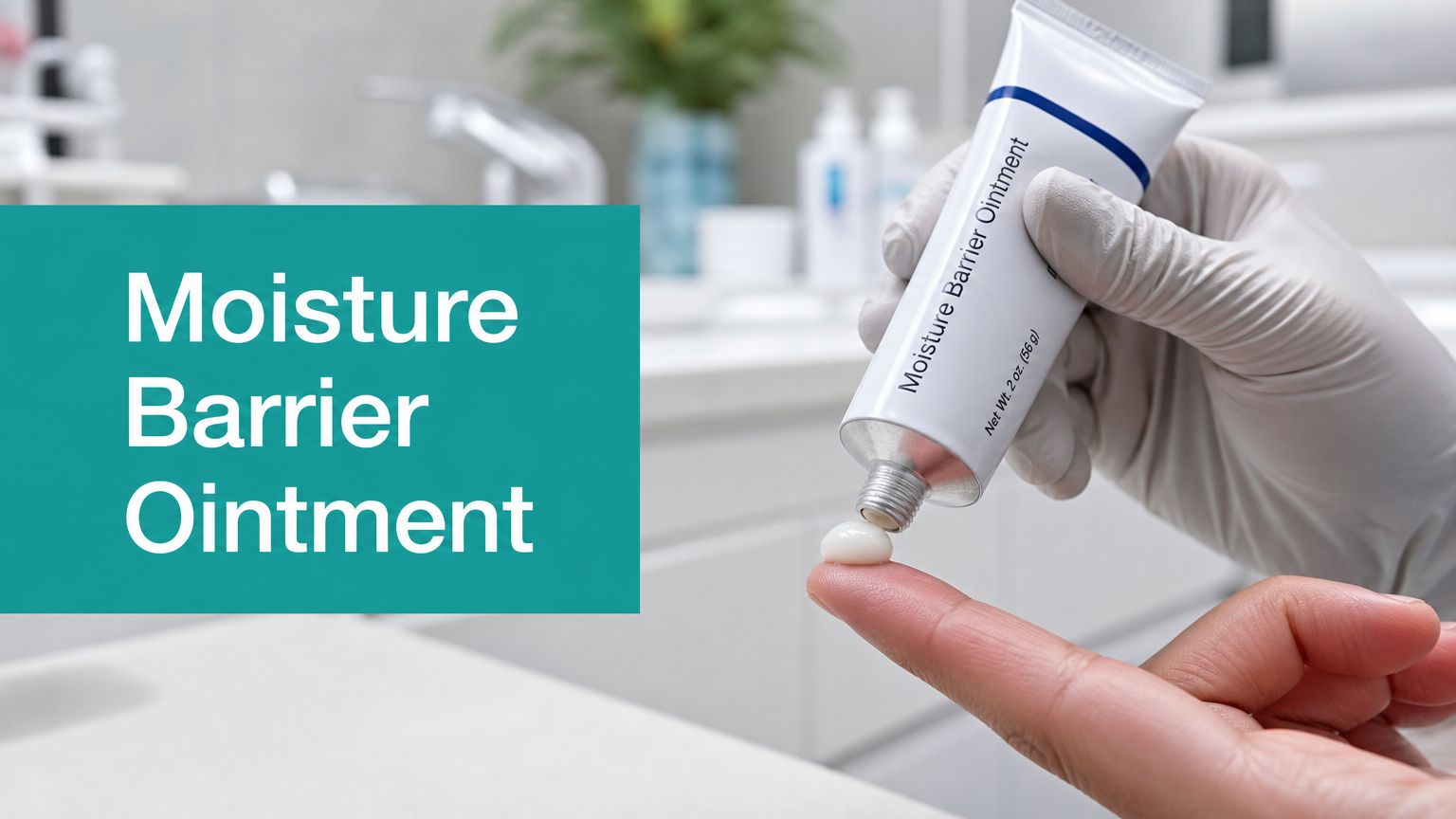
The patient has a sacral Stage 1. The skin isn't open yet, but the edges are telling you where this is headed. Pink periwound skin. Slight softening. Dampness that keeps coming back after each cleanup. That's the moment where a lot of clinicians either save the skin or lose ground.
A basic moisturizer won't do the job. A dressing alone won't fix constant urine, stool, or exudate exposure. What usually matters here is whether you protect the threatened skin early, and whether you document that decision well enough to defend medical necessity later. Moisture barrier ointment lives in that space between bedside judgment and payer scrutiny. Used well, it prevents avoidable breakdown. Used badly, it creates a mess, lifts adhesives, traps fluid where it shouldn't, and disappears into vague charting as “skin care.”
Table of Contents
- The First Sign of Trouble Periwound
- The Core Job of a Moisture Barrier Ointment
- Clinical Indications and Critical Contraindications
- Proper Application Technique and Frequency
- Documenting Barrier Use to Prevent Claim Denials
- Integrating Barriers into a Comprehensive Protocol
- Common Pitfalls That Get Clinicians in Trouble
The First Sign of Trouble Periwound
The early warning sign usually isn't the wound bed. It's the skin around it.
A common example is the sacral patient who is incontinent, turned on schedule, and still showing that faint shiny damp look over the sacrum and adjacent tissue. The pressure injury may still be Stage 1, but the periwound skin is already losing resilience. If the patient also has frequent cleansing, friction during repositioning, or wound drainage, breakdown accelerates fast. You can review how different drainage patterns affect surrounding tissue in this guide to exudate types.
What matters at the bedside is recognizing that this isn't “just a little redness.” It's often the start of moisture-associated skin damage. Once the stratum corneum stays overhydrated, you lose the skin's normal barrier function. Then adhesive borders stop holding, the patient reports more burning and tenderness, dressing changes get harder, and nursing time goes up for a problem that could have been contained earlier.
Practical rule: If the skin is intact but wet-exposed and softening, protect it before it denudes.
This is why moisture barrier ointment has a very specific place in wound care. It isn't a comfort add-on. It's a preventive intervention for skin at risk from urine, stool, repeated cleansing, and some wound exudate patterns. Around the sacrum, gluteal cleft, buttocks, perineum, and selected periwound zones, that decision can stop a manageable problem from turning into a larger wound management issue.
The Core Job of a Moisture Barrier Ointment
A moisture barrier ointment is basically a raincoat for skin. It doesn't need to sink in to work. In fact, its main job is the opposite. It stays where you put it and forms a hydrophobic layer between vulnerable skin and external irritants.
What it's actually doing
In practice, moisture barrier ointment falls within the broader category of skin protectants used to prevent moisture-associated skin damage, especially incontinence-associated dermatitis. Guidance summarized in the wound-care literature recommends a barrier product for patients assessed as incontinent, and the NHS South West London formulary states that a cream or ointment is usually first line because it is the most cost-effective option unless the skin is broken, as described in this wound-care review on skin protectant ointment use.
That distinction matters. A lotion is for hydration. A moisture barrier ointment is for occlusion and protection.
At the bedside, that means three practical uses:
- Blocking irritants like urine and stool from sitting directly on compromised skin
- Reducing friction injury in areas exposed to repositioning, briefs, or skin-on-skin rubbing
- Protecting periwound tissue from low to moderate moisture exposure when the primary focus is the surrounding skin, not the wound bed itself
If a nurse says the skin “looks wet all the time,” an ointment may be the right answer. If the skin is dry and flaky with no moisture exposure, it may not be.
A lot of confusion comes from treating all barrier products as interchangeable. They aren't. The base ingredient affects spreadability, visibility, removability, and how well the barrier stands up to repeated cleansing. If your continence team needs a stronger framework for matching protection to exposure patterns, this comprehensive incontinence guide is a useful companion read.
Moisture Barrier Ingredient Comparison
| Ingredient | Mechanism | Best For | Clinical Note |
|---|---|---|---|
| Petrolatum | Occlusive layer that sits on top of skin and repels moisture | High-risk moisture exposure, fragile periwound skin, sacrum, buttocks, perineum | Strong protectant. Easy to over-apply. Can interfere with adhesive performance if layered too heavily. |
| Zinc oxide | Physical barrier with thicker paste-like protection | More irritated skin, heavier incontinence exposure, denuded adjacent skin where a sturdier coating helps | More visible and harder to remove. Helpful when you need a more durable shield, but don't cake it on. |
| Dimethicone | Silicone-based film that creates a lighter protective coating | Mild moisture exposure, prevention in frequently cleansed skin, situations where a lighter finish is useful | Often easier to spread and less messy. May not be enough when exposure is severe. |
Think of the selection this way. Match the barrier to the exposure burden, not to whatever tube is closest to the sink.
The wrong product choice usually shows up quickly. Too light, and the skin keeps failing. Too heavy, and the dressing edge starts lifting by the next turn.
Clinical Indications and Critical Contraindications
The right patient for a moisture barrier ointment is usually easy to identify once you stop thinking in product terms and start thinking in exposure terms.
Where it earns its place
Barrier ointment works best when the skin is intact or superficially irritated, but repeatedly exposed to moisture or friction.
Typical examples include:
- Periwound protection around a draining ulcer where the wound bed is being managed appropriately, but the surrounding skin is turning pale, soft, or wrinkled from persistent serous drainage
- Incontinence-associated dermatitis risk over the buttocks, perineum, gluteal cleft, and sacrum
- Bony prominences at risk when friction and intermittent moisture are both present
- Stage 1 pressure injury zones where skin isn't open, but repeated contamination is threatening progression
A thin barrier on adjacent skin can save you dressing changes and prevent a larger surface area problem. It's especially useful when the primary dressing is doing its job on the wound itself, but the runoff or repeated episodes of incontinence are destroying the perimeter.
Where it gets clinicians in trouble
The biggest mistake is applying a thick occlusive ointment to a wound that needs active exudate control, debridement, or infection management first.
There is a persistent misconception that ointments are “too thick” and always trap moisture. That isn't accurate. Hydrophobic ointments with 80% oil can create a superior passive hydration barrier. But the other half of that point matters just as much. In wounds with more than 100 ml/day of exudate, a thick petrolatum barrier can trap fluid and contribute to deep tissue necrosis if it is not used correctly, as noted in this PMC review discussing ointment properties and contraindication nuance.
That means you need a decision filter:
- Use it on threatened surrounding skin
- Don't use it as a cover-up for unresolved heavy exudate
- Don't spread it into deep, infected tissue
- Don't mistake occlusion for exudate management
An infected Wagner 3 ulcer with heavy drainage doesn't need a thick smear of ointment. It needs proper assessment, bioburden control, and, when indicated, debridement planning first.
For open deeper wounds, the issue isn't whether ointment is “good” or “bad.” The issue is whether you're protecting adjacent skin while still respecting what the wound bed needs. Those are different tasks. Mixing them up is how clinicians worsen maceration, miss evolving infection, or delay needed debridement under CPT 11042 to 11047 when tissue depth supports it.
Proper Application Technique and Frequency
Bad application technique ruins a good product.
Bedside technique that works
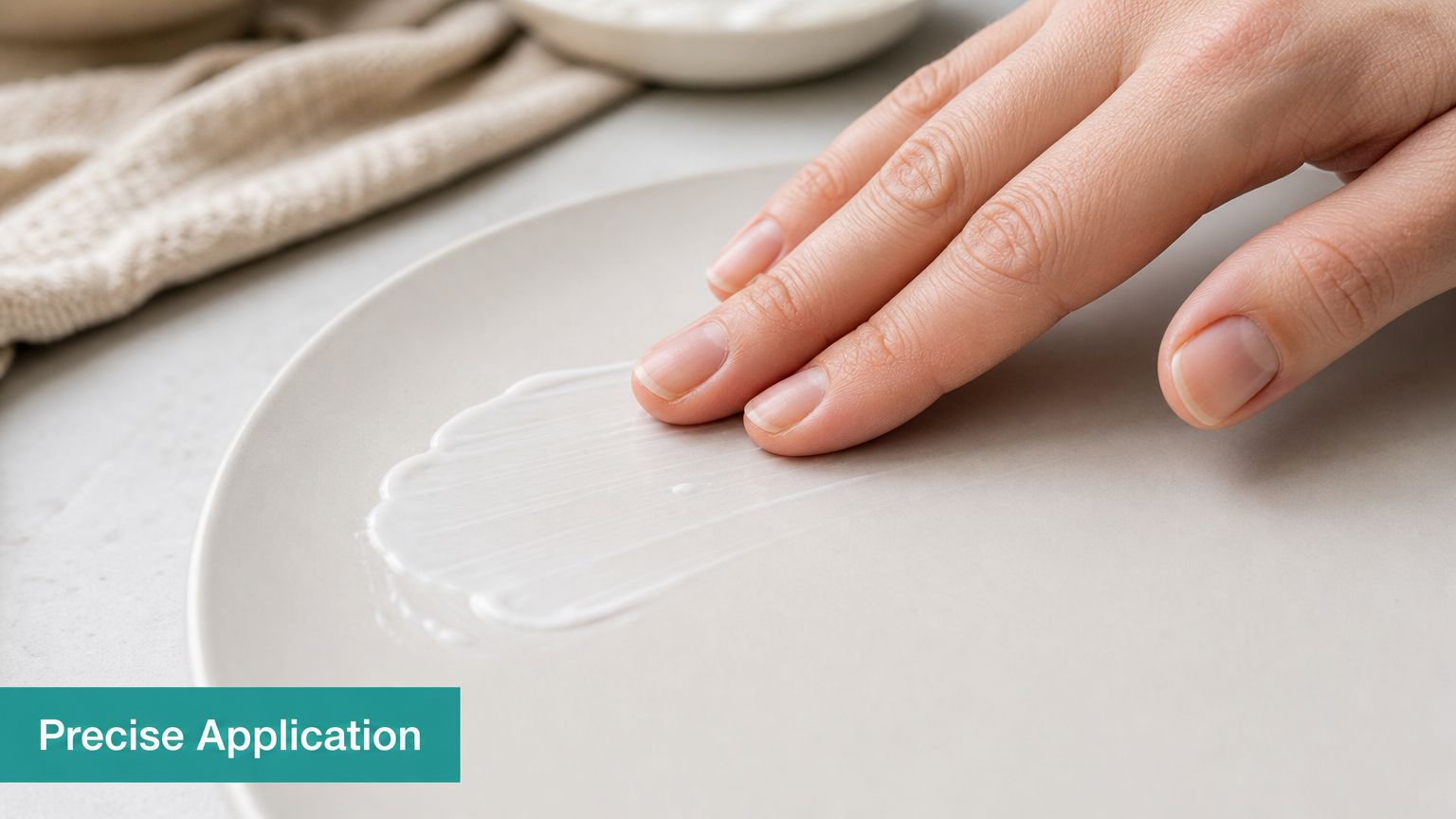
Use a thin, targeted layer on clean, dry skin. That's the whole play.
The practical workflow is straightforward:
- Cleanse gently after the incontinent episode or at dressing change.
- Pat dry fully. Don't rub irritated skin.
- Apply a pea-sized amount and spread it into a thin layer over the at-risk area.
- Keep it on the skin you're protecting, not packed into the wound bed.
- Remove residue and reapply with each skin-care episode so buildup doesn't accumulate.
The NHS barrier-product guidance specifically recommends a pea-sized amount in a thin layer on clean, dry skin, with removal and reapplication at each skin-care episode to avoid buildup. It also warns that excess product can interfere with dressing adhesion and create its own moisture-retention problem, according to this NHS barrier products factsheet.
A good application should leave a sheen. Not frosting. Not clumps in the fold. Not a thick white layer that migrates onto the dressing border.
What over-application causes
Over-application creates problems that are easy to miss if you only think in nursing terms and not wound mechanics.
- Adhesive failure happens first. Border dressings won't hold on greasy skin.
- Residue buildup follows. The skin gets harder to assess because you're looking through old product.
- Moisture retention can get worse in folds if the ointment is caked on instead of refreshed properly.
Plainly put, more isn't more. Better technique beats heavier application every time.
Documenting Barrier Use to Prevent Claim Denials
A moisture barrier ointment that isn't documented might as well not have happened.
Clinicians often provide the right care and still create denial risk because the note makes barrier use look incidental. That's where clinics lose clean reimbursement. The preventive logic is clear at the bedside, but the chart often reduces it to “wound care performed” or hides it inside debridement language that doesn't explain why adjacent skin protection was medically necessary.
What has to be in the note
The note needs to connect four things clearly:
- The lesion or risk area
- The moisture source
- The skin findings
- The intervention
If you only document the wound and omit the moisture driver, the barrier looks optional. If you only document “barrier applied,” the payer doesn't know what you were preventing.
A defensible SOAP structure looks more like this:
Subjective
Patient reports burning or tenderness with cleansing, frequent incontinence, dressing looseness, or repeated wetness to sacral area.Objective
Stage 1 pressure injury to sacrum with adjacent pink, softened, damp periwound skin. Evidence of moisture exposure. No deep tissue exposure in the protected area. Exudate characteristics documented if present.Assessment
Pressure injury with concurrent moisture-associated skin damage risk or incontinence-associated dermatitis pattern affecting surrounding skin.Plan
Apply petrolatum-based moisture barrier ointment in thin layer to periwound or sacral skin after cleansing and drying to prevent maceration and progression of skin breakdown. Continue pressure redistribution, incontinence care, and dressing strategy as indicated.
If your team needs a more structured format, this wound care documentation template is a practical starting point.
What payers and auditors notice
One recurring problem is undercoding or non-specific documentation around preventive barrier use. There is a 40% undercoding rate for preventive moisture barrier applications in SNFs and outpatient wound clinics because the barrier is often lumped into general wound care under CPT 97597-97598 without a separate clinical indicator for the specific barrier product use, leading to claim denials and AR delays.
That doesn't mean there is always a separate payable procedure for the ointment itself. It means your note has to show why this preventive intervention was medically necessary within the broader E/M and wound-management encounter. Auditors look for specificity. If your record says “skin care provided,” that's weak. If it says the patient had ongoing incontinence exposure, sacral skin softening, and targeted barrier application to prevent maceration, that's defensible.
If the barrier protected at-risk skin, say what skin, from what moisture source, and what deterioration you were preventing.
Also keep the coding logic clean. Don't blur preventive periwound protection with debridement work. If you performed selective or surgical debridement, document that distinctly under the appropriate CPT pathway. If you protected adjacent skin to support wound management and prevent conversion of threatened skin to open breakdown, chart that as a separate clinical action inside the visit narrative.
Integrating Barriers into a Comprehensive Protocol
A moisture barrier ointment is rarely the hero by itself. It works when the rest of the protocol makes sense.
Bundle the intervention or expect failure
If the patient is still lying in prolonged moisture, if the dressing isn't controlling drainage, or if pressure isn't being offloaded, the ointment won't rescue the plan.
The strongest real-world use of barrier ointment is inside a bundle:
- Gentle cleansing that removes irritants without scrubbing compromised skin
- Targeted barrier protection on threatened intact or superficially irritated skin
- Appropriate primary and secondary dressing selection for the wound's actual exudate burden
- Offloading or repositioning for sacral, heel, or other pressure-prone sites
- Routine reassessment and documentation so progression or failure is visible early
The prevention literature supports that broader approach. Evidence reviewed by NIH/NCBI found that a skin-care protocol using cleanser plus barrier cream or barrier film was cost-effective compared with standard care, reinforcing that barrier ointment works best as one part of a structured skin-protection bundle, as summarized in this NIH evidence review on pressure ulcer prevention and skin-care protocols.
That lines up with what surveyors and payers expect. They don't want to see a product in isolation. They want to see a coherent plan tied to risk. If the patient is incontinent, say so. If the wound has moderate serous drainage and the periwound is turning white and boggy, say so. If repositioning is ordered, document adherence and barriers.
The ointment matters. The protocol matters more.
Common Pitfalls That Get Clinicians in Trouble
Most trouble with moisture barrier ointment comes from five avoidable mistakes.
Using too much
Thick application looks protective but often causes border lift, residue accumulation, and bad skin visualization at the next assessment.Putting it where debridement or infection work should come first
A draining infected wound with depth, odor, necrotic tissue, or obvious bioburden needs wound-bed management, not just a surface protectant.Matching the product poorly to the exposure pattern
A lighter barrier may be reasonable for mild risk. Severe moisture exposure usually needs a sturdier approach. Product choice should reflect the burden on the skin.Applying over poorly cleansed skin
Ointment over urine, stool, or dried drainage is just contamination under occlusion.Leaving no chart trail
This is the one that causes both audit pain and revenue leakage. If the barrier use isn't in the note, the intervention disappears. For teams working through maceration-related care plans, this overview of skin maceration treatment is worth keeping handy.
The simplest audit failure is ghost documentation. Care happened. The note never proves it.
Clinically, the pattern is easy to remember. Protect intact threatened skin. Don't bury active wound problems under ointment. Apply thinly. Reapply intelligently. Chart the moisture risk and the reason for the intervention in plain language.
EkagraHealth AI helps wound care teams turn bedside decisions into clean, defensible documentation. If your clinicians are tired of losing time to charting and your revenue cycle team is tired of vague wound notes that invite denials, EkagraHealth AI is built for that exact problem. It supports wound care documentation, coding alignment, and claim-ready note structure so the link between diagnosis, risk, treatment, and reimbursement is clear.
