

When you see the DFU medical abbreviation in a patient’s chart, it stands for Diabetic Foot Ulcer. But for any experienced clinician, those three letters represent far more than just a sore on the foot. They signify a severe complication of diabetes and one of the most challenging, high-stakes conditions managed in wound care, often requiring extensive resources and a multidisciplinary approach to prevent devastating outcomes.
This guide will expand far beyond the basic definition, diving deep into the intricate clinical story, the standardized assessment methodologies, the critical importance of precise documentation and coding, and the transformative role of modern technology in managing these complex wounds. Our goal is to provide a pillar resource for clinicians, coders, and healthcare administrators who navigate the complexities of DFU care daily.
More Than Just an Acronym: The Clinical Weight of a DFU Diagnosis

While D-F-U is the common shorthand for Diabetic Foot Ulcer, it should be interpreted as a significant clinical red flag. This abbreviation signals that a patient's systemic health issues, primarily uncontrolled diabetes, have progressed to a dangerous and limb-threatening stage. For wound care specialists, podiatrists, nurses, and medical coders, the "DFU" designation triggers a specific and immediate sense of urgency because the underlying risks are profound.
A DFU diagnosis instantly categorizes a patient as high-risk, necessitating a coordinated, multi-disciplinary approach. It is a critical call to action, mobilizing a team that may include endocrinologists, vascular surgeons, infectious disease specialists, and wound care nurses. The primary objective is to prevent catastrophic outcomes, the most feared of which is lower-extremity amputation. This proactive, team-based response is essential for mitigating the severe consequences associated with this diagnosis.
A Staggering Global Health Issue
The statistics surrounding DFUs paint a sobering picture of a massive global health crisis. These ulcers are not a rare complication; they are a prevalent and growing problem that affects a significant percentage of the millions living with diabetes.
Out of the 537 million adults living with diabetes worldwide, current estimates suggest that somewhere between 19% and 34% will develop a DFU in their lifetime. This staggering figure underscores the widespread nature of the issue. Even more alarming is the data on outcomes: approximately 20% of moderate to severe diabetic foot ulcers lead to a lower-extremity amputation. This translates to a diabetes-related amputation occurring somewhere in the world every 20 seconds. For a more detailed examination of the scope and impact of this problem, the global challenges of Diabetic Foot Ulcers on bonvadis.com offers invaluable perspective and data.
A DFU is more than a wound; it’s a warning. It signals a cascade of underlying problems—from peripheral neuropathy and arterial disease to a compromised immune system—that have reached a critical tipping point.
This guide will thoroughly explore the clinical narrative, detailed assessment methods, and the crucial documentation realities intrinsically linked to the DFU medical abbreviation, providing a comprehensive resource for healthcare professionals.
The Clinical Story Behind a DFU Diagnosis
When a clinician examines a diabetic foot ulcer, they are not merely observing a simple break in the skin. They are witnessing the culmination of a clinical "perfect storm"—a devastating cascade of systemic failures all rooted in the metabolic chaos of uncontrolled diabetes. It serves as a powerful, visible signal that the body's innate protective and healing mechanisms are failing. This is precisely why one of the initial and most critical steps in managing a DFU is to assess long-term glycemic control, often by evaluating the patient's Hba1c test results.
The development of a DFU typically involves three distinct but interconnected pathophysiological processes, which many in wound care refer to as the "triad" of diabetic foot complications. Each component plays a pivotal role in transforming a seemingly minor injury, like a blister or a small cut, into a non-healing, limb-threatening ulcer.
The Triad of Diabetic Complications
To understand this triad, imagine the foot possesses its own internal security system with three essential functions: sensory alarms to detect threats, a rapid-response team for repair, and a strong perimeter defense against invaders. In an individual with long-standing, poorly managed diabetes, this entire sophisticated system can be systematically dismantled and go offline.
Neuropathy (The Alarms Are Off): Chronic hyperglycemia is toxic to nerve fibers, leading to a condition known as diabetic peripheral neuropathy. This nerve damage effectively silences the sensory alarm system in the feet. As a result, a patient can experience significant trauma—stepping on a sharp object, developing a blister from ill-fitting shoes, or sustaining pressure from a foreign object inside a shoe—and feel absolutely nothing. The initial injury goes completely unnoticed.
Peripheral Artery Disease (PAD) (The Response Team Can't Arrive): Simultaneously, diabetes accelerates the process of atherosclerosis, causing blood vessels, particularly those in the lower extremities, to narrow and harden. This resulting poor circulation, or Peripheral Artery Disease (PAD), severely restricts blood flow to the feet. Consequently, the "response team"—oxygen, essential nutrients, growth factors, and white blood cells—cannot reach the wound site in sufficient quantities. The unnoticed injury is now starved of the fundamental resources required for healing.
Immunopathy (The Defenses Are Weakened): To compound these issues, hyperglycemia also impairs the function of the immune system. The body's ability to effectively fight off invading bacteria is significantly diminished. This small, unfelt, and unhealed wound now becomes an open gateway for infection. Bacteria can colonize the wound rapidly, and without a robust immune response, the infection can spread from soft tissue to the underlying bone, a severe complication known as osteomyelitis.
In short, a diabetic foot ulcer is what happens when an injury you can't feel (neuropathy) occurs on a part of the body that can't heal (PAD) and can't effectively fight infection (immunopathy). It is this treacherous combination that makes a simple "DFU" diagnosis so incredibly serious and complex.
This is precisely why a DFU is never "just a foot sore." It is a major red flag that signals systemic failure and demands immediate, aggressive, and coordinated care from a multidisciplinary team. The patient's internal protective mechanisms have failed, and it becomes the healthcare team's responsibility to provide an external system of protection and healing.
How to Properly Assess and Stage Diabetic Foot Ulcers
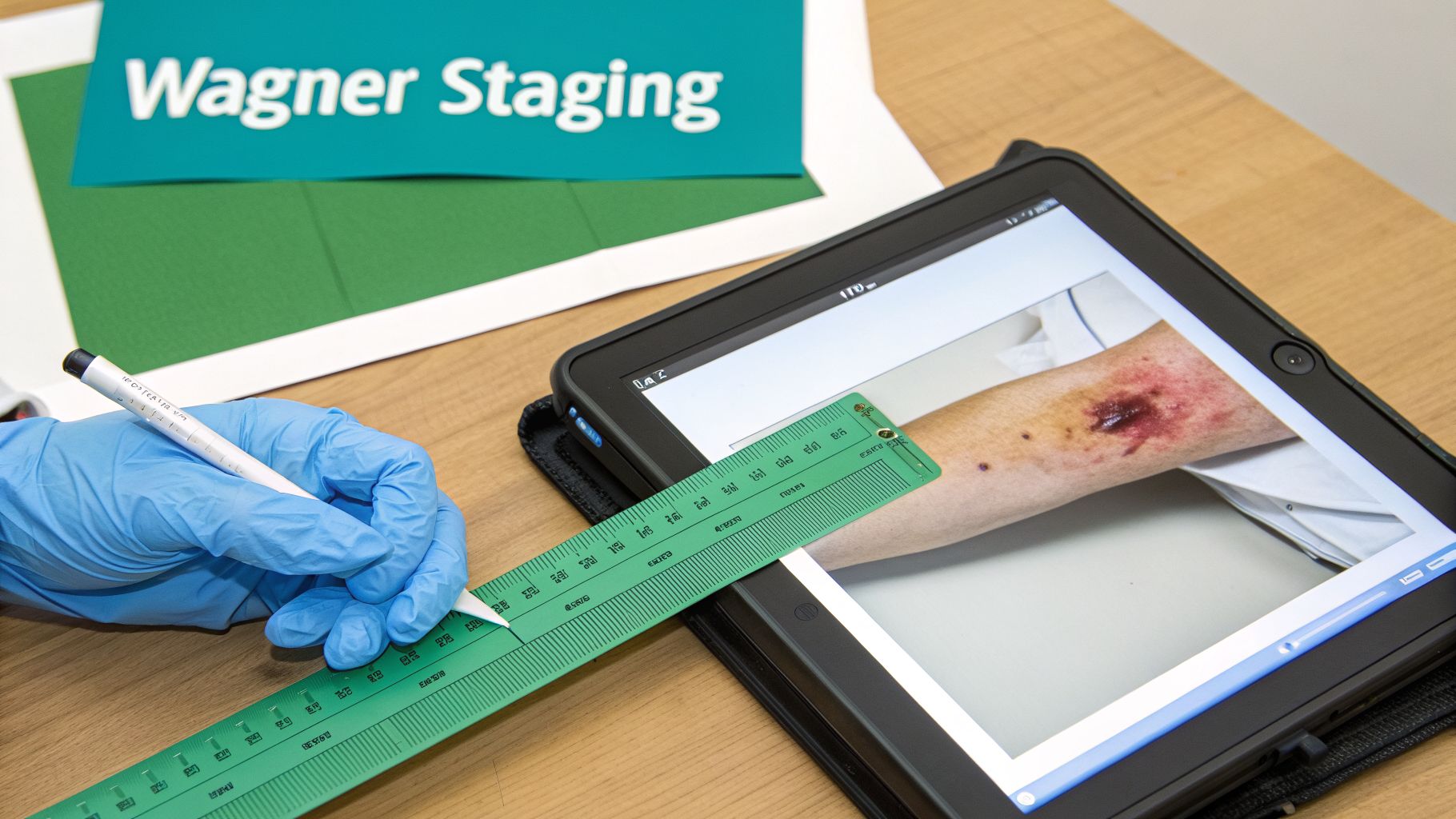
Once a potential DFU has been identified, the subsequent assessment is a critical determinant of the patient's outcome. A consistent, accurate, and comprehensive evaluation forms the bedrock of the entire care plan. Think of it as establishing the precise starting coordinates for a GPS journey toward healing—without knowing the exact starting point, mapping an effective and efficient route to recovery is impossible.
This initial evaluation dictates the course of treatment, provides the necessary basis for meticulous documentation, and facilitates clear communication across the entire care continuum. For the DFU medical abbreviation to carry meaningful, actionable information, every member of the team—from the podiatrist and vascular surgeon to the primary care physician and home health aide—must be operating from the same standardized understanding of the wound's severity. This is where validated, standardized classification systems become absolutely essential.
The Wagner Ulcer Classification System
One of the most enduring, trusted, and widely utilized frameworks in wound care is the Wagner Ulcer Classification System. This system provides clinicians with a straightforward, reliable method for grading the severity of a DFU on a scale from 0 (pre-ulcerative) to 5 (extensive gangrene). The grade is determined primarily by the depth of tissue penetration and the presence or absence of infection and gangrene.
This shared lexicon is vital for creating a consistent plan of care, tracking wound progression—or regression—over time, and ensuring that all stakeholders are aligned. It is one of several crucial wound assessment tools for nurses and other providers that help transform subjective clinical observations into objective, actionable data that can guide treatment decisions and justify interventions.
To make this practical, here’s a simplified breakdown of the Wagner scale, what each grade represents clinically, and how it typically presents in a patient.
Wagner Ulcer Classification System at a Glance
| Grade | Clinical Description | Common Presentation |
|---|---|---|
| 0 | Pre-ulcerative lesion, skin intact | A high-risk foot with a callus, bony deformity (like a Charcot foot), or a previously healed ulcer site. There is no open wound, but the potential for breakdown is high. |
| 1 | Superficial ulcer | An open wound that involves only the superficial layers of the skin (epidermis or dermis), without penetrating into the subcutaneous fat. |
| 2 | Deep ulcer extending to tendon, capsule, or bone | The ulcer has penetrated through the subcutaneous tissue, potentially exposing deeper structures like tendons, joint capsules, or bone, but with no abscess or bone infection (osteomyelitis) yet present. |
| 3 | Deep ulcer with abscess or osteomyelitis | The wound is deep and shows clear signs of infection, often with the formation of pus (abscess), cellulitis, or confirmed involvement and infection of the underlying bone. |
| 4 | Localized gangrene | Necrosis or tissue death is present but is confined to a specific, limited area, such as the forefoot, heel, or one or more toes. |
| 5 | Extensive gangrene of the foot | Widespread tissue death involving the entire foot, which is no longer viable and often necessitates a major, above-the-ankle amputation to save the patient's life. |
Employing a clear, objective scale like the Wagner system removes ambiguity and guesswork from wound assessment. It provides the clear, defensible documentation required to justify advanced treatment plans, secure reimbursement, and ensure every member of the care team fully comprehends the true severity of the wound and the urgency of the situation.
Mastering DFU Documentation and Coding
When you're running a wound care practice, you know that documenting a diabetic foot ulcer (DFU) is about so much more than just keeping a clinical record. It’s the very foundation of your revenue cycle. For coders and revenue cycle managers, that simple DFU medical abbreviation signals a high-stakes case that leaves zero room for error. If the documentation isn’t precise, getting paid and staying compliant can feel like an uphill battle.
Think about it from a payer's perspective. A quick note that just says "DFU on left foot" tells them almost nothing. They need the full story to justify the services you're billing for. What's the Wagner grade? What are the exact measurements? Is there slough or eschar? Are there signs of infection? Without these details, you can’t prove medical necessity.
The Financial Stakes of Vague Documentation
The numbers surrounding Diabetic Foot Ulcers are sobering and paint a clear picture of their complexity. With a DFU prevalence of 13% in the US and North America, these wounds demand significant healthcare resources. In fact, 6% of DFU patients end up hospitalized for related infections.
Consider that of the 15% of people with diabetes who will develop a DFU, a staggering 14%-24% will ultimately require an amputation. That contributes to more than one million diabetes-related limb losses around the world each year. For any revenue cycle team, this clinical complexity makes securing reimbursement a constant challenge. You can find more details on these DFU statistics in a study on PMC.
When documentation is incomplete or vague, it's a fast track to claim denials. If the chart doesn't clearly support the services you've billed, payers will push back, which means delayed payments, more administrative work, and, ultimately, lost revenue.
Good documentation isn't just another task on your to-do list—it's your best defense. It shields your practice from audits, keeps cash flowing, and makes sure you have the resources to deliver the best possible care to your patients.
Navigating Key DFU-Related ICD-10 Codes
To turn great clinical work into successful claims, your team has to be fluent in the language of ICD-10-CM. The codes for DFUs are incredibly specific, so your documentation must provide clear details on the ulcer’s location, laterality (right, left, or unspecified), and severity.
Here are the key coding categories you'll be working with:
- L97 series: This covers non-pressure chronic ulcers of the lower limb. The codes get very granular, specifying location and depth (e.g., L97.512 for a non-pressure chronic ulcer of the left heel and midfoot with fat layer exposed).
- E11.621: This is the code for Type 2 diabetes mellitus with a foot ulcer. It’s crucial to remember that this code must be paired with a code from the L97 series to give a complete picture of the patient's condition.
- Associated Conditions: Don’t forget to code for related diagnoses that impact the patient’s healing, such as peripheral neuropathy (G-series), peripheral artery disease (I-series), or osteomyelitis (M-series).
For a closer look at the specifics, especially when infection is involved, be sure to read our guide on the ICD-10 code for diabetic foot infection. Getting the coding right is that final, critical step that ensures your excellent clinical care is properly recognized and reimbursed.
Taming DFU Workflows With Modern Technology

Dealing with the clinical and administrative weight of DFU care calls for a smarter approach. What if a clinician's natural conversation during a wound exam could be turned into a perfectly structured and coded claim in just minutes? This isn't science fiction anymore; it's what AI-powered tools are doing right now.
Ambient AI platforms are built to listen to clinical dictation and instantly create compliant chart notes. This "voice-to-claim" process closes the gap between providing patient care and handling the billing, drastically reducing the time spent on administrative work.
For truly effective DFU management, pulling together patient data from different places is critical. This is where solid healthcare interoperability solutions come in, creating a connected care environment. When your systems can all talk to each other, the entire team gets a complete picture of the patient's story, from their initial diagnosis all the way through healing.
From Manual Data Entry to Intelligent Automation
For home health agencies and outpatient clinics, managing DFUs often involves juggling disconnected workflows and endless paperwork. AI brings it all together with features like ambient note capture, automated measurements, and tools for patient engagement.
Platforms like Ekagra Health, which are ONC-certified and HIPAA-secure, standardize the entire assessment process. They do this through image annotation, tracking healing over time, and can even cut documentation time by up to 70%. You can read more about these findings from PMC.
This kind of automation frees up staff to focus on what matters most: the patient. AI-powered wound imaging, for example, gives you objective measurements instead of relying on subjective estimates. This gives clinicians the power to:
- Track the healing process with millimeter-level accuracy.
- Spot wounds that have stalled and adjust treatment plans sooner.
- Provide clear, visual proof to support medical necessity for payers.
By swapping manual tasks for automated, intelligent workflows, technology gives clinicians both the data and the time they need to make better decisions. This has a direct, positive impact on patient outcomes and the financial stability of the practice.
These tools also play a huge role in improving clinical judgment. If this topic interests you, our related article provides a deeper dive into the benefits of clinical decision support systems.
Common Questions About DFU Management
When you're dealing with diabetic foot ulcers, questions are bound to come up—whether you're a clinician at the bedside, a coder trying to make sense of a chart, or an administrator looking at the bottom line. Let's tackle a few of the most common ones.
What’s the First Thing I Should Do When I Find a DFU?
Your absolute first move is a comprehensive assessment. This isn’t a quick glance. It’s a deep dive that sets the stage for every decision you'll make afterward.
At a minimum, you need to look at the wound itself—its size, depth, and stage (using a system like Wagner is standard practice). You also have to check for any clinical signs of infection, like redness, warmth, or drainage. But you can't stop there. Assessing the patient's vascular and neurological status is just as vital to understand why the ulcer appeared in the first place.
Then, you must immediately get the patient to offload the area. That means taking all pressure off the ulcer. It’s a non-negotiable step that stops the damage from getting worse and gives the tissue a fighting chance to heal.
A DFU is never just a hole in the foot; it's a symptom of a much larger problem. Your first assessment has to go beyond the wound to address the real culprits—poor circulation, nerve damage, and pressure—if you want to see any meaningful healing.
How Much Does Bad DFU Documentation Really Matter?
Poor documentation can be catastrophic for both patient outcomes and your practice's finances. When notes are vague or missing key details, you're opening the door to a host of problems.
From a clinical standpoint, sloppy notes create confusion. They lead to inconsistent care plans and make it impossible to tell if a wound is getting better or worse. Financially, it’s the fastest way to get a claim denied. Payers demand clear proof of medical necessity, and a note that doesn't include specifics—like precise measurements, tissue types, or the ulcer's stage—simply won’t cut it.
This leads directly to lost revenue, but it also means patients can't get access to advanced treatments they need. It's a cycle that only creates more work for everyone. Think of good documentation not as a chore, but as one of your most important tools for delivering quality care and keeping your practice financially healthy.
Can Technology Actually Help Prevent Amputations?
Absolutely. The right technology can make a huge difference in lowering amputation risk by tackling the biggest headaches in DFU management head-on.
AI-driven tools, for instance, can bring consistency to your wound assessments. By using images to capture objective measurements, they help you track healing with incredible accuracy. This makes it much easier to spot a wound that isn't healing and step in with a more effective treatment plan before it's too late.
On top of that, these systems can automate huge chunks of the documentation and coding process. All that time clinicians save isn't just a convenience—it's time they can put right back into patient care and education. And we know that more time with patients is directly linked to better outcomes and a lower risk of amputation.
Ready to unify your wound care workflow from voice to claim? Ekagra Health AI delivers an end-to-end, AI-powered platform that reduces documentation time by up to 70% and helps you secure reimbursement faster. Learn more about Ekagra Health AI and join our Early Access program today.
