
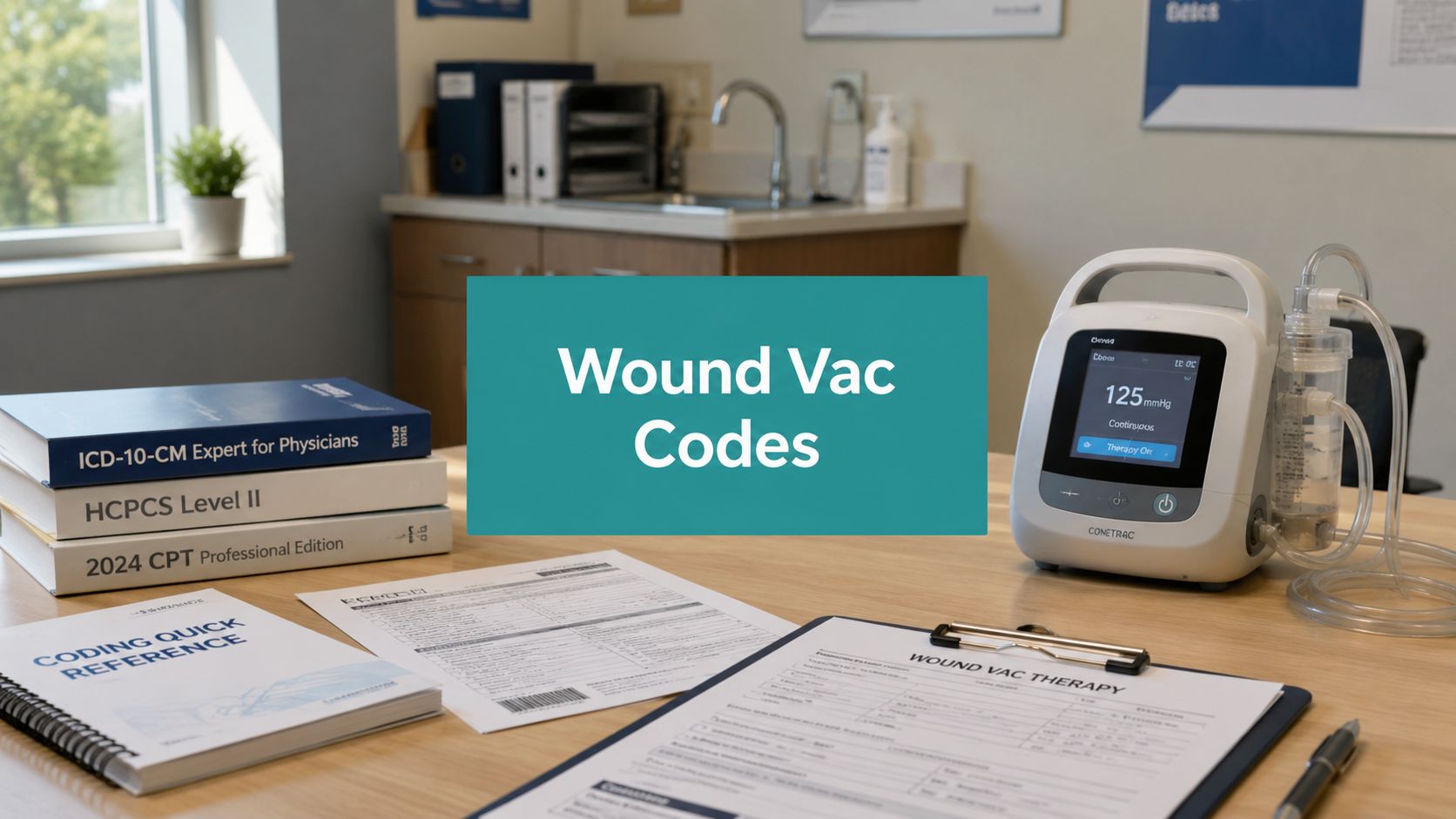
You've just debrided a plantar diabetic foot ulcer, the wound bed looks ready, and you decide to place NPWT. Then the charting screen stares back with four nearly identical CPT codes. That's where claims start going bad.
Most wound vac denials aren't caused by exotic coding rules. They come from bedside decisions that never made it clearly into the note. Wrong device family. Wrong wound size calculation. NPWT placed over a closed incision and billed as if it were active wound care. I see this most often when a good clinical plan gets documented like a dressing change.
The cpt code for wound vac placement isn't hard once you stop treating it as a memorization exercise. Payers are looking for two basic facts first: what device did you apply and what was the total wound surface area. After that, they want proof that you used NPWT on an open wound and that conservative treatment had already failed.
Stop Guessing Your NPWT Codes
A common clinic scenario goes like this. You've got a Wagner-grade diabetic foot ulcer after sharp debridement. There's moderate serosanguineous exudate, viable granulation at the base, some residual slough along one edge, and the periwound is macerated but salvageable. You place NPWT because the wound needs controlled exudate management and a protected healing environment.
Then coding gets reduced to four numbers: 97605, 97606, 97607, 97608.

The two questions that matter
You only need to answer two questions correctly.
- What is the total wound surface area in square centimeters
- Is the device durable medical equipment or a disposable non-DME system
That's the whole logic tree.
If you get either one wrong, the claim often fails before anyone reads the rest of your note. Device type mismatch is especially expensive because it tells the payer your coding doesn't match the actual supply used.
Practical rule: Don't pick an NPWT code until the wound has been measured in centimeters and the device type is documented in plain language.
Why bedside details drive payment
Many clinicians often get tripped up. They focus on the wound and leave the billing team to infer the rest. That doesn't work well with NPWT. If your note says “wound vac applied” and nothing more, the coder still has to know whether you used a reusable DME pump or a disposable system, whether the wound remained open, and what area was treated.
When those details aren't explicit, staff guess. Payers don't.
The Core NPWT CPT Codes A Quick Reference
The code set is built on a strict split at 50 square centimeters. CMS also drew a hard line between durable and disposable NPWT for coding purposes effective January 1, 2015, when 97607 and 97608 became the codes for disposable, non-durable systems according to CMS reimbursement guidance for disposable NPWT coding.
NPWT CPT Code Quick Reference
| CPT Code | Device Type | Wound Surface Area | Common Scenario |
|---|---|---|---|
| 97605 | DME | 50 cm² or less | Reusable NPWT pump applied to a smaller open wound |
| 97606 | DME | Greater than 50 cm² | Reusable NPWT pump applied to a larger open wound |
| 97607 | Disposable non-DME | 50 cm² or less | Single-use NPWT system applied to a smaller open wound |
| 97608 | Disposable non-DME | Greater than 50 cm² | Single-use NPWT system applied to a larger open wound |
How I teach the decision matrix
Don't think of these as four separate codes first. Think of them as two device families, each split once by size.
- DME family: 97605 or 97606
- Disposable family: 97607 or 97608
Once you sort the device family, the wound area chooses the code.
For teams that want a broader coding reference beyond NPWT, this overview of ICD-10 and CPT coding workflows is useful for keeping wound procedure coding aligned with diagnosis documentation.
The mistake I see most often is starting with size and forgetting the device. Payers don't forget the device.
Coding for Durable Medical Equipment DME Wound Vacs
When you're using a reusable NPWT pump, you're in the DME lane. That means your code choice is between 97605 and 97606. The deciding factor is total wound surface area, not how many wounds you treated.
Per DME wound vac coding guidance, 97605 applies when the total treated area is 50 cm² or less, and 97606 applies when the total area is greater than 50 cm². That same guidance also makes clear that the service includes device application, topical agents, wound assessment, and patient instructions for ongoing care.
Measure surface area the right way
Use length × width in centimeters for each wound. If more than one wound is treated in the same session, calculate each wound's surface area and then sum the areas.
Do not use depth in the calculation. Depth matters clinically. It doesn't determine which NPWT CPT code you select.
A simple example:
- wound A is 4 cm × 3 cm
- wound B is 2 cm × 2 cm
Your billable surface area is the sum of those two wound surfaces. You don't assign one NPWT code per wound if they were treated in the same encounter under the same code family.
What's already included
A lot of unforced errors come from unbundling work that the code already covers. These DME NPWT codes include the session work tied to the application itself.
That means your note should support the service, but you shouldn't expect separate payment for the built-in components such as:
- Assessment work: wound bed evaluation, exudate review, and periwound findings
- Application work: dressing setup, seal creation, and connection to therapy
- Patient instruction: home care directions, troubleshooting basics, and follow-up guidance
Where clinicians create avoidable trouble
The claim gets fragile when the note says “multiple wounds” but never gives individual measurements. It also gets fragile when the note documents depth and tunneling in detail but omits the simple length and width values that support code selection.
That's a common pattern in complex wounds. The clinician documents all the hard parts and leaves out the one field the payer edit is reading.
Coding for Disposable NPWT Systems
Disposable NPWT is the other half of the coding matrix. For non-DME, single-use systems, the correct codes are 97607 for wounds 50 cm² or less and 97608 for wounds greater than 50 cm², according to disposable NPWT billing guidance.
That same source states that 20–30% of NPWT denials stem from device misclassification. I believe that number because this denial pattern shows up constantly in wound practices that rely on shorthand charting.
Why misclassification happens
Clinicians often document “wound vac placed” as if all NPWT devices belong in one bucket. They don't. Billing treats reusable DME systems and disposable non-DME systems as distinctly different services.
If your supply usage, nursing note, or charge entry points to a disposable system but the claim carries 97605 or 97606, the mismatch is obvious. Payers flag it fast.
What belongs in the note
For disposable NPWT, the documentation should clearly identify that the system is single-use or disposable. Don't assume the product sticker or supply invoice will rescue an incomplete procedure note later.
Use language a reviewer can understand without guessing:
- Device description: disposable NPWT, single-use, non-DME
- Wound measurements: length and width in centimeters, with total surface area
- Clinical details: exudate type, wound bed appearance, periwound condition
- Care instructions: what the patient or caregiver was told about ongoing management
If the note doesn't clearly identify the device class, the coding team is forced to infer. That's where denials start.
A practical trade-off
Disposable NPWT can fit workflow well in outpatient and mobile settings, but the convenience on the clinical side doesn't reduce coding precision. In fact, it raises the stakes. Because the systems look simpler to apply, teams sometimes document them like a dressing. That's exactly the wrong instinct.
Essential Documentation to Prove Medical Necessity
Choosing the right code doesn't defend the claim. The note does.
CMS stated in its September 2017 clarification that the record must show failure of conservative management before NPWT is authorized, and that these codes are reportable only when the provider applies NPWT to an open wound site, as outlined in CMS MLN Matters SE17027 on NPWT medical necessity.
What auditors look for first
In real-world review, two items tend to decide whether the chart survives first pass.
- Failed conservative care: prior dressings, offloading, compression when appropriate, local wound care, and serial debridement if performed
- Open wound status: not a closed incision, not a prophylactic dressing over a surgically closed site
If either one is missing, the rest of the note may not matter.
A documentation checklist that works
Your NPWT note should include all of the following:
- Wound measurements in centimeters: length × width for each wound, then total surface area
- Wound bed description: granulation, slough, fibrin, eschar, exposed structures when present
- Exudate characterization: serous, serosanguineous, purulent, scant, moderate, heavy
- Periwound assessment: maceration, erythema, callus, induration, undermining if clinically relevant
- Medical necessity statement: why conservative treatment wasn't enough
- Therapy specifics: dressing type and pressure settings if documented in your workflow
- Patient instructions: what the patient or caregiver was told regarding care continuity
- Procedural sequence: especially if debridement happened first and NPWT followed
For teams trying to tighten note quality, a review of the benefits of clinical documentation software is worth your time because NPWT denials often trace back to omitted details rather than bad clinical judgment. If your practice is standardizing these workflows, this resource on medical necessity documentation in wound care is also relevant.
What weak notes sound like
“Vac applied. Tolerated well.”
That kind of note might be true. It's also a denial waiting to happen.
A stronger note ties the wound status, prior failed management, open-wound condition, and the reasons for active wound care together in one narrative. If you debrided a neuropathic plantar ulcer with persistent drainage and then placed NPWT because prior moist wound care and offloading weren't enough, say exactly that.
Good NPWT documentation reads like a clinical decision. Bad NPWT documentation reads like supply placement.
Billing NPWT with Debridement Codes and Modifiers
This comes up constantly after sharp debridement. You debride devitalized tissue, achieve a cleaner wound bed, and then place NPWT in the same encounter. In many cases, both services can be billed if the documentation shows they were distinct procedural services.
A common wound care sequence
Take a chronic lower-extremity ulcer with slough and nonviable subcutaneous tissue. You perform surgical debridement and bill the appropriate code from 11042–11047 based on tissue depth and surface area. After hemostasis and reassessment, you apply NPWT to manage exudate and support the post-debridement wound environment.
That's not the same as saying, “I did debridement and put on a dressing.”
The note should make the sequence clear:
- wound assessment and decision for debridement
- debridement performed
- post-debridement wound reassessment
- NPWT applied as a separate therapeutic service
Modifier logic
When the debridement and NPWT application are separately reportable in the same encounter, the NPWT code often needs Modifier 59 or, when appropriate, a more specific subset modifier to show a distinct procedural service. If you skip that step, many payers will bundle the NPWT work into the debridement payment logic.
What supports separate billing
The strongest notes document a real transition from wound bed preparation to NPWT placement. That means post-debridement measurements, tissue findings, and the rationale for NPWT should appear after the debridement portion, not buried in a single blended paragraph.
Useful details include:
- Debridement endpoint: what nonviable tissue was removed
- Post-debridement wound condition: viable tissue, bleeding base, residual depth, exposed structures if present
- Why NPWT was selected: exudate burden, wound complexity, need for active management of an open wound
If your note makes NPWT sound like the last step of the debridement itself, expect bundling.
Top Payer Gotchas and How to Avoid Denials
The most frustrating NPWT denials usually come from predictable mistakes. Not complex mistakes. Basic ones that were easy to prevent at the bedside.
Per wound vac billing guidance focused on open-wound eligibility, payers increasingly deny claims when NPWT is used over a closed incision or a surgically closed wound, because CPT 97605 through 97608 are only reportable for open wounds.
Closed incision is a hard stop
This is the one clinicians underestimate. They think, “I used negative pressure, so one of the NPWT codes must apply.” Not for these CPT codes. If the wound is closed and the device is acting as a dressing over that closure, it's non-codeable under 97605 to 97608.
That's where many templates fail. They capture measurements and supplies but never ask whether the wound remained open.
The denial patterns I'd warn any new colleague about
- Device family mismatch: the claim says one device class, the chart implies another
- No failed conservative care documented: the note jumps straight to NPWT without showing why simpler care didn't work
- Closed incision billed as open wound NPWT: often happens after surgical cases when workflow language is copied forward
- Routine dressing change billed as fresh placement: nursing maintenance and provider application aren't the same service
- Weak measurement documentation: dimensions are missing, unclear, or not in centimeters
How to outsmart the payer edit
Build your note so the reviewer doesn't have to infer anything.
A practical checklist:
- State open wound status plainly
- Name the device class clearly
- Record measurements before application
- Document failed prior management
- Separate debridement language from NPWT language when both were done
I'd add one more operational point. Audit your templates. If the phrase “closed incision” can sit in the same template as an NPWT placement charge without anyone noticing, your workflow is inviting denials.
Automating NPWT Documentation and Coding
Manual NPWT documentation fails in familiar ways. The clinician dictates a strong wound assessment but forgets the exact size calculation. The coder sees “vac” but not the device category. The biller gets the claim out the door, then the payer rejects it because the chart doesn't prove an open wound or failed conservative treatment.
That isn't a knowledge problem most of the time. It's a workflow problem.
Where automation actually helps
The useful kind of documentation automation doesn't replace clinical judgment. It captures it more reliably. If the system can structure the note around wound measurements, tissue description, exudate, periwound findings, failed prior care, debridement details, and device type, your coding becomes much less fragile.
That matters with NPWT because the cpt code for wound vac placement depends on a few critical details. Miss one, and the claim gets shaky.
A practical use case
EkagraHealth AI is designed for wound care documentation and billing workflows. It can capture the encounter narrative, draft the SOAP note, and support coding decisions based on what was documented, including wound characteristics, procedure details, and the distinction between NPWT device types. For practices evaluating structured workflow support, these medical coding automation tools for wound care show the kind of tasks that are worth automating.
The gain isn't just speed. It's consistency.
When your note format reliably prompts for:
- open versus closed wound status
- length and width in centimeters
- device family
- debridement sequence
- medical necessity language
you cut down on the exact omissions that trigger denials.
The best NPWT workflow is the one that makes the correct documentation easier than incomplete documentation.
A final practical point. If you use visuals in patient education or internal training about NPWT workflows, keep them abstract and brand-style. Don't use AI-generated images that depict real wounds or clinical conditions. For compliance and credibility, those images create more problems than they solve.
If your practice is tired of losing revenue to avoidable wound care documentation gaps, EkagraHealth AI is worth a look. It's built for wound care teams that need cleaner SOAP notes, better coding support, and fewer NPWT claim errors without adding more charting time to the day.
