
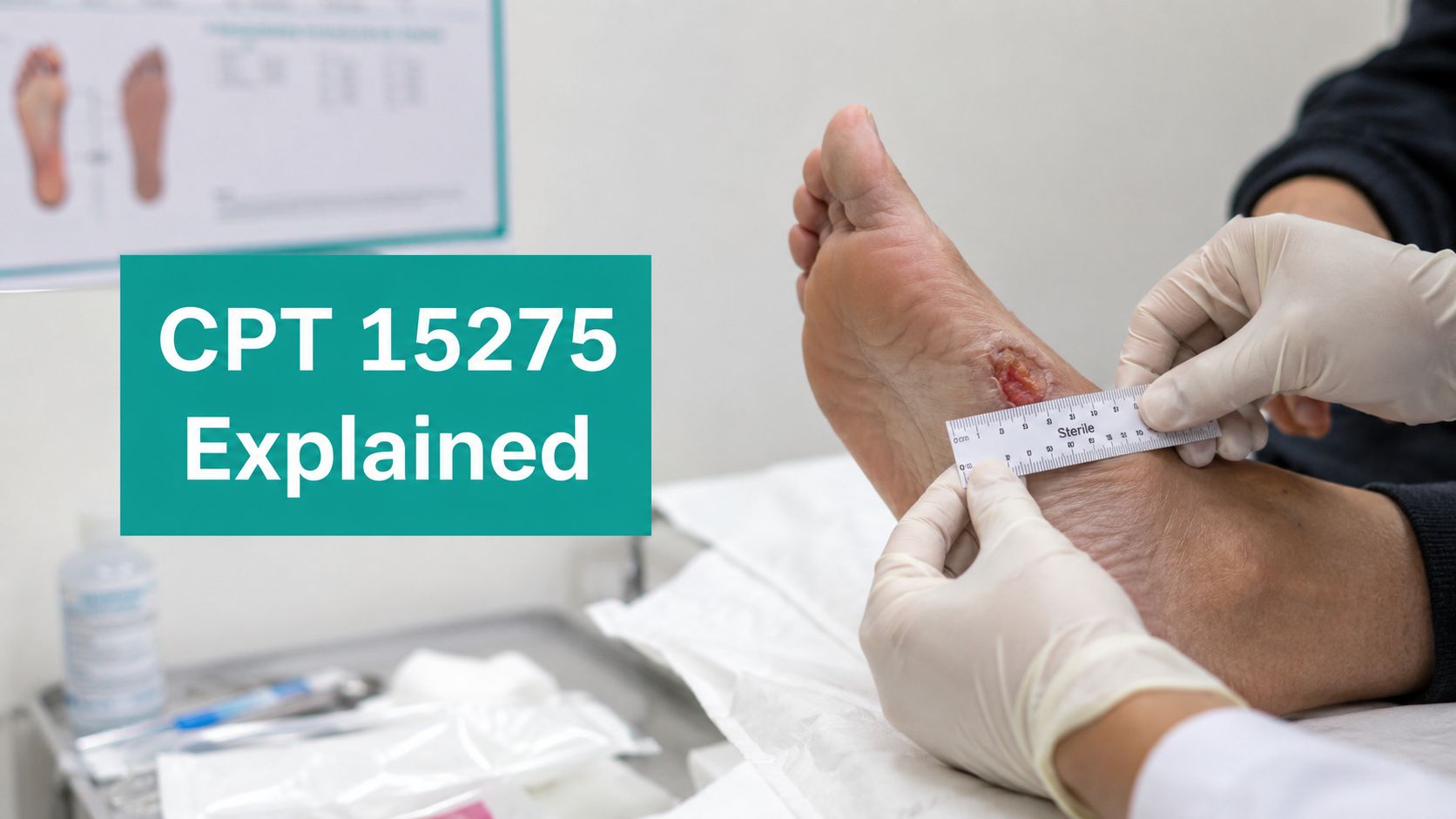
The chart is already half done, the foot is still bleeding a little at the edges, and someone in billing is asking why the claim hit a denial before the dressing dried. That's the everyday world of cpt 15275. The problem usually isn't the graft itself, it's whether the wound really belongs in the face, scalp, eyelids, mouth, neck, ears, orbits, genitalia, hands, feet, and/or multiple digits bucket, whether the surface area math is clean, and whether the note proves the product was medically necessary.
When Two Wounds on the Same Foot Trigger a 15275 Argument
A Wagner grade 3 plantar ulcer gets everyone's attention because it's deep, it's chronic, and it's already cost the patient months of conservative care. Then the heel ulcer shows up on the same foot, and that's where the argument starts. One clinician sees one foot, one session, one biologic. The payer sees a documentation gap and a chance to deny.
That dispute usually has nothing to do with whether a skin substitute belongs on the wound. It's about what counts as one treated wound surface area, whether adjacent lesions are aggregated, and whether the lesion stays inside the higher-complexity anatomic group that supports 15275. If the plantar wound and heel wound are both on the foot, the anatomy still matters more than the fact that they're on the same limb.
Practical rule: don't let the note say “foot ulcer treated with graft” and stop there. That's not enough to defend the claim when the wounds sit close together or span more than one lesion.
If you need a reminder of how wound-care documentation choices spill into unrelated operational decisions, the contrast in pressure injury prevention vs breathing is a good example of how site, purpose, and risk drive very different workflows. 15275 lives in that same world of precision. It's not a dressing code. It's an anatomic-group, measurement, and product-documentation code.
What 15275 Covers and How to Read the Descriptor

A claim for CPT 15275 lives or dies on how the descriptor is read line by line. The code covers application of skin substitute graft to the face, scalp, eyelids, mouth, neck, ears, orbits, genitalia, hands, feet, and/or multiple digits, with total wound surface area up to 100 sq cm, and the first 25 sq cm or less is reported under 15275 (FastRVU; Maryland Department of Health CPT descriptor). The add-on code 15276 applies to each additional 25 sq cm or part thereof (FastRVU).
Read the code the way an auditor does
The phrase total wound surface area causes the most disputes. If more than one lesion is treated, the note has to show whether those wounds were measured and billed as one aggregated surface or as separate wounds that support separate reporting. When that detail is missing, denials follow because the payer cannot tell what area was covered.
The phrase multiple digits matters for the same reason. It tells you the code is tied to a narrow anatomic group, not to the product alone. The same skin substitute can be reported correctly on a hand wound and reported under a different code on a lower-extremity wound, even when the clinician uses the same material in both places.
A clean note should leave no guesswork. It needs the site, the measured surface, and the product applied, all tied to the same wound event.
What the payment profile tells you
For 2026 Medicare Physician Fee Schedule data cited by FastRVU, 15275 carries a work RVU of 1.78, a non-facility total RVU of 4.80, and an estimated national Medicare payment of $160.32 before geographic adjustments (FastRVU). That profile matters because it shows where claims tend to break. This is not a minor dressing line, and it is not a reconstruction code with broad billing tolerance. Payment depends on correct measurement, correct site selection, and documentation that matches the product used.
Documentation standard: if the wound size, anatomic site, and skin substitute product are not each explicit in the note, the claim is exposed even when the procedure was clinically appropriate.
15275 vs 15271 and Picking the Right Anatomic Group
The site drives the base-code choice. 15271 applies to trunk, arms, and legs, while 15275 is reserved for the higher-complexity anatomic groups, including face, scalp, neck, hands, feet, genitalia, and multiple digits. Both code families use the same first 25 sq cm pricing logic, but the site still controls which code family belongs on the claim.
That distinction creates the most common dispute I see on these claims. The same biologic can be billed correctly in one anatomic group and incorrectly in another if the wound location is wrong. A heel ulcer belongs in the 15275 family. A pretibial ulcer does not, even when the wound is worse and even when the same product was used.
| Anatomic group | Base code | Add-on code | Typical wound example |
|---|---|---|---|
| Face, scalp, neck, hands, feet, genitalia, multiple digits | 15275 | 15276 | Plantar diabetic foot ulcer |
| Trunk, arms, legs | 15271 | 15272 | Venous ulcer on the lower leg |
The cleanest way to code it is to start with the anatomic site, not the diagnosis. A diabetic foot ulcer can still be denied if it is billed under the leg code family. A venous ulcer can still be wrong if it is pushed into the foot family just because the wound is large or chronic. That is the split payers look for, and it is the split that a denial reviewer will test first.
Pairing 15275 with the Right ICD-10-CM Codes
Procedure coding doesn't stand alone here. The diagnosis sequence has to tell the same story the wound note tells. For diabetic foot ulcers, the causal diabetes code from the E08-E13 family comes first, then the L97.- code for the ulcer site and severity, then any additional codes for infection or other complications. That sequencing is where a lot of otherwise good claims fall apart.
For pressure ulcers, the payer expects L89.- staging logic. For venous or arterial ulcers, the causal vascular disease codes matter just as much as the ulcer code itself. If the chart says “chronic foot ulcer” but the diagnosis line leaves out the underlying diabetes or vascular disease, the claim looks incomplete.
What the diagnosis line should do
It should show etiology, location, and severity without forcing the reviewer to guess. If there's a healed amputation site, the chart needs to be clear about whether the current open wound is at the same site, adjacent to it, or entirely separate. The same is true when the wound has drainage, periwound maceration, or signs of local infection.
I keep one internal reference open for team training because it helps coders and clinicians speak the same language on the claim line, ICD-10 and CPT code pairing guidance.
Bottom line: the diagnosis set has to explain why the wound exists and why it still needs advanced coverage. If the causal code and the ulcer code don't line up, the procedure code doesn't have much to defend it.
Documentation, Measurement, and Modifiers That Hold Up in Audit

A defensible 15275 note reads like a wound record, not a billing afterthought. It has to show the current length × width × depth in centimeters, the area calculation, the periwound description, the exudate type and amount, and the exact product used. If the wound was debrided, the note also has to show that the debridement was separately identifiable, especially when 11042-11047 is billed with the skin substitute application.
What belongs in the SOAP note
- Measurement: record each wound's dimensions in cm and show the area calculation. If the total treated surface reaches the next increment, the add-on logic has to be visible.
- Bed and edge assessment: document granulation, slough, maceration, undermining, rolled edges, or other findings that support advanced treatment.
- Conservative care failure: note offloading, compression, prior sharp debridement, or other standard care that did not close the wound.
- Product details: include the skin substitute product name, the lot number, and the application method.
- Encounter logic: if the same visit included an E/M service, a separate procedure, or staged follow-up care, the documentation has to support the modifier path. For modifier selection tied to separate procedure logic, KX modifier billing guidance is useful for staff who need to match the note to the claim.
Modifier use needs discipline. 59 or XU may be appropriate when the graft application is distinct from debridement on the same date. 25 belongs only when the E/M is separately identifiable. 58 fits a staged return for planned additional grafting, and 78 applies when the patient returns to the OR for an unplanned related procedure. If the documentation does not prove the separate work, the modifier will not save the claim.
For the payer-side language around staging and medical necessity, I keep medical necessity documentation standards close to the work queue. If the team still tries to hold graft claims, debridement, and encounter-level billing in memory alone, revenue cycle management for your practice shows why one missing line item can sink the whole encounter.
Denial Patterns and the Appeal Language That Works in 2025 2026
The denial patterns are boring because they repeat. That's also why they're fixable. In 2025 and 2026, the policy environment around skin substitutes keeps moving, while the 15275 descriptor itself hasn't changed (Organogenesis procedure codes reference.pdf)). The practice burden is to prove the claim still fits the current payer rules.
The four denials that keep coming back
Failed standard care wasn't documented well enough.
Appeal language should say the wound remained open despite conservative care, and the chart shows the details of offloading, wound cleansing, debridement history, and follow-up wound measurements. Attach the progress notes that show the plateau.The product or policy didn't match the payer rule.
Appeal language should state the product was selected under the plan's current skin substitute coverage requirements and was applied with the documented wound size and site. Attach the product record and the encounter note that identifies it.The anatomic group was disputed.
Appeal language should say the wound was located on the foot, hand, face, or other listed site in the code descriptor, and the note explicitly documents that anatomy. Attach the wound diagram or image annotation, if available, plus the bedside measurement.The surface-area math changed the units.
Appeal language should state the total treated surface area was measured before application and that the first 25 sq cm is properly captured under 15275, with 15276 used only for each additional increment. Attach the measurement worksheet and the application note.
A lot of denials that appear “new” in 2025 are really the result of 2024 charting habits colliding with tighter review. That's where clean revenue cycle habits matter more than appeal theatrics. If the team has a systematic intake and claim review process, the appeal reads like a correction. If not, it reads like a defense.
Appeal line that works: the wound met the anatomical and surface-area requirements for 15275, the product used was documented, and the note shows failed standard care before skin substitute application.
A Pre-Claim Checklist for Clean 15275 Submissions
A clean 15275 claim starts before the claim file does. Walk the note the way a reviewer will, because the denial usually comes from something simple, not something exotic. Start with the body site. If the wound is not on the face, scalp, eyelids, mouth, neck, ears, orbits, genitalia, hands, feet, or multiple digits, the code family is probably wrong. If it is on one of those sites, the chart needs to say that directly, not leave the reviewer to infer it from a template or a photo.
Then check the measurement logic. The total treated surface area has to stay under 100 sq cm for the 15275/15276 family, and the first 25 sq cm belongs to 15275. If the wound is larger, the add-on units have to follow the measured area. If the wound is smaller, do not stretch the unit count to fit the code.
Run this before submission
- Anatomic group checked: the site is explicitly one of the listed 15275 locations.
- Size checked: total wound surface area is documented before application and supports the unit count.
- Diagnosis pairing checked: the causal code and ulcer code match the wound type and site.
- Product checked: the skin substitute name and lot are in the note.
- Same-day procedures checked: any debridement, E/M, or staged return has modifier support in the documentation.
- Billing crossover checked: dressing or supply charges do not get layered in a way that triggers a predictable denial.
The common plantar-plus-heel example usually stays in 15275 if the foot lesions are documented cleanly and the treated area is measured and combined the way the code expects. The claim breaks when the note gets vague about wound borders, product identity, or why the skin substitute was chosen instead of more conservative care. That is the pattern I would teach every new coder and every new wound clinician on day one.
If you want the file to survive payer review, the note needs a few lines that are hard to argue with. State the anatomic site plainly, record the pre-application measurement, name the product, and describe the failed standard care that led to the skin substitute. That language gives billing something defensible when the claim is questioned later.
If your wound team is still fighting the same 15275 denials, EkagraHealth AI can help by mapping the visit into cleaner wound documentation, suggested CPT and ICD-10 codes, and claim-ready notes before the encounter leaves the chart. Visit EkagraHealth AI and see how it fits into a real wound-care billing workflow.
