At its core, a clinical decision support system (CDSS) delivers four huge wins: drastically better patient outcomes, smoother clinical operations, a healthier bottom line, and much simpler regulatory compliance. Think of these systems as an expert co-pilot for your care team. They use data to flag risks, suggest evidence-based actions, and cut down on administrative busywork, ultimately freeing clinicians to make faster, safer, and more confident decisions. The integration of a CDSS is no longer a luxury but a fundamental component of modern healthcare, transforming how clinicians interact with patient data and make critical care decisions. This guide will explore the profound benefits these systems offer, from improving patient safety to boosting financial performance and reducing clinician burnout.
The Real Power of Clinical Decision Support in Modern Healthcare
Let's cut through the tech talk for a moment. What does a CDSS actually do for a nurse or physician on the floor? It’s less like a typical piece of software and more like a seasoned expert sitting alongside them, constantly reviewing patient data to point out the safest, most effective path forward. It acts as an intelligent layer on top of the electronic health record (EHR), converting a static patient chart into a dynamic, interactive tool that actively participates in the care process. This real-time guidance is crucial in fast-paced clinical environments where decisions must be made quickly and accurately.
This is a game-changer in complex specialties like wound care, where patients often have a long list of comorbidities and require highly specific treatments. A CDSS helps untangle that complexity by adding a crucial layer of intelligent oversight. It’s not about replacing a clinician’s expertise; it’s about amplifying it with powerful, data-driven insights. By analyzing vast amounts of clinical data against evidence-based guidelines, the system can highlight subtle patterns or risks that might otherwise go unnoticed, empowering clinicians to deliver more personalized and effective care.
To give you a clearer picture, here's a quick summary of how these systems provide value across the board.
Core Benefits of Clinical Decision Support at a Glance
| Benefit Category | Key Impact Area | Example in Wound Care |
|---|---|---|
| Clinical | Improved Patient Outcomes | Recommends a specific dressing based on wound type, exudate level, and infection risk. |
| Operational | Increased Efficiency | Automates the generation of wound assessment notes, saving nurses valuable time. |
| Financial | Enhanced Revenue Cycle | Ensures all procedures and supplies are accurately documented for proper reimbursement. |
| Compliance | Reduced Audit Risk | Flags care plan deviations from evidence-based guidelines, ensuring quality standards are met. |
As you can see, the impact of a well-implemented CDSS is felt in every corner of a healthcare organization, from the patient's bedside to the billing department. It creates a connected ecosystem where clinical decisions, operational workflows, and financial outcomes are all aligned and optimized.
Empowering Clinicians at the Point of Care
The real magic of a CDSS is its ability to deliver the right information to the right person at precisely the right moment in their workflow. Instead of making a clinician dig through a patient’s chart or try to recall a specific guideline from memory, the system proactively serves up what they need, when they need it. This contextual intelligence is what separates a helpful tool from a distracting piece of technology.
This proactive support creates a ripple effect of benefits across the entire organization. By weaving itself directly into the clinical workflow, a CDSS helps providers:
- Improve Patient Safety: It acts as a safety net, flagging potential medication errors, alerting for allergies, or highlighting when a care plan strays from established protocols. This reduces the risk of preventable adverse events and enhances the overall quality of care.
- Enhance Clinical Outcomes: The system can recommend the most effective treatments by drawing on the latest research and tailoring suggestions to the patient's unique condition. This promotes adherence to evidence-based medicine and standardizes high-quality care across the organization.
- Boost Operational Efficiency: By automating routine documentation and administrative chores, it frees up clinicians to spend more quality time with their patients. This not only improves patient satisfaction but also helps combat the growing problem of clinician burnout.
- Strengthen Financial Performance: It helps ensure documentation is complete and coding is accurate, which leads to fewer claim denials and faster payments. This directly impacts the organization's bottom line and supports long-term financial stability.
A modern CDSS transforms the electronic health record from a passive data repository into an active, intelligent partner in care delivery. It helps ensure every decision is informed, compliant, and optimized for the best possible patient outcome.
The Evolution to AI-Powered Assistance
Today’s most advanced systems have moved far beyond simple, rule-based alerts. The integration of artificial intelligence is turning them into truly dynamic partners. Platforms like Ekagra Health AI are leading this charge, using sophisticated AI to interpret unstructured notes, analyze wound images, and even listen to patient-clinician conversations to automate documentation. This shift represents a move from passive alerts to active, intelligent assistance that understands context and nuance.
This evolution is a significant leap from basic EHR add-ons to platforms that become the central nervous system for delivering higher-quality, more efficient care. These AI-driven systems can predict patient deterioration, identify high-risk individuals, and provide personalized treatment recommendations with a level of precision that was previously unattainable. You can explore more on the growing role of AI in healthcare to see where this technology is headed.
What Exactly Is a Clinical Decision Support System?
Let’s cut through the jargon and talk about what a clinical decision support system (CDSS) actually is. Think of it as a "spell-check" for medicine, but much smarter. It’s not there to write the care plan for the clinician, but it acts like an expert partner, constantly looking over their shoulder to spot potential errors, suggest evidence-based options, and make sure the final treatment is both safe and effective. It provides a crucial layer of support that enhances, rather than replaces, human clinical judgment.
At its core, a CDSS is designed to give clinicians the right information, for the right patient, at the right time. It intelligently connects the dots between a patient's data and a massive base of clinical knowledge to help guide tough decisions. This process, known as the "Five Rights" of CDSS, ensures that the guidance provided is timely, relevant, and actionable, fitting seamlessly into the clinical workflow.
This is all about delivering better, safer care. It's like having an intelligent assistant who brings you exactly the research or guideline you need in the moment, saving you from having to dig through databases or rely on memory when time is critical. By automating the process of information retrieval and synthesis, a CDSS allows clinicians to focus on the higher-level task of applying their expertise to the unique context of each patient.
How a CDSS Actually Works
A CDSS works on a pretty simple but powerful three-step process. This is the engine that allows it to deliver relevant advice right when it’s needed, directly within a clinician's workflow. Understanding this mechanism helps demystify how these systems generate their valuable insights.
- Data Input: The system pulls in data from multiple sources, but mostly from the patient's electronic health record (EHR). This includes everything from demographics and lab results to medications, allergies, vital signs, imaging reports, and the notes you've written. The more comprehensive the data, the more accurate the system's recommendations.
- Inference Engine: This is the "brain" of the operation. It uses rules, algorithms, or even machine learning to compare the patient's specific data against a huge knowledge base filled with clinical guidelines, medical research, peer-reviewed literature, and best practices. This engine is constantly updated to reflect the latest medical science.
- Actionable Output: Finally, the system gives its findings back to the clinician. This might be an alert about a potential drug interaction, a reminder for a preventive care screening, a specific recommendation for a diagnostic test, or even a chart that helps visualize a trend in patient data. The key is that the output is quick to understand and directly useful for the decision you're making.
This cycle is what turns raw data into real clinical intelligence, and it’s one of the most powerful benefits of clinical decision support systems. It creates a continuous loop of data analysis and feedback that supports ongoing quality improvement.
From Simple Rules to Smart AI
Not all clinical decision support systems are built the same. They've come a long way, evolving from basic rule-followers to sophisticated AI platforms that can understand context and subtlety. This evolution mirrors the broader technological advancements in data science and artificial intelligence.
The first generation of these systems were mostly knowledge-based. They ran on a series of "if-then" rules programmed by experts. A classic example: "IF a patient has a penicillin allergy, THEN alert the clinician if they try to prescribe amoxicillin." These are helpful, but they can be rigid, require constant manual updates, and sometimes create a lot of noise with low-priority alerts, leading to "alert fatigue."
Today's systems are increasingly non-knowledge-based, using artificial intelligence and machine learning to find patterns in huge sets of data. These advanced platforms can predict patient risks, understand unstructured text in clinical notes, analyze medical images, and offer much more personalized guidance. Instead of relying on pre-programmed rules, they learn from real-world clinical data, becoming smarter and more accurate over time.
A modern, AI-powered CDSS doesn't just follow a script; it learns from every single patient interaction. This allows it to provide guidance that is highly relevant to the specific situation, which cuts down on "alert fatigue" and actually helps, rather than hinders, a clinician's thought process.
This evolution is what makes tools like Ekagra Health AI so powerful. Its ambient listening and AI wound analysis are perfect examples of an advanced, integrated CDSS. It goes far beyond flagging a drug interaction—it can analyze a wound photo to track healing or listen to a patient conversation to automate documentation, offering a much deeper and more helpful kind of support. This contextual awareness makes the technology a true partner in care.
The rapid adoption of EHRs really set the stage for this growth. By 2021, a solid 88% of office-based physicians were using them, a huge jump from just 42% in prior years. This created the perfect environment for CDSS to plug right in. As a result, the market has exploded; the U.S. CDSS market hit USD 2.14 billion in 2024 and is expected to climb to USD 3.40 billion by 2030. That kind of investment shows just how much value organizations are getting from these tools. You can explore the data behind the U.S. market growth for these systems on Grand View Research.
Improving Patient Safety and Clinical Outcomes
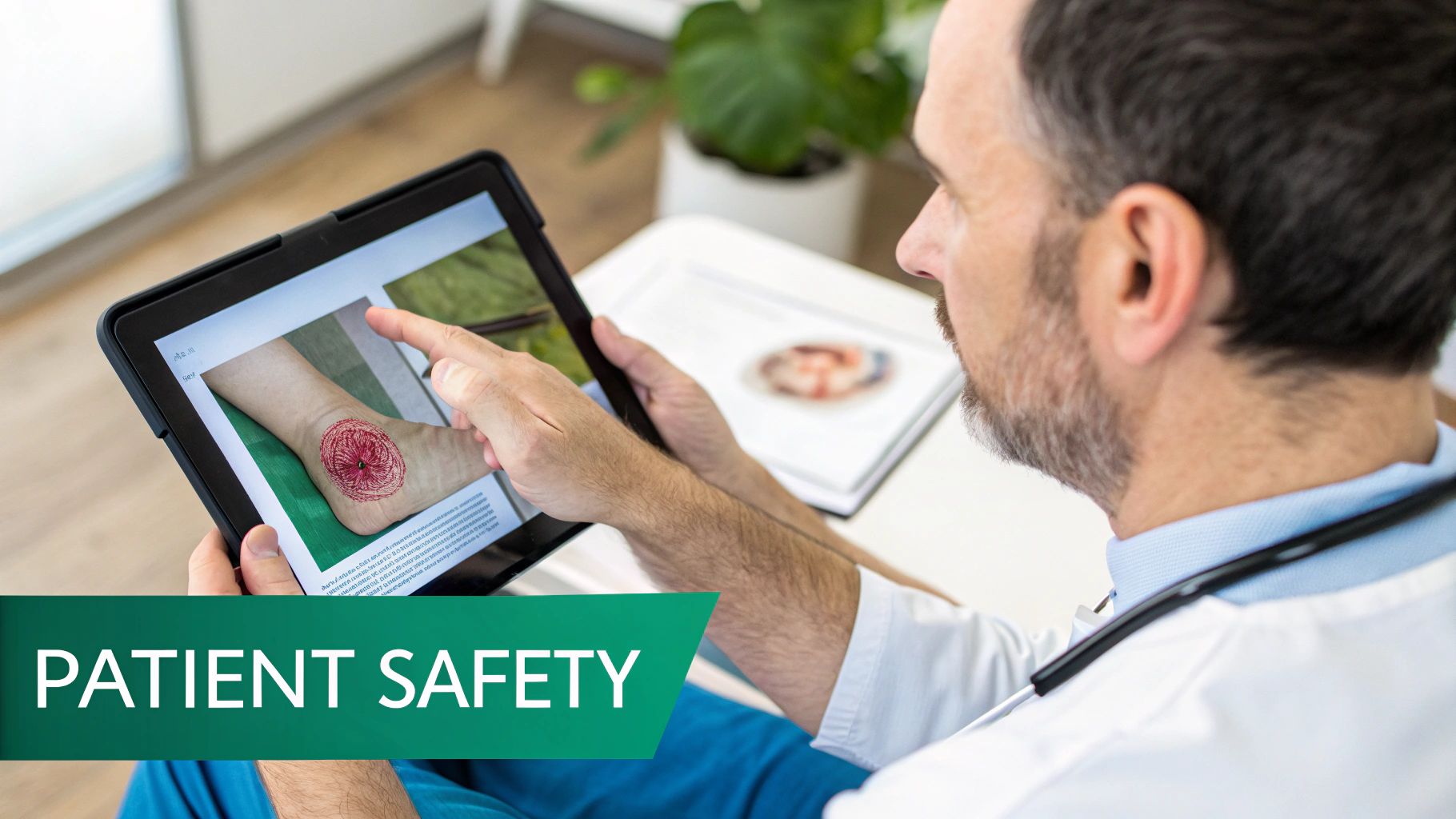
When you boil it all down, the single most important thing a clinical decision support system does is build a powerful safety net for patients. It shifts care from being reactive to proactive, flagging potential problems long before they can cause harm. This proactive stance is particularly vital in managing chronic conditions and complex patient cases. This is a game-changer in wound care, where patients are often juggling multiple, complex health conditions at once.
Think of a CDSS as a vigilant co-pilot, constantly scanning patient data for risks that a busy clinician might overlook. This could range from identifying a patient at high risk for sepsis based on subtle changes in vital signs to flagging a potential adverse drug event. This proactive monitoring translates directly into better, safer patient care and a reduction in preventable medical errors.
Preventing Medication Errors and Adverse Events
One of the most immediate wins with a CDSS is its ability to slash medication errors. For wound care teams, this is huge. Patients with chronic wounds, like diabetic or vascular ulcers, are frequently on a long list of medications, creating a minefield of potential interactions. The complexity of polypharmacy is a leading cause of adverse drug events, and a CDSS is an essential tool in mitigating this risk.
A CDSS helps navigate this complexity by automatically checking for:
- Adverse Drug Interactions: It flags dangerous medication combinations before a prescription is even finalized, considering both drug-drug and drug-allergy interactions.
- Patient Allergies: The system ensures a patient isn’t prescribed a drug they have a known allergy to, cross-referencing their complete medical history.
- Incorrect Dosages: It confirms the prescribed dose is right for the patient’s age, weight, renal function, and other physiological factors, preventing both under-dosing and toxicity.
This intelligent safety check, powered by AI and machine learning, delivers evidence-based alerts right at the point of care. The impact is undeniable. The global market for these systems was valued at USD 2.46 billion in 2025 and is projected to hit USD 3.89 billion by 2030. In the U.S. alone, where over 96% of hospitals and 78% of physicians use EHRs, these tools are becoming essential for automating workflows and providing real-time guidance. You can learn more about the CDSS market trends on MarketsandMarkets.
Standardizing Care with Evidence-Based Protocols
Consistent, high-quality care shouldn't be a lottery based on which clinician is working that day. A CDSS helps standardize treatment by embedding evidence-based protocols directly into the clinical workflow. This ensures every single patient gets the benefit of the most current medical science, reducing unwarranted clinical variation that can lead to suboptimal outcomes.
For example, when a patient presents with a new venous leg ulcer, the clinician is guided by the CDSS through a best-practice care pathway, rather than having to rely on memory alone. This might include prompts for specific diagnostic tests, recommendations for compression therapy, and alerts for follow-up assessments, all based on established clinical guidelines.
By embedding established guidelines into daily practice, a CDSS ensures that critical steps are never missed. This consistency is key to achieving predictable, positive outcomes and reducing variations in care that can lead to complications.
This approach not only drives better results but also helps new team members get up to speed much faster, making sure everyone is working from the same high-quality playbook. It serves as a valuable educational tool, reinforcing best practices with every patient encounter.
Enhancing Wound Healing with AI-Powered Analysis
Modern, AI-driven systems bring some truly groundbreaking advantages specifically to wound care. Let's be honest—traditional wound assessment can be subjective, often relying on a clinician's visual estimate. This subjectivity can lead to inconsistencies in documentation and treatment. An AI-powered CDSS introduces objectivity and precision, which leads directly to more effective treatment plans.
This is exactly where a platform like Ekagra Health AI makes a difference. By analyzing a digital photo of a wound, the AI can:
- Objectively Measure Wound Dimensions: It calculates the exact length, width, and surface area, taking the guesswork out of it. This provides a consistent, reliable baseline for tracking progress.
- Track Healing Trajectories: The system charts measurements over time, giving you a clear visual graph of healing progress—or lack thereof. This data-driven approach allows for early identification of wounds that are not healing as expected.
- Identify Early Signs of Trouble: Its algorithms can spot subtle changes in tissue color or texture that signal a brewing infection or deterioration, often before the human eye can catch it. This enables earlier intervention, preventing serious complications.
This isn't just a minor improvement; it fundamentally changes the game. It lets clinicians intervene earlier and with greater confidence, basing treatment adjustments on hard data instead of just intuition. The result? Measurably faster healing, fewer complications, and a reduction in costly hospital readmissions. At the end of the day, the benefits of clinical decision support systems are most powerfully seen in the improved health and safety of each patient you treat.
Streamlining Workflows and Reducing Clinician Burnout
Beyond patient safety, one of the biggest wins from a clinical decision support system is its ability to fight a massive problem in healthcare: the administrative overload that leads directly to clinician burnout. Think of these systems as an efficiency engine, built to automate the mundane, repetitive tasks that eat up so much of a provider's day. The relentless demand for documentation has become a primary source of dissatisfaction among healthcare professionals, and CDSS offers a tangible solution.
Instead of getting bogged down in manual data entry, a CDSS can automatically populate order sets, generate the right CPT and ICD codes from clinical notes, and simplify documentation. By handling these time-consuming tasks, it reduces the cognitive load on clinicians. The goal is simple but incredibly powerful: give clinicians their time back so they can focus on what they got into medicine for in the first place—caring for patients.
Combating the Burden of Alert Fatigue
Early CDSS tools got a bad rap for causing "alert fatigue." They were notorious for flooding clinicians with so many low-priority pop-ups that they became more of a distraction than a help. This phenomenon occurs when clinicians are exposed to a high volume of alerts, leading them to ignore or override them, including potentially critical ones. Thankfully, modern systems are built to avoid this exact problem. They deliver smart, context-aware notifications, not a constant barrage of noise.
Picture a system that only flags a critical drug interaction for a high-risk patient instead of sending generic warnings for every little thing. By using sophisticated algorithms to prioritize alerts based on clinical significance, these systems ensure that the information presented is both relevant and actionable. This intelligent filtering means that when an alert does pop up, clinicians actually pay attention. It's a critical shift from noise to signal, making the CDSS a helpful co-pilot rather than another digital headache.
A good CDSS makes the clinical workflow smoother and quiets the constant alarms, letting wound care teams get back to patient-focused work. With 96% of U.S. hospitals now on EHRs, integrating CDSS is the next logical step to automate things like guideline reminders and problem alerts. In fact, the 2023 Ascom Report found that mobile "push" alerts were the top pick for nurses—with 96% endorsement—which is a perfect fit for home health nurses managing chronic wounds on the go. This is where AI-driven wound measurements and analytics can feed directly into decisions, standardize assessments, and support HIPAA-compliant processes that make everyone's job easier. You can discover more insights about the clinical decision support market at SNS Insider.
Transforming the EHR from Burden to Assistant
For years, the electronic health record has often felt more like a clunky data-entry chore than a clinical partner. A well-designed CDSS completely changes that relationship. It turns the EHR from a passive file cabinet into an active member of the care team, one that anticipates needs and proactively provides support.
For example, a modern CDSS can automate a huge chunk of the documentation process, which is consistently named as a top cause of burnout. By leveraging natural language processing and ambient listening technologies, it can capture the details of a patient encounter and translate them into structured clinical notes automatically. This kind of automation makes a real difference in the day-to-day work of wound care teams, freeing them up for more meaningful patient interactions.
By taking over the repetitive administrative work, a CDSS helps bring the human element back to the bedside. It lets clinicians look up from the screen and truly connect with their patients.
This operational lift is one of the most immediate and tangible benefits of clinical decision support systems, directly boosting both clinician satisfaction and the quality of patient care. When clinicians are less burdened by administrative tasks, they have more time and mental energy to devote to complex clinical problem-solving and empathetic patient communication.
The Power of Voice to Claim Automation
The most advanced systems are pushing workflow automation even further. Platforms like Ekagra Health AI are pioneering a "voice to claim" system that slashes the administrative workload. This innovative approach streamlines the entire process from patient interaction to billing, creating a seamless and efficient workflow. It’s a pretty elegant process:
- Ambient Listening: The AI listens in on the natural conversation between a clinician and patient during their visit, securely and unobtrusively capturing the clinical narrative.
- Automated Charting: It then instantly creates a structured, compliant clinical note based on that conversation, extracting key medical information and organizing it appropriately in the EHR.
- Intelligent Coding: Finally, the system analyzes the generated note and proposes the correct CPT and ICD codes for billing, ensuring accuracy and completeness.
This whole sequence can cut documentation time by as much as 70%. By turning spoken words directly into a clean insurance claim, this technology removes some of the most frustrating parts of a clinician's job. To see how this works in practice, you can learn more about Ekagra Health AI's Voice Smart Charting capabilities at https://ekagrahealth.ai/voice-smart-charting/. It’s a perfect example of how a CDSS can lighten the load for wound care teams, no matter where they practice.
Driving Financial Health and Operational Excellence
Great patient care is the goal, but every healthcare organization knows that without a healthy bottom line, the mission is at risk. A Clinical Decision Support System (CDSS) is more than just a clinical tool; it’s a financial guardian working behind the scenes to make sure the value of care you provide is accurately captured and paid for. In an era of value-based care and tightening margins, the financial impact of a CDSS can be just as significant as its clinical benefits.
It strengthens the entire revenue cycle by turning solid clinical notes into clean claims that get paid fast. By ensuring that documentation is complete, accurate, and compliant from the moment of care, it prevents downstream issues that can delay or reduce reimbursement. For any administrator or revenue cycle manager, this is where a CDSS proves its worth far beyond the bedside, helping create a more stable and efficient financial future.
Optimizing the Revenue Cycle with Accurate Coding
One of the most immediate financial wins from a CDSS comes from nailing medical coding and billing. We all know that inaccurate or incomplete coding is the main reason for claim denials, payment delays, and lost revenue. A CDSS takes this problem head-on by integrating coding intelligence directly into the clinical documentation process.
Modern systems, like Ekagra Health AI, analyze a clinician's structured notes and instantly generate the right CPT and ICD codes. This automation is a game-changer. It slashes the risk of human error, ensures every single service, procedure, and supply is documented and billed correctly, and helps clinicians capture the full complexity of a patient's condition. The result? A huge drop in claim denials and a much faster path to reimbursement.
A CDSS transforms clinical documentation from a simple record-keeping task into a strategic asset for revenue cycle management. By ensuring coding accuracy from the start, it prevents downstream billing headaches and protects the organization’s financial health.
This precision is absolutely vital in complex fields like wound care, where treatments and coding rules get incredibly specific. The system can prompt for details needed to support higher-level codes, ensuring that the organization is reimbursed appropriately for the intensive care provided. To see how this works in practice, you can explore Ekagra Health AI's smart coding and billing capabilities, which are built to handle exactly these challenges.
Boosting Operational Efficiency and Resource Use
Beyond just billing, a CDSS is an efficiency engine. It helps your teams make smarter use of valuable resources—time, staff, and supplies—without ever cutting corners on patient care. By providing data-driven insights into resource utilization, it enables leaders to make more informed decisions about staffing, inventory, and capital expenditures.
It does this by weaving cost-awareness right into the clinical workflow. The system might recommend the most cost-effective diagnostic test or treatment that still aligns with best-practice guidelines. For example, it could suggest a more affordable yet equally effective dressing based on the wound's specific needs, stopping unnecessary supply costs from piling up.
This kind of intelligent guidance helps your organization:
- Reduce Waste: By preventing the overuse of expensive supplies and redundant tests, ensuring that resources are allocated where they are most needed.
- Standardize Processes: Ensuring every clinician follows the same cost-effective, high-quality care pathways, which reduces variability and improves predictability in costs and outcomes.
- Improve Staff Allocation: By automating documentation and coding tasks, it frees up your skilled clinical staff to focus on what they do best: treating patients. This allows for more efficient use of your most valuable asset—your people.
These operational gains lead to a leaner, more agile organization that can deliver top-tier care in a financially sustainable way. It isn't about being cheap; it's about being smart and using data to optimize every aspect of care delivery.
A Practical Framework for Measuring ROI
Okay, so how do you actually measure the return on investment (ROI) from a CDSS? It comes down to tracking the right key performance indicators (KPIs) that tie directly to your financial and operational goals. By monitoring these numbers before and after you implement the system, you can paint a clear picture of its impact and build a strong business case for continued investment.
Measuring the ROI of Your Clinical Decision Support System
This table outlines a practical guide to the KPIs your organization can use to track the financial and operational impact of your CDSS implementation.
| Metric Category | Key Performance Indicator (KPI) | How to Measure It |
|---|---|---|
| Financial Health | Claim Denial Rate | Track the percentage of claims denied by payers due to coding errors or lack of documentation. A lower rate signifies improved billing accuracy. |
| Operational Efficiency | Documentation Time per Patient | Measure the average time clinicians spend on charting per encounter. A significant reduction indicates improved workflow and productivity. |
| Clinical Quality | Adherence to Quality Measures | Monitor compliance with MIPS/MACRA and other value-based care reporting requirements. Improved adherence often leads to financial incentives. |
| Resource Management | Cost per Case | Analyze the average cost of supplies and diagnostic tests for specific wound types. A decrease suggests better resource optimization. |
By keeping an eye on these KPIs, you’ll have clear, data-backed evidence showing exactly how your CDSS is improving both financial performance and operational excellence across the board. This data is essential for demonstrating value to stakeholders and guiding future technology strategy.
How to Bring Clinical Decision Support into Your Practice
Bringing a clinical decision support system on board is much more than a software install. It’s about weaving a powerful new tool into the daily rhythm of your team. A thoughtful rollout is what turns the potential benefits of a CDSS into actual, measurable results. A successful implementation requires a strategic approach that considers technology, people, and processes. The secret lies in careful planning, with a sharp focus on how the system will work with your existing tech, how your team will actually use it, and rolling it out in stages to keep disruption to a minimum.
Any successful implementation begins with choosing a system that fits into your existing environment like a missing puzzle piece. It absolutely must play well with your current Electronic Health Record (EHR). Seamless interoperability is crucial. This simple requirement prevents the creation of frustrating data silos and stops clinicians from having to bounce between multiple, disconnected apps—a surefire way to kill adoption.
Start with a Solid Technical Foundation
Before you can start seeing the clinical and financial wins, you have to get the technical groundwork right. A couple of things are completely non-negotiable: ONC-Health IT certification and airtight HIPAA compliance. Certification from the Office of the National Coordinator for Health Information Technology (ONC) is your proof that the system meets national standards for how it works, how it protects data, and how it connects with other systems. This ensures the technology is secure, reliable, and interoperable.
Beyond the official stamps of approval, make sure the interface is genuinely user-friendly. The user experience (UX) is paramount. Let's be honest—if a tool is clunky, confusing, or slow, clinicians just won't use it. It doesn't matter how powerful the features are. You're looking for a clean design and an intuitive workflow that feels like a natural extension of a clinician's thought process, not another hurdle to jump. Involve end-users in the selection process to ensure the chosen system meets their practical needs.
The whole point of a CDSS is to make a clinician's job easier, not add more clicks and headaches. A system that demands hours of training or complicates a simple task is doomed from the start. Simplicity and ease of use are the keys to making sure your team actually embraces the technology.
A Roadmap for a Smooth Rollout
Once you’ve picked the right system, how you introduce it is just as critical as the technology itself. Trying to do everything at once is a recipe for chaos and resistance. A "big bang" implementation can overwhelm staff and lead to pushback. Instead, a structured, phased rollout builds confidence and makes the transition much smoother for everyone involved.
Here’s a practical roadmap to guide your implementation:
- Form a Dedicated Team: Pull together a small, cross-functional group. You'll want a physician champion, a nurse super-user, an IT specialist, and an administrator. This team will own the project, serve as advocates for the change, and become your go-to internal experts.
- Start with a Pilot Program: Don't flip the switch for everyone at the same time. Pick a single area to test the waters—maybe one wound care clinic or a small team of home health nurses. This lets you find and fix any kinks in the technology or workflow on a much smaller, more manageable scale.
- Provide Robust, Role-Based Training: One-size-fits-all training is a waste of time. Create different training sessions for different roles. Nurses, physicians, billers, and administrators all have unique needs and workflows, so focus on the features that matter most to their specific jobs.
- Gather Feedback and Iterate: During the pilot, constantly ask your users for feedback. What’s working well? What’s driving them crazy? What suggestions do they have for improvement? Use their real-world insights to tweak workflows and settings before you roll it out to a wider audience.
- Expand Incrementally: Once the pilot is a proven success and you’ve made your adjustments, you can start expanding. Roll the system out to other departments or teams in logical phases. This methodical approach gives each group the support and attention they need to get up and running successfully, building momentum for the change across the organization.
Common Questions About Clinical Decision Support
Bringing any new technology into your practice naturally comes with a few questions. Addressing these concerns head-on is crucial for building trust and ensuring user adoption. Let's tackle some of the most common ones we hear about clinical decision support systems and what they really mean for your day-to-day work.
Will a CDSS Take Over My Clinical Judgment?
Not at all. This is perhaps the most significant misconception about CDSS. The best way to think of a CDSS is as a highly-informed partner, not a replacement for your own expertise. It’s there to bring evidence-based insights and relevant data directly to you when you need it most—at the point of care. It serves to augment, not replace, human intelligence.
The system might suggest a treatment path based on clinical guidelines or flag a potential issue based on data patterns, but you, the clinician, are always in the driver's seat. You use your professional experience, clinical intuition, and deep understanding of the patient's unique circumstances and preferences to make the final call. The CDSS provides the data; the clinician provides the wisdom.
How Hard Is It to Get a CDSS to Work with Our Current EHR?
This used to be a major headache, but modern systems are built with smooth integration in mind. The level of difficulty really depends on the vendor, but solutions like Ekagra Health AI are designed for interoperability from the ground up, using standard healthcare data protocols like HL7 and FHIR. This ensures that data can flow seamlessly between the CDSS and the EHR.
Look for a partner with robust support, ONC certification, and a clear, well-defined implementation roadmap. Cloud-based platforms, in particular, tend to make this process much faster and less disruptive than older, on-premise software. A good vendor will work closely with your IT team to ensure a smooth and secure integration, minimizing downtime and disruption to clinical operations.
A well-designed CDSS should feel like a natural part of your existing workflow, not a clunky add-on. The goal is to enhance your tools, not create more work by forcing you to jump between disconnected systems.
How Can a CDSS Help in a Niche Field Like Wound Care?
This is where a CDSS really shines. For a specialty like wound care that demands precision, consistency, and detailed documentation, a tailored system can make a world of difference. It brings a level of data-driven accuracy that’s nearly impossible to maintain manually across a busy caseload, transforming a subjective art into a more objective science.
A specialized wound care CDSS can:
- Automate wound measurements from a simple photo, giving you objective, repeatable data for length, width, surface area, and tissue composition.
- Track healing progress visually and numerically over time, comparing it to expected outcomes and alerting clinicians to wounds that are failing to progress.
- Recommend the right dressings and treatments based on the wound’s specific characteristics, such as exudate level, tissue type, and infection status, all guided by evidence-based algorithms.
- Guarantee accurate coding for reimbursement of complex supplies and procedures, ensuring that the value of the care provided is fully captured.
Tools built specifically for these tasks, like Ekagra Health AI, help standardize the quality of care, eliminate documentation errors, and give your team the hard data needed to fine-tune treatment plans for every single patient. They empower clinicians to practice at the top of their license, supported by the best technology available.
Ready to see how AI-driven clinical decision support can transform your wound care practice? Discover how Ekagra Health AI streamlines documentation, enhances clinical insights, and accelerates reimbursement. Learn more at https://ekagrahealth.ai.
