
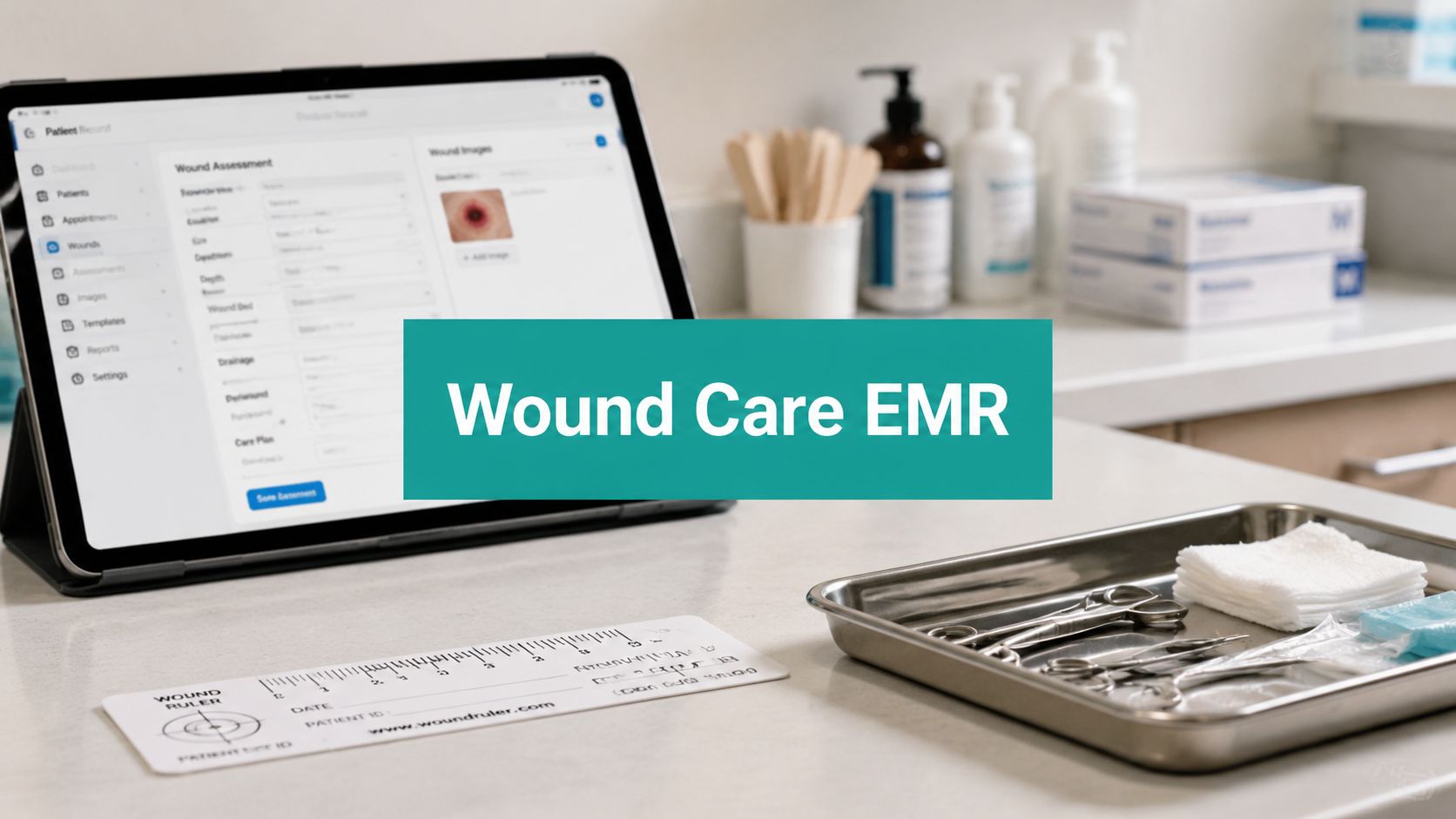
A podiatrist finishes a diabetic foot ulcer visit, selects the debridement code, and sends the claim out. Days later, the payer rejects it because the note never states the tissue depth removed or the wound surface area after debridement. The clinician performed the work. The chart failed to prove it.
That failure is common in wound care because reimbursement follows the documentation trail. A usable wound care EMR software workflow has to connect bedside assessment, serial measurements, wound images, CPT and ICD-10-CM selection, prior authorization, and claim review. If those steps live in separate systems or depend on memory, denials and copy-forward errors become part of the operating model.
Why Generic EHRs Fail Wound Care Clinics
Generic EHRs are usually built around the outpatient encounter, not the wound's changing clinical state. A standard note may capture a diagnosis, assessment, plan, and procedure, but wound care needs a much more granular record. The clinician must show what the wound looked like today, how it compares with prior visits, what tissue was present, what tissue was removed, and whether treatment is producing a response.
A narrative paragraph rarely handles that well. One clinician writes “ulcer improving,” another writes “debrided,” and a third copies last week's description without updating the depth or drainage. The billing team then has to reconstruct the encounter from incomplete text. That's where a generic charting workflow creates risk that may stay invisible until a claim is rejected.
Practical rule: A procedure entry that says “debridement performed” is not a defensible wound care record.
The mismatch appears at the bedside
CMS expects the chart to include the wound's size, depth, location, stage, infection signs, necrotic or non-viable tissue, and response to treatment at each physician visit. The record also needs legible signatures, complete patient identifiers, and enough detail for contractor review, as outlined in CMS wound care documentation guidance.
A generic EHR may offer a free-text wound field, but that doesn't force the clinician to document length, width, depth, exudate, periwound condition, or post-procedure findings. It also may not connect the diagnosis to the specific CPT code selected. The result is a note that reads plausibly but doesn't support medical necessity.
Structured data changes the risk profile
Wound care EMR software should treat each wound as a longitudinal clinical object. The system needs to preserve serial measurements, link images to dates, distinguish multiple wounds by location and depth, and make missing elements visible before signature.
That's the purpose of a specialized point-of-care documentation workflow. It moves the clinician away from remembering every required field after the visit and toward completing the right assessment while the wound is in front of them.
CMS Documentation Rules That Shape Wound Care EMR Design
CMS requirements are not a decorative compliance layer. They determine the fields, prompts, and validation logic a wound care EMR needs. At every physician visit, the chart should capture wound dimensions, depth, location, stage, infection indicators, necrotic or non-viable tissue, and the wound's response to treatment.
The wound description must also make clinical sense. A heel ulcer documented as Wagner grade 3, with slough, drainage, and exposed tendon, cannot be charted like a shallow venous ulcer with scant serous exudate. The diagnosis, tissue description, treatment plan, and procedure note should tell the same story.
Debridement is depth-based and area-based
Debridement coding isn't based only on whether a procedure occurred. CMS guidance requires the note to support the tissue removed and the wound surface area involved. For the relevant code family, that includes CPT 97597, 97598, 97602, and 11042 through 11047, with the documentation matching the service billed.
CMS also specifies that debridement services must document both the wound surface area after debridement and the depth of tissue removed, as explained in Medicare contractor coding guidance. A pre-procedure measurement alone doesn't establish the post-debridement area. The note should state what tissue level was reached and what the resulting area measured.
For CPT 11042 through 11047, independent coding guidance explains that selection depends on excision depth and wound size. CPT 11042 covers subcutaneous tissue for the first 20 square centimeters, while add-on codes apply to each additional 20 square centimeters at the matching depth, according to this CPT coding reference.
Auditors follow the chain
Surveyors and auditors look for internal consistency. The wound location should match the diagnosis. The documented tissue depth should support the CPT code. The procedure description should identify the tissue removed, and the post-debridement measurement should support the billed area.
A well-designed wound care documentation template makes those relationships visible during charting. It can require the clinician to complete missing fields before signing, rather than leaving the billing team to chase clarification after the claim has already gone out.
Essential Features for Clinical and Revenue Cycle Workflows
Evaluate wound care EMR software in the order a visit happens. Start with assessment, move through treatment and procedure documentation, then test coding, authorization, and claim readiness. A long feature list means little if the system breaks at one of those handoffs.
Assessment begins with images and measurements
The image workflow should support a photograph of the whole anatomic site, followed by a close-range wound image with a measurement guide, under facility policy. Peer-reviewed wound assessment guidance recommends that sequence and supports transferring the image into the EMR for longitudinal review in wound assessment guidance.
The system should date-stamp images, preserve measurement conventions, and show comparisons in one timeline. Length should follow the head-to-toe direction, width should follow the lateral direction, and greatest depth should include tunneling or undermining when present. Clock-face notation gives the next clinician a usable map instead of a vague statement that “undermining noted.”
SOAP automation should turn common observations into discrete fields. Exudate type, drainage amount, odor, periwound maceration, erythema, edema, callus, and off-loading adherence shouldn't disappear inside a paragraph. Free text still has a place, but critical data must remain searchable and reportable.
Coding and authorization must follow the note
CPT and ICD-10-CM mapping should appear during documentation, not after the encounter. If the clinician selects a debridement service, the workflow should prompt for the tissue depth removed and post-debridement surface area. For multiple wounds, it should preserve each wound's depth and prevent inappropriate area aggregation.
Prior authorization deserves its own workflow. The packet should pull the diagnosis, serial measurements, images, treatment history, response to treatment, and procedure details from the chart. Payer-facing documentation shouldn't require staff to download images, search old notes, and assemble a separate narrative by hand.
| Workflow Stage | Required Feature | Why It Matters |
|---|---|---|
| Assessment | Three-dimensional measurements and standardized images | Establishes a dated baseline and supports comparison |
| Tissue evaluation | Structured tissue, exudate, infection, and periwound fields | Makes medical necessity easier to review |
| Procedure | Debridement depth and post-procedure area prompts | Aligns the note with the billed CPT service |
| Diagnosis and coding | ICD-10-CM and CPT support during charting | Reduces mismatches between clinical findings and charges |
| Authorization | Auto-assembled clinical evidence | Prevents incomplete submissions for advanced therapies |
| Claims review | Pre-submission completeness checks | Finds missing documentation before denial |
Revenue cycle connectivity matters, but the useful test is whether the system catches a missing field before the claim leaves the organization. A practical healthcare claims management workflow should connect clinical completion with charge capture and review.
Selection Criteria That Matter in Real Clinics
A polished demonstration can hide the conditions that determine whether a system survives daily use. Mobile wound programs, SNFs, and home health teams often document in hallways, resident rooms, and homes where connectivity is weak and interruptions are routine. Slow screens and fragile photo uploads turn a technically capable EMR into a system clinicians avoid.
Test the field workflow, not the conference-room workflow
Ask a clinician to document a full visit on the actual device used in the field. Capture an image, enter length, width, and depth, record exudate and periwound maceration, document off-loading adherence, add a procedure, and sign the note. Then repeat the test with intermittent connectivity.
The system should preserve work during a connection gap and synchronize without creating duplicate notes or lost images. It should also prevent signature when required clinical elements are missing. A note that can be signed despite absent depth or response-to-treatment data transfers the problem to billing.
Recent user-review coverage describes complaints involving slow performance, billing errors related to documentation gaps, and notes that can be signed while required elements remain incomplete field workflow and user-review discussion. Those are not minor usability defects. They directly affect adoption and claim quality.
Multiple wounds expose weak logic
A patient may have wounds at different tissue depths. CMS guidance requires wounds to be summed only when they share the same depth. The EMR should therefore keep each wound separate, retain its location and depth, and calculate or present areas in a way that supports correct coding.
Integration questions also need specificity. Confirm HIPAA-compliant processes, ONC-Health IT certification, role-based access, image security, billing connectivity, and support for electronic prior authorization workflows. CMS and ONC materials describe payer support for electronic prior authorization APIs under the 2024 interoperability rule, with key implementation deadlines pushed to January 1, 2027, and HealthIT.gov describes the need for systems to maintain a Prior Authorization API for ePA workflows in the federal interoperability requirements.
A useful demo test: Ask the vendor to show the incomplete-note warning, offline behavior, multiple-wound coding logic, and pre-submission claim review. Those screens tell you more than a feature catalog.
Implementation Decisions That Drive Measurable ROI
Implementation succeeds when the organization defines the data it must capture, the handoffs it must protect, and the measures it will review after launch. Buying software without redesigning those workflows usually produces a faster version of the same old problems.
Start with a single wound assessment standard. Decide how clinicians will record measurements, clock-face undermining, tissue type, exudate, periwound findings, infection indicators, treatment response, and image timing. Use the same structure across physicians, nurses, mobile providers, and SNF teams, while allowing specialty-specific additions.
Reduce re-entry at the source
Structured templates reduce duplicate entry because the same wound data can support the clinical note, procedure documentation, authorization packet, and claim review. Voice-assisted drafting can help with the narrative, but staff still need to verify the discrete fields that drive coding and medical necessity.
Coding prompts should appear at the moment of selection. If 11042 is chosen, the system should prompt for subcutaneous tissue removal and the post-debridement surface area. If the documented depth doesn't support the selected service, the clinician should see the conflict before signature.
Measure operational changes after go-live
Track measures that reflect the documentation-to-reimbursement chain:
- Completion quality: Review whether required wound dimensions, tissue details, response to treatment, and procedure elements are present before signature.
- Coding corrections: Monitor how often coders return notes because the tissue depth, area, diagnosis, or procedure description doesn't align.
- Claim outcomes: Separate denials caused by missing documentation from denials caused by eligibility, authorization, or other payer issues.
- Accounts receivable: Watch whether reviewed debridement, skin substitute, and prolonged visit claims remain open because staff must retrieve supporting evidence.
- Clinical visibility: Confirm that clinicians can see serial measurements and images without searching across separate records.
The fastest return usually comes from preventing rework, not from adding another dashboard. A system that stops an incomplete note at the bedside can save more operational effort than an advanced report that arrives after the denial.
Clinical Scenarios That Test EMR Capability
A complex diabetic foot ulcer reveals whether the EMR connects assessment, treatment, coding, and authorization. Under the Wagner scale, grade 2 extends to tendon, bone, capsule, or deep fascia without abscess or osteomyelitis, while grade 3 includes deep abscess, osteomyelitis, or joint sepsis. The scale also includes grade 0 for intact skin or a pre-ulcerative lesion, grade 1 for a superficial ulcer, grade 4 for partial-foot gangrene, and grade 5 for whole-foot gangrene, as described in this Wagner classification reference.
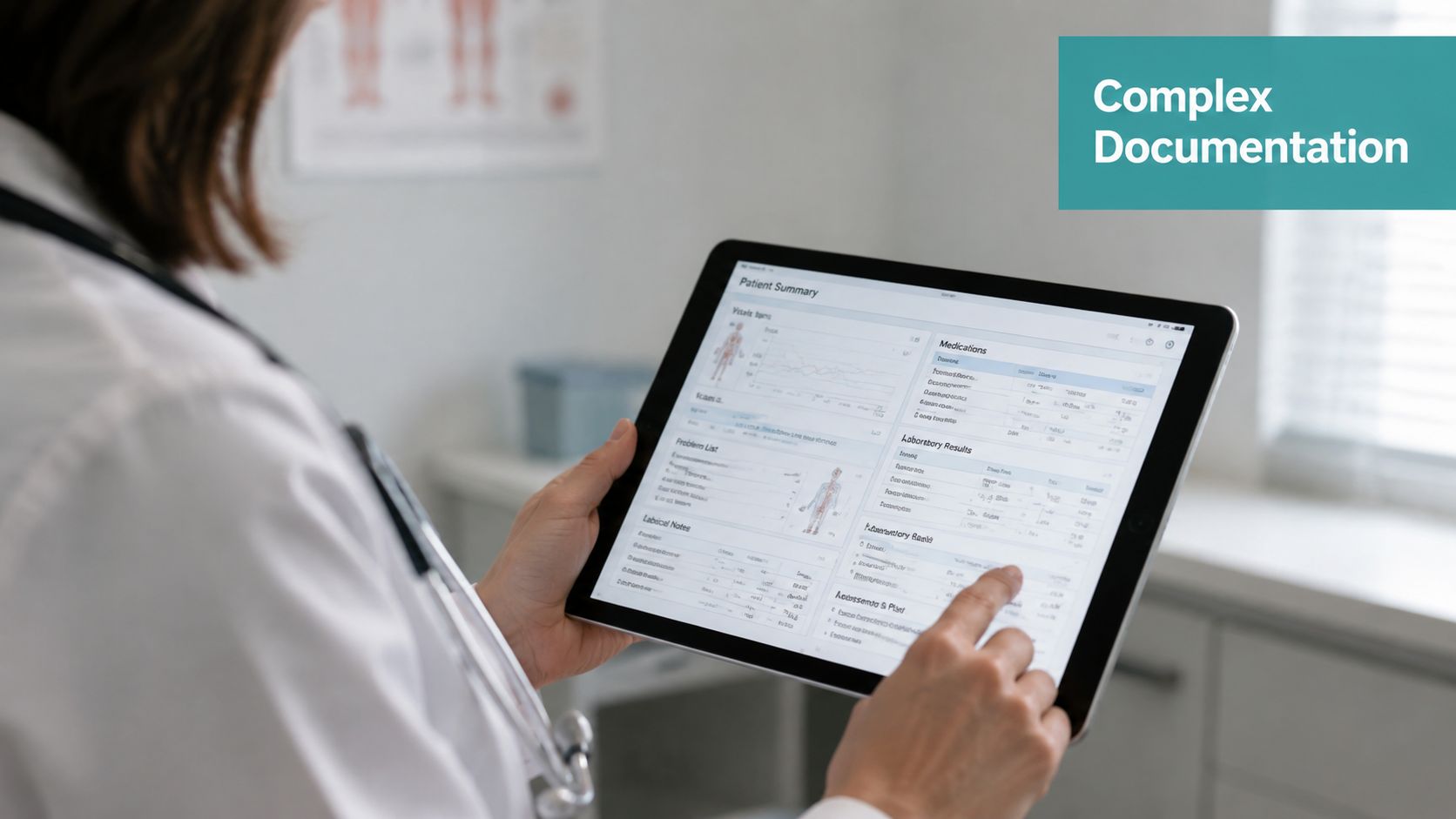
For a Wagner grade 3 ulcer, the clinician should record the grade, precise location, length, width, depth, tissue type, drainage, infection findings, and any exposed structures. Undermining belongs in the wound map with clock-face position and depth. The procedure note should identify the tissue removed and connect the diagnosis to the selected sharp debridement service, such as CPT 11042 when the documented tissue level supports it.
The authorization package should then draw from the same record. Serial images, dated measurements, treatment history, response to treatment, and procedure documentation should remain linked rather than assembled manually from separate folders. If the photo is missing or the tissue description is incomplete, the system should flag the gap before submission.
The mobile SNF visit
The second test is less dramatic and more revealing. A clinician enters a nursing facility with a tablet, limited time, and intermittent connectivity. The patient has a chronic wound with moderate drainage, periwound maceration, and inconsistent off-loading adherence.
The clinician needs to capture the image, document exudate type, describe the periwound, record measurements, update the treatment plan, and sign without duplicating the prior note. The system should retain the encounter if the connection drops and synchronize the completed record later.
That workflow also protects against copy-forward errors. The prior measurement can remain visible for comparison, but today's value must be actively confirmed. A useful EMR makes the current assessment easy and the stale assessment difficult.
Building Your Evaluation Framework
Choose wound care EMR software by testing the chain from wound observation to paid claim. Feature count should come after reliability, documentation enforcement, and payer defensibility. A system that looks impressive but lets incomplete notes through will create more work than it removes.
Use this decision matrix during vendor conversations:
- Point-of-care enforcement: Can the system require wound size, depth, location, stage, infection findings, non-viable tissue, response to treatment, and procedure details before signature?
- Longitudinal evidence: Are images, standardized measurements, annotations, and comparisons stored in one dated timeline?
- Coding alignment: Does the workflow connect the documented tissue depth and post-debridement area to CPT and ICD-10-CM selection?
- Multiple-wound logic: Can it keep wounds separate and respect the rule that areas are combined only at the same depth?
- Field reliability: Does it work on the devices used in mobile programs, SNFs, and home visits when connectivity is inconsistent?
- Authorization readiness: Can staff assemble a payer packet from existing chart data, and does the system identify missing evidence before submission?
- Revenue cycle visibility: Can billing teams see why a claim is held, what documentation is missing, and whether the record supports the billed service?
Red flags include a photo module that stores images outside the clinical timeline, a procedure button with no tissue-depth prompt, unrestricted signing of incomplete notes, and reports that can't distinguish current measurements from copied-forward values.
EkagraHealth AI offers a wound care documentation and billing workflow that can draft SOAP notes, map CPT and ICD-10 codes, support wound image analysis with measurements and annotations, and connect prior authorization and accounts receivable work to the clinical record. Evaluate it by the same bedside and claims tests described above, then choose the system that protects both patient care and documentation integrity.
If your wound care team is losing time to incomplete notes, manual image review, or preventable debridement denials, visit EkagraHealth AI to review a workflow built around point-of-care documentation and reimbursement readiness. Bring your hardest mobile, SNF, and multi-wound scenarios to the evaluation so you can see whether the system fits the work your clinicians perform.
