
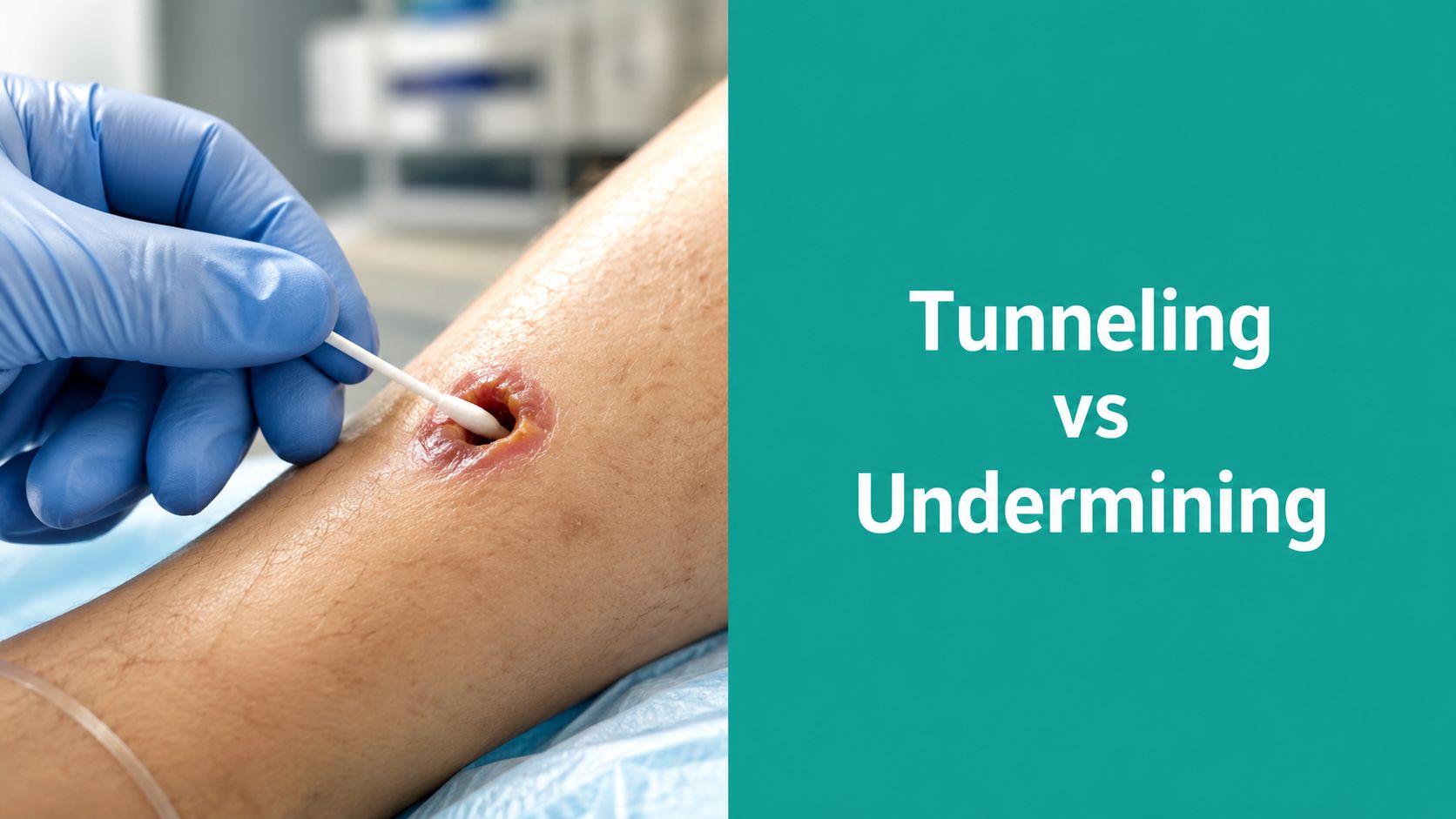
“Measure the wound, not the tunnel.” That advice sounds sensible, but it causes trouble when clinicians treat every hidden extension as one generic deep space. A tunneling wound vs undermining assessment requires more than recording a centimeter value. The direction, tissue plane, clock position, exudate, exposed structures, and certainty of the exam all affect treatment planning and the defensibility of the chart.
A tunnel is a narrow passage extending from the wound base. Undermining is tissue destruction beneath the wound edge, often forming a shelf or pocket along an arc. Those findings can coexist, but they aren't interchangeable. The distinction affects probing, packing, offloading, debridement planning, progression tracking, and the documentation that supports medical necessity.
Why Tunneling and Undermining Are Not the Same Wound Finding
The popular shortcut is to chart “tunneling and undermining present” followed by one depth. That shortcut erases the anatomy. A tunnel is documented as a tract with a direction and length. Undermining is documented around the wound margin, usually with a clock-face range and depth by position. The distinction is described clearly in this clinical reference on tunneling and undermining.
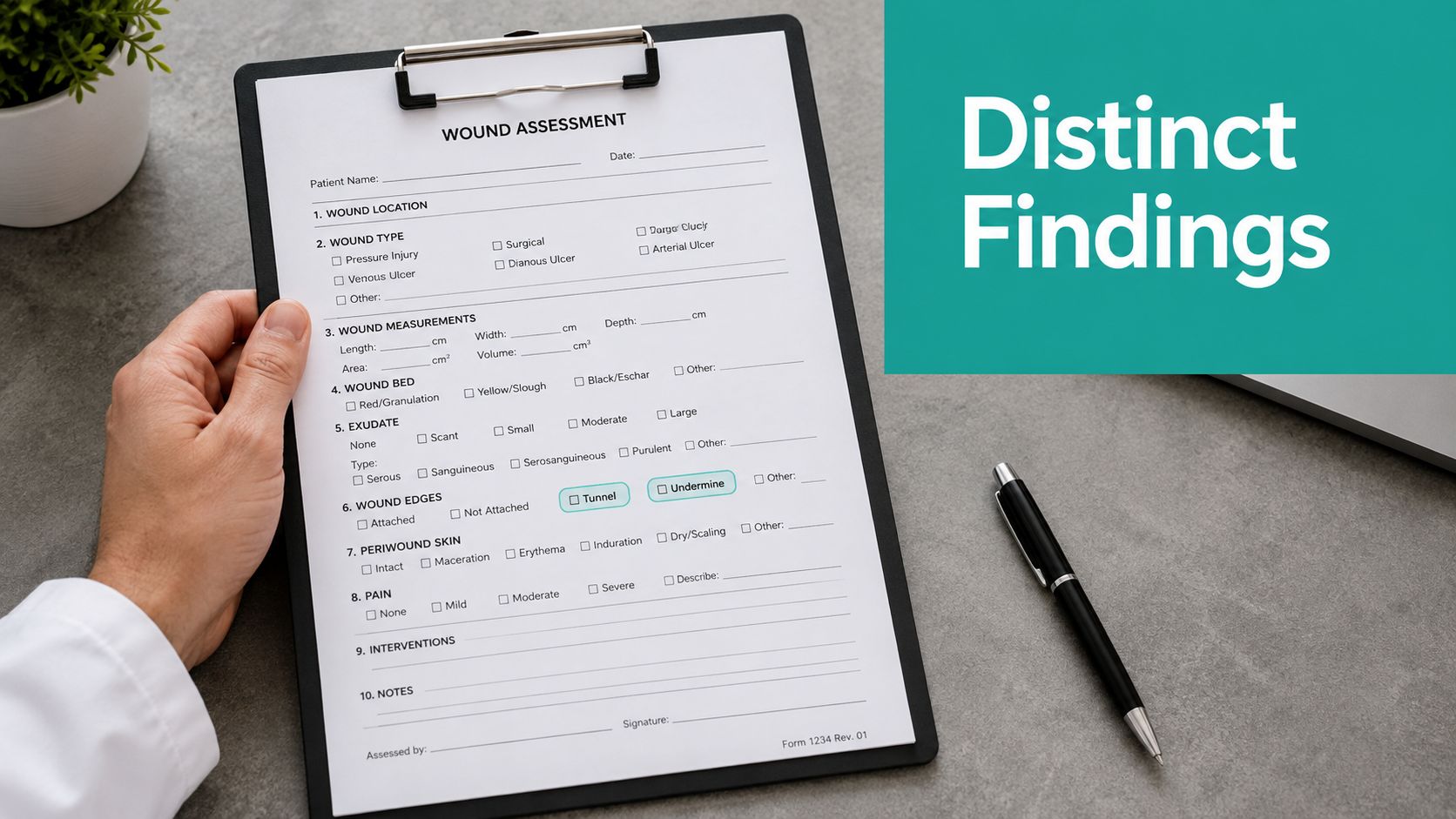
The anatomy changes the chart
Tunneling extends from the wound base in a single direction. A practical entry might read, “Tunnel at 4 o'clock, 3 cm.” Undermining extends under intact skin from the wound edge and may span more than one direction, such as “Undermining from 12:00 to 3:00, depth varies by position.”
Those descriptions aren't interchangeable even when the numeric depth matches. A single 2 cm tunnel is a tract length. A 2 cm undermining measurement describes how far tissue has separated beneath the edge at a particular position. Combining them into one number loses the location and the tissue plane.
That loss matters in sacral ulcers, heel wounds, and cavity wounds. Hidden dead space can retain exudate and bioburden, interfere with granulation, and make debridement planning less precise. A clinician assessing undermining wound documentation should be able to identify whether the finding begins at the base or at the margin.
Practical rule: If the chart doesn't tell the next clinician where the space is, it hasn't fully described the wound.
Why auditors notice the shortcut
A vague entry such as “deep tunneling noted” doesn't establish whether the clinician evaluated the wound edge, probed the base, or assessed the entire cavity. It also makes serial comparison unreliable. At the next visit, a smaller surface opening could conceal a persistent tract, while an apparent increase in “depth” might reflect a different probing direction.
The distinction can also affect how the record supports a debridement claim. The measured extension doesn't automatically determine the deepest tissue removed, but it can support the clinical explanation for why a particular tissue plane was assessed or treated. When the note collapses separate findings, coders and payers have less evidence connecting the wound assessment to the service performed.
Bedside Measurement Technique for Each Finding
Measurement should be gentle, deliberate, and reproducible. The goal isn't to push until the applicator reaches a dramatic number. The goal is to identify the tissue plane, locate the extension, and record the distance from the wound edge or base accurately enough for the next assessment.
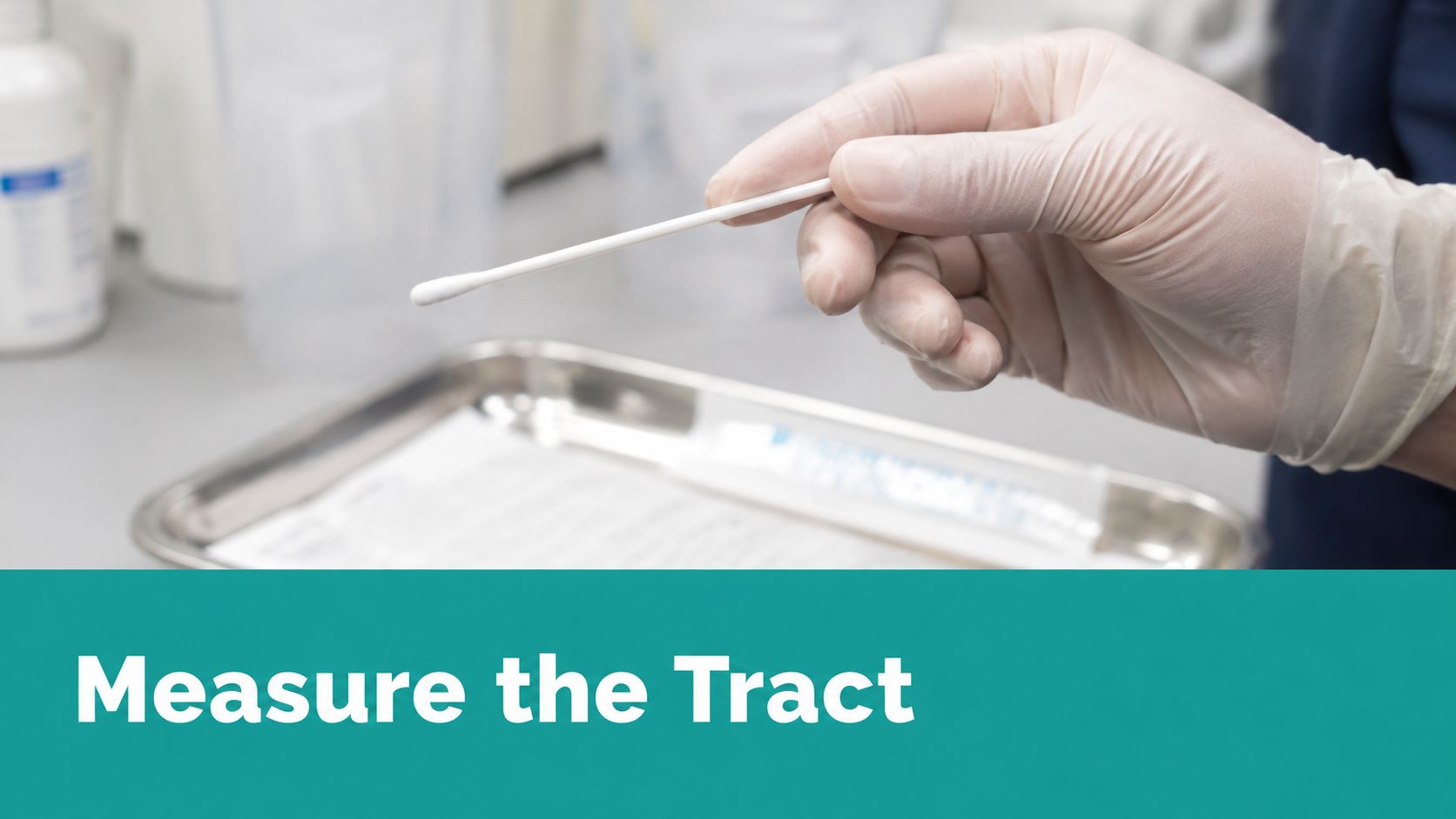
Probe the tunnel along its tract
For tunneling, use a sterile cotton-tip applicator or appropriate sterile probe. Advance it into the opening or tract until resistance is felt. Don't force the instrument through friable tissue, and don't convert resistance into a deeper measurement by applying pressure.
Record the distance from the wound edge to the tip in centimeters, then add the clock position. A useful entry is, “Tunnel at 4 o'clock, 3 cm, terminates with gentle resistance.” If the tract branches, document each direction separately rather than averaging the findings.
The clock-face orientation should be consistent. CMS wound documentation guidance uses the patient's head as 12 o'clock and feet as 6 o'clock. State the orientation in the facility record when needed, particularly for mobile teams or wounds that may be photographed and reviewed by someone who wasn't present.
Assess undermining nearly parallel to the surface
For undermining, place the probe nearly parallel to the wound surface. Advance it beneath the wound edge until resistance is felt, then measure the distance from the edge to the tip. The finding should be recorded as a range, such as “Undermining from 12:00 to 3:00,” with depth documented at the relevant positions if it varies.
A single number is inadequate when the shelf is irregular. “Undermining 2 cm” doesn't tell the reader whether the pocket is at 12 o'clock, spans the inferior margin, or surrounds the wound. The arc gives the anatomy needed for packing, offloading, and reassessment.
Handle uncertainty honestly
Pain, slough, bleeding, friable tissue, and a post-debridement cavity can limit the examination. In those cases, don't invent precision. Write “Unable to fully assess the tract due to pain,” “Probe advanced only to 1 cm because of friable tissue,” or “Slough obscures the base; full depth not confirmed.”
That language is stronger than a confident but unsupported number. Wound measurement examples can help teams standardize how they record partial assessment, resistance, and positional findings without implying that an incomplete exam was definitive.
Anatomy, Language, and Documentation Format Side by Side
Geometry alone does not make a defensible wound note. The tissue plane, the landmark used, and the way the finding is measured must agree. A narrow tract and a broad pocket can sit beside the same wound, yet they require different chart language and different reassessment points. CMS expects tunneling and undermining to be described because each can affect wound measurement and healing.
| Feature | Tunneling | Undermining |
|---|---|---|
| Anatomical location | A narrow channel extending from the wound base | Tissue separation extending beneath the wound edge |
| Directionality | Usually a single tract or primary direction | A shelf or pocket that may extend across an arc or in multiple directions |
| Measurement format | Clock position plus tract depth or length in centimeters, such as 4 o'clock, 3 cm | Clock range plus depth by position, such as 12:00 to 3:00 with varying depth |
| Starting point | Wound base or cavity | Wound margin beneath intact or partially intact skin |
| Progression tracking | Compare tract location and length at each visit | Compare the arc and depth at each relevant clock position |
| Treatment implication | Document the tract's extent and reassessment limits | Document the affected arc, depth variation, and margin condition |
Choose language that matches the tissue plane
“Sinus,” “cavity,” “tunnel,” and “undermining” describe different findings and should not serve as interchangeable chart terms. A sinus may describe a channel, but the note still needs its location and measurement. A cavity may be broad and open without forming a tunnel. Undermining describes separation beneath the wound margin, even when no discrete passage is present.
The progression record should preserve the same landmarks over time. If the first visit identifies undermining from 12:00 to 3:00, reassess that same arc at the next visit. Changing “2 cm undermining” to “1 cm undermining” leaves a major gap if the location and measurement points are missing. That shortcut weakens clinical comparison and can create avoidable coding questions.
Don't confuse wound size with hidden extension
Length, width, and surface depth describe the visible wound and its measurable bed. A tunnel adds a tract measurement from the wound base. Undermining adds a margin measurement that follows the affected clock range. These values belong in the same wound assessment, but one cannot substitute for another.
“One number may be easy to enter, but it isn't always clinically meaningful.”
What the Measurement Actually Changes for Treatment
The same depth can lead to different decisions depending on the shape of the space. A narrow tunnel may need selective packing or careful assessment for retained drainage. Broad undermining may point to shear, tissue separation, or unstable wound margins that won't improve until pressure and friction are addressed.
Packing follows the space
A tunnel is packed along its tract, using an appropriate dressing material and avoiding forceful filling. The objective is to manage dead space without compressing fragile tissue or leaving material unaccounted for. A broad undermined area may require coverage of the pocket rather than a narrow strip placed only in the visible opening.
Packing isn't automatically the answer to every hidden space. If the tract is too painful to assess, the wound contains nonviable tissue, or drainage suggests an abscess, the priority is reassessment and treatment of the underlying problem. Premature surface closure over an unresolved cavity can hide ongoing bioburden.
NPWT requires a wound-specific decision
Negative pressure wound therapy may be considered for selected complex wounds, but the presence of a tunnel alone doesn't establish suitability. The team must evaluate the wound bed, exudate, exposed structures, infection status, seal feasibility, and whether all relevant spaces can be safely addressed.
A narrow tract that can't be visualized or safely filled needs careful consideration before applying a therapy that could obscure changes. Broad undermining may create seal and tissue-protection challenges. The treatment plan should state why the chosen approach fits the wound geometry, not just list a device category.
Exudate changes alter urgency
Track type and amount of exudate, odor, wound-bed tissue, periwound condition, pain, and exposed structures at every reassessment. A shift from serous drainage to purulent drainage from any tunnel or undermined pocket warrants prompt clinical reassessment, not a routine dressing change.
A draining plantar diabetic foot ulcer with a 4 cm tunnel raises a different concern than a minimally draining heel ulcer with posterior undermining. The etiology, perfusion, pressure exposure, temperature, pain pattern, and systemic findings determine escalation. Consider abscess, deeper infection, or surgical evaluation when the clinical picture supports it.
A 2026 case report described a synthetic electrospun fiber matrix used to help seal complex tunneling and undermining wounds, reflecting ongoing interest in dead-space closure strategies beyond packing alone (the published case report). That report doesn't replace fundamentals. Accurate assessment still comes first.
How Each Finding Presents by Wound Type
A measurement only becomes useful when it is interpreted alongside etiology. The same tract pattern can represent different risks in a diabetic foot ulcer, pressure injury, or surgical wound.
Diabetic foot ulcer
In a Wagner grade 3 diabetic foot ulcer, deep extension can involve a tendon sheath or other structures. A plantar opening may look modest while a tunnel tracks beneath the forefoot. Document the clock position from a consistent orientation, tract length, drainage, odor, callus, maceration, exposed tendon or bone, and the deepest tissue visualized or removed.
A tunnel in this setting should prompt a deliberate search for deep-space infection and consideration of imaging or surgical evaluation when supported by the exam. Offloading is not an afterthought. Continuing repetitive pressure over a plantar tract can keep the wound open even when the dressing is appropriate.
Sacral pressure injury
Sacral pressure injuries commonly develop undermining along an inferior or lateral edge as pressure and shear separate tissue planes. The chart should describe the arc and depth at the affected positions, along with the condition of the periwound skin and any maceration from moisture.
True tunneling may point toward the coccyx or another focal direction. That finding differs from a broad inferior shelf and should be charted separately. Repositioning, support surfaces, moisture control, nutrition assessment, and serial reassessment address the forces contributing to the wound, while packing decisions follow the actual cavity.
Post-surgical wound
A post-surgical wound with a narrow tract may require evaluation for retained material, infection, or a localized sinus. Undermining along the incision can suggest dehiscence and tissue separation, particularly when the wound edges are unstable or drainage has changed.
The surgical history matters. Document the procedure context, incision location, drainage, approximation of the edges, visible or exposed structures, pain pattern, and whether the base can be assessed safely. Escalation may be needed when the finding is new, rapidly changing, associated with purulence, or located near an anastomosis or other protected structure.
CPT, ICD-10, and HCPCS Coding Considerations
The chart doesn't code itself, but poor documentation makes accurate coding difficult. For excisional debridement, CPT 11042 through 11047 are reported by the depth of tissue removed and the surface area of the wound, as stated in CMS billing guidance for surgical debridement.
Tie the procedure to the tissue removed
When only one wound is treated, the deepest level removed controls code selection. When multiple wounds are debrided, areas at the same depth are summed, while areas from different depths aren't combined. The wound assessment should therefore distinguish the visible wound characteristics from the tissue removed during the procedure.
A tunnel or undermined pocket can support the clinical narrative for why deeper assessment or treatment was necessary, but it doesn't automatically prove that the deepest billable tissue layer was excised. The procedure note should identify the tissue removed, the wound location, the post-debridement dimensions, and the surface area relevant to the service.
Connect diagnosis severity to the record
For non-pressure ulcers, the L97 series requires documentation that supports site and severity. For pressure injuries, the L89 series depends on the documented location and stage. Don't let a tunnel measurement stand in for the diagnosis. State the wound type, anatomic site, severity, exposed structures, and any progression or complication clearly.
Dressing-related HCPCS claims also depend on documented wound characteristics and utilization requirements. A vague entry such as “draining wound with undermining” may not explain why the selected dressing, quantity, or frequency is clinically appropriate.
Denial triggers are usually basic
Payers and surveyors commonly find the same gaps:
- No clock position: The note says “tunnel present” without direction or localization.
- No centimeter measurement: The tract or undermined shelf isn't measurable in the record.
- Vague undermining: “Some undermining” doesn't establish an arc or depth.
- Unsupported debridement depth: The procedure code exceeds the tissue layer identified in the note.
- Missing exudate and exposed-structure findings: The record doesn't show why the plan or escalation was reasonable.
Every centimeter should be traceable to a specific finding. It isn't a lever for upcoding. It's evidence that lets the coder connect the clinical exam, procedure, diagnosis, and treatment plan.
Documentation Templates and Sample Notes That Hold Up in Audit
A useful template should force the clinician to record anatomy without slowing the encounter. Keep the structured fields short, then reserve one line for uncertainty or a limiting factor.
A practical bedside template
Use the following sequence:
- Wound dimensions: Length, width, and surface depth in centimeters.
- Tunneling: Present or absent. If present, clock position, tract length in centimeters, direction, resistance, and whether branches are present.
- Undermining: Present or absent. If present, clock range and depth at each relevant position.
- Wound bed: Granulation, slough, eschar, exposed tendon, muscle, fascia, cartilage, or bone.
- Exudate: Type, amount, odor, and change from the prior assessment.
- Periwound: Maceration, erythema, induration, edema, callus, discoloration, or edge separation.
- Pain and tolerance: Pain level or observed intolerance during probing.
- Uncertainty line: What couldn't be assessed and why.
The final line matters. “Full tract not assessed due to pain and friable tissue” is clinically honest and supports a planned reassessment. Avoid documenting a precise depth when the probe only reached part of the tract.
Sample tunnel note
“Left plantar diabetic foot ulcer, wound bed 2.4 cm by 1.8 cm, surface depth 1.2 cm. Narrow tunnel at 4 o'clock extends 3 cm from wound edge, gentle resistance at endpoint, no branch identified. Moderate serous drainage, no purulence or malodor. Granulation with adherent slough, tendon not visible. Periwound callus and mild maceration. Patient tolerated limited probing. Offloading continued, deep-space infection reassessment planned based on drainage and clinical findings.”
Sample undermining note
“Sacral pressure injury with undermining from 12:00 to 3:00, extending 2 cm at 12:00 and 1 cm at 3:00. No discrete tunnel identified on gentle probing. Moderate serous drainage. Granulation present, no exposed bone. Periwound moisture-associated maceration without spreading erythema. Repositioning and moisture management reinforced, pocket to be reassessed at the next dressing change.”
Structured records can be generated and routed through secure document generation for healthcare when a practice needs consistent forms and controlled workflows. For teams refining their own language, wound documentation examples provide a useful reference point.
Commit to “tunnel” when a narrow tract clearly extends from the base and you can document its direction and depth. Commit to “undermining” when the probe travels beneath the edge across a defined margin. If the exam is incomplete, document the limitation, the portion assessed, and the reason for reassessment instead of manufacturing certainty.
EkagraHealth AI helps wound care teams capture structured findings such as clock position, tunnel length, undermining depth, exudate, and exposed structures, then supports SOAP note and CPT and ICD-10 documentation workflows. Visit EkagraHealth AI to see how it can fit tunneling and undermining assessment into point-of-care charting.
