
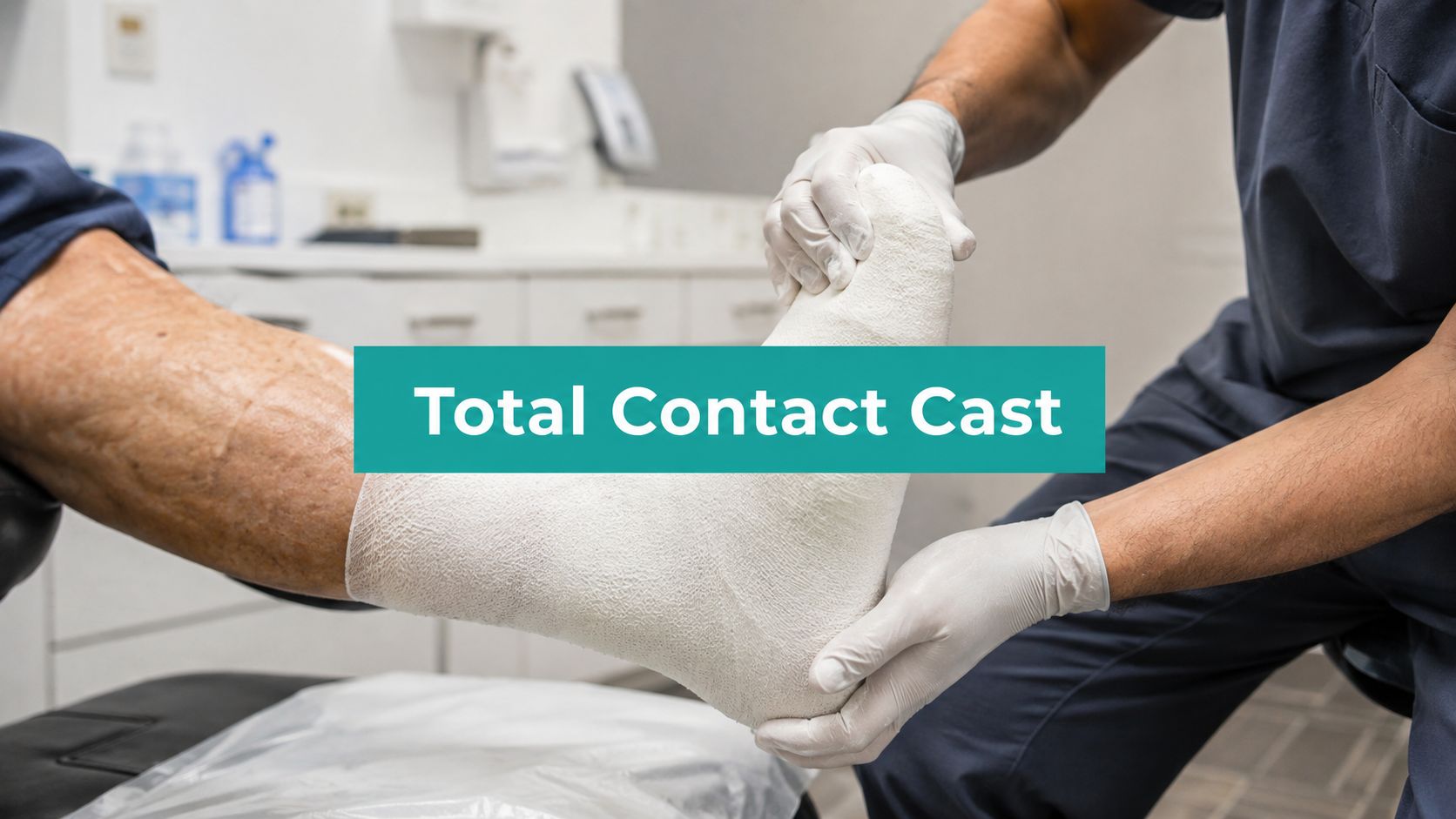
The patient who keeps saying, “I wore the boot,” while the plantar ulcer opens again is usually the one who ends up in a total contact cast. You can see the pattern in clinic before you even measure the wound. The ulcer is shallow, neuropathic, plantar, and stubborn, and the removable device has turned into a suggestion instead of a treatment.
That's why total contact casting still matters. It forces off-loading when patient behavior won't, and the evidence supports that logic. A major meta-analysis of 12 studies with 591 participants found higher healing rates with total contact casts than removable off-loading, with a risk ratio of 1.22 and a shorter healing time, while also showing more device-related complications that have to be monitored closely (PMC meta-analysis). In real practice, the cast wins on biomechanics, but only if the clinic is disciplined about follow-up, skin checks, and re-casting.
For a broader treatment framework around plantar diabetic ulcers, see the complete guide to diabetic foot ulcer management in 2026, which fits well with a casting-first mindset when the wound is neuropathic and the patient keeps breaking off-loading.
Why Total Contact Casting Still Matters
A patient who keeps reopening a Wagner 1 plantar ulcer after “good” boot instructions is exactly the kind of case that justifies total contact casting. The wound is usually healable. The failure point is practical. Every transfer, pivot, and short barefoot step reloads the same plantar spot, and a removable device can be correct in theory while weak in day-to-day use.
The classic total contact cast changes that by removing the patient's ability to negotiate with off-loading. In a daily-practice study of diabetic foot ulcers, 74 of 97 patients healed, for an overall healing rate of 76%, with a median healing time of 33 days and a median cast-treatment duration of 34 days (daily-practice study). Results were strongest in nonischemic, noninfected ulcers, where 90% healed in the cast, while ulcers with both infection and peripheral arterial disease healed much less often. That spread is the point. TCC works best when the ulcer is neuropathic and mechanically driven, and selection has to match that reality.
A practical benchmark helps set expectations. Total contact casting is not a one-and-done intervention, it is a clinic process that requires frequent reassessment, careful skin checks, and fast re-casting when the fit changes. The benefit is real, but so is the monitoring burden. A meta-analysis found more device-related complications with TCCs, with a risk ratio of 1.70, so the trade-off is better healing at the cost of tighter follow-up and cleaner documentation (PMC meta-analysis).
Practical rule: if the patient will not stay off the foot in a removable walker, the cast is often the more honest treatment.
The biomechanics are straightforward. A pressure-mitigation review reports that total contact casting reduces peak pressure and pressure-time integral, which is why it outperforms removable off-loading when adherence is poor (pressure-mitigation review). That pressure reduction is what gives a plantar neuropathic ulcer a chance to close. Padding alone does not do that job, and a removable boot only works if the patient uses it.
The operational piece matters just as much. Frequent cast changes are part of the treatment, not an inconvenience to work around, and the chart has to reflect that the wound was examined, the fit was reassessed, and the off-loading plan was appropriate that day. For the broader diabetic foot context, see this guide to diabetic foot ulcer management. When the ulcer is the right type and the clinic can keep up with the cast cycle, total contact casting remains the benchmark because it solves the adherence problem instead of documenting around it.
Patient Selection and Contraindications
A cast only helps when it matches the ulcer in front of you and the way the patient lives. The usual fit is a neuropathic plantar ulcer, especially a Wagner 1 or 2 lesion that keeps reopening because the patient cannot reliably stay off it. The daily-practice data above already showed that the best outcomes came from nonischemic, noninfected ulcers, which lines up with what is seen in a busy wound clinic.

What makes a good candidate
A strong candidate for total contact casting has a plantar neuropathic ulcer, limited drainage, and a foot that can be inspected on the schedule you are able to keep. Deep callus usually needs debridement at the visit, and if the wound is appropriate for sharp debridement, document that with the correct debridement code range when clinically indicated before moving into off-loading. The cast then holds pressure off the ulcer after the wound bed has been addressed.
The best results come when the problem is mechanical. If the ulcer keeps getting hit during walking, the cast creates a healing window the patient does not have to remember to maintain. When adherence is the main barrier, the cast removes a lot of the judgment calls that come with removable care.
When the cast is the wrong tool
The practical contraindications are the situations where you cannot monitor the limb well or where the cast will trap moisture against fragile tissue. The PMC review of total contact casting specifically flags acute infection, excessively draining wounds, fragile skin, excessive swelling, and deep tracking ulcers as situations that do not fit the model (PMC review). That is not theoretical caution. If the drainage is too heavy or the limb cannot be checked, maceration and missed deterioration become real problems.
Peripheral arterial disease changes the decision too. The daily-practice study showed worse healing when infection and PAD were both present, which is a reminder that pressure relief does not fix poor perfusion. In that setting, the vascular problem needs attention before anyone assumes a cast will be safe or useful.
Plain rule: if the wound is too wet to inspect or too deep to trust, do not hide it in a cast.
Patient behavior matters as much as wound type. A cast can force adherence, but only if the patient comes back for recasts on time. If follow-up is unreliable, the plan weakens quickly. That is the point where a removable knee-high device or an off-loading shoe may be safer from an operational standpoint, even though the biomechanical effect is usually weaker.
Keep the ulcer laterality and depth clear from the first note if you want the claim to survive review. The internal diabetic foot ulcer ICD-10 reference is a practical backstop when the exam has to line up with the documentation.
Casting Technique and Materials
The cast starts before the fiberglass ever touches the leg. Clean the ulcer, debride what needs debriding, and dress the wound so the team is not improvising after the material starts to set. The practical build is a deliberate mold that aims for true plantar contact from the toes to just below the knee, with pressure redistributed and shear reduced rather than the wound being padded.
The goal is off-loading through plantar contact
Minimal padding over the malleoli, tibial crest, and ulcer is standard, with felt or foam over bony prominences where needed. Then comes the stockinette, followed by a rigid or semi-rigid fiberglass or plaster shell molded in ankle neutrality. The technique references emphasize close molding and reinforcement around the ankle and plantar surface, because that is where the cast fails if the shape is sloppy or the contours are left loose (casting technique reference).
Proper plantar contact is what redistributes force. A cast that leaves too much room around the heel or ankle invites pistoning, rubbing, and edge breakdown once swelling starts to drop. A cast that does not contact the plantar surface will not off-load the ulcer the way you need it to.
Set the room up before the material sets
Material choice matters less than preparation, but the workflow matters a lot. The practical casting references list common systems built from acrylic, cotton, felt, fiberglass, and stockinette, with a 15 to 20 minute set time. That is a short window when the patient's leg is moving, the dressing is not ready, or the toe spacer has not been placed.
Have everything within reach before you start. The ulcer should already be dressed, the toe spacer should already be in place if you use one, and the molding team should know who is holding, who is smoothing, and who is checking the ankle position.
Workflow note: if your staff is still looking for supplies after the cast has started to set, the fit is already compromised.
Early changes are part of the technique, not a nuisance. As edema comes down, limb volume changes, and that is where the first cast can fail if you do not re-cast promptly. The fit loosens, the heel begins to piston, and the edges start to rub. That is why the early follow-up schedule matters more than the bragging rights around a perfectly molded first cast.
Cast Changes and Complication Management
The operational weak point in a TCC program is rarely the first application. It shows up at the second and third visits, when swelling has changed, clinic flow gets busy, and the cast that once fit well is now a little too loose to trust. That looseness leads to heel pistoning, rubbing over the malleoli, and skin injury that can turn a therapeutic device into a problem you now have to manage.
HRSA guidance says the first cast is usually left on for about 1 week or less if drainage is heavy, then changed every 2 weeks, with average healing time about 6 weeks (HRSA guidance). The same guidance notes that Charcot fractures may be cast for up to 3 months or until surface temperatures are within 2 degrees Celsius. Those targets matter because they drive scheduling, follow-up, and the decision to re-cast before the limb slips out of alignment.
What to watch for at each change
The complication profile is real. Reviews describe the practical problems clinicians see, including iatrogenic ulceration, skin abrasions, fungal infection, maceration, impaired ambulation, and tight-cast injury. A meta-analysis also found more device-related complications with TCCs, which is why every cast change needs a deliberate skin check, not a quick glance. One review cited iatrogenic ulceration at 5.52% in a sample of 398 casts, which is a good reminder that small complications still need prompt action and clean charting (complication review).
Track the casted limb like it can change between visits, because it can. If the cast is loose after edema drops, the patient needs a new cast, not reassurance. If drainage, odor, or pain appears under a cast that should be insensate, assume the situation has changed until you prove otherwise. If the skin at the malleoli, tibial crest, or dorsum begins to break down, the cast is no longer doing the job you intended.
When to switch away from TCC
Move to a removable knee-high device when the cast cannot be monitored safely, when drainage is too heavy to manage, or when repeat cast-related skin injury starts to outweigh the off-loading benefit. That decision is recognition that the treatment has crossed into harm reduction.
Document the change itself. If the cast is loose, wet, foul-smelling, or associated with new erythema, say exactly that in the note and record the action taken.
For Charcot, the temperature target in the HRSA guidance gives you a concrete endpoint. For ulcer care, the endpoint is simpler, closed skin without new injury. Keep the cast on only while the limb and the wound still fit the treatment plan. When you document the episode, use a plain-language guide to chart notes to keep the record clear enough for the next clinician and for the auditor who reads it later. If the diagnosis coding needs tightening, the diabetic foot ulcer ICD-10 reference can help align the bedside description with the code set.
Documentation and Billing for Clean Claims
TCC claims get denied for sloppy notes more often than for bad medicine. That's because the cast is more expensive to justify than a shoe, and payers want to see why a removable device wasn't enough. Your note has to show the ulcer, the biomechanical problem, the chosen intervention, and the reason that intervention was necessary on that date.
What the note needs to say
Include the ulcer measurements, Wagner grade, exudate type and amount, and periwound assessment. If you debrided at the visit, document the tissue removed and the CPT debridement code range 11042 to 11047 when appropriate to the depth and tissue involved. Then link the wound care decision to off-loading. State why the total contact cast is medically necessary instead of a removable device, and connect that choice to the patient's ulcer location and adherence history.
For diagnosis coding, make sure the ICD-10-CM diagnosis reflects the diabetic foot ulcer with correct laterality and depth. If the note says plantar ulcer but the diagnosis only says diabetes without a foot manifestation, you've undercut your own claim. The internal diabetic foot ulcer ICD-10 reference can help align the bedside description with the code set.
What payers and surveyors look for
They want consistency. If the wound is called superficial in one line and full-thickness in another, or if laterality disappears from the assessment, you're inviting denial. They also look for medical necessity language that makes sense. “Patient education provided” is not enough. “Patient has recurrent plantar neuropathic ulcer that reopens with removable off-loading due to nonadherence” is the sort of plain documentation that carries weight.
If you want a clean way to tighten your narrative, a plain-language guide to chart notes can be useful for shaping the story without turning the chart into a novel. The best notes stay clinical, specific, and boring in the right way.
Denial pattern to avoid: no laterality, no ulcer size, no exudate description, and no explanation for why the cast was needed.
That combination tells the payer almost nothing. A total contact cast needs a more rigorous note than removable off-loading because the intervention is more consequential. If you treat the documentation like an afterthought, the claim will usually behave the same way.
Making TCC Work in Your Practice
A good total contact cast program is built on workflow, not heroics. The clinic needs trained staff, a standing follow-up schedule, and supplies ready when the patient arrives. If the system depends on one person who happens to be available that day, the program will drift.
Patient education should stay blunt. Tell them the cast is there because the foot won't heal if they keep loading it, and tell them exactly what should trigger a call, new odor, soaked padding, cast loosening, pain, or skin change. Track healing rates, complication rates, time to closure, and whether cast changes happened on time. Those numbers tell you whether the program is working or just busy.
The patients who do best are the ones with neuropathic plantar ulcers, manageable drainage, and enough follow-up reliability to make recasting routine. The patients who do poorly are the ones with infection, heavy exudate, fragile skin, or no realistic way to return for checks. In those cases, a different off-loading strategy is usually the safer choice.
If your team is trying to tighten total contact cast documentation, off-loading follow-up, and clean claim capture, EkagraHealth AI is built for exactly that workflow. It helps wound care practices turn the visit into a defensible note with the right coding structure, which matters when TCCs need precise medical necessity and frequent re-casting. Visit EkagraHealth AI to see how it can support your wound care documentation without slowing the clinic down.
