
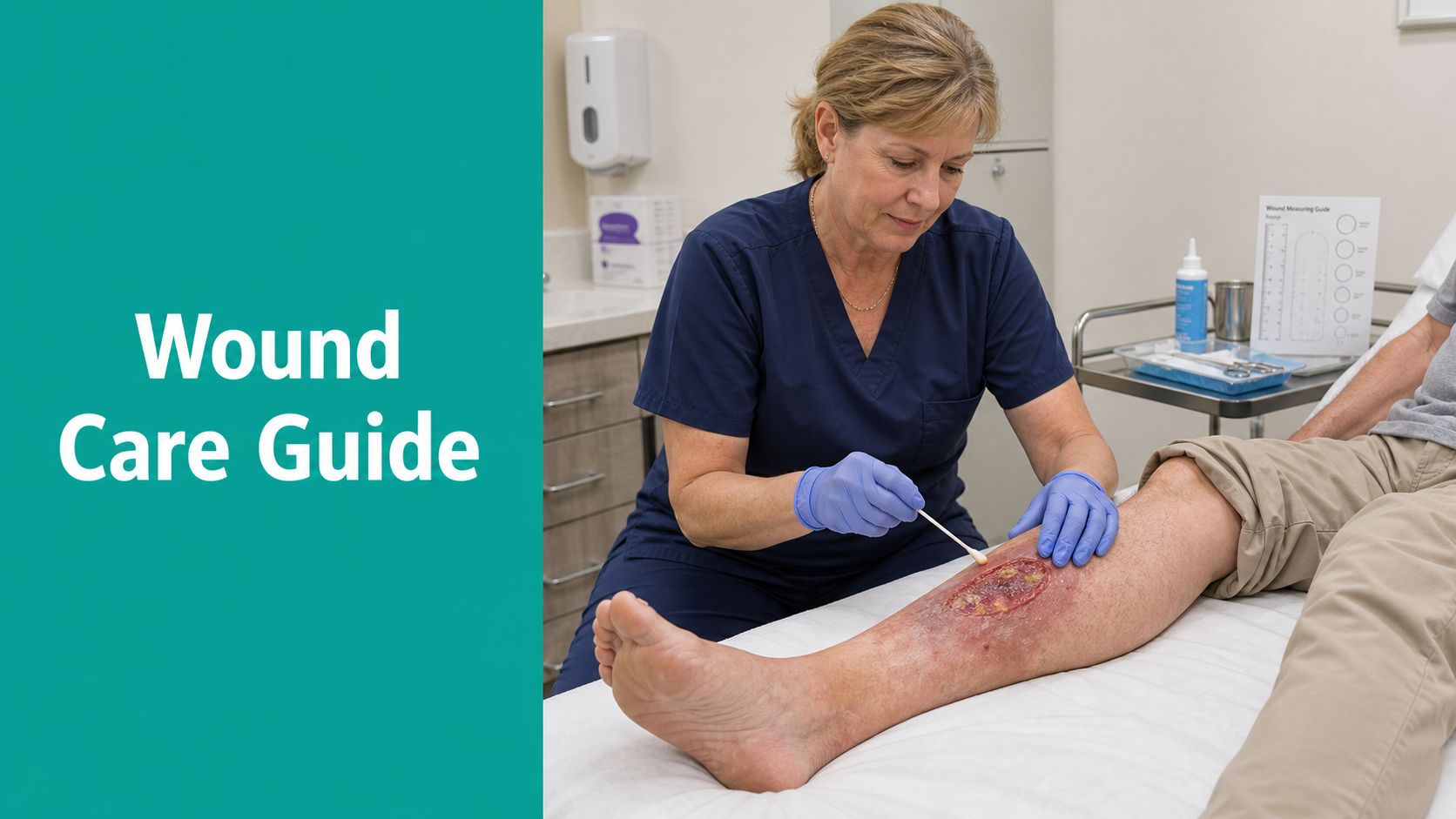
You can usually tell within a week whether a new outpatient wound care clinic is being built on solid ground or on wishful thinking. The warning signs show up early. Notes say “improving” with no measurements. Debridement is documented by wound depth instead of tissue removed. A dressing change gets treated like a procedure. Front desk staff schedule everyone the same way, whether it's a simple traumatic wound check or a complex diabetic foot ulcer with vascular risk.
That setup creates the same outcome every time. Clinicians do real work, patients still need follow-up, and the clinic struggles because the chart doesn't prove what happened or why it mattered.
The clinics that hold up under payer review tend to share the same habits. They assess the wound the same way every visit. They stage and grade correctly. They separate clinical decision-making from habit. And they understand that workflow, documentation, and revenue aren't separate problems. They're the same system viewed from different angles.
The First Five Minutes Patient Assessment and Staging
If the first note is weak, every later decision gets harder to defend. Before any debridement, dressing selection, or referral, the record has to establish an objective baseline.
Start with standardized wound measurement. Wound assessment documentation must use the clock-face method for standardized measurements: length from 12 to 6 o'clock, width from 3 to 9 o'clock, and depth measured at the deepest point, as outlined in the WCEI wound assessment documentation guidance. That sounds basic, but it's one of the first things auditors notice when a chart starts to drift into free-text storytelling.

Measure like someone else will read it
A wound note should let another clinician walk into the room and know exactly what you saw. That means documenting:
- Length and width correctly: Use the clock-face orientation every time.
- Depth at the deepest point: Don't estimate from the edge and don't skip undermining or tunneling if present.
- Tissue composition by percentage: Granulation, slough, eschar, necrosis. Percentages force precision.
- Exudate using approved terms: Serous, sanguineous, purulent. “Moderate drainage” alone isn't enough.
- Periwound condition: Macerated, erythematous, indurated, callused, intact, fragile.
If your team needs a consistent template, a structured set of wound assessment charts helps prevent the usual omissions.
Practical rule: “Looks better” is not wound documentation. Measurements, tissue percentages, and exudate characteristics are.
Staging and grading can't be improvised
For diabetic foot ulcers, document the Wagner grade explicitly. For pressure injuries, state the NPIAP stage explicitly. Generic language such as “deep diabetic wound” or “bad sacral ulcer” creates confusion for treatment planning and payer review.
The clinical reason is obvious. A Wagner-graded diabetic foot ulcer raises different concerns than a superficial traumatic wound. The operational reason matters just as much. Staging and grading drive medical necessity, follow-up intensity, referral urgency, and coding specificity.
Infection risk also belongs in this first-pass assessment when the presentation warrants it. In outpatient care, red flags include wound duration exceeding 30 days, depth exposing tendon or bone, HbA1c greater than 8% in diabetic patients, and ABI below 0.7 for peripheral vascular disease, according to the outpatient wound infection prevention bundle. If you suspect infection and you're culturing, technique matters. The same source specifies the Levine technique rather than a casual surface swab.
What works in practice
The best initial assessments are boring in a good way. They're reproducible. Every provider in the clinic uses the same language and sequence. That consistency makes follow-up comparisons meaningful and turns your chart into a defensible clinical record instead of a narrative essay.
Doing the Work Debridement CPT Codes and Procedures
Debridement confusion is one of the fastest ways to lose money and credibility at the same time. The clinical act may be appropriate. The billing fails because the note describes the wound, not the tissue removed.
Surgical versus selective debridement
Clinicians often blur selective debridement and surgical debridement because both may happen in the same room with similar instruments. That's where trouble starts. If you're billing CPT 11042 through 11047, code selection is based strictly on the deepest level of tissue removed, not on the wound's total depth or severity, per the CMS debridement billing guidance.
That means a deep wound does not justify a deeper surgical debridement code unless you removed tissue at that level.
Here's the practical distinction:
- Selective debridement: You're removing devitalized tissue without taking viable deeper tissue. Documentation should reflect the method and the tissue addressed.
- Surgical debridement: You're removing tissue to the level billed, such as subcutaneous tissue, muscle/fascia, or bone. The operative note must say that clearly.
Debridement CPT Code Selection Guide
| Code(s) | Tissue Level Removed | Description | Billing Unit |
|---|---|---|---|
| 11042–11047 | Subcutaneous tissue, muscle/fascia, or bone | Surgical debridement, selected by deepest tissue actually removed | Based on code family and total applicable surface area at that same depth |
| 97597/97598 | Devitalized tissue without surgical depth billing | Selective debridement | Based on code family requirements and documented treated area |
The coding side gets harder when multiple wounds are treated. CMS allows you to sum surface areas only when multiple wounds are debrided at the same depth, and you cannot combine areas from different tissue depths into one total under the same CMS debridement billing guidance. That rule matters more than many teams realize.
What the note needs to say
A defensible debridement note should answer four questions:
- Why was debridement medically necessary
- What tissue was removed
- How much surface area was treated
- What changed in the wound bed afterward
If the note says the wound “extends to muscle” but never states that muscle was removed, don't bill the muscle-level code.
For teams building templates, an organized reference for ICD-10 and CPT codes in wound care can reduce the usual mismatch between the procedure performed and the procedure billed.
Getting Paid Documentation Pitfalls and Billing Realities
The hardest lesson in outpatient wound care is that excellent treatment doesn't guarantee a clean claim. The billable event is the note, not your memory of the visit.
The drag is real. Clinicians often spend 30 to 45 minutes per visit charting, which contributes to claim denials and inflated AR days when CPT and ICD-10 coding don't match or wound image annotations are missing, as described in the Frontiers discussion of documentation friction in wound care workflows. That kind of charting burden is bad for morale, but the revenue impact is worse.
Where claims usually break
Most denials in a wound clinic come from ordinary omissions, not exotic compliance failures.
- Missing dimensions: Billing for debridement without documented length and width in centimeters invites denial.
- No tissue percentages: If the wound bed description is vague, medical necessity for serial debridement gets harder to support.
- Weak exudate description: “Drainage present” doesn't establish severity or infection concern.
- No periwound assessment: Maceration, erythema, edema, and callus often explain treatment choices.
- Escalation without progression history: Advanced treatment is hard to justify if the chart doesn't show prior interventions and response.
The billing record also needs the right level of specificity. Outpatient wound billing documentation requirements call for precise measurements in centimeters, total surface area in square centimeters, percentage of tissue types, amount and type of exudate, and the periwound skin condition to support medical necessity and reduce denials.
Small documentation mistakes with expensive consequences
A simple dressing change is a classic example. There is no standalone CPT code for a simple dressing change without a therapeutic procedure. If only a dressing change is performed, it's typically captured under the E/M service. If the dressing change includes non-selective debridement such as wet-to-dry, enzymatic, or mechanical cleaning, CPT 97602 may apply under the guidance summarized in the wound care CPT coding overview. Teams that bill every dressing room encounter as a procedure don't stay solvent for long.
Documentation authentication matters too. If your organization is tightening workflow around consent forms, treatment records, and visit sign-off, it helps to understand signature types for your business so the operational process matches the legal standard your records need to meet.
Build the note for review, not for memory
When wounds stall, the chart should show previous interventions, progression over time, underlying conditions, and why a referral or higher level of care was justified. That's not defensive charting. That's what surveyors and payers expect to see.
For clinics trying to reduce missed details at the point of care, medical necessity documentation workflows are worth standardizing early rather than trying to repair patterns after denials pile up.
The Clinic Engine Staffing Models and Patient Workflow
A wound clinic becomes profitable when patient flow matches case complexity. If everyone moves through the same lane, the schedule backs up, documentation quality falls, and procedures start late.
National visit data makes the staffing point clear. The United States had an estimated 45.1 million office-based outpatient visits for cutaneous wounds across 2011 to 2019, with about 33 million acute wounds and 13 million chronic wounds, according to the NAMCS analysis of outpatient wound visits. That mix matters. Acute wounds bring volume and speed. Chronic wounds consume more clinical attention, coordination, and documentation.
Two workflow models that actually work
A linear model fits routine follow-up care. Check-in, rooming, measurement, provider assessment, procedure if needed, dressing application, discharge instructions. It's simple and reliable for stable patients.
A parallel model works better for new patients and complex wounds. While the assistant captures history, photos, vitals, and dressing removal, the provider reviews referral records and prior imaging. That overlap cuts dead time and gets critical details into the record before the provider enters.
Roles that prevent bottlenecks
- Provider leadership: The MD, DPM, NP, or PA handles staging, debridement decisions, escalation, and coding-linked procedure documentation.
- Wound-trained clinical staff: A CWS or CWSP often becomes the consistency anchor for measurements, tissue description, dressing protocols, and patient education.
- Medical assistant support: Room turnover, supply prep, image capture, and repeatable intake tasks keep clinicians from doing clerical work in a procedure slot.
- Front desk control: Referral intake, authorization status, scheduling logic, and return-visit interval discipline protect the entire schedule.
A good wound clinic schedule isn't built around appointment length alone. It's built around how much uncertainty the patient brings into the room.
Tools of the Trade Essential Equipment and Supplies
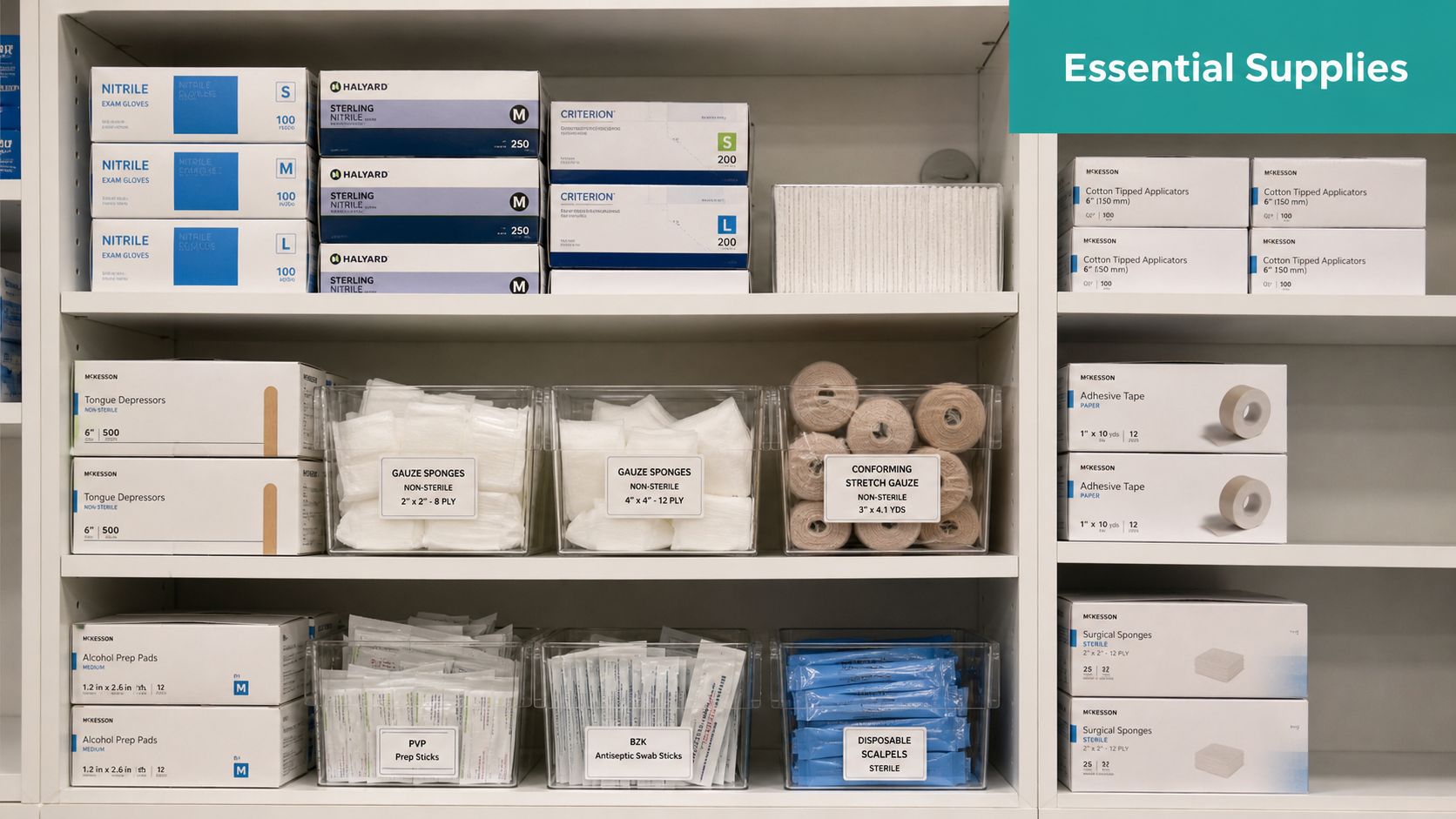
Most new clinics overspend on niche products and underspend on workflow basics. Start with the equipment that helps you assess accurately, debride safely, and dress consistently.
The must-have room setup
Your treatment rooms should have three categories covered from day one.
- Assessment tools: Doppler, disposable measuring guides, probes, foam-tipped applicators, camera workflow, and offloading evaluation basics.
- Debridement instruments: Curettes, scalpels, forceps, scissors, hemostatic supplies, and sterile reusable equipment where indicated.
- Dressing inventory: Foams, alginates, hydrocolloids, contact layers, absorbent secondary dressings, and compression-related supplies where appropriate.
Sterility gets mishandled more often than people admit. For debridement procedures, reusable equipment used in invasive tissue manipulation must be sterile, not merely processed with low- or intermediate-level disinfection. That detail matters in both infection control and survey readiness.
The 2026 skin substitute change affects buying decisions now
If your clinic plans to use cellular and tissue-based products, don't build your purchasing assumptions on old reimbursement logic. Effective January 1, 2026, most skin substitute products are reclassified by CMS as incident-to supplies and paid at a mandatory flat rate of $127.14 per square centimeter, tied to application CPT codes 15271 through 15278, based on the 2026 skin substitute payment summary.
That change should influence inventory strategy, contracting, and case selection. If your supply chain and treatment protocols don't account for it, margin disappears quickly.
Don't ignore home support
A clinic visit is only part of wound management. Patients and families still have to handle dressing changes, offloading, and skin protection outside the treatment room. For teams building patient education packets, a practical primer on wound care for caregivers can be useful as a plain-language supplement to your own discharge instructions.
This is also the one place where a documentation tool can earn its keep operationally. EkagraHealth AI can draft wound notes during the visit, map CPT and ICD-10 codes, and support image-based measurement workflows, which helps when the room is moving fast and the team is trying to keep supply use, chart quality, and billing aligned.
Building the Patient Panel Referrals and Access to Care
Referral growth in wound care rarely comes from marketing language. It comes from being easy to work with and clinically predictable.
Primary care, podiatry, vascular surgery, dermatology, SNFs, and hospital discharge teams all want the same thing from an outpatient wound care clinic. They want fast access, a clear plan, and communication that closes the loop. If you don't send concise updates back to the referring clinician, referrals slow down. If you overbook simple follow-ups and can't absorb urgent limb-risk cases, referrals shift elsewhere.
Be useful to referral sources
The strongest clinics make intake simple and response fast.
- Accept imperfect referrals: Don't force every office to submit a perfectly packaged packet before scheduling.
- Send focused updates: Diagnosis, stage or grade, vascular concerns, infection concerns, procedures performed, next step.
- Clarify thresholds for referral: Nonhealing diabetic foot ulcers, pressure injuries needing escalation, post-op wounds that stall, wounds with exposed deeper structures.
Access problems are clinical problems
A lot of wound programs still act as though transportation, housing instability, and substance use are outside the clinic's lane. They're not. Research on community-based wound care for medically vulnerable populations highlights a major gap in traditional outpatient care for unhoused patients and points to the value of integrating housing support and harm reduction nursing to improve outcomes and reduce diabetic foot ulcer-related amputations.
That changes referral strategy. Community clinics, shelters, street medicine teams, and case managers can become legitimate referral partners if your workflow can support inconsistent attendance and high follow-up risk. A modern clinic that ignores those patients isn't just missing a mission opportunity. It's missing a real part of the wound care population.
Proving Your Value Key Metrics and Quality Benchmarks
If you want administrative support, payer credibility, and strong referral relationships, your clinic needs a scorecard. Not a vanity dashboard. A short list of metrics that show whether patients are healing and whether the service line is worth funding.
The financial backdrop is large enough that payers already care. Chronic nonhealing wounds affect nearly 15% of Medicare beneficiaries, or 8.2 million patients, and conservative annual cost exceeds $28 billion, according to the ASPE analysis of wound prevalence, cost, and healing benchmarks. The same source reports a 74.6% modified intent-to-treat healing rate across 626 clinics as a meaningful benchmark.

Metrics worth tracking monthly
Don't track everything. Track what changes behavior.
- Healing rate: Benchmark your overall performance against the 74.6% figure above.
- Infection rate: The outpatient infection prevention bundle places a monthly benchmark in the 2% to 5% range and defines it as new wound infections divided by total active wounds under management, as described in the earlier infection guidance.
- Time-to-escalation discipline: Cases that miss expected progress should trigger review, referral, or a treatment-plan change.
- Denial patterns: Look for repeat documentation failures by provider, code family, or referral source.
- Procedure mix and collection lag: This tells you whether the clinic is performing the work it documents and getting paid for it on time.
Why this matters beyond compliance
These numbers are how you defend staffing, supply spend, and clinic expansion. They're also how you keep yourself honest. A clinic can feel busy and still be clinically mediocre. Data exposes that quickly.
Track outcomes and revenue together. A high-volume clinic with weak collections or poor healing is not a successful clinic. It's just a crowded one.
For teams building the financial side of this reporting, resources on optimizing healthcare financial health can help frame revenue-cycle analytics in a way administrators understand.
Frequently Asked Questions
Can I bill a simple dressing change as a procedure
Not by itself. If the visit only involved a dressing change and no therapeutic procedure, that work is generally captured under the E/M service. If non-selective debridement was performed as part of the dressing change, the coding may differ, but the note has to support it clearly.
When should I worry that an outpatient wound may be infected or stalled
Pay attention to wound duration beyond 30 days, exposed tendon or bone, HbA1c above 8% in diabetic patients, and ABI below 0.7 in peripheral vascular disease. If a wound fails to meet a 2-week healing goal after 4 weeks of consistent care, specialist involvement and nutrition review should move up the list.
What do payers usually want to see before approving advanced wound treatment
They want a record that shows objective wound measurements, tissue percentages, exudate type, periwound condition, prior treatment history, and documented progression over time. If you skip those basics, advanced treatment starts to look elective rather than medically necessary.
EkagraHealth AI fits best when your clinic already knows how it wants to practice and needs the documentation and billing process to keep up. It supports point-of-care note drafting, wound image measurement workflows, and CPT and ICD-10 mapping so the clinical record more closely matches the care your team delivered.
