
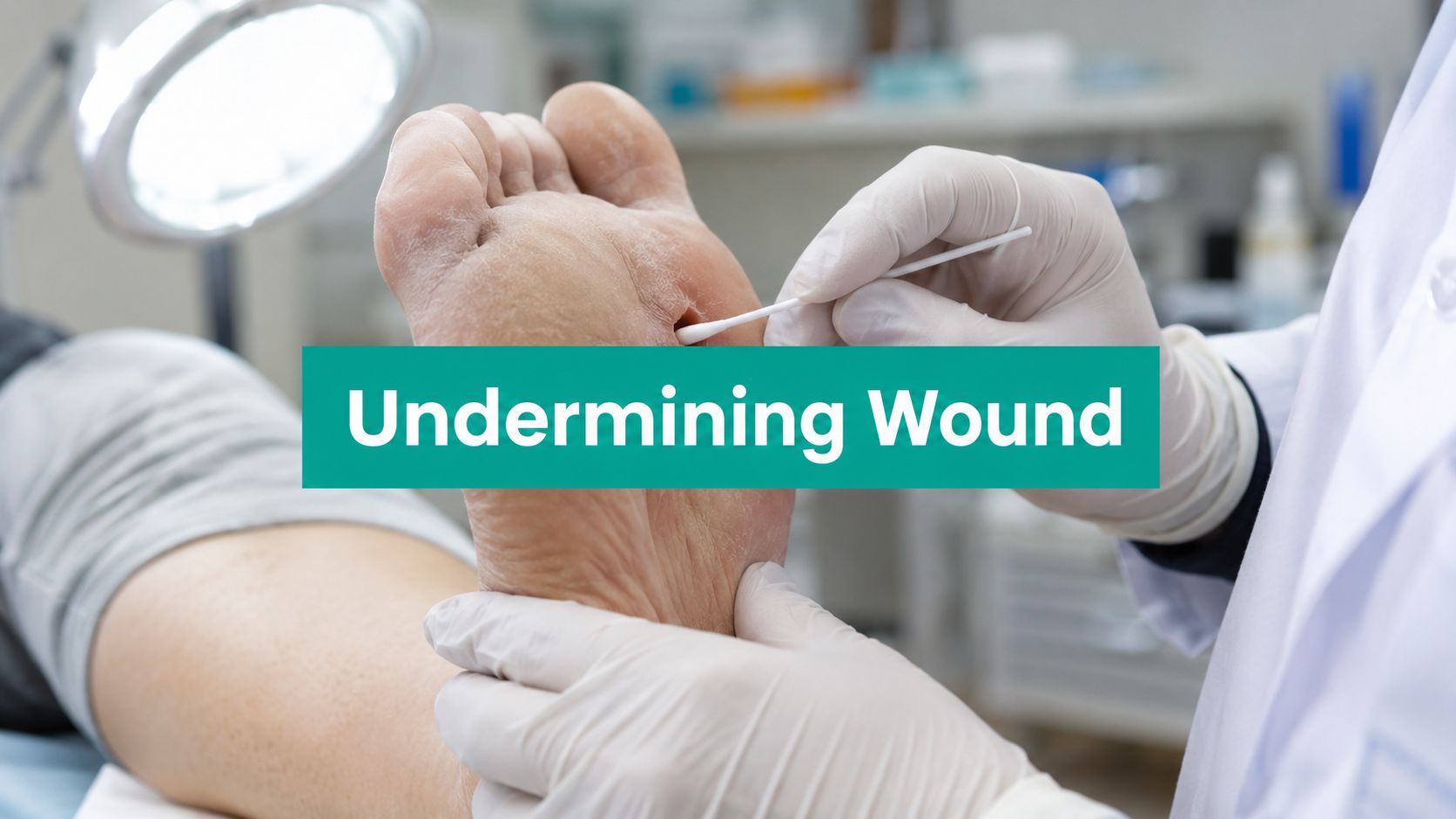
You measure a sacral pressure injury at the bedside. The opening looks modest. Maybe it even seems manageable with routine packing and an offloading reminder. Then the cotton-tipped applicator slides under the edge and keeps going.
That's the moment an undermining wound stops being a simple skin problem and becomes a care-planning problem, a documentation problem, and often a reimbursement problem. If the hidden cavity isn't measured correctly, the treatment plan drifts. If the note is vague, the payer reads “deep dead space” and asks why higher-acuity treatment was ordered. If the debridement isn't tied clearly to tissue depth and medical necessity, the claim becomes hard to defend.
Clinically, good wound care distinguishes itself from checkbox wound care. You can't manage what you don't map. And with undermining, the visible opening is often the least informative part of the wound.
That Small Wound Is Deeper Than You Think
A common bedside trap is the pressure injury that looks smaller than it is. The surface opening may seem limited, while the tissue loss under the margin reveals the true extent. That disconnect is what makes the undermining wound so easy to underestimate in a busy clinic, SNF, or mobile round.
Undermining is a clinical complication where tissue destruction extends beneath intact skin at the wound margins, creating a hidden pocket that makes the actual wound surface area 2–3 times larger than the visible opening; this occurs primarily due to infection spreading into subcutaneous tissue or shear forces from improper patient repositioning, and it significantly delays healing by trapping necrotic material in dead space that standard packing cannot fully access according to this wound undermining reference.
That hidden pocket changes everything. It changes how you stage risk, how you choose a dressing, how aggressively you debride, and how closely you watch for infection. It also changes how surveyors and payers read the chart. A wound that looks small in a photo but has poorly documented undermining often triggers the same reaction from reviewers: the note doesn't explain the treatment intensity.
What makes undermining different in practice
This isn't just a deeper wound. It's a shelf of tissue loss under skin that may still appear intact at the edge. That means:
- The visible size lies: Surface length and width can underrepresent the tissue injury.
- Exudate control gets harder: Fluid and necrotic debris collect in space you can't manage with superficial dressing changes alone.
- Packing can fail: If the cavity configuration isn't understood, the dressing may miss part of the pocket or create pressure where you don't want it.
- Charting gets sloppy fast: “Undermining present” is not a useful clinical note.
A wound can look cleaner than it is. Undermining is where that false reassurance causes trouble.
Assessing the True Size of an Undermining Wound
The exam has to be reproducible. If one clinician documents “deep undermining” and the next writes “slight shelfing,” the team can't tell whether the wound changed or the language changed. That's how treatment plans drift and prior authorizations get messy.

Use a clock-face method every time
For undermining, I want the note to show three things clearly:
- Where it starts and stops
- Maximum depth
- Where that maximum depth was found
Use the patient's head as 12 o'clock. Gently probe under the wound edge with a sterile applicator. Advance only until resistance changes and the pocket is defined. Don't force the tract.
A defensible example reads like this:
- Undermining from 2 o'clock to 5 o'clock
- Maximum undermining depth 4 cm
- Greatest depth at 3 o'clock
That kind of wording gives the next clinician a map, not an impression.
A practical assessment sequence
When the wound bed is open enough to inspect safely, the bedside workflow is straightforward:
- Start with the visible wound dimensions: Length, width, and central depth first.
- Check the entire edge: Don't stop after finding one undermined segment. Partial probing is a common miss.
- Document tissue quality: Note granulation, slough, eschar, exposed structures if present, and whether the undermined shelf feels boggy or fibrotic.
- Record exudate and odor: Serous, serosanguineous, purulent, thick, thin, absent, or heavy. Be specific.
- Assess periwound skin: Maceration, erythema, induration, callus, warmth, fragility.
If your team needs examples of structured wording, these wound measurement examples are useful for standardizing bedside notes.
Undermining versus tunneling
These get mixed up all the time, and that confusion matters.
| Finding | Undermining | Tunneling |
|---|---|---|
| Shape | Shelf-like tissue loss under wound edge | Narrow channel or sinus tract |
| Location | Extends beneath intact wound margin | Extends away from wound into surrounding tissue |
| Measurement style | Clock-face spread plus max depth | Direction and tract depth |
| Treatment implication | Often requires dead-space management across a broader margin | Often requires tract-specific filling and monitoring |
A wound can have both. Don't merge them into one line item. If undermining is present from 7 to 11 o'clock and there's also a tunnel at 9 o'clock, document both separately. Otherwise, the plan becomes muddled, especially when debridement, packing method, or NPWT justification is reviewed later.
Practical rule: If the applicator glides under the wound edge along a shelf, that's undermining. If it tracks into a narrow channel, that's tunneling.
Pathological vs Intentional Undermining
Not all undermining is a destructive wound finding. That distinction doesn't get enough attention in wound training, and it causes avoidable errors in post-op management.
Most wound care documentation guides treat undermining as a defect that needs packing and often debridement. But recent surgical literature says the picture is more nuanced. Most wound documentation guides treat undermining as a purely destructive defect requiring packing, yet surgical literature from the last 12 months shows that controlled undermining during primary closure under low-to-moderate tension does not significantly increase scar distortion or complication rates compared to non-undermined closure. This gap persists in clinical training: wound care clinicians rarely distinguish between pathological undermining (e.g., in pressure injuries or infected surgical sites) and intentional surgical undermining used to release fibrous bands for better skin mobility, as discussed in this publication on surgical undermining and closure outcomes.
Why this distinction matters
If the wound is a chronic pressure injury, diabetic foot ulcer, or infected surgical site, undermining usually reflects tissue destruction and shear. That pushes you toward debridement, dead-space management, offloading, and close infection surveillance.
If the wound is post-op and the undermining was created intentionally to mobilize tissue for closure, the management logic changes. Aggressive probing, unnecessary packing, or treating it like a contaminated cavity can interfere with the surgical goal.
Questions worth asking before you touch the dressing plan
- Is this chronic or post-op? Context decides a lot.
- Was tissue intentionally undermined at closure? If the answer is yes, the note should say so explicitly.
- Is there evidence of dehiscence, ischemia, or infection now? Intentional undermining can become pathological later.
- What was the original closure tension? Low-to-moderate tension behaves differently than a struggling, ischemic closure.
A good post-op note doesn't just say “undermining present.” It says whether the undermining is expected post-surgical anatomy versus a new destructive finding. That single distinction can prevent unnecessary escalation and stop a payer from interpreting the chart as proof of uncontrolled dead space.
Documentation language that avoids confusion
Use plain, specific wording:
- Intentional undermining present from operative tissue mobilization
- No necrotic pocket identified
- No indication for cavity packing at this visit
- Monitor flap support, drainage, edge approximation, and perfusion
That kind of note protects the patient and the claim.
Documenting and Coding Undermining for Payers
Many solid clinicians lose time and revenue. The bedside care may be correct, but the note doesn't establish what was found, what was removed, why the treatment was necessary, or why the visit frequency made sense.
The payer doesn't see your clinical intuition. The payer sees the chart.
What has to be in the SOAP note
For an undermining wound, vague language is what gets you in trouble. “Deep wound with undermining” won't carry much weight. A stronger note connects findings to action.
Your assessment should include:
- Wound location and etiology: Pressure injury, diabetic foot ulcer, surgical wound, venous ulcer, or other documented cause.
- Visible dimensions and hidden dimensions: Surface measurements plus clock-face undermining and maximum depth.
- Wound bed description: Granulation, slough, necrotic tissue, biofilm, exposed fascia, tendon, or bone if present.
- Periwound findings: Maceration, induration, erythema, shear-related edge damage, edema.
- Exudate profile: Amount and character.
- Pain and tolerance: Especially if debridement was done.
- Treatment performed: Cleansing, debridement type, packing material, offloading, compression if appropriate, dressing plan.
- Medical necessity statement: Why the intervention was needed that day.
If your staff is tightening note quality, these wound documentation examples are the kind of framework that helps reduce inconsistent wording from one clinician to the next.
CPT selection depends on tissue depth removed
The code has to match what you removed, not just what the wound looked like before you started. For excisional debridement, the documented depth of tissue removed drives the code family.
CPT Codes for Excisional Debridement (11042-11047)
| CPT Code | Tissue Depth Removed | Key Documentation Requirement |
|---|---|---|
| 11042 | Subcutaneous tissue | State excisional debridement performed and document removal to subcutaneous tissue |
| 11043 | Muscle and/or fascia | Document excisional debridement with tissue removed to muscle and/or fascia |
| 11044 | Bone | Document excisional debridement with tissue removed to bone |
| 11045 | Add-on to 11042 | Document additional wound surface area debrided beyond primary code |
| 11046 | Add-on to 11043 | Document additional wound surface area debrided beyond primary code |
| 11047 | Add-on to 11044 | Document additional wound surface area debrided beyond primary code |
If the note says “debrided slough from undermined edge” but never states the tissue depth removed, coding support is weak. If the note says “sharp debridement” but doesn't clarify whether this was selective versus excisional, that's another avoidable problem.
Common denial triggers
The most frequent charting failures are boring, repetitive, and expensive:
- Ambiguous dead-space language: “Large cavity” without measurement invites scrutiny.
- No clock-face detail: Reviewers can't track progress if each note just says “undermining present.”
- Debridement without tissue-depth language: Consequently, CPT selection falls apart.
- Frequency without rationale: Repeated procedures need a clear healing barrier and ongoing medical necessity.
- Post-op confusion: Intentional undermining documented like a destructive defect can trigger the wrong utilization pathway.
One billing pressure point is frequency. Medicare generally limits surgical debridement to a maximum of 12 sessions within any 360-day period, and enforces a strict threshold of 4 sessions per 30-day period; exceeding these limits without documented evidence of medical necessity or a change in treatment approach triggers automatic payer denials for services deemed not reasonable, per these wound care billing guidelines.
That means your note has to do more than repeat prior findings. It has to show why another debridement was needed and what changed clinically.
Coding workflow and compliance reality
Some teams still document undermining in free text and leave coding interpretation to the back office. That's how details get lost. Structured capture at point of care is safer. It also supports cleaner handoff to coding, prior auth, and audit review.
The administrative side matters too. If your organization is tightening chart access, role permissions, and audit processes around wound documentation, a refresher on HIPAA administrative safeguards is worth reviewing alongside your clinical workflow.
If you can't tell from the note where the undermining is, how deep it is, what tissue was removed, and why treatment escalated, don't expect the claim to defend itself.
Management Strategies for Undermined Wounds
Once the wound is mapped correctly, treatment gets more rational. The goal isn't to “fill the hole.” The goal is to remove what blocks healing, manage bioburden and moisture, eliminate avoidable shear, and address dead space without creating new tissue injury.

Evidence-based management of undermining wounds requires thorough surgical or sharp debridement to remove all non-viable tissue from the undermined pocket, followed by negative pressure wound therapy (NPWT) which applies controlled suction to collapse the dead space, draw wound edges together, and promote granulation; studies confirm NPWT is particularly effective for undermining, as described in this clinical overview of undermining wound measurement and management.
Debridement first, but not mindlessly
If there's non-viable tissue under the shelf, you won't fix the wound with dressing changes alone. Debridement is often the turning point. But the type matters.
- Sharp or surgical debridement: Best when necrotic tissue is accessible and the wound needs immediate burden reduction.
- Selective approaches: Useful when the wound is painful, fragile, or the non-viable material is limited.
- Conservative pacing: Sometimes the right choice in a compromised patient, especially if perfusion or tolerance is poor.
The mistake is performing repeated superficial cleanups while leaving non-viable tissue hidden in the undermined pocket. That's activity, not progress.
Packing and filler choice
Packing should support drainage and contact the wound space gently. It should not be stuffed in tightly. Overpacking creates pressure, distorts the wound edge, and can worsen ischemia.
A practical approach:
- For heavier exudate: Absorptive fillers are usually more useful.
- For drier wounds: Moisture-donating options may make more sense.
- For irregular undermined shelves: Loosely guide the dressing into the space so it wicks, not compresses.
- For macerated periwound: Protect the edge aggressively or the wound will enlarge at the margin.
If your staff needs a simple refresher on NPWT indications and mechanics, this explanation of what a wound vac does is a practical starting point.
When NPWT earns its place
NPWT is especially useful when the issue is persistent dead space that conventional packing isn't managing well. It can help collapse the cavity, manage fluid, and support granulation through the wound depth rather than allowing the surface to mislead you.
That doesn't mean every undermining wound needs NPWT. It does mean that when you order it, the chart should show why standard care wasn't enough, what dead space exists, and what the treatment target is.
Infection and deeper-structure red flags
A few findings should lower your threshold for broader workup:
- Probe to bone
- Foul or abruptly changed odor
- Increasing periwound cellulitis
- Unexpected pain escalation
- Friable tissue with worsening undermining despite care
- Systemic decline or poor glycemic control in the broader clinical picture
Bedside judgment: If the undermining keeps enlarging while the wound opening looks stable, assume the deeper problem is still active until proven otherwise.
Undermining Wound Cases from the Clinic
Diabetic foot ulcer hidden under callus
A plantar diabetic foot ulcer can look deceptively tidy when callus walls mask the true edge. In practice, the undermining often declares itself only after careful edge work. The key mistake is documenting a neat circular ulcer while ignoring the lifted rim and sub-callus shelf.
In that setting, the management priority is selective debridement of callus and non-viable tissue, then a fresh measurement of the actual wound geometry. I want the note to distinguish the visible opening from the undermined segment and to pair that with offloading. If the chart only describes the plantar opening, the treatment plan will underestimate risk.
Sacral pressure injury in an SNF resident
This is the classic scenario where bedside skill and payment policy collide. A sacral wound with broad undermining, heavy drainage, and recurring shear won't improve if repositioning technique stays poor and the dead space is charted loosely.
The care plan has to tie together offloading, periwound protection, debridement when indicated, and escalation when cavity management is failing. This is also where notes often fall apart. “Packed as tolerated” tells no one whether the undermining is shrinking, whether exudate is changing, or why a higher-acuity therapy was justified. SNF surveyors and payers both look for consistency between wound measurements, treatment intensity, and staff education around repositioning.
Post-op abdominal dehiscence with intentional undermining
This one gets mishandled when clinicians treat every undermined edge as pathology. A post-op site may have intentional undermining from tissue mobilization, then later partial separation at part of the incision. If the note ignores the surgical context, the team can easily overpack or over-debride.
The better approach is to clarify what was expected surgically, then document what's changed. Is the undermining stable anatomy from closure technique, or is there new tissue loss from infection, tension, or ischemia? Management may focus more on supporting the tissue, controlling drainage, and watching perfusion than on aggressively opening every space.
The common thread
These cases look different, but the workflow is the same:
- Map the wound accurately
- Separate visible opening from hidden injury
- Document the wound cause clearly
- Match treatment to tissue status, not habit
- Write the note so an auditor can follow the logic
That last point matters more than many clinicians like to admit.
Mastering the Challenge of Undermining Wounds
An undermining wound punishes shortcuts. If you assess only the surface, you'll undertreat the wound. If you treat the wound well but document it poorly, you'll fight denials you could have prevented. If you code repeated debridement without clear tissue-depth language and medical necessity, the back end won't hold.
Good care here is integrated care. The exam, the note, the coding, and the treatment plan all need to line up. The distinction between pathological and intentional undermining is part of that discipline. So is documenting clock-face location, maximum depth, tissue removed, exudate, periwound condition, and the reason today's intervention was necessary.
That's the standard. Not just healing tissue, but a chart that proves why the care made sense.
EkagraHealth AI helps wound care teams handle the part of undermining wound management that eats time after the visit. It drafts structured SOAP notes, maps CPT and ICD-10 coding, supports wound measurements and annotations, and helps get cleaner claims out the door without turning clinicians into data-entry staff. If your team is spending too much time documenting complex wounds and not enough time treating them, take a look at EkagraHealth AI.
