
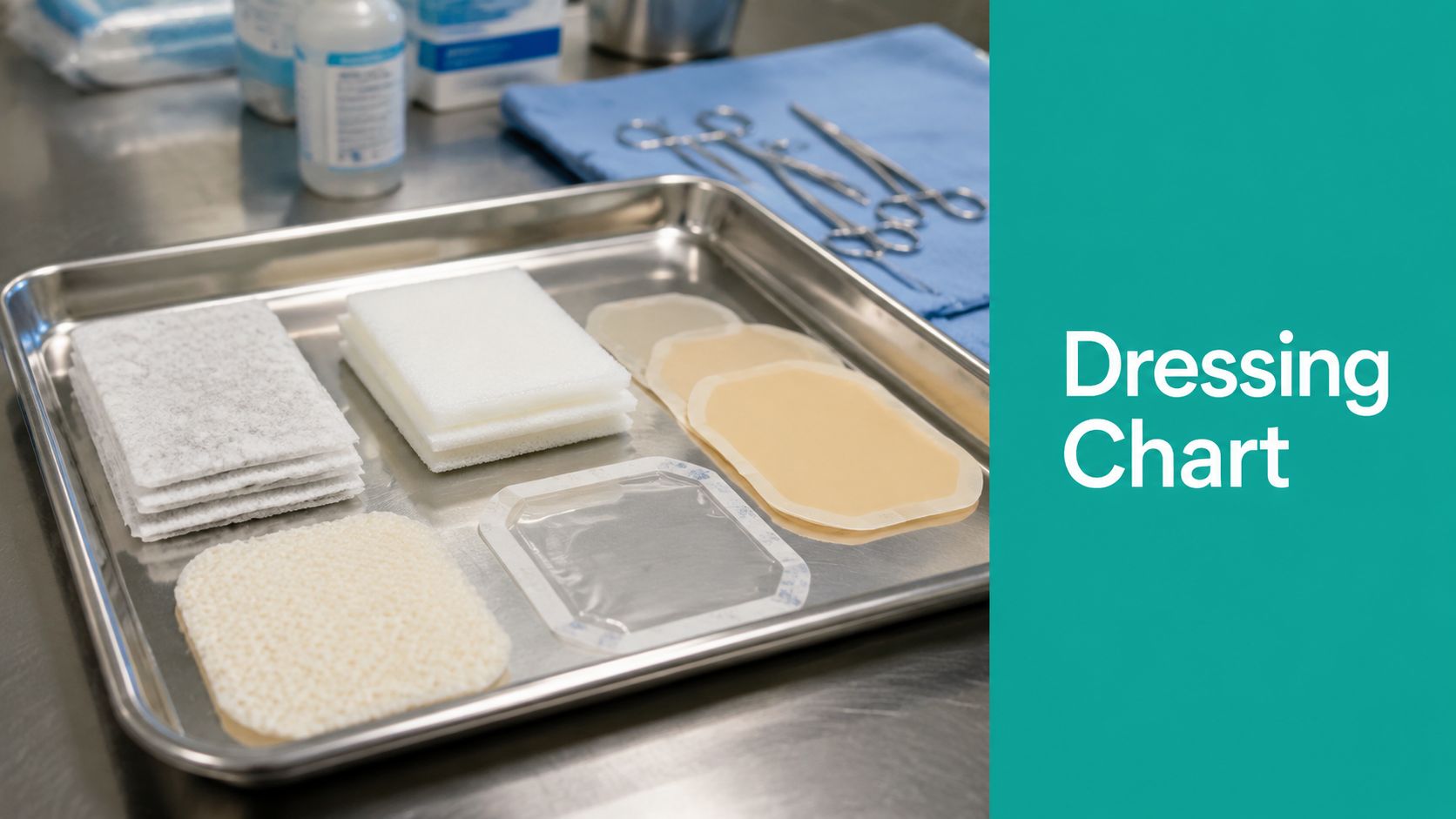
You've got a new patient in the chair, the dressing tray is open, and the wound itself isn't the hard part. The hard part is knowing whether what you apply today will still make sense when billing submits the claim, when supplies are reordered, and when an auditor reads your note six weeks later.
That's where most wound care dressing charts fall apart. They tell you what absorbs, what hydrates, what occludes. Fine. But they don't tell you what happens when you order an antimicrobial without documenting colonization, or when you bill debridement without stating tissue type, depth, and exudate in a way that supports medical necessity. In wound care, dressing choice and documentation are the same decision written in two places.
Matching the Dressing to the Documentation
A common clinic scenario looks simple until it hits the claim queue. A Wagner grade 2 diabetic foot ulcer measures 4 cm, the periwound is intact, the wound bed is 50% slough, and drainage is moderate serous exudate. You can make a reasonable clinical argument for more than one absorbent option. The problem starts when the note says only “DFU dressed appropriately.”

That note won't carry the dressing order, and it won't defend your coding. If the wound is sloughy with active drainage, your chart has to say so in plain language. If you chose foam because you expected sustained moderate output and needed periwound protection, write that. If you packed depth with a more conforming absorbent filler and used a secondary cover, write that too. Reviewers can't infer clinical reasoning from a supply list.
The financial side is not a small side issue. The global advanced wound dressing market is projected to reach USD 10,171.1 million by 2036, with chronic ulcers representing 64.3% of demand and foams holding 26.9% market share, according to advanced wound dressing market projections. Those numbers matter because chronic ulcers are exactly where revenue leaks happen when documentation is weak.
Use a structured note from the start. A solid wound care documentation template helps, but the template alone won't save you if the clinical descriptors are vague.
Practical rule: If your note doesn't explain why this dressing matches this exudate level and this tissue presentation, expect trouble with supplies, prior auth, or both.
Three details should appear before the patient leaves:
- Exudate profile. Type and amount, not just “draining.”
- Tissue composition. Granulation, slough, necrotic burden.
- Plan logic. Why this dressing, why this frequency, what you're monitoring next.
The Core Wound Care Dressings Chart
A useful wound care dressings chart has to work at the point of care. You should be able to glance at the wound, classify moisture needs, check the tissue in the bed, and narrow the field fast. Then you match the product category to what you can defend in the note.
Read the chart left to right. Start with mechanism and indication, then confirm exudate suitability, then make sure the change frequency fits the wound you documented. The last column matters more than often recognized. That's where denials start.
Wound Dressing Selection and Billing Quick Reference
| Dressing Category | Mechanism & Indications | Exudate Suitability | Change Frequency | Billing & Documentation Pearl |
|---|---|---|---|---|
| Foam | Absorbs drainage, cushions wound, protects periwound. Useful for ulcers with ongoing output. | Moderate to high | Usually every 2 to 4 days when output supports it | Document exudate amount and type. “Moderate serous” supports the choice better than “drainage present.” |
| Alginate | Conforms to depth and handles wet wound beds well. Often useful when packing is needed. | Moderate to high | Based on saturation and wound condition | If packed, state location and that it was loosely placed. Avoid vague wording like “packed wound.” |
| Hydrofiber | Wicks fluid vertically and helps limit maceration when drainage control is the main goal. | Moderate to high | Based on output and seal integrity | Pair the order with clear drainage and periwound documentation. |
| Hydrogel | Donates moisture to dry or minimally draining tissue. Useful for softening dry slough or eschar in selected wounds. | Nil to low | Depends on dryness and secondary cover | Support with a dry-bed description. Don't order moisture donation for a wet wound note. |
| Hydrocolloid | Occlusive option for clean, minimally exudative wounds and autolytic support. | Low to minimal | May stay longer if the wound and skin allow | If the wound is infected, heavily draining, or anaerobically colonized, this category is a bad fit. |
| Film | Protective cover or secondary dressing for superficial, low-output wounds | Nil to minimal | Depends on seal and location | Film over a draining wound is an easy mismatch for a reviewer to reject. |
| Antimicrobial dressing | Reserved for documented colonization or infection concern | Varies by base dressing | Based on wound status and chosen primary material | State the infection or colonization findings explicitly. “Using silver” is not a diagnosis. |
| Contact layer or gauze | Simple coverage for stable wounds when advanced absorption or occlusion isn't needed | Nil to low, sometimes more with frequent changes | Depends on wound stability and care setting | Basic can be appropriate. Expensive is not automatically better. |
Absorbent Dressings Alginates Foams and Hydrofibers
For wet wounds, these are the workhorses. People talk about them as if they're interchangeable. They aren't. Each handles drainage differently, and the wrong choice shows up fast in the periwound.
When foam is the right answer
Foam earns its place because it handles a lot of day-to-day outpatient reality. It manages moderate-to-high exudate, protects fragile surrounding skin, and works well when you need something simple enough for repeat care without losing control of moisture balance.
Best practice guidance says foam dressings for moderate-to-high exudate are generally changed every 2 to 4 days, and documenting exudate amount such as “moderate seropurulent exudate” is critical to support frequency and CPT 97597 in a Stage 3 pressure injury. If your note says “wound improving, continue foam,” you've left out the very detail that justifies both the product and the visit intensity.
Bordered foam works when the anatomy allows it and the skin can tolerate the adhesive. Non-bordered foam makes more sense when you need flexibility with fixation or the periwound is fragile.
Where alginates and hydrofibers pull ahead
Alginates and hydrofibers belong in the conversation when shape and fluid behavior matter more than convenience.
- Alginate often makes sense for cavities, undermining, or wounds that need a conforming filler.
- Hydrofiber is useful when vertical wicking helps keep exudate from spreading across the periwound.
- Foam fits broad, shallow, draining wounds where coverage and protection matter as much as absorption.
That distinction matters in the note. If the wound has undermining or a deeper contour, document that you selected a filler because a flat cover alone wouldn't address the wound architecture. If the periwound is getting macerated, state that you chose a material better suited to controlling lateral moisture spread.
A lot of clinicians also reach for antimicrobial versions too early. Sometimes that's justified. Often it isn't. If you're considering that route, the alginate dressing with silver guidance is a useful reminder that “expensive absorbent” and “medically necessary antimicrobial” are not the same thing.
A dressing category isn't justified by habit. It's justified by exudate, tissue, depth, and the condition of the surrounding skin.
What usually goes wrong
Most mistakes are basic:
- Undershooting absorption. Film or low-absorbent cover on a wet wound, followed by leakage and maceration.
- Overpacking depth. Material stuffed tightly into a cavity instead of loosely filling dead space.
- Missing the periwound. Drainage documented, but no note on denudement, maceration, or intact skin.
- No frequency rationale. A dressing ordered with a wear time that doesn't match the amount of drainage charted.
If the wound is wet, your note has to read wet.
Moisture Donors and Occlusives Hydrogels Hydrocolloids and Films
Dry wounds create a different set of errors. Clinicians who spend all day fighting drainage sometimes overcorrect and keep dry wounds too dry. Then the bed stalls, slough hardens, and the dressing plan starts working against you.
Hydrogels for dry or nearly dry wounds
Hydrogels are moisture donors. They're useful when the wound bed is desiccated or when you're trying to support autolytic softening of dry slough in an appropriate wound. They need a matching note. If you choose a hydrogel, describe a wound bed that is dry, minimally draining, or in need of moisture support.
That sounds obvious, but charting often contradicts the order. If the note says “copious drainage” and the order says hydrogel, you've handed the reviewer a mismatch.
Hydrocolloids and films are not universal covers
Hydrocolloids have a real role. For wounds with minimal exudate, hydrocolloid dressings are indicated and can remain in place for up to seven days to promote autolytic debridement, but their occlusive nature makes them contraindicated for highly exudative or anaerobically colonized wounds. That means they belong on the right wound, not the convenient wound.
Transparent films are even easier to misuse. They're fine for superficial protection, low-output sites, or as a secondary cover in selected situations. They are not a rescue plan for active drainage.
Use this quick filter in practice:
| If the wound is… | More likely fit | Avoid |
|---|---|---|
| Dry with adherent slough and little drainage | Hydrogel with appropriate cover | High-absorbent primary as default |
| Clean, minimally draining, shallow | Hydrocolloid | Heavy absorbent dressing that dries the bed |
| Superficial and low output | Film or simple protective cover | Occlusive use over infection concern or active drainage |
| Wet, malodorous, or heavily draining | Absorbent family instead | Hydrocolloid or film as primary plan |
Clinical reminder: Long wear time is not the goal. Appropriate wear time is the goal.
A hydrocolloid left in place because “it can stay a week” is poor care if the wound characteristics changed on day two. Wear time follows the wound, not the package insert.
Using Specialty and Antimicrobial Dressings
The fastest way to waste money in wound care is to treat “advanced” like a synonym for “better.” It isn't. Specialty and antimicrobial dressings have a place, but they attract scrutiny for a reason.
The evidence should make clinicians pause before defaulting upward. A 2024 meta-analysis found zero evidence that advanced dressings reduce infection rates more than basic contact dressings in common wounds, and for many stable Wagner Grade 1 ulcers, simple sterile gauze may be more clinically sound and cost-effective than defaulting to foam or hydrofiber.
What justifies an antimicrobial
If you're using a silver or other antimicrobial dressing, the chart should show why. Not in vague language. In observable findings.
Document things like:
- Malodor after cleansing
- Increasing pain
- Friable granulation tissue
- Purulent or suspicious exudate
- Stalled progress despite appropriate basic care
- Clinical concern for colonized or infected status
If those findings aren't there, reviewers are right to push back. An antimicrobial used “just in case” is rarely a defensible plan.
Collagen and other specialty categories
Specialty dressings aimed at stalled wounds can make sense when the bed is clean, granulating, and not progressing under simpler management. But your note has to show that simpler management was tried and why it wasn't enough. A clean granular wound that's slowly improving doesn't need a premium dressing just because it exists.
That's the trade-off. Specialty products may help in selected cases, but they also raise the bar for medical necessity. The more expensive and more specialized the dressing, the less room you have for lazy documentation.
If a reviewer can't see the reason for escalation in your note, they'll assume there wasn't one.
When to Consider Advanced Therapies and Adjuncts
Some wounds outgrow standard dressings. That doesn't mean the next step is automatic. It means the documentation burden gets heavier, fast.
Negative pressure therapy, cellular and tissue-based approaches, and other adjuncts usually come into the conversation after conservative management has failed, the wound has been adequately debrided, and the underlying barriers to healing are being addressed. In practice, that means your chart has to show more than a stubborn wound. It has to show a treated wound that still isn't progressing for defensible reasons.
The threshold is higher than most teams expect
Before escalating, make sure the record consistently shows:
- A wound bed description over time, not one isolated good note
- Serial treatment history, including dressing categories tried
- Debridement details when performed
- Etiology management, such as offloading, edema control, or pressure relief
- Perfusion and infection considerations addressed in the plan
If you can't prove mastery of basic wound care documentation, you're not ready for the paperwork tied to advanced therapies. That's true clinically and financially.
For teams managing negative pressure documentation, this overview of wound vac ICD-10 coding considerations is worth keeping handy because the diagnosis linkage has to be as clean as the treatment narrative.
Don't escalate to compensate for bad basics
I see this mistake too often. The wound is wet because edema isn't controlled. The ulcer is stalled because offloading is inconsistent. The note is weak, so someone reaches for a more complex therapy instead of fixing the underlying problem. Advanced therapy won't rescue a bad plan.
Applying the Chart to Clinical Scenarios
A wound care dressings chart only matters if it helps you make a cleaner decision in the room. Here's how that looks in practice.
Venous leg ulcer with heavy drainage
The lower leg is edematous, the gaiter area shows hemosiderin staining, and the ulcer is draining enough to threaten the periwound by the next visit. In this case, I want absorption and skin protection first. A foam or another high-absorbent primary can work, depending on the contour and drainage behavior, with close attention to secondary coverage and edema management.
The note should say more than “venous ulcer dressed.” Write the exudate amount, describe whether the periwound is intact or macerated, and document the rationale for an absorbent dressing category. If the surrounding skin is already breaking down from moisture, that needs to be in the record because it supports the need for stronger exudate control.
Sacral pressure injury with slough and granulation
This is the wound that punishes vague charting. You've got mixed tissue in the bed, often irregular depth, and drainage that may not be dramatic but is enough to matter. If selective debridement is performed, your tissue description has to support it. If you choose an absorbent filler plus cover, document both layers and why each is needed.
A good note includes:
- Stage and location
- Tissue mix in the bed
- Exudate type and amount
- Periwound condition
- Whether undermining is present
- Exact dressing plan and change interval
If there's odor, document whether it persisted after cleansing. If pain increased, write that too. Those are not side comments. They affect treatment selection.
Non-infected diabetic foot ulcer over the first metatarsal head
This one exposes a common bad habit. People obsess over dressing selection and under-document offloading. For a stable, non-infected plantar ulcer with limited drainage, the best dressing in the world won't fix repetitive pressure.
If the wound is low output and clean, a simpler dressing approach may be enough. Your note should connect the dressing choice to the wound bed, then state the offloading plan clearly. If there's callus at the edge, record it. If the periwound is dry and intact, record that too. If the wound isn't infected, don't imply that it is by choosing an antimicrobial without supporting findings.
The dressing supports healing. It doesn't substitute for pressure relief, edema control, or glycemic management.
Post-op wound with minimal exudate
A clean post-op wound with little to no drainage usually needs protection, not aggressive absorption. That's where low-burden options such as a thin occlusive choice may be appropriate if the wound and surrounding skin support it. The chart should reflect the low exudate state. If the note later starts showing increased drainage or erythema, the dressing plan should change with it.
That's the point of using a wound care dressings chart well. It keeps the decision tied to the wound in front of you, not the dressing you happen to favor.
Connecting Dressings to Debridement and Billing Codes
Many good clinicians lose money when they treat the wound correctly but document it loosely. Billing can't rescue that after the fact.

Your dressing choice should line up with the wound characteristics in the note, and your debridement code should line up with the tissue removed and the depth documented. If those two tracks don't match, the claim starts to wobble.
Selective versus surgical debridement
The distinction between CPT 97597/97598 and CPT 11042–11047 isn't academic. It changes payment, audit risk, and whether the record supports what was billed.
Use 97597 when the documentation supports selective debridement of devitalized tissue in a way that matches that service. If you're documenting a Stage 3 pressure injury with selective debridement, the wound description has to be specific enough to justify both the procedure and the dressing that follows.
Use 11042–11047 when the record supports surgical debridement by depth and tissue removed. If you bill one of these codes, your note needs depth, tissue type, and post-debridement status written clearly. “Debrided wound, tolerated well” is not enough.
Dressing orders must match the wound note
Payers don't just look at the HCPCS supply category. They look for a believable chain:
- What the wound looked like
- What tissue and exudate were documented
- Why this dressing category was chosen
- Why the change frequency is reasonable
- Whether infection or colonization language supports a specialty item
That's why the denial pattern is so frustrating. According to Gloucestershire wound care guidance, 34% of denied wound care claims stem from insufficient documentation of exudate type and infection level, not inappropriate dressing choice, and using a silver dressing without documenting “colonized” or “infected” is a common trigger for prior authorization denials. The clinician may have picked a reasonable product. The claim still fails because the note didn't say enough.
What reviewers look for
Reviewers are not impressed by brand familiarity or by “advanced dressing continued.” They want alignment.
- If you used high absorbency, show moderate or high exudate.
- If you used an antimicrobial, show colonization or infection concern.
- If you billed debridement, show tissue removed, depth, and wound status.
- If you ordered repeat supplies, show why the wear schedule is medically necessary.
This is why I tell clinicians that coding literacy is part of wound care competency. You don't need to think like a biller all day. But when you choose a dressing, you should already know what language must appear in the note to support the code set attached to that visit.
Good wound care notes don't just describe treatment. They prove why the treatment and the code belong together.
Point of Care Documentation for Clean Claims
A bulletproof wound note is built from repeatable fields, not memory. If you leave the room with half the wound still in your head instead of in the chart, you're setting up a denial.
The core elements are straightforward, but they must be explicit. Payers require documentation of the percentage of each tissue type, wound measurements including length, width, and depth, and undermining described with a clock-face analogy to prove medical necessity for advanced dressings. If you skip those, everything built on top of them gets weaker.
The note elements that actually protect the claim
Use a checklist mentality:
- Exact wound measurements. Length × width × depth at the deepest point.
- Tissue percentages. Necrotic, slough, granulation, epithelial if present.
- Exudate description. Type and amount.
- Periwound assessment. Intact, macerated, denuded, erythematous, callused, edematous.
- Undermining or tunneling. Use clock-face location and depth.
- Signs of infection or colonization. Write the findings, not just the label.
- Intervention details. Cleansing, debridement type, primary dressing, secondary dressing, frequency.
- Plan factors outside the dressing. Offloading, compression, repositioning, nutrition, glycemic issues when relevant.
Wording that prevents trouble
Don't write “wound looks better.” Write what changed.
Better examples:
- “Wound bed 60% granulation, 40% slough after cleansing.”
- “Moderate serous exudate with mild periwound maceration at inferior edge.”
- “Undermining 2 cm from 3 o'clock to 5 o'clock.”
- “Selective debridement performed of slough and nonviable tissue.”
- “Primary absorbent dressing chosen due to moderate drainage and risk of periwound breakdown.”
If your team uses ambient documentation, make sure everyone understands the consent rules in your state and setting. This practical piece on is it illegal to record someone is worth reviewing because documentation efficiency never excuses sloppy consent habits.
What clean claims usually have in common
They tell the whole story in one pass. The diagnosis, wound characteristics, intervention, and coding logic all match. There's no gap for billing to fill later. That's the definitive standard.
A strong note doesn't need fancy language. It needs specificity, consistency, and enough detail that another clinician, a payer reviewer, or an auditor could understand exactly why you chose that dressing and whether it still makes sense at the next visit.
EkagraHealth AI helps wound care teams capture the details that claims live or die on. It drafts structured wound notes during the visit, maps CPT and ICD-10-CM logic, supports cleaner prior auth workflows, and reduces the charting burden that pulls clinicians away from patient care. If your team is tired of losing revenue to preventable documentation gaps, take a look at EkagraHealth AI.
