
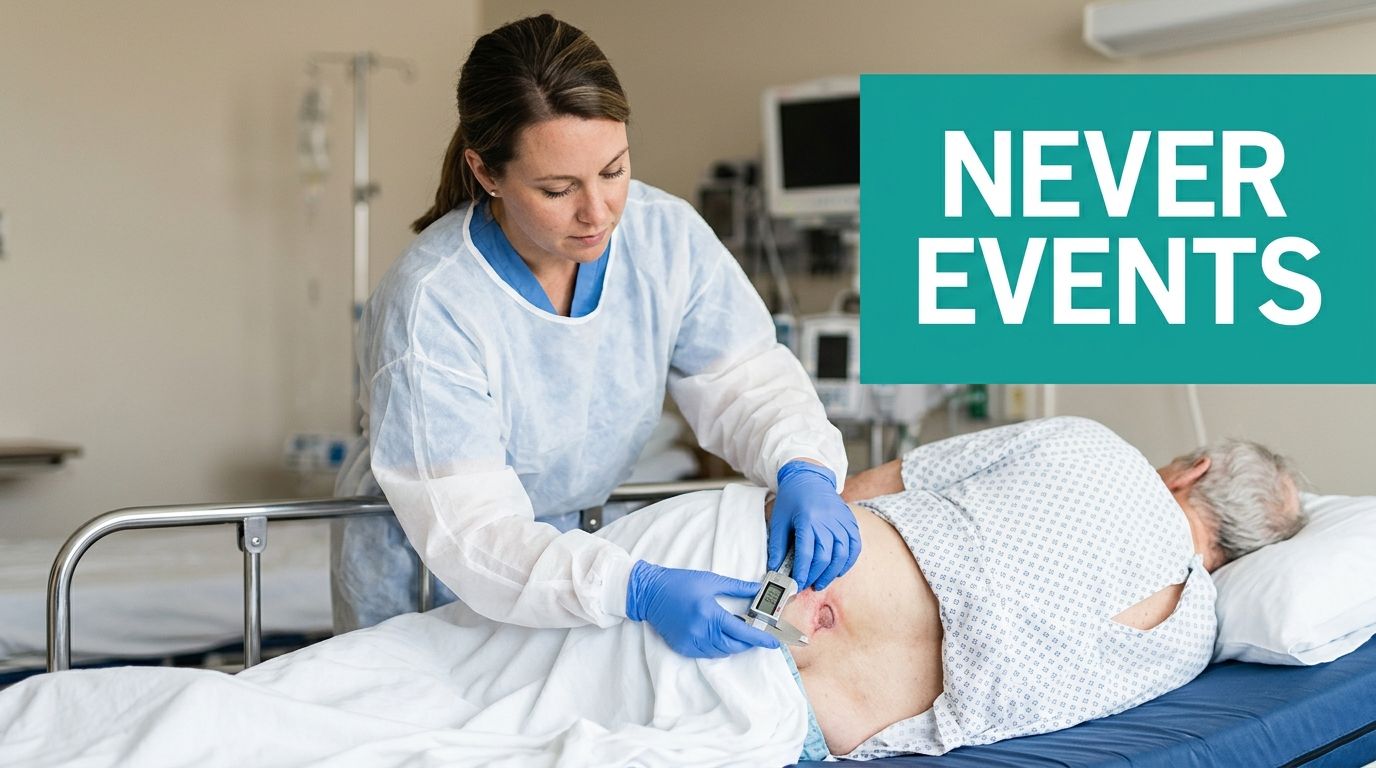
You admit a patient to the SNF on Friday afternoon. The discharge packet says “skin breakdown to sacrum.” That's it. No stage. No measurements. No wound photo. No note telling you whether the ulcer was present on admission, evolving, or already full-thickness. By the time your team gets a proper head-to-toe done, offloading started, and nutrition reviewed, the wound declares itself as a Stage 3 pressure ulcer.
Now the chart tells two stories. Clinically, this may have been present before transfer and poorly described. Administratively, it can look like your facility caused it.
That gap is where never events healthcare stops being a policy phrase and becomes a daily threat to wound programs. In under-resourced settings, especially SNFs, home health, and mobile wound services, the problem usually isn't that clinicians don't know what to do. It's that the documentation chain breaks during handoff, and the receiving team inherits the liability.
I've seen the same pattern over and over. Good care delivered late because the baseline wasn't captured early. Correct treatment, but weak attribution. Accurate staging eventually, but not defensibly tied to arrival status. When surveyors or payers review the record, they aren't reading intent. They're reading timestamps, wound descriptors, orders, and whether the chart proves what happened.
The Transfer That Became a Never Event
A thin transfer summary is one of the most dangerous documents in wound care.
The patient arrives from acute care with edema, incontinence, diabetes, and limited mobility. Nursing notes mention redness to the heel and sacral skin breakdown. There's no wound LDA built out, no measurement, no exudate description, no periwound assessment, and no admission photo packet attached. Two weeks later, the sacral wound has slough, measurable depth, and undermining. The heel now has a firm eschar that was likely evolving before arrival.
The bedside team knows this didn't appear out of nowhere. The chart may not be able to prove it.
Where the record usually fails
The failure points are boring. That's why they're dangerous.
- Transfer language is vague: “skin issue,” “open area,” and “breakdown” aren't staging terms.
- The first receiving assessment is delayed: the admission skin check happens after the patient has already spent time in bed, in transport briefs, or on a stretcher.
- Photo evidence is missing: later measurements don't help if there's no baseline image tied to the first assessment.
- POA status is implied, not stated: clinicians assume everyone knows the wound was there already. Payers and surveyors don't accept assumptions.
If the wound was present on admission, say it plainly and say it early. If you aren't sure, document that uncertainty and the reason for it.
This isn't about blaming the sending hospital or the receiving SNF. It's about recognizing that pressure ulcer attribution is often decided by documentation quality, not bedside memory. In home health, the same problem shows up after hospital discharge when the start-of-care note inherits incomplete wound details. In outpatient wound clinics, it appears when a patient arrives with a dehisced incision and no operative follow-up note clarifying timing, depth, or prior management.
What works is disciplined intake. What doesn't work is trying to reconstruct the story after deterioration is obvious.
Defining Never Events Beyond the Buzzword
The phrase gets used loosely, but the formal definition matters because regulators, payers, quality teams, and plaintiff attorneys all use that language differently from frontline clinicians.

Ken Kizer coined the term “never events” in 2001. The National Quality Forum later defined them as preventable, serious, and unambiguous adverse events, and compiled 29 specific events in seven major categories: surgical or invasive procedure errors, product or device events, care management events, environmental events, radiologic events, patient protection failures, and potential criminal events, as summarized by EBSCO's overview of never events.
The three words that matter
Preventable doesn't mean medicine is risk-free. It means the event should not occur when basic safeguards are followed. In wound care, that points straight at handoff failures, site confirmation failures, missed repositioning protocols, omitted dressing orders, and incomplete escalation when a wound worsens.
Serious means the harm is not trivial. We're talking about events associated with death, permanent loss of function, major disability, or severe avoidable deterioration. In the wound world, that can include advanced pressure injury, limb loss after a wrong-site procedure, or catastrophic sepsis after breakdown in procedural care.
Unambiguous is what makes these events so operationally important. They can be clearly identified in the chart. Either the procedure was performed on the correct site or it wasn't. Either the object count reconciled or it didn't. Either the pressure ulcer was documented as present on admission with supporting assessment data or it wasn't.
The categories wound teams should actually know
You don't need the full taxonomy memorized. You do need to recognize where wound practice touches it.
| Category | Why it matters in wound practice |
|---|---|
| Surgical or invasive procedure errors | Sharp debridement, bedside excision, incision and drainage, amputation planning |
| Product or device events | Dressings, negative pressure systems, tubing, retained materials |
| Care management events | Medication mistakes, preventable deterioration, acquired severe pressure ulcers |
| Patient protection failures | Falls, elopement, self-harm risk in cognitively impaired patients with wounds |
| Environmental events | Burns, oxygen-related injury, unsafe treatment areas |
| Radiologic events | Less common, but relevant when image-guided procedures are involved |
| Potential criminal events | Assault, impersonation, diversion, or intentional harm |
Practical rule: If an incident triggers immediate debate about reporting, reimbursement, and legal exposure, stop treating it as a charting nuisance. It may fit a never event framework.
The point of the NQF framework wasn't to create a dramatic label. It was to mark system failures that should be clearly recognizable and preventable. That distinction matters. In real practice, staff often talk about never events as if they're rare disasters from the OR only. They're not. In wound care, they often start with a missing assessment, a mislabeled site, or a handoff note that says almost nothing.
Wound Care Never Events You Cannot Ignore
Most wound clinicians won't deal with every NQF category. We will, however, run into a handful of high-risk events repeatedly across hospitals, SNFs, outpatient wound centers, and home-based care.
AHRQ PSNet notes that a 2013 study estimated more than 4,000 surgical never events annually in the United States, including wrong-site surgery and retained foreign objects, and that over 70% of these surgical errors are associated with death in analyses of these events, which is why procedural discipline around debridement and site confirmation matters so much in wound practice according to the AHRQ PSNet never events primer.
The wound-specific list that deserves your attention
| NQF Category | Specific Never Event | Wound Care Clinical Example |
|---|---|---|
| Surgical or invasive procedure errors | Wrong-site procedure | Debriding the wrong diabetic foot ulcer when multiple ulcers are present on the same limb |
| Surgical or invasive procedure errors | Wrong-patient procedure | Performing bedside sharp debridement on the wrong patient during a busy rounding block |
| Surgical or invasive procedure errors | Retained foreign object | Retained packing, gauze fragment, or procedural material after debridement or incision and drainage |
| Care management events | Stage 3 or 4 pressure ulcer acquired in the facility | Sacral pressure injury not documented as present on admission and later attributed to the facility |
| Care management events | Major medication error | Incorrect antibiotic, anticoagulant, or insulin management in a complex wound patient leading to severe harm |
| Product or device events | Device-related serious injury | Mishandling wound-related devices or support surfaces contributing to avoidable harm |
Where these events actually happen
Wrong-site risk is real in wound care because our patients often have more than one lesion. A diabetic patient may have a Wagner grade 3 plantar ulcer, a lateral malleolar pressure injury, and a callused contralateral toe. If the note says “debrided right foot ulcer,” that's not enough. Site description must distinguish plantar versus dorsal, medial versus lateral, digit versus metatarsal head, and whether the tissue removed was epidermis, dermis, subcutaneous tissue, muscle, fascia, or bone when you're reporting debridement codes in the CPT 11042 to 11047 family.
Retained material doesn't only belong in the OR conversation. It can happen after packing changes, cavity wound management, or sharp bedside procedures when documentation is sloppy and handoff between shifts is weak.
The pressure ulcer issue is more politically charged because attribution is often messy. The receiving facility may be caring for the consequences of delayed recognition upstream. Still, if the chart lacks a defensible present-on-admission trail, the event can land on your doorstep. That's why teams working to reduce hospital-acquired pressure injuries need to think beyond prevention bundles and focus just as hard on transfer documentation.
What usually separates noise from reportable risk
A wound getting worse is not automatically a never event. Some ulcers deteriorate despite appropriate care. A palliative patient with skin failure, unstable perfusion, severe malnutrition, or terminal decline may worsen even when your team does everything right.
What pushes a case into dangerous territory is a combination of factors:
- No baseline description
- No documented prevention plan
- No evidence of reassessment after change
- No clear procedural safeguards
- No handoff trail showing what was known when
That combination is common in under-resourced settings. It's also exactly what reviewers notice.
The Financial and Regulatory Fallout of a Never Event
Once a never event enters the chart, the problem stops being purely clinical. It becomes a reimbursement issue, a survey issue, a legal issue, and a staffing issue all at once.

One of the most practical figures to remember is this: never events increase Medicare hospital payments by an average of $700 per case to treat resulting complications, and CMS has responded by stopping payment for complications from certain never events, including serious pressure ulcers acquired in the facility, as outlined in QPI's summary of six things to know about never events.
Why under-resourced settings get squeezed harder
Hospitals have quality departments, coding teams, risk managers, and more formal escalation pathways. SNFs, home health agencies, and smaller wound programs often have less infrastructure to sort out attribution disputes. The bedside nurse, wound clinician, and biller are left trying to reconstruct a timeline from incomplete paperwork.
That creates an ugly trade-off. The more medically complex the patient population, the more likely the wounds are already evolving across settings. But the less resourced the setting, the harder it is to prove that progression started elsewhere.
Common denial and scrutiny triggers include:
- Missing POA language: a stageable pressure injury appears in later notes without a clear admission statement
- Inconsistent staging: one note says deep tissue pressure injury, another says Stage 2, then another says unstageable, with no explanation of evolution
- Debridement billed without support: the note doesn't justify tissue type removed, depth, surface area, or medical necessity
- No linkage between treatment and reassessment: dressing changes are ordered, but the response to treatment isn't documented
- Operative language in clinic notes without procedural safeguards: the billing suggests an invasive service, but the note reads like a dressing change
Surveyors don't care that the day was busy
Surveyors look for sequence. Payers look for support. Attorneys look for contradiction.
If a sacral ulcer is first fully documented several days after admission, the reviewers will ask why the admission assessment didn't establish location, size, stage, exudate type, odor, wound bed composition, periwound condition, offloading plan, and whether the patient was incontinent or nutritionally compromised. If your debridement claim uses 11042 or an add-on code such as 11045, they'll expect the note to support excisional technique, tissue level, measurements, and site specificity.
The chart doesn't have to be elegant. It has to be defensible.
Operations and revenue cycle directly collide. Teams that want cleaner claims and fewer preventable write-offs need workflows that force critical wound fields to be completed before the charge goes out. That's the same discipline behind strong revenue cycle management in medical billing. In wound care, weak documentation isn't just a compliance flaw. It directly affects whether the claim survives review.
What the aftermath usually looks like
After a suspected never event, the facility may need to report externally, open an internal investigation, review policies, and perform root cause analysis. Staff interviews follow. Timelines get built from notes, order history, skin assessments, photos, and communication logs.
The painful part is that many of these cases don't start with gross negligence. They start with ordinary sloppiness:
- the photo wasn't uploaded
- the night shift documented “red area”
- the provider copied forward old measurements
- no one clarified whether the heel eschar was present before transfer
- the code was billed before the narrative was complete
Those are fixable problems. They just aren't cheap once they mature into a formal event.
Prevention Tactics and Documentation That Protects You
The best defense in never events healthcare is a process that makes the right documentation easier than the wrong documentation.

Start with a wound-specific admission standard
Every transfer patient with any mention of skin issues needs a real baseline assessment. Not “wound noted.” A real one.
Document:
- Exact location: “sacrum” is weaker than “midline sacrococcygeal region extending toward right gluteal cleft”
- Stage or status: Stage 3, unstageable, deep tissue pressure injury, or “unable to stage at admission due to obscuring necrotic tissue”
- Measurements: length, width, depth, and any undermining or tunneling by clock method
- Wound bed tissue: granulation, slough, eschar, exposed structures if present
- Exudate and odor: serous, serosanguineous, purulent, scant, moderate, heavy; odor before and after cleansing
- Periwound: maceration, erythema, induration, callus, hyperkeratosis, denudement
- Pain and tolerance: especially before debridement
- Photo evidence: date-stamped and linked to the note when policy allows
- POA statement: explicit, not implied
A usable sentence is: “Pressure injury to sacrococcygeal area present on admission to facility based on initial skin assessment completed on arrival, with full-thickness tissue loss and slough noted at first evaluation.”
Use a wound care time-out for invasive work
Before sharp debridement, incision and drainage, or any invasive bedside procedure, do a brief pause. It doesn't need to be theatrical. It does need to be consistent.
Confirm:
- Correct patient
- Correct wound
- Correct side and anatomic site
- Correct planned procedure
- Consent and tolerance plan
- Supplies available and countable if relevant
- Post-procedure dressing plan
For patients with multiple ulcers, mark the site in the note with anatomic precision. “Right foot ulcer” is denial bait and safety bait. “Right plantar first metatarsal head ulcer” is much safer.
When there are two wounds on one limb, site ambiguity is a clinical risk, not just a documentation flaw.
Write notes that support billing and safety at the same time
A good debridement note should make sense to a clinician, coder, and surveyor.
If you bill 97597 or 97598, the note should support selective debridement and the tissue removed. If you bill 11042 to 11047, the record must support surgical debridement depth and surface area. Don't let templated phrases outrun what happened at bedside.
A practical structure helps:
- Pre-debridement wound status
- Procedure performed
- Tissue level removed
- Instrument used
- Total area treated
- Hemostasis
- Patient tolerance
- Post-debridement measurements
- Dressing applied
- Plan for follow-up
Teams that struggle with speed often benefit from tightening point-of-care dictation and structured fields. A resource on medical dictation software is worth reviewing if your clinicians are still finishing wound notes late and backfilling critical details from memory.
For recurring consistency, a standardized wound care documentation template helps reduce the usual omissions around measurements, periwound findings, and procedural support.
Distinguish unavoidable progression from poor care
Not every worsening wound represents preventable harm. But if the chart doesn't explain why deterioration occurred despite appropriate care, reviewers may assume the worst.
Document the context:
- Perfusion limits: ischemic limb, no revascularization option, or delayed vascular intervention
- Systemic decline: terminal condition, severe malnutrition, or multisystem failure
- Tolerance limits: patient declines turning, offloading, or procedure
- Clinical barriers: contractures, incontinence, spasticity, agitation, or pain limiting repositioning
If you believe a skin injury reflects terminal decline rather than neglect, don't rely on shorthand labels alone. Describe the pattern, trajectory, goals of care, and conversations with family.
Have a response plan before the event
The response cannot be invented in the middle of a crisis. The Leapfrog Group requires hospitals to take nine actions after a never event, including apologizing to the patient, waiving all related costs, reporting the event, conducting a root cause analysis, and implementing a support protocol for caregivers involved, as summarized in Wikipedia's overview of never event policy expectations.
Whether or not your setting follows that exact structure, the principle is sound. The response should be predefined.
At minimum, know:
- Who gets notified first
- How photos and records are preserved
- Who reviews billing hold status
- How family communication is documented
- How the team conducts root cause analysis without scapegoating one nurse
What works is repetition. What doesn't work is relying on memory, heroics, or chart addenda written days later.
Moving from Blame to Systemic Safeguards
The original purpose of never event policy was to identify failures in systems, not to pin every bad outcome on one clinician. Wound care teams need to reclaim that frame, especially in settings where staffing is thin and transfer quality is inconsistent.

Blame-centered cultures produce defensive charting, delayed reporting, and quiet workarounds. Safer cultures produce early escalation, standardized documentation, and cleaner attribution across settings. In practical terms, that means the wound program should build a workflow where a transfer note triggers an immediate skin assessment, a debridement charge can't move forward without site-specific documentation, and image capture is tied directly to the clinical note rather than saved in someone's phone queue or memory.
The systems that hold up under scrutiny
A defensible wound operation usually shares a few traits:
- Structured intake: present-on-admission status is captured at the first encounter
- Required wound descriptors: stage, measurements, exudate, tissue type, and periwound fields aren't optional
- Procedure hard stops: debridement billing requires procedural support in the note
- Closed-loop handoffs: changes in wound status are communicated across nurse, provider, and biller
- Corrective action discipline: the team learns from misses
For leaders building that last piece, a practical reference on CAPA best practices is useful because wound programs often do the “corrective” part informally and skip the preventive redesign.
Strong systems don't eliminate hard cases. They make the hard cases explainable.
That's the shift that matters. Never events healthcare shouldn't force wound clinicians into fear-based charting. It should push organizations to make safe care visible in the record. When the documentation reflects what happened, patients are better protected, clinicians are easier to defend, and facilities are less likely to absorb a preventable financial hit because someone wrote “skin breakdown” instead of a real wound assessment.
EkagraHealth AI helps wound care teams build that kind of defensible documentation workflow. If your practice is trying to tighten wound charting, support accurate CPT and ICD-10-CM capture, and reduce billing friction across clinic, mobile, and SNF settings, take a look at EkagraHealth AI.
