
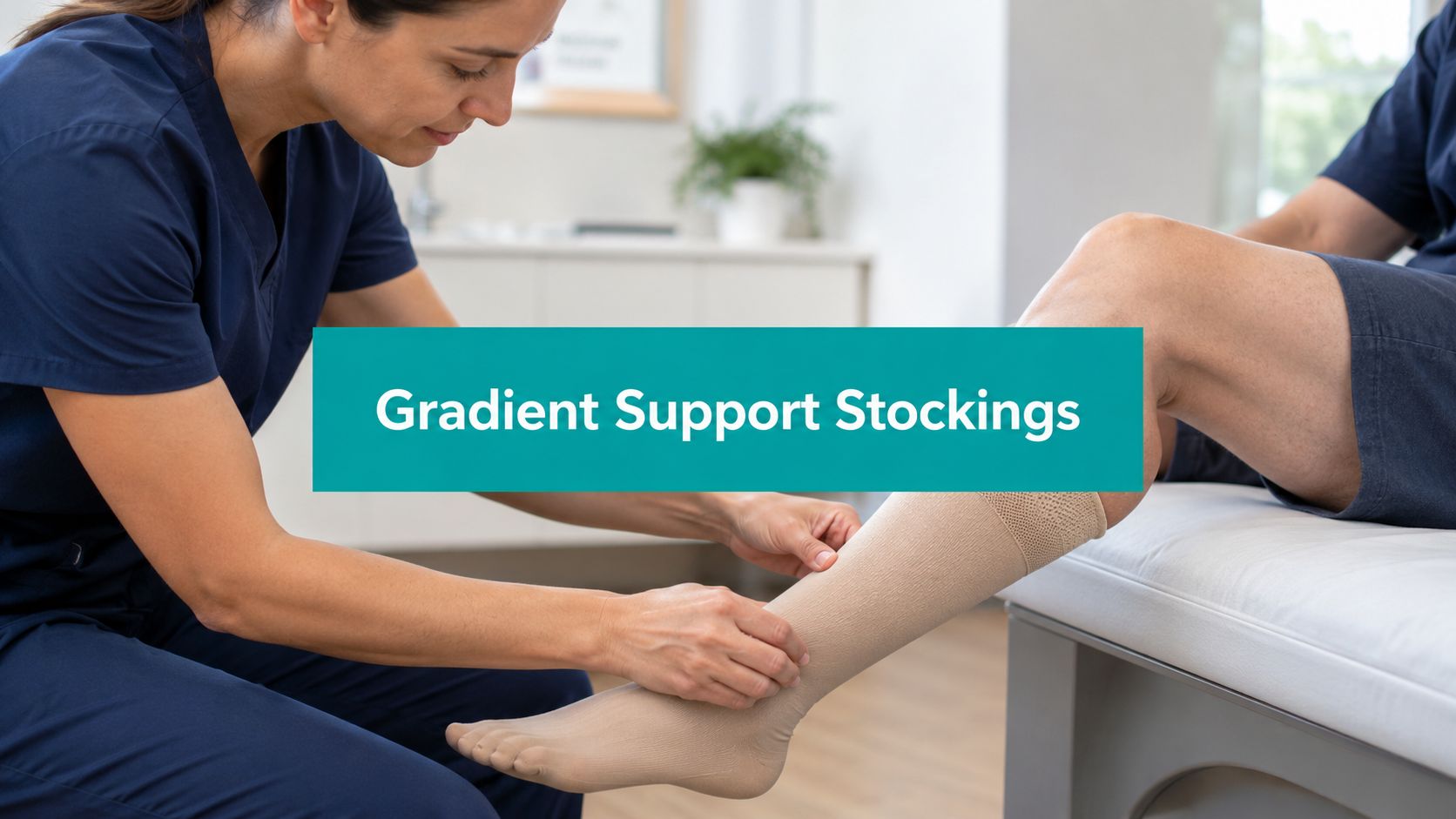
The ulcer looked fine at discharge. Medial ankle, shallow base, granulating well after serial sharp debridement and compression wraps. A few months later the patient is back with the same leg, the same brawny edema, the same stasis skin changes, and a familiar line: “I've been wearing my stockings.”
That's the moment when newer clinicians learn the hard part of compression therapy. A prescription isn't treatment. Gradient support stockings only work when the patient is the right candidate, the pressure is high enough to matter, the garment fits, and someone has thought through how that patient is supposed to get it on every morning without turning the plan into fiction.
Table of Contents
- Beyond the Basics of Compression Failure
- How Gradient Compression Actually Works
- Patient Selection Indications and Contraindications
- Choosing the Right Compression Class
- Mastering Measurement Fitting and Adherence
- Documentation and Billing for Compression Therapy
Beyond the Basics of Compression Failure
A recurrent venous leg ulcer rarely means compression “doesn't work.” More often, the process failed somewhere between clinic discharge and home use.

I see this pattern all the time in patients with recurrent gaiter-area ulceration, stasis dermatitis, hemosiderin staining, and edema that never really stayed controlled after the wraps came off. During active treatment, the limb improved because the compression system was supervised. Once the patient transitioned to stockings, nobody checked whether the garment was therapeutic, whether it rolled at the calf, or whether the patient with arthritis could even apply it.
Where the plan usually breaks
The common failure points are practical, not theoretical:
- The pressure was too light: “Support hose” bought casually isn't the same as medical compression.
- The limb was measured badly: An edematous leg measured at the wrong time of day produces a bad fit.
- The patient couldn't manage the device: If donning takes too much grip strength, adherence collapses.
- The wound environment was ignored: Heavy exudate, macerated periwound skin, or fragile tissue may make a stocking the wrong first move.
If the periwound is already soggy and breaking down, review your local moisture strategy too. A leg can be under-compressed and over-wet at the same time. That combination is how you end up chasing recurrent skin maceration treatment instead of effectively stabilizing the venous disease.
Practical rule: When a patient says they're wearing the stockings, verify the garment, the fit, and the technique before you label the case “noncompliant.”
Compression failure is often a systems problem
The clinician's job doesn't end with “wear these daily.” It includes selecting the right device, confirming safe use, documenting the indication, and setting the patient up for repeatable success. In wound care, the details matter because recurrence isn't just inconvenient. It means another cycle of drainage, periwound damage, dressing changes, missed work, home-health burden, and often another round of debridement.
That's why I treat compression as a workflow, not an order.
How Gradient Compression Actually Works
A patient comes back two weeks after a venous ulcer visit and says, “I wore the stockings every day.” The leg is still heavy, the gaiter area is still swollen, and the wound bed still looks waterlogged. In clinic, that usually means one thing. The garment may be snug, but it is not creating enough graduated pressure to change venous hypertension in a meaningful way.
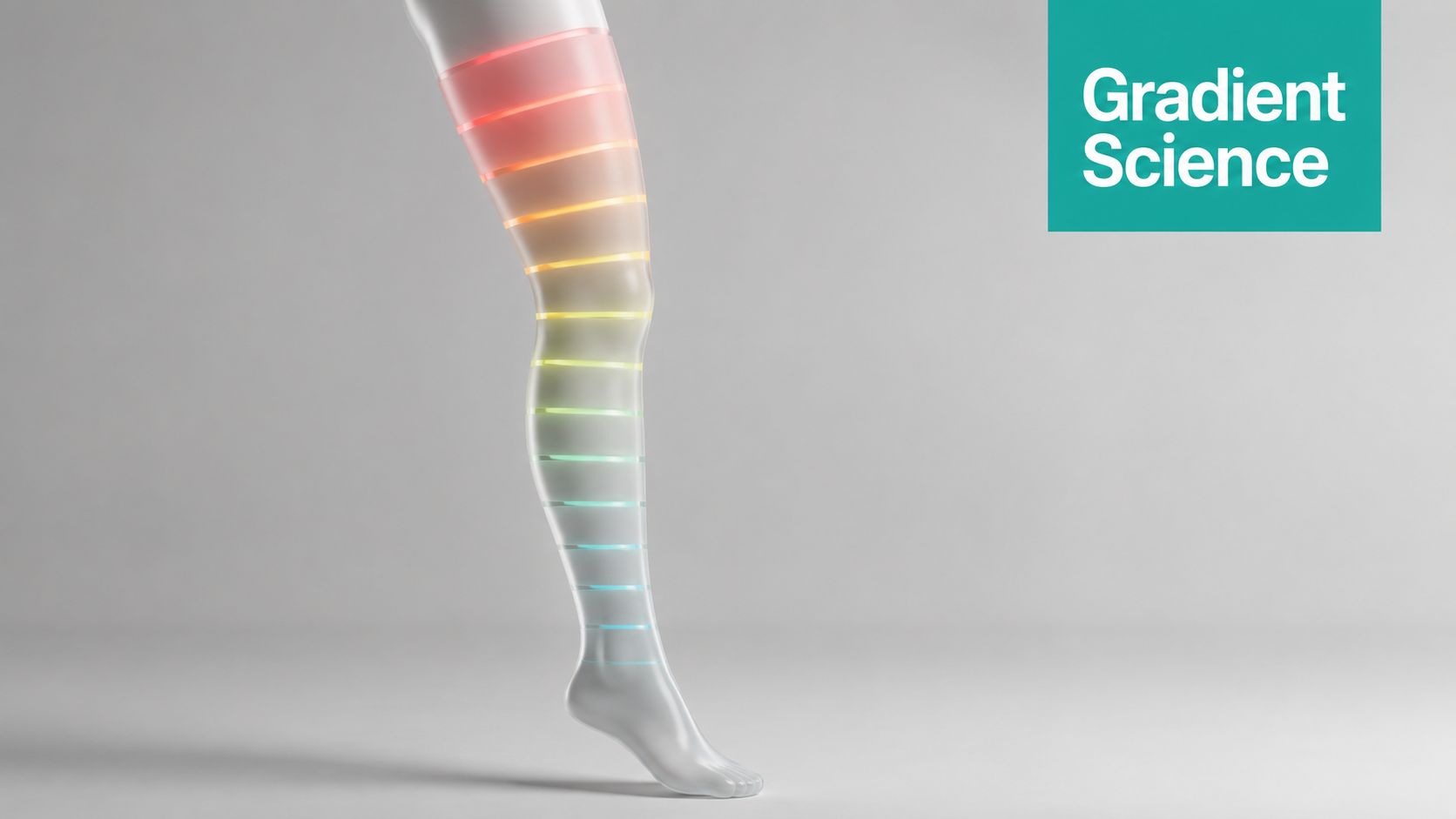
A true gradient support stocking applies the greatest pressure at the ankle and less pressure as the garment moves up the leg. That pressure profile is the treatment, not a comfort feature. The International Consensus on medical compression describes graduated external pressure as a way to reduce venous diameter, improve valve competence, and support venous return from the lower limb in ambulatory patients, which is why stocking design matters far more than whether the garment only feels tight (international consensus statement on medical compression).
The ankle gets the highest pressure because the distal leg carries the greatest hydrostatic burden during standing and walking. If pressure is strongest there and decreases proximally, fluid is pushed in the direction you want it to go. If pressure is flat, weak, or poorly distributed, the patient may feel supported without getting much hemodynamic benefit.
That distinction shows up fast in wound care. Venous congestion drives edema. Edema stretches tissue, impairs oxygen diffusion, increases leakage into the interstitium, and makes the skin easier to injure. Once swelling is controlled, the wound bed usually behaves better. Drainage becomes easier to manage, the periwound is less likely to soften and break down, and the tissue has a better chance of progressing through the stages of normal wound healing.
Walking matters too. Stockings work best when they assist the calf muscle pump during ambulation. They do not substitute for movement. They make each step more productive by improving the pressure conditions around the venous and lymphatic systems. That is why a sedentary patient with the right stocking can still struggle, while an ambulatory patient in a well-fitted garment often improves faster.
Support hose and medical compression should not be treated as interchangeable terms. A soft retail garment may give mild symptom relief, but it often fails to control edema in patients with established venous disease or ulcer history. The clinical consequence is familiar. The wound stalls, drainage continues, and staff keep changing dressings while the underlying venous pressure remains largely untreated.
This is also where clinic operations and payer reality start to matter. If the chart only says “compression stocking recommended,” you have not documented the therapeutic logic. Record the edema pattern, ulcer history, venous findings, tolerance, and why a graduated garment was selected over wraps or another device. That level of detail helps the next clinician continue the plan correctly, and it gives you something defensible when coverage questions come up or the patient returns saying the garment “didn't work.”
If edema is still obvious on exam after consistent wear, assume a treatment failure until you prove otherwise. Check pressure class, fit, donning method, wear time, and whether the limb shape has changed enough to make the original garment ineffective.
Patient Selection Indications and Contraindications
Not every swollen leg belongs in a stocking. Inexperienced prescribing, in such cases, causes trouble.
A patient with straightforward chronic venous disease and preserved arterial inflow may do well. A patient with mixed disease, reduced sensation, infection, severe deformity, or questionable perfusion may need a different path first. Public guidance on compression repeatedly stresses caution in peripheral arterial disease, reduced sensation, infection, and other contraindications, and it also highlights the gray-zone patient with mixed venous-lymphatic disease or borderline arterial inflow in this policy summary on pressure gradient garments.
Good candidates and overconfident prescribing
The usual candidates are the people you'd expect in wound clinic: chronic edema from venous disease, stasis dermatitis, healed or active venous ulcer history, and selected patients with post-thrombotic symptoms or phlebolymphedema. But even within that group, the right device isn't automatic.
A shallow venous ulcer with manageable drainage and a stable limb shape may transition well into stockings after wraps. A limb with heavy exudate, major contour change, or significant skin fragility often won't.
Here's the practical divide:
- Stockings work best when the limb is ambulatory, measurable, and stable enough to maintain a therapeutic gradient.
- Stockings work poorly when edema fluctuates wildly, the leg shape is distorted, or the patient can't apply the garment consistently.
The post DVT lesson
The post-DVT story is worth knowing because it changed habits. A medical policy summary recounts an earlier randomized trial where post-thrombotic syndrome of any severity occurred in 26% of patients using stockings versus 46% without them, but a later trial found cumulative incidence by 750 days of 14.2% with stockings versus 12.7% without, with p = 0.58. Another summary reports a 10,005-patient trial with 10.0% assigned to thigh-length graduated compression stockings versus 10.5% assigned to avoid stockings, for an absolute risk reduction of 0.5% according to the Healthy Blue Kansas medical policy.
That swing moved practice away from routine reflex prescribing after DVT. It pushed clinicians toward selective use based on symptoms, edema control, ulcer prevention, and whether the patient can realistically use the garment.
The gray-zone limb
This is the patient who causes the most trouble in real life. Recurrent edema. Stasis dermatitis. Maybe a shallow nonhealing ulcer. Maybe diabetic foot changes at Wagner 0 or Wagner 1. Maybe arterial status that isn't clearly normal. Maybe home-health support that's inconsistent.
That patient often needs bedside judgment more than a standard algorithm.
Clinical caution: If the limb may be underperfused, don't let the convenience of a stocking substitute for vascular assessment.
When I'm unsure a patient can safely tolerate a fixed garment, I'd rather stabilize the edema with a more adjustable compression approach and get clearer vascular information than force a stocking too early. The wrong device doesn't just fail. It can create focal pressure injury, worsen pain, and destroy adherence.
Choosing the Right Compression Class
A patient leaves clinic with a strong stocking prescription, then comes back a week later with the garment still in the box. That is a class-selection failure, even if the mm Hg looked right on paper.
Compression is a dose, but it is also a use problem, a fitting problem, and sometimes a payer problem. The class has to match the limb, the diagnosis, and the patient's ability to apply it consistently. If the chart says 30 to 40 mm Hg and the patient can only tolerate 20 to 30 mm Hg, the effective treatment is 20 to 30, or nothing at all.
The ankle pressure ranges most clinicians work with are 15 to 20 mm Hg, 20 to 30 mm Hg, and 30 to 40 mm Hg. In wound care, the middle and higher classes do most of the therapeutic work. Lower-pressure garments have a role, but usually not for the leg with established venous edema, skin change, or repeat ulcer history.
Clinical Compression Classes and Common Indications
| Class (mmHg) | Primary Indications | Wound Care Considerations |
|---|---|---|
| 15 to 20 mmHg | Mild symptomatic venous disease, light support needs | Usually too light for sustained control of established venous edema or prevention in a leg with recurrent ulcer history |
| 20 to 30 mmHg | Edema control, chronic venous disease, patients who need a balance of effectiveness and wearability | Reasonable starting point when donning ability, tolerance, or transition from wraps is the main limiter |
| 30 to 40 mmHg | Post-thrombotic symptoms, heavier edema, venous ulcer healing and recurrence prevention | Often more therapeutic for advanced venous disease, but only if the patient can apply it safely and wear it long enough to matter |
What usually works in wound clinic
For uncomplicated mild symptoms, 15 to 20 mm Hg may be enough. For the limb with stasis change, recurrent swelling, or a healed venous ulcer that likes to reopen, it often is not. I treat that class as light support, not as serious edema management.
20 to 30 mm Hg is often the practical starting class after edema is brought under better control. It gives many patients a usable option, especially older adults, patients with arthritis, and patients who are stepping down from wraps or adjustable devices. If the leg stays quiet, the skin holds up, and the patient wears the garment, that is a good result.
30 to 40 mm Hg is often the better therapeutic target for venous ulcer prevention and for legs that refill quickly. Higher compression generally performs better than lower-pressure stockings for ulcer healing and recurrence prevention, as noted earlier. The catch is simple. Stronger compression fails fast when the patient cannot get it on, pulls it off by midday, or develops pain at the ankle crease because the fit is wrong.
That trade-off matters in clinic operations too. A prescription that looks aggressive but goes unused creates repeat visits, more drainage, more skin breakdown, and more time spent fixing a plan that was unrealistic from the start.
Match the class to the whole case
Choose the class based on more than edema severity. Look at ulcer status, drainage, limb shape, arterial risk, hand strength, caregiver help, and whether the patient has the cognition and routine to use a daily garment correctly.
Then look at documentation. Payers often scrutinize why a stronger or custom option was chosen, especially if the chart does not explain prior failure, limb shape issues, ulcer history, or inability to manage a standard garment. If you prescribe a higher class, document why lower compression is unlikely to control the disease or has already failed. If you choose a lower class, document the barrier clearly, such as frailty, pain, neuropathy concern, or donning limitation. That protects the plan and reduces avoidable denials.
The right compression class controls edema, protects tissue, and still gets worn at home.
That is the standard. Anything else is a prescription without a delivered treatment.
Mastering Measurement Fitting and Adherence
A badly fitted stocking can turn decent wound care into a recurrence plan. This is the part people rush, then regret.
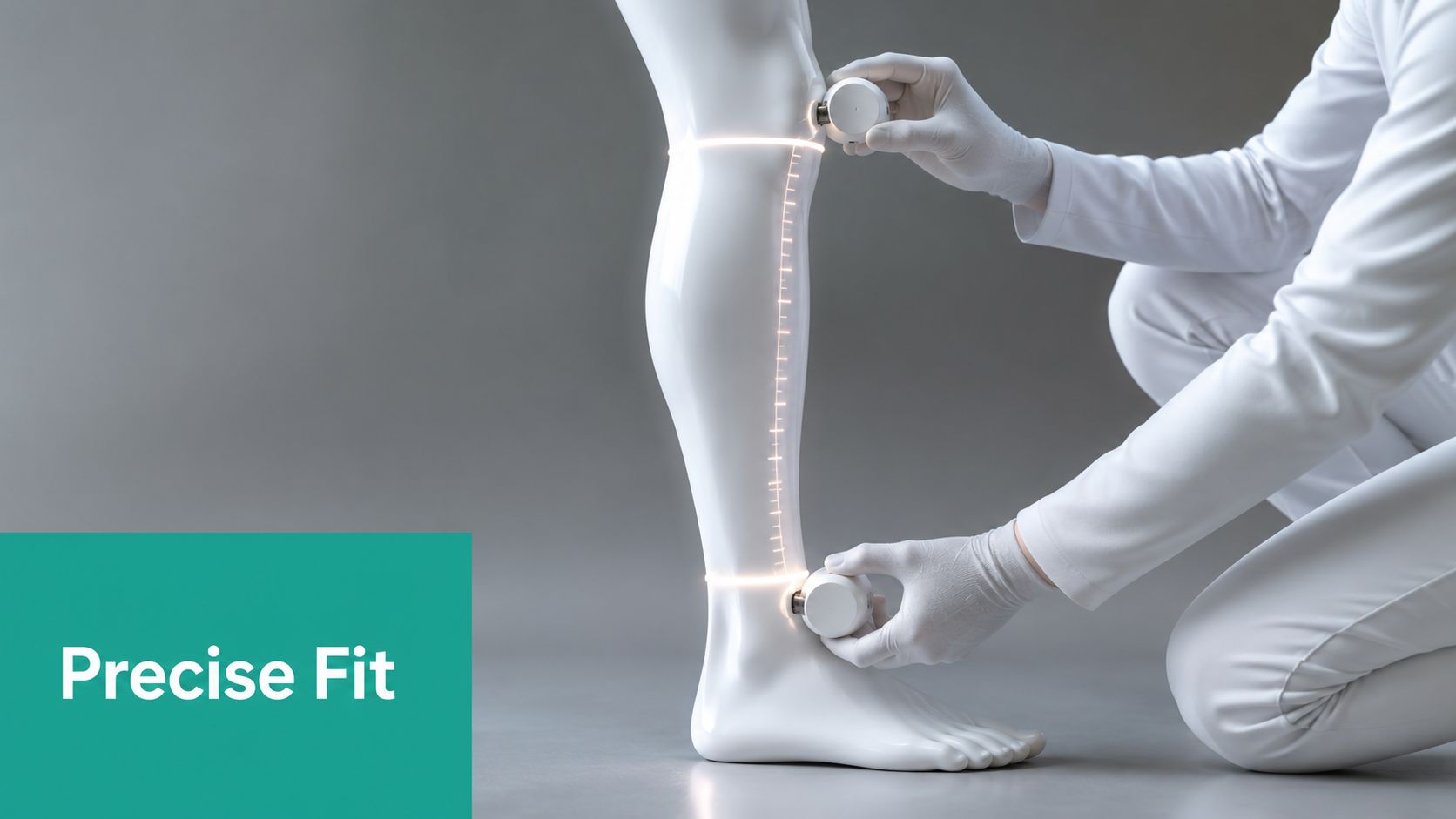
Medical policy sources note that even off-the-shelf garments still require 3 to 5 limb measurements for sizing, while custom garments are used when limb dimensions fall outside standard sizing. The same policy summary also notes that poor fit in irregular limbs can lead to slippage, focal constriction, and poor adherence, problems that can worsen periwound breakdown according to this pressure gradient garment policy document.
Measure the limb you want to treat
If you measure a maximally swollen leg late in the day, you may end up fitting the edema instead of controlling it. That's how you get a garment that slides after morning reduction or binds in the wrong place once the patient starts moving.
My practical sequence is simple:
- Reduce first if needed: If the limb is very edematous, control volume before final measurement.
- Measure when swelling is lower: Earlier in the day or after elevation is usually more reliable than late afternoon.
- Use the same landmarks every time: Be consistent with ankle, calf, and length landmarks.
- Recheck after the wound improves: Limb volume can change enough during treatment to make the first garment obsolete.
Common fitting mistakes
The errors are repetitive. So are the consequences.
- Ignoring limb shape: Post-thrombotic change, obesity, and lymphedema distort contours. Standard sizes may not hold the gradient correctly.
- Accepting top-band rolling: A rolled edge becomes focal pressure. That's not benign on fragile skin.
- Missing foot and heel problems: If the heel cup is wrong or the foot section twists, patients stop wearing the garment.
- Skipping a wear trial discussion: Some patients nod through education and go home unable to don the stocking at all.
Adherence starts with honesty
Patients don't usually reject compression because they don't care. They reject plans that don't fit their hands, schedule, body habitus, pain level, or living situation.
Ask direct questions:
- Can you reach your foot safely?
- Do you live alone?
- Do you have hand pain or weakness?
- Can a caregiver apply the garment correctly?
- What happened the last time you tried stockings?
If the answers are bad, change the plan. A patient in an SNF or home-health setting may do better with a more adjustable compression option than with a tight stocking that nobody can apply consistently.
A stocking that slips, binds, or sits unworn on a dresser isn't conservative care. It's failed care dressed up as a prescription.
For clinics trying to standardize this, build fitting checks into the workflow. Inspect the garment on the limb. Look for bunching, wrinkling, distal crowding, and pressure lines. Then document that the patient or caregiver demonstrated application technique. If they can't do it in clinic, they won't do it at home.
Documentation and Billing for Compression Therapy
If your note is vague, payers will treat the garment like optional comfort wear. That's the billing reality.
Policies often separate gradient support stockings from other compression methods and restrict coverage to specific indications. One payer policy notes that A6531/A6532 stockings are not covered for venous insufficiency without stasis ulcers or for prevention of recurrence after healing, and it may allow no more than four replacements per year according to the BCBSM medical policy on pressure gradient support stockings.

What has to be in the note
A defensible wound note ties the garment to an active, documented medical need. That means the chart should clearly show the venous disease, the wound status, the edema findings, the skin findings, and the treatment plan.
At minimum, document:
- The active diagnosis: Use the appropriate ICD-10-CM code set for the ulcer and venous disease being treated.
- The wound specifics: Location, depth, tissue type, exudate character, and periwound findings.
- Arterial safety assessment: Don't leave perfusion assumptions unstated.
- The exact compression ordered: State the compression class and garment type.
- Why standard sizing is or isn't appropriate: If you need custom, explain the limb morphology.
If you performed debridement, make sure the compression plan and the debridement documentation support the same episode of care. Notes tied to CPT codes 11042 through 11047 should read like they belong to the same patient and same wound reality. Surveyors and auditors notice when the procedure note describes a serious chronic wound but the compression documentation reads like a generic supply request.
Denials are often self-inflicted
The easiest denial is the prevention-only chart. If the note says the ulcer healed and now the patient “would benefit from stockings to avoid recurrence,” some policies won't cover that scenario. The active ulcer and active treatment episode matter.
The second easy denial is poor specificity. “Compression recommended” is weak. “Medical necessity for gradient support stockings due to active venous stasis ulcer with persistent edema despite wound dressings alone” is stronger because it links diagnosis, symptoms, and treatment purpose.
For clinics tightening compliance and data handling around these workflows, the operational side matters too. If your staff is moving wound images, orders, billing records, and signed DME paperwork across multiple systems, a practical overview of Titanium Computing on HIPAA solutions is worth a look.
Write for the claim and the next reviewer
Don't assume the next person understands why the garment is necessary. Spell it out. Document the failed transition from wraps if that happened. Document why lower-level or non-medical garments were inadequate if that is the clinical reality. Document why the patient needs replacement when the prior garments are worn out, stretched, or no longer fit the limb.
A structured workflow helps. Many clinics use templated documentation to avoid missing the same details over and over. If your notes around wound severity, debridement, compression, and medical necessity need tightening, this wound care documentation template is a practical starting point.
EkagraHealth AI helps wound practices turn real bedside care into clean documentation, accurate coding, and billable claims without burying clinicians in after-hours charting. If your team is managing recurrent venous ulcers, compression orders, debridement notes, and payer friction every day, EkagraHealth AI is built for that workflow.
