
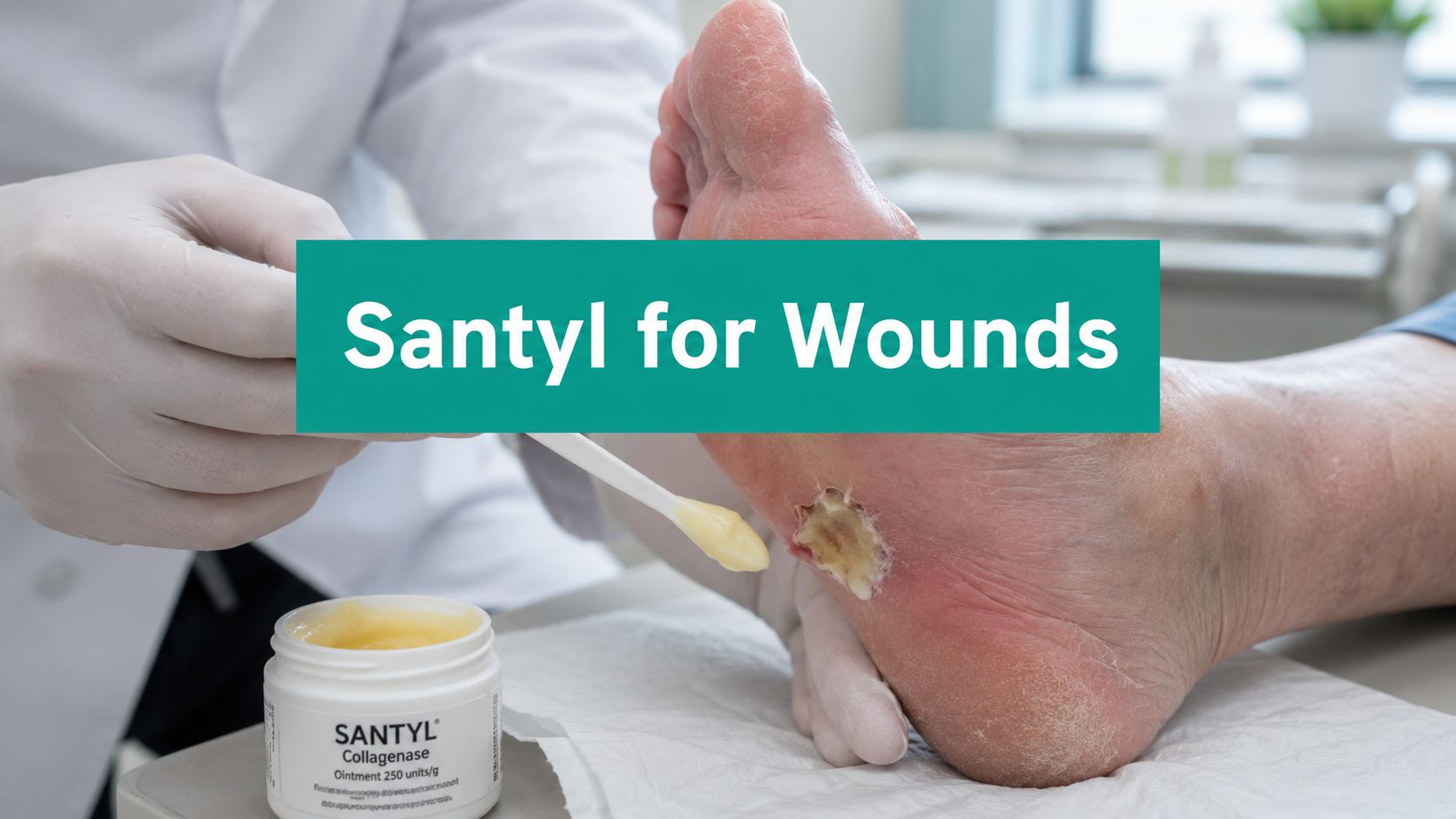
You've got a chronic wound in front of you that has looked basically the same for two or three visits. The base is still coated with yellow slough, the edge isn't advancing, the drainage is manageable, and weekly sharp debridement hasn't fully changed the trajectory. That's the moment when Santyl for wounds becomes either a smart move or an expensive reflex.
Used well, Santyl can help convert a stagnant wound bed into one you can work with. Used badly, it turns into a tube that gets ordered, reapplied, denied, and continued long after the wound no longer needs it. Most of the mistakes aren't pharmacology mistakes. They're selection mistakes, dressing mistakes, and documentation mistakes.
Table of Contents
- The Clinical Case for Enzymatic Debridement
- How Santyl Actually Debrides Necrotic Tissue
- Patient Selection and Appropriate Wound Types
- Application Technique and Dressing Strategy
- Integrating Santyl with Other Debridement Methods
- Monitoring Outcomes and Managing Adverse Events
- Documentation and Coding for Enzymatic Debridement
The Clinical Case for Enzymatic Debridement
The wound that pushes this decision is usually not the dramatic one. It's the one that keeps hanging around. A Wagner 2 diabetic foot ulcer with adherent yellow slough. A stage 3 pressure injury with a necrotic base. A venous ulcer that still has enough fibrinous debris to block meaningful wound-bed preparation.
That's where enzymatic debridement earns its place. Not as a substitute for judgment, and not because every chronic wound needs a prescription ointment, but because some wounds stay stalled when you rely on passive autolysis alone. If you need a quick refresher on what clinicians mean by slough in practical wound terms, this review of slough meaning in medical wound care is useful.
The cost side matters too. A clinical evidence summary reports that early initiation of Santyl was associated with 34% lower all-cause healthcare costs in stage 3 and 4 pressure injuries and 22% lower all-cause costs in diabetic foot ulcers, with per-patient savings of $212 for pressure injury patients and $129 for diabetic foot ulcer patients according to the manufacturer's savings study. In day-to-day practice, that lines up with what many wound teams see. Waiting while necrotic burden sits in place often means more visits, more stalled progress, and more downstream resource use.
Practical rule: If the wound is clearly blocked by necrotic burden and sharp debridement alone isn't enough, delaying treatment usually doesn't save money. It just delays wound-bed preparation.
Santyl for wounds makes the most sense when you're trying to keep momentum between visits, especially in patients who aren't great candidates for aggressive bedside sharp debridement every time.
How Santyl Actually Debrides Necrotic Tissue
Calling Santyl an “enzymatic debrider” is accurate, but it undersells what it's doing. The useful part is its selectivity. Collagenase works by cleaving denatured collagen in necrotic tissue, which is why it helps loosen the slough or eschar that keeps a wound bed stuck.
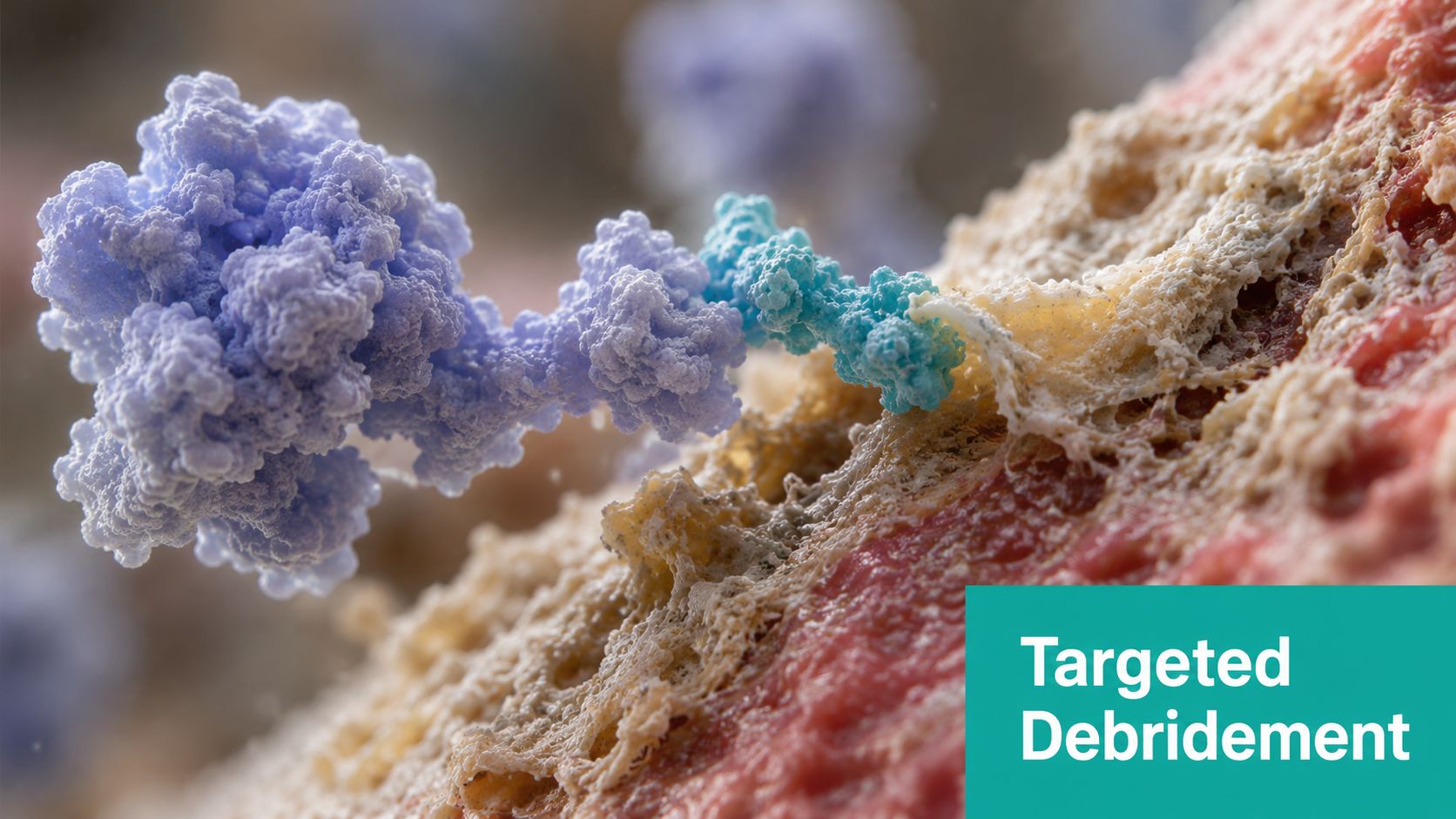
That selective action is the reason it's useful in wounds where you want debridement without repeatedly traumatizing fragile viable tissue. It isn't “melting the wound.” It's targeting the necrotic collagen that anchors devitalized tissue to the surface.
More than surface cleaning
What matters clinically is that debridement changes biology, not just appearance. Independent experimental work found that collagenase Santyl Ointment increased pro-reparative macrophage polarization and decreased pro-inflammatory polarization, and the collagen byproducts generated during debridement recruit fibroblasts, keratinocytes, and endothelial cells, as described in this independent mechanistic study.
That helps explain why a wound can start looking more “ready” after good enzymatic debridement. You're not only reducing necrotic burden. You're shifting the wound environment toward repair.
Why that matters at the bedside
Herein lies the difference between experienced use and rote prescribing:
- If the wound has adherent slough, collagenase can keep working between visits on the material you didn't fully remove with curette or blade.
- If the wound is already beefy red and granular, there's no real target left. Continuing it at that point usually adds cost without adding value.
- If there's thick dry eschar, don't expect topical enzyme to magically penetrate an intact leathery cap. It often needs mechanical help first.
The best results usually come when you use Santyl for the problem it actually solves. Ongoing selective removal of necrotic collagen. Not closure, not epithelialization, and not rescue of a wound that needs a different diagnosis.
Patient Selection and Appropriate Wound Types
Not every chronic wound needs Santyl. In fact, one of the easiest ways to waste money in wound care is to order it for a wound that's already clean.

The basic starting point is straightforward. Santyl is FDA-approved for debriding chronic dermal ulcers and severe burns, and the label specifies that it should be discontinued once debridement of necrotic tissue is complete and granulation tissue is well established, as outlined in the Santyl dosing and coverage guidance.
When it's usually a good fit
Clinically, the strongest candidates are wounds with visible necrotic burden that is delaying progress:
- Diabetic foot ulcers with adherent slough, especially a Wagner 2 wound where depth is present and the bed still isn't clean enough to move forward
- Stage 3 pressure injuries with necrotic or fibrinous tissue over the base
- Venous or varicose ulcers that need selective debridement before you'll get meaningful granulation
- Patients who can't tolerate repeated aggressive sharp debridement because of pain, friability, bleeding risk, or overall frailty
The common thread is simple. There has to be something for collagenase to work on.
When it's a waste of money
There are a few situations where I'd stop or never start:
- A clean granular wound bed. If the wound is already mostly healthy granulation tissue, the therapeutic job is different now.
- A wound that needs urgent bulk removal. Thick unstable necrosis with broader clinical concern usually needs procedural debridement strategy first.
- A wound being treated without a real reassessment plan. Automatic refill culture is how practices burn through authorizations and trigger denials.
Bottom line: Santyl is for the slough and eschar phase. It is not a wound-closure product.
Payers often mirror that clinical reality. The same dosing guidance notes a standard quantity example of 30 g per 30 days, with continued therapy commonly constrained to short authorization windows such as around two months. If your note says the wound is fully granular and you're still renewing the medication, don't be surprised when the claim or prior auth gets challenged.
A simple selection framework
Before prescribing Santyl for wounds, document these four points:
Tissue type
State whether the bed contains adherent slough, soft necrosis, or eschar. Be specific.Why other debridement alone isn't enough
Weekly sharp debridement may still leave residual necrotic collagen between visits.What the treatment goal is
The goal is wound-bed preparation, not closure.What the stop point will be
Once granulation is well established and necrotic tissue is cleared, discontinue.
That last line matters clinically and financially.
Application Technique and Dressing Strategy
Most failures with Santyl for wounds happen because the product never gets a fair chance to work. Either the wound bed wasn't prepared, the ointment was applied poorly, or someone paired it with a dressing that inactivates collagenase.
Prep matters more than people think
Collagenase SANTYL ointment is pH-sensitive, with an optimal range of pH 6 to 8, and its activity can be inhibited by topical agents containing silver, iodine, mercury, or lead, according to the application guidance for collagenase SANTYL ointment.
So the first step isn't grabbing the tube. It's prepping the wound bed.
Use a sensible cleansing routine and remove loose debris so the enzyme can contact the necrotic tissue directly. If a patient comes in with residue from incompatible topical agents or dressings, clean that off thoroughly before application. Otherwise you're asking the enzyme to work in the wrong environment.
How to apply it without wasting it
The recommended application is a layer about the thickness of a nickel directly on the wound surface, and it should be changed daily. More isn't better. Smearing a heavy mound over intact periwound skin doesn't improve debridement. It just increases mess, waste, and skin irritation risk.
A practical routine looks like this:
Cleanse the wound well
Remove old ointment and loose devitalized material at each dressing change.Protect the periwound if needed
If there's drainage or fragile surrounding skin, use a barrier strategy around, not in, the wound bed.Apply Santyl directly to the necrotic tissue
Keep the target in mind. This isn't a broad skin ointment.Choose a secondary dressing based on exudate
The cover dressing should maintain moisture balance without drowning the periwound.Reassess the target tissue regularly
If the necrotic burden is gone, stop.
Don't mix sophisticated debridement logic with sloppy dressing selection. The enzyme can be right and the wound can still fail because moisture control is wrong.
Santyl secondary dressing selection guide
| Exudate Level | Primary Goal | Recommended Dressing Types | Clinical Note |
|---|---|---|---|
| Low | Keep the wound bed moist and maintain contact with the ointment | Gauze or other simple nonadherent cover dressing | Useful when drainage is minimal and the main need is coverage without drying the bed |
| Moderate | Balance moisture while preventing periwound maceration | Foam dressing or absorptive cover dressing | A common choice for chronic ulcers with ongoing drainage |
| Higher drainage | Absorb exudate and protect surrounding skin | More absorptive secondary dressing based on clinic protocol | Recheck often. If the periwound is whitening or breaking down, your cover dressing may be inadequate |
| Fragile periwound with variable drainage | Protect surrounding skin and maintain a workable seal | Secondary dressing chosen for skin protection and gentle removal | In these wounds, dressing trauma can set you back as much as the necrosis itself |
The table is simple on purpose. Dressing strategy should match the wound's moisture profile, not a habit. If exudate shifts, your secondary dressing should shift too.
Integrating Santyl with Other Debridement Methods
Santyl works best when you stop treating debridement methods like rival camps. In actual practice, they're complementary.

If a wound has thick eschar or heavy adherent slough, a single sharp debridement session often won't fully solve the problem. You remove what you can safely remove at the visit, then use Santyl between encounters to continue selective microscopic debridement of residual necrotic collagen.
That's the right mental model. Sharp debridement handles the bulk. Santyl handles what keeps reaccumulating or what remains attached after the procedure.
Where the combination works well
A few common scenarios:
- Cross-hatched or scored dry eschar can allow better topical penetration than an intact hard surface.
- Undermined sloughy wounds often improve when gross debris is reduced first and collagenase then maintains progress between visits.
- Painful or fragile wounds may tolerate selective ongoing enzymatic debridement better than repeated aggressive bedside removal.
Where Santyl shouldn't carry the whole load
If the wound needs fast macroscopic removal of unstable necrotic tissue, enzymatic debridement alone is usually too passive. That doesn't make it wrong. It just means it's the wrong lead tool for that moment.
Use Santyl as part of a sequence, not as a belief system.
I also think Santyl for wounds gets underused in one specific way. Not as a replacement for sharp debridement, but as the bridge between sharp debridements. That's where it often saves time, because it prevents the wound bed from backsliding into the same slough pattern by the next visit.
Monitoring Outcomes and Managing Adverse Events
Once treatment starts, the wound should tell you fairly quickly whether the plan makes sense. You're looking for trend, not perfection.
What progress should look like
The first thing I watch is tissue composition. Less adherent slough. More healthy granulation. Better visibility of the true wound base. Sometimes the dimensions don't change much at first, but the bed quality clearly improves. That still counts as meaningful progress.
For consistent follow-up, your descriptions should stay disciplined. If your team needs a tighter framework for documenting tissue percentages, exudate, and base appearance, this guide to wound bed description is worth keeping handy.
Track the wound the same way each visit:
- Necrotic burden by percent of the wound bed
- Granulation quality including whether it's increasing
- Exudate character such as serous, serosanguineous, or heavier drainage
- Periwound condition including maceration, erythema, callus, or denudement
- Pain and tolerance during dressing changes and debridement
When to troubleshoot and when to stop
If the wound isn't improving, start with the boring questions first because they're often the right ones.
- Is the enzyme being inactivated? Check for incompatible topical agents or dressings.
- Is the ointment reaching the necrotic tissue? Thick crusted eschar may still be blocking contact.
- Is moisture balance off? Too dry and the bed stalls. Too wet and the periwound macerates.
- Is the diagnosis incomplete? Ongoing ischemia, uncontrolled pressure, infection, or edema will defeat any local debridement plan.
Periwound erythema and maceration are usually management problems before they're medication problems. Protect the surrounding skin, tighten dressing selection, and make sure excess ointment is removed at dressing change.
And then stop when it's time to stop. Once the wound has a clean bed with well-established granulation, continuing Santyl out of habit is poor stewardship.
Documentation and Coding for Enzymatic Debridement
The denial usually starts with a chart that says "slough present" and a prescription that keeps getting renewed. Then the payer asks the obvious question: what necrotic tissue was there, why was enzymatic debridement chosen, and why is it still being used?

Santyl can be the right clinical choice and still be poorly supported on paper. That is where practices lose money. Ordering or reapplying Santyl does not, by itself, support debridement CPT codes 11042 to 11047. Those codes are tied to procedural debridement, such as sharp debridement performed and documented at that visit. Enzymatic debridement usually supports the medical necessity for the E/M service, the wound treatment plan, and in some cases the rationale for serial reassessment when bedside sharp debridement is not the whole answer.
The chart has to show more than product use. It has to show clinical reasoning, wound status, and a defined endpoint.
What needs to be in the note
Document the wound so another clinician, auditor, or payer reviewer can follow the decision without guessing.
Include:
Wound diagnosis with specificity
Use the correct diagnosis set, including site, laterality, associated condition, and depth when the code set requires it.Current wound measurements and tissue description
Record length, width, depth, and the wound bed composition. Percent slough, eschar, granulation, and any exposed tendon, fascia, muscle, bone, or hardware should be explicit.Reason for enzymatic debridement
State that Santyl is being used to remove devitalized tissue and advance wound bed preparation. If sharp debridement is deferred, partial, poorly tolerated, or not appropriate at every visit, say that plainly.Dressing plan and frequency
List what is applied with Santyl, how often dressings are changed, and what the patient or caregiver is expected to do at home.Response to treatment
Note whether necrotic burden is decreasing, whether granulation is increasing, and whether the wound is stalled. Continued use without interval reassessment is a common denial setup.Stop criteria
Document when you plan to discontinue Santyl. Once the wound bed is clean and granulating, continuing it without a reason invites payer scrutiny.
If your team needs a cleaner reference for ICD-10 and CPT codes used in wound care documentation, keep one standard close and train to it. Coding errors around debridement are rarely complicated. They are usually the result of vague notes.
Where practices get denied
The same problems show up over and over:
- The wound is described as clean or fully granular, but Santyl is still ordered
- Necrotic tissue is mentioned without a percentage or clear tissue description
- The note never explains why enzymatic debridement was chosen over, or alongside, procedural debridement
- Dispensed quantity does not make sense for wound size, treatment frequency, or duration
- Follow-up notes repeat the medication list but do not reassess the wound
- The diagnosis code lacks enough specificity to support the severity and location being treated
One more point matters in real practice. If a clinician performs sharp debridement that day, document the procedure separately and completely. If the visit is focused on reassessment, dressing management, and continued Santyl use, document that visit for what it is. Trying to force every Santyl follow-up into a procedural coding frame creates avoidable denials.
EkagraHealth AI can help teams draft wound-focused SOAP notes, map CPT and ICD-10 coding, and keep image documentation tied to the written note. That is useful because the billing story falls apart when the wound photo, measurements, and assessment do not match.
Good Santyl documentation is specific and time-bound. Measure the wound. Quantify the necrotic burden. Explain why the enzyme is needed now. State what would make you stop. That level of detail protects both the treatment plan and the claim.
