
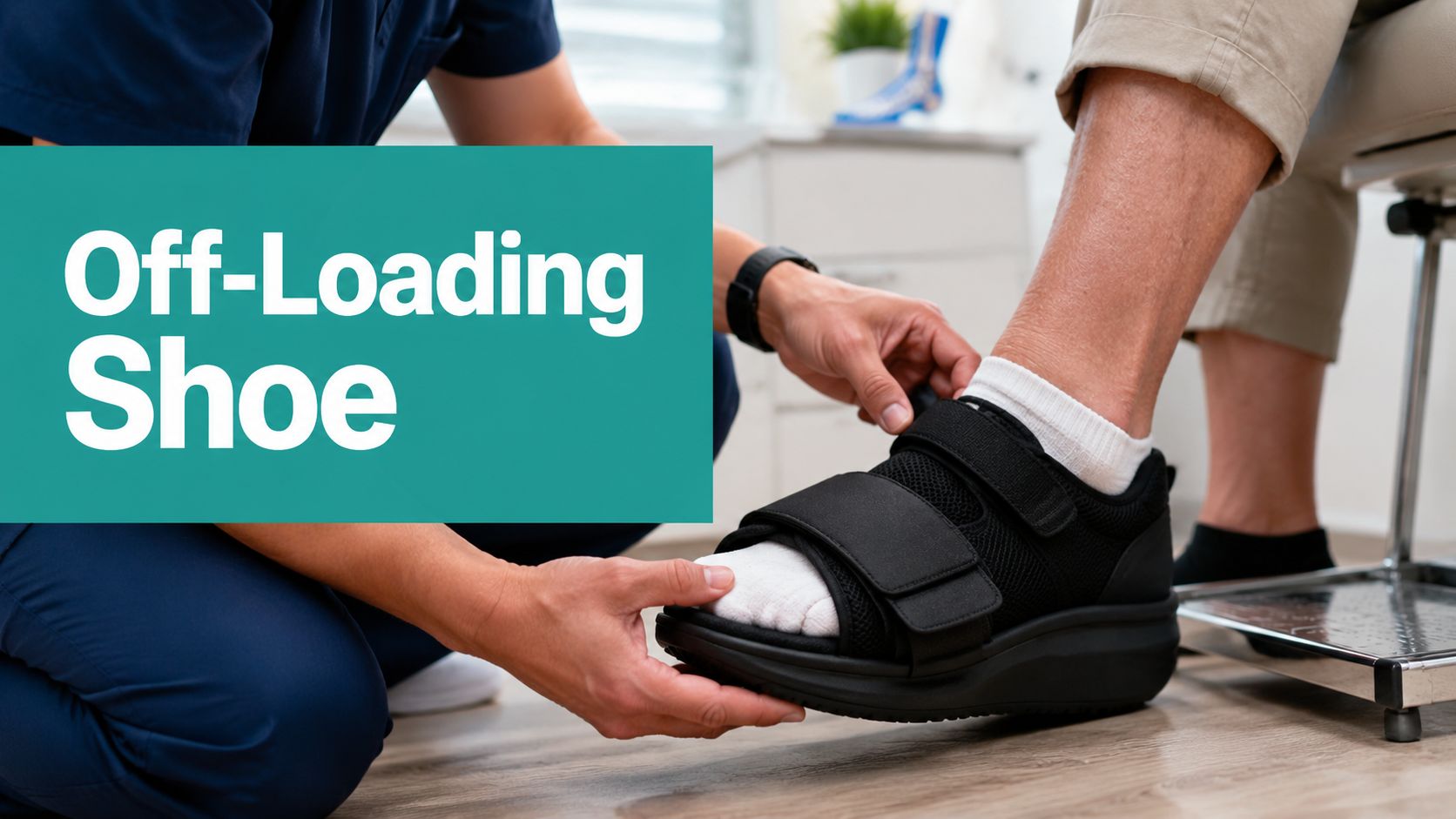
You debrided a plantar forefoot ulcer, built a sensible dressing plan, and the patient still comes back with the wound stalled because the off-loading choice failed in real life. That usually isn't about theory. It's about the wrong device for the wound location, a loose fit, too much dressing bulk, or a patient who only wore the shoe when leaving the house.
An off loading shoe can work well. It can also create transfer pressure, gait instability, and denial-prone documentation if you treat it like a generic post-op item. In clinic, the difference comes down to patient selection, dispensing details, and whether your note makes medical necessity obvious to a payer and defensible to a surveyor.
Table of Contents
- The Off Loading Shoe in Your Clinical Toolkit
- Patient Selection When to Prescribe an Off Loading Shoe
- Fitting and Dispensing for Maximum Efficacy
- Integrating the Shoe with Wound Management
- Documentation and Coding for Off Loading Shoes
- The Clinical Bottom Line
The Off Loading Shoe in Your Clinical Toolkit
The common crossroads is familiar. A patient shows up with a Wagner grade 2 plantar forefoot ulcer after weeks of walking through pain because neuropathy muted the warning signs. You know a more restrictive off-loading approach may reduce pressure more aggressively, but the patient refuses casting, lives alone, or needs frequent dressing access after serial sharp debridement.
That's where the off loading shoe earns its place. Not as a comfort item. Not as a casual substitute. As a calculated choice for the patient who needs forefoot pressure reduction, can ambulate safely enough to use it, and needs a removable option that fits the broader wound plan.
The larger evidence base matters here. Off-loading footwear became a foundational part of wound care and recurrence prevention because therapeutic footwear and insoles reduce relapse compared with regular shoes, which is one reason these devices moved into routine use in wound, podiatry, and vascular practice rather than remaining a niche option, as discussed in the systematic review literature on diabetic foot management.
What the shoe is actually for
Used well, an off loading shoe gives you three practical advantages:
- Forefoot load shift: useful for plantar forefoot wounds after debridement when repetitive pressure is the main barrier to healing.
- Access: you can inspect the wound, adjust dressings, and reassess the periwound without destroying the off-loading plan.
- Bridge therapy: helpful when the patient can't tolerate or won't accept a more restrictive device.
A removable device is only a good choice when the patient will actually remove it for the right reasons and wear it for all weight-bearing.
That last point is what gets missed. The off loading shoe belongs in the same conversation as debridement, moisture control, infection surveillance, and follow-up cadence. It isn't a stand-alone fix. It's part of the treatment architecture you build around the wound.
For clinics trying to standardize that architecture, a broader chronic wound care workflow helps keep the device decision tied to ulcer characteristics, vascular status, and follow-up planning instead of habit.
Patient Selection When to Prescribe an Off Loading Shoe
The biggest mistake is prescribing an off loading shoe because the patient has “a foot wound.” That isn't specific enough. The wound location and the patient's stability determine whether this is a smart choice or a setup for failure.
Where it fits
The best candidate is usually a patient with a plantar forefoot ulcer, often Wagner grade 1 or 2, where pressure at the metatarsal heads or hallux is clearly contributing to delayed healing. This is especially practical after sharp debridement when you need ongoing wound access and don't want bulky immobilization to interfere with dressing changes.
Patients who tend to do well usually have these traits:
- Forefoot target lesion: plantar hallux, plantar metatarsal head, or adjacent forefoot site where shifting load proximally makes biomechanical sense.
- Manageable drainage: low to moderate exudate that can be controlled with a low-profile dressing.
- Reasonable balance: no major gait instability, no severe contralateral pain, and no obvious inability to follow ambulation instructions.
- Follow-up reliability: someone you can reassess frequently enough to catch transfer lesions, slippage, or dressing-related friction.
If the patient also needs long-term pressure redistribution after healing, resources on specialized insoles for diabetes can be useful for the maintenance phase. That's a separate decision from active ulcer off-loading, but the transition matters.
Where it does not
This device is often overused in the wrong scenarios. The critical distinction is whether you're trying to off-load the forefoot, the heel, or a more complex pressure pattern. Clinical resources on offloading devices for pressure injuries make that distinction clear, and it matches what most of us see in practice.
Avoid treating the off loading shoe like a universal answer in these cases:
- Heel ulcers: the mechanics are wrong. A forefoot-focused design can shift pressure somewhere you don't want it.
- Wagner grade 3 or deeper concern: especially when you suspect osteomyelitis, deeper space infection, or need more aggressive immobilization and infection management.
- Heavy exudate: if the wound is going to saturate dressings and macerate the periwound in a closed device, solve that first or choose another strategy.
- Significant PAD: pressure relief alone doesn't fix ischemia.
- High fall risk: poor balance, contralateral limb disease, neuropathic gait instability, or severe knee and hip issues can turn the device into a mobility hazard.
Off-Loading Modality Comparison
| Modality | Pressure Relief | Wound Access | Adherence | Fall Risk |
|---|---|---|---|---|
| Off loading shoe | Good for selected plantar forefoot wounds when fit correctly | Excellent | Highly dependent on patient use during all weight-bearing | Moderate, especially with gait instability |
| Total contact cast | Often strongest pressure control in appropriate patients | Limited once applied | Less dependent on daily patient choice | Present, but gait is usually more controlled than with inconsistent removable use |
| Removable cast walker | Strong option when tolerated and worn consistently | Good | Also highly adherence-dependent | Moderate to high depending on bulk, balance, and contralateral limb issues |
Clinical filter: If the main problem is forefoot plantar stress and the patient can use a removable device correctly, an off loading shoe is reasonable. If the main problem is infection, ischemia, heel pressure, or unsafe gait, it isn't.
Fitting and Dispensing for Maximum Efficacy
A poorly fitted off loading shoe doesn't just underperform. It can redirect pressure, create toe trauma, and give you a false sense that the wound has been off-loaded when it hasn't.
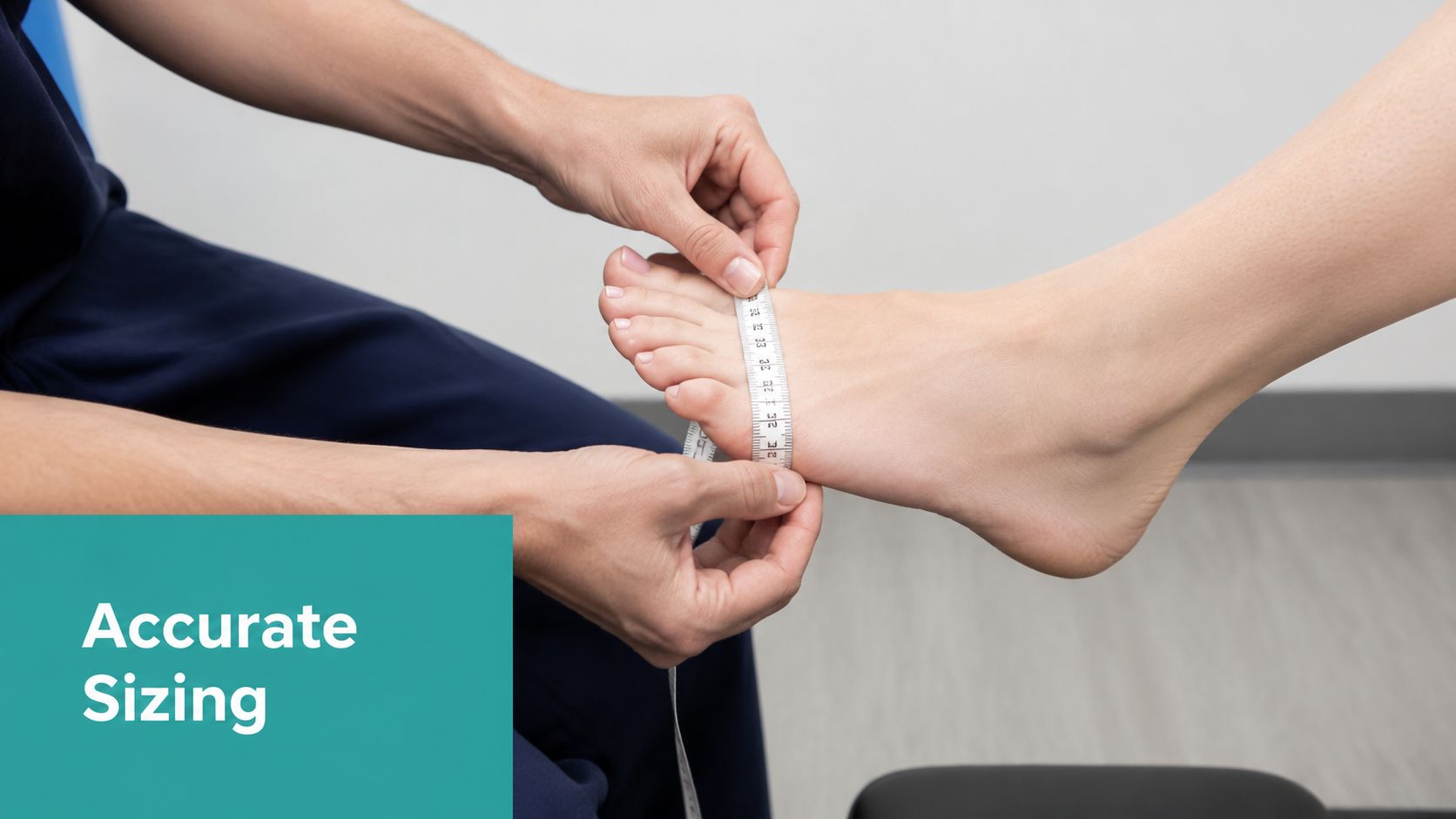
Fit the foot, then accommodate the dressing
Start with the foot. Then account for the dressing. Don't size primarily to the dressing bulk if it means the foot can slide forward. In gait-lab testing, this shoe design has been reported to lower metatarsal head pressure by 57% and hallux pressure by 75%, and the protective square-toe bumper also matters for distal toe safety, according to this discussion of forefoot off-loading mechanics and fit failure.
The same source highlights the most common failure mode. Slippage. If the ankle strap is loose and the foot migrates forward, the patient effectively falls into the front of the shoe and loses the off-loading effect.
My fitting sequence is simple:
- Seat the heel all the way back. If the calcaneus isn't firmly positioned from the start, everything that follows is compromised.
- Secure the ankle and midfoot. Snug enough to prevent migration, not so tight that you create edge pressure or impair tolerance.
- Check toe clearance. The forefoot needs room, but not enough room for forward travel.
- Walk the patient immediately. A static fit check isn't enough. Off-loading happens during gait.
What to check before the patient leaves
After the first few steps, look for the details that predict trouble:
- Forward drift: the foot should stay back in the heel cup.
- Instability: short, cautious steps are expected at first. Repeated wobble isn't.
- Dressing interference: if the dressing bunches, wrinkles, or lifts, you'll get friction where you don't want it.
- New pressure areas: inspect the dorsal toes, lateral forefoot, and plantar midfoot if the patient reports rubbing.
Use plain instructions. Patients remember plain instructions.
- Wear it for every step. Bed to bathroom counts.
- Take short, steady steps. No rushing, no uneven ground if it can be avoided.
- Don't drive in it. The gait mechanics are altered.
- Use a balancing approach on the opposite side when needed. If limb-length mismatch is obvious, address it early or the patient will develop hip, knee, or back complaints and stop wearing the device.
If the patient says, “It feels loose but comfortable,” fix the fit before they leave. Loose is not a success state.
Integrating the Shoe with Wound Management
Dispensing the shoe is when critical management starts. If the dressing plan, debridement schedule, and patient instructions don't match the device, the off-loading strategy breaks down fast.
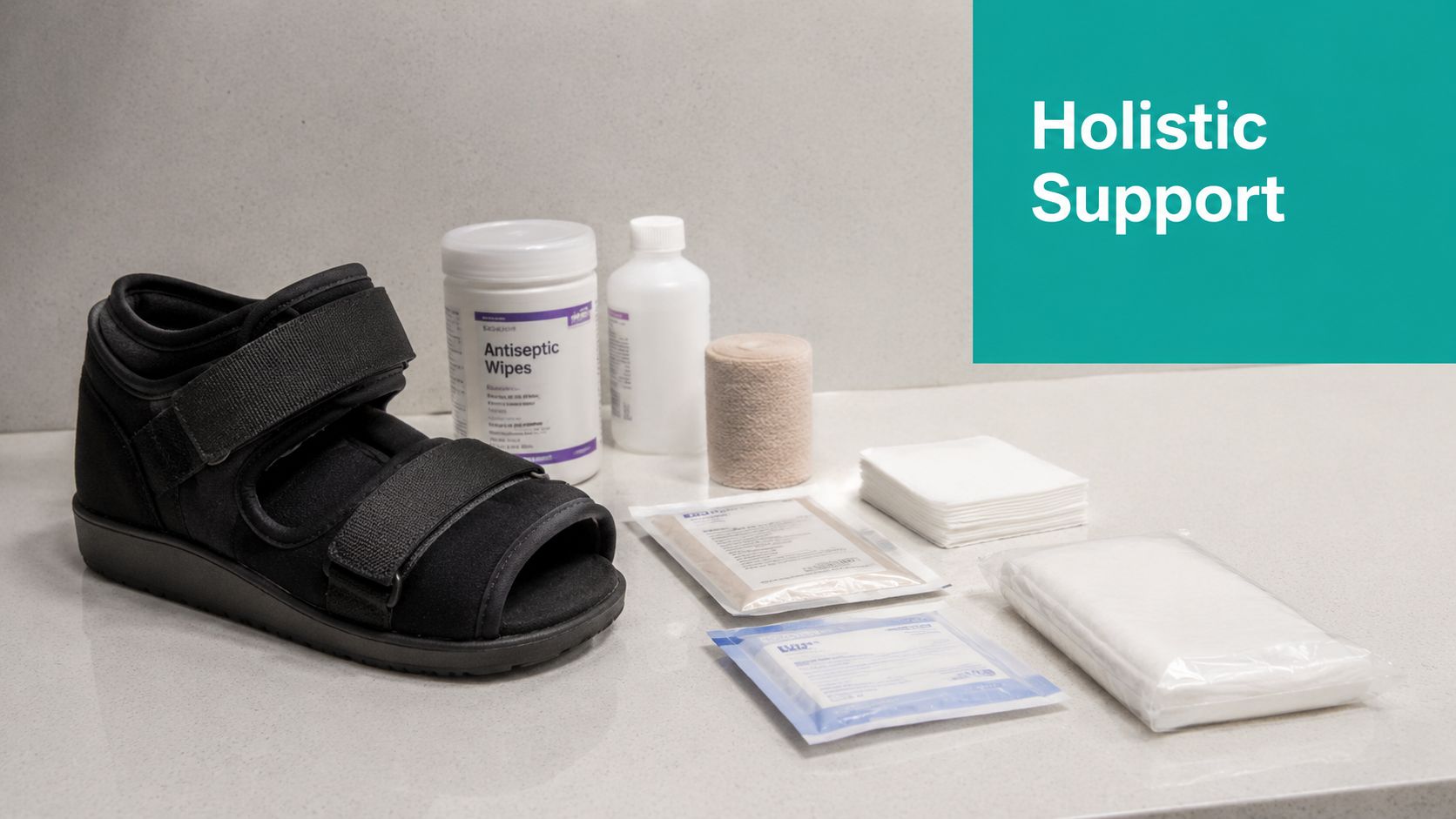
Dressings that help instead of sabotage
For an off loading shoe, lower profile usually wins. You need a dressing that manages exudate without creating bulk that changes fit and shifts contact points. That often means thinking harder about volume and edge control than about absorbency alone.
A few practical rules:
- Keep the plantar surface smooth: wrinkles and stacked layers become friction points inside the shoe.
- Match dressing depth to exudate reality: if exudate is moderate, choose absorbency that handles it without overbuilding the plantar contour.
- Watch the periwound closely: maceration inside a closed device can widen the problem even when the wound bed itself looks cleaner.
- Reassess after debridement: post-debridement changes in depth, bleeding, and dressing thickness can alter fit enough to matter.
If you're doing serial debridement and billing CPT 11042 to 11047 where appropriate, document how the off-loading plan supports the post-debridement healing environment. Surveyors and payers like to see the treatment pieces connect.
Adherence problems show up as wound problems
Most articles stop at “reduces pressure.” Real life is messier. Public clinical discussion has pointed out that offloading footwear changes posture and gait, and one small clinical series found that all ulcers healed with a forefoot offloading device but secondary ulcers and a plantar hematoma still occurred, as summarized in this discussion of real-world offloading tradeoffs.
That lines up with what many clinics see. The issue isn't just whether pressure is reduced. It's whether the patient can live in the device safely for weeks.
When a patient says they wear it “most of the time,” translate that as a wound risk until proven otherwise.
- At home nonadherence: many patients skip the device indoors because the distance feels short.
- Workplace nonadherence: some stop wearing it because it slows them down or feels unsafe on uneven surfaces.
- Pain improvement: once discomfort decreases, adherence often drops before the tissue has recovered.
Healing can continue while a complication is developing somewhere else on the foot. Check the whole foot, not just the primary ulcer.
During follow-up, ask operational questions instead of yes-or-no questions. Ask what they wear from bed to bathroom. Ask what happens at work. Ask whether stairs, gravel, or driving changed their use. Those answers are more useful than “yes, I'm wearing it.”
For clinics building a standardized diabetic wound pathway, this broader diabetic foot ulcer management resource is a useful reference point for connecting off-loading with debridement, moisture balance, and infection surveillance.
Documentation and Coding for Off Loading Shoes
Most denials aren't caused by the device. They're caused by vague charting. If your note reads like you dispensed a generic post-op shoe for comfort, expect trouble. The record has to show that the off loading shoe was selected to treat a specific wound problem with a specific pressure-reduction goal.

Forefoot off-loading shoes are a core intervention in diabetic foot ulcer management because reducing plantar pressure supports healing. For a Wagner grade 1 or 2 plantar forefoot ulcer, the device choice is part of medical necessity, not a cosmetic preference, as outlined in this review of off-loading in diabetic foot ulcer care.
What has to be in the note
For DME claims involving HCPCS L3260, make your SOAP note do the work up front.
Document these elements every time:
- Exact ulcer location: left plantar second metatarsal head is better than “foot ulcer.”
- Wagner grade: don't leave depth and severity implied.
- Measurements and tissue description: dimensions, wound bed, exudate type and amount, periwound findings.
- Why this modality was chosen: removable access, forefoot target, patient-specific reason a different modality wasn't used.
- How it was dispensed: size, fit assessment, gait instruction, wear instructions, follow-up plan.
- Risk discussion: instability precautions, adherence counseling, signs that trigger urgent reassessment.
If you want cleaner point-of-care capture, process thinking from Superdocu's automation guide is useful. The principle is simple. Standardize repetitive documentation steps so clinicians don't omit the details that later become denial reasons.
Weak documentation versus defensible documentation
Weak note:
Diabetic foot ulcer. Off-loading shoe given. Follow up next week.
That note tells a payer almost nothing. It doesn't identify the target lesion, the mechanical reason for the device, or the education provided.
Stronger note:
Left plantar forefoot ulcer over second metatarsal head, Wagner grade 2, sharply debrided today. Wound measures X cm x X cm x X cm after debridement, with granulation tissue and moderate serosanguinous exudate, periwound callus and mild maceration. Off loading shoe dispensed to reduce plantar pressure at the ulcer site during ambulation because wound location is plantar forefoot and patient requires removable access for dressing changes. Fit verified with heel seated fully posterior, secure ankle closure, no forward migration during in-clinic ambulation. Patient instructed to wear device for all weight-bearing, use short stable steps, monitor for rubbing or instability, and return sooner for drainage increase, new blistering, or worsening pain.
That language ties the device directly to the treatment plan. It also shows clinical judgment, dispensing work, and education.
Coding and denial prevention
Use the ICD-10-CM code set with full specificity for the diabetic ulcer diagnosis, laterality, and depth description that matches your documented wound status. If the record and diagnosis specificity don't match, the claim weakens before anyone reads your assessment.
Common denial triggers include:
- Not medically necessary: your note doesn't connect the off loading shoe to plantar pressure reduction for the documented ulcer location.
- Incomplete documentation: no Wagner grade, no wound measurements, no laterality, or no dispensing details.
- Diagnosis mismatch: the diagnosis code lacks specificity or doesn't support the wound described in the note.
- No conservative treatment context: payers often want to see the device as part of an active ulcer treatment plan, not a standalone supply.
A few habits reduce rework:
- State the purpose plainly: “dispensed to reduce plantar pressure on the left plantar forefoot ulcer during ambulation.”
- Document wound access needs: especially if removable access is part of why the device was selected.
- Record patient instruction: surveyors notice whether education is specific or generic.
- Note reassessment timing: follow-up isn't a formality with these devices. It's part of safe use.
For teams that want a diagnosis reference organized around diabetic ulcer specificity, this diabetic foot ulcer ICD-10 resource can help tighten coding alignment with the wound note.
The Clinical Bottom Line
An off loading shoe is a specific instrument. Use it like one. The best results come when the wound is plantar forefoot, the patient is stable enough to walk in it, the dressing doesn't sabotage the fit, and your follow-up is close enough to catch trouble early.
The mechanics matter, but implementation matters more. A wedge geometry of about 15 degrees is meant to shift weight away from the forefoot, yet the bigger failure point in practice is adherence. Once pain improves, many patients wear the device less, which is why this modality should be treated as a temporary bridge rather than a cure by itself, as noted in this discussion of wedge geometry, gait tradeoffs, and adherence limits.
What usually works
- Careful patient selection: plantar forefoot ulcer, manageable drainage, acceptable balance.
- Meticulous dispensing: heel seated back, closure secure, gait checked before discharge.
- Direct education: every step means every step.
- Frequent reassessment: fit changes when edema, dressings, or wound depth change.
What usually fails
- Using it for the wrong wound: heel ulcers and deeper infected wounds need a different plan.
- Ignoring gait risk: patients with contralateral disease or instability often stop using the device or fall.
- Bulky dressings: too much plantar bulk ruins off-loading and creates friction.
- Lazy charting: “post-op shoe dispensed” invites denial and doesn't reflect the clinical work.
The shoe is the easy part. The follow-up is where you save the wound.
If I had to reduce this to one practical rule, it would be this: don't judge the off loading shoe by how it looks in the room. Judge it by what the patient can safely do in it over the next week, and by whether your note proves exactly why it was necessary.
If your team is spending too much time documenting wound visits and still fighting denials, EkagraHealth AI is built for that exact problem. It helps wound practices capture the visit, draft the SOAP note, map CPT and ICD-10 coding, and move cleaner claims out the door so clinicians can spend more time treating patients and less time chasing chart corrections.
