
If you want to get paid correctly in healthcare, you have to master two distinct "languages": ICD-10 and CPT codes. Think of it this way: ICD-10 codes explain why the patient is there (the diagnosis), while CPT codes describe what you actually did for them (the procedure).
Getting this “why vs. what” relationship right is the absolute cornerstone of clean claims and a healthy revenue cycle. In this comprehensive guide, we'll dive deep into the nuances of these code sets, exploring how they connect, what the upcoming 2026 updates mean for your practice, and how to apply them with precision in your daily workflow. We'll also examine the role of emerging technologies like AI in revolutionizing this critical aspect of healthcare administration, ensuring your practice is prepared for the future.
The Core of Medical Billing: ICD-10 and CPT Codes
Diving into medical billing can feel overwhelming, but it all boils down to these two interconnected code sets. They’re the shared vocabulary that lets clinicians, billers, and insurance payers all speak the same language. Without a solid understanding of how they work together, your practice is setting itself up for denials, compliance headaches, and, ultimately, lost revenue. The complexity and sheer volume of these codes underscore why a deep understanding is not just beneficial but essential for financial stability and operational efficiency.
What’s the Story Behind Each Code?
The International Classification of Diseases, 10th Revision (ICD-10) is managed globally by the World Health Organization (WHO). Its entire purpose is to classify diseases and injuries with a high level of detail. In wound care, this is the difference between coding for a simple cut versus a chronic, non-healing diabetic foot ulcer—two very different clinical stories with vastly different implications for treatment and reimbursement. The granularity of ICD-10 allows for precise documentation of a patient's condition, which is the first step in justifying the care provided.
Then you have Current Procedural Terminology (CPT) codes. Maintained by the American Medical Association (AMA), these codes detail the services you perform. They answer the payer’s question: "What did the provider do during this visit?" This could be anything from a new patient evaluation to a complex surgical debridement. CPT codes are the action-oriented part of the billing narrative, translating clinical work into a billable service.
I like to use a simple analogy: The ICD-10 code is the diagnosis—the "illness" we're treating, like a pressure ulcer. The CPT code is the "medicine" or action we took—the procedure, like wound debridement. You can't justify the medicine without first identifying the illness.
These code sets provide the essential structure for the entire healthcare services industry, creating a universal standard for both documentation and billing. Every detail matters. For a deeper dive into the specifics of billing, our guide on Medicare billing units is a great resource.
To make it even clearer, here’s a quick side-by-side comparison that your team can use as a handy reference. This table encapsulates the fundamental differences and respective roles of each code set, providing a foundational understanding for anyone involved in the revenue cycle.
ICD-10 vs CPT Codes At a Glance
| Attribute | ICD-10 Codes | CPT Codes |
|---|---|---|
| Primary Purpose | Communicates the patient's diagnosis or condition ("Why") | Describes the medical service or procedure performed ("What") |
| Governing Body | World Health Organization (WHO) | American Medical Association (AMA) |
| Code Structure | 3-7 alphanumeric characters | 5 characters (mostly numeric) |
| When It's Applied | Primarily at initial evaluation to establish a diagnosis | During every treatment session to document services |
| Role in Billing | Establishes medical necessity for the services | Determines the reimbursement rate for the service |
In short, the ICD-10 code proves the service was medically necessary, while the CPT code tells the payer what service to pay you for. You absolutely need both, and they must paint a logical, consistent picture of the patient encounter. The synergy between these two code sets is non-negotiable for successful claim submission. A claim lacking this synergy is almost guaranteed to be rejected, leading to rework and delayed payments.
Connecting Diagnosis and Procedure for Medical Necessity

When you submit a claim, the ICD-10 and CPT codes have to tell a complete and logical story. The diagnosis (ICD-10) sets the stage, and the procedure (CPT) is the action that follows. This critical connection is what we call medical necessity.
At its core, medical necessity is your proof that the service you provided was reasonable and appropriate for the patient’s condition. If that link is broken or unclear, payers have every reason to deny the claim. This concept is the gatekeeper of reimbursement, determining whether your clinical efforts translate into financial compensation. Without establishing clear medical necessity, even the most expertly performed procedure will not be paid for.
Building a Defensible Narrative
Think of it this way: the ICD-10 code is the why, and the CPT code is the what. When a payer’s automated review system (or a human auditor) looks at your claim, it's asking one simple question: Does what you did make sense, given why you did it?
Any mismatch sends up an immediate red flag. The logic must be flawless. For example, a diagnosis of a minor skin irritation cannot justify a major surgical procedure. The payer's algorithms are specifically designed to detect such inconsistencies, flagging them for further review or outright denial.
The relationship between ICD-10 and CPT codes is the absolute foundation of successful billing. One code establishes the medical problem; the other details your clinical solution. If they don't align, you’re looking at a near-certain denial.
For example, billing for a complex surgical debridement (a high-value CPT code) when the diagnosis is just a simple abrasion (a low-acuity ICD-10 code) just doesn't add up. The story is inconsistent, and the claim will bounce right back. This not only delays payment but also increases audit risk, potentially leading to more extensive scrutiny of your practice's billing patterns.
Real-World Scenarios in Wound Care
Let's walk through how this plays out in a busy wound care clinic. A patient comes in with a diabetic foot ulcer—a situation we all see constantly. This common scenario provides a perfect illustration of how correct code pairing is crucial.
- The Diagnosis (The Why): After a thorough exam, you land on the ICD-10 code E11.621, Type 2 diabetes mellitus with foot ulcer. This single code tells the payer a lot about the patient's systemic disease and the severity of the wound. It establishes a high-risk context.
- The Procedure (The What): The ulcer has non-viable tissue, so you perform a debridement down to the subcutaneous layer. This action corresponds with CPT code 11042, Debridement, subcutaneous tissue.
Here, the why perfectly justifies the what. A serious diabetic foot ulcer absolutely warrants a debridement. This pairing creates a complete, defensible narrative that sails through the validation process. To see more detailed breakdowns, you can explore our guide on the ICD-10 code for diabetic foot infection. This example highlights the importance of not only choosing the right codes but also ensuring the clinical documentation supports this choice.
Why Specificity Is Your Best Defense
This is where many practices leave money on the table. Choosing a vague or "unspecified" diagnosis code is one of the easiest ways to trigger a denial because it fails to build a strong case for your services. The era of "good enough" coding is over; payers now demand precision.
Just look at the difference between these two coding choices for a lower leg ulcer:
- Vague Coding:
L97.909– Non-pressure chronic ulcer of unspecified part of unspecified lower leg, unspecified severity. - Specific Coding:
L97.523– Non-pressure chronic ulcer of other part of left foot with necrosis of muscle.
The first code tells the payer almost nothing. It lacks laterality, specific location, and severity, making it impossible to assess medical necessity. But the second one? It paints a crystal-clear picture: the exact location (left foot), the tissue involvement (necrosis of muscle), and the chronic nature of the wound. This level of detail provides irrefutable support for a more intensive and higher-reimbursement procedure. It tells a story that justifies the clinical intervention.
Proper coding isn't just about plugging in numbers. It's about building a coherent story that gets you paid correctly and holds up under scrutiny. It is an exercise in clinical and administrative precision, where every character in a code can have significant financial and compliance implications.
What to Know About the 2026 Coding Updates
Medical coding never stands still. Every year, it shifts to keep pace with new diseases, better technology, and a deeper understanding of clinical realities. For any practice, staying on top of these changes is non-negotiable for compliance and getting paid correctly. The updates to ICD-10 and CPT codes for 2026 are especially important, bringing in new layers of detail that are critical for providing—and billing for—comprehensive patient care.
If your practice handles wound management, think of these updates as more than just a new set of rules. They’re a real chance to finally capture all the revenue you've earned and to paint a precise picture of patient care that payers are now demanding. Falling behind isn't an option; it can lead straight to claim denials, compliance headaches, and a tangled mess that gets in the way of both patient outcomes and your bottom line. Proactive education and system updates are essential to navigate these changes successfully.
Key ICD-10-CM Changes for 2026
The yearly updates to the ICD-10-CM codebook are a direct reflection of what's happening in healthcare. For 2026, the focus is really on capturing the whole patient story, especially the factors that go hand-in-hand with chronic wounds and can make or break healing. This holistic approach is becoming increasingly important in a value-based care environment.
One of the biggest shifts is the expansion of codes for conditions often seen alongside chronic wounds. Think of it this way: new, more specific codes for certain vascular diseases or metabolic disorders let you clearly justify why a patient needs advanced wound therapies. It helps you connect the dots for the insurance company, showing how a systemic problem requires a specific local treatment.
We're also seeing a major expansion of Z-codes, which are used to document factors that influence a patient's health but aren't diseases themselves. These codes are moving from the periphery to the core of comprehensive patient documentation.
The upcoming Z-code additions for Social Determinants of Health (SDoH) are a game-changer. For the first time, we can systematically code for factors like housing instability, food insecurity, and transportation challenges—all of which directly impact a patient's ability to heal.
Documenting SDoH creates a much richer clinical narrative. It helps explain why a wound might be healing slowly and justifies a more intensive or extended care plan. This kind of detail is quickly becoming a must-have, especially in value-based care models where outcomes are directly linked to payment.
To give you a clearer picture, here’s a quick summary of some of the most notable changes coming in 2026 that will directly affect wound care specialists. This table provides a snapshot of the evolution in coding philosophy.
Key 2026 Code Changes for Wound Care
| Code Set | Type of Change | Example/Area of Impact | Relevance to Wound Care |
|---|---|---|---|
| ICD-10 | New Codes | Expanded codes for Social Determinants of Health (SDoH) like homelessness or food insecurity. | Justifies medical necessity for extended care plans when social factors impede healing. |
| ICD-10 | Code Revisions | Greater specificity for non-pressure chronic ulcers of the lower limb (e.g., L97 series). | Allows for more precise documentation of wound severity, location, and laterality, improving reimbursement accuracy. |
| CPT | New Codes | New codes for Remote Patient Monitoring (RPM) for physiologic data (e.g., glucose, BP). | Enables billing for monitoring diabetic or venous ulcer patients remotely, improving proactive management. |
| CPT | Code Revisions | Updated guidelines for telehealth services, clarifying synchronous vs. asynchronous care. | Supports billing for virtual check-ins and store-and-forward image reviews, making remote wound assessment viable. |
These updates underscore the industry's move toward more holistic and precise documentation, directly linking clinical detail to reimbursement. They are a clear signal that the future of medical billing is data-driven and patient-centric.
CPT Code Updates Reflecting Digital Health
On the procedure side of things, the 2026 CPT code updates are clearly shaped by the ongoing rise of digital health. New and revised codes are coming that finally give practices a way to bill for remote patient monitoring (RPM) and other telehealth services, which are quickly becoming essential tools in modern wound care.
These new CPT codes will let you bill for activities like:
- Remote monitoring of physiologic parameters, such as tracking a patient's blood sugar or blood pressure—both critical for managing those with diabetic or venous ulcers.
- Asynchronous communication, which covers situations where a patient sends an image of their wound for a clinician to review later, outside of a live appointment.
- Virtual check-ins that help you manage patient concerns and tweak care plans without the need for a full in-person office visit.
The American Medical Association (AMA) is sending a clear message with these codes: remote care is a valid and reimbursable part of the patient journey. As medical coding adapts to new rules and tools, it's also helpful to understand how the entire ecosystem of medical documentation is changing, including the medical transcriptionists' evolving role, which provides important context for these 2026 updates.
The 2026 ICD-10-CM code set, which became effective October 1, 2025, marks one of the biggest updates we've seen in a while. It introduces 614 new codes, 28 deletions, and 38 revisions. For wound care, these changes are incredibly important because they expand on codes you use every day, including major revisions for non-pressure ulcers. Practices that don't get up to speed on these new codes are risking compliance issues and a spike in claim denials. You can get the details on these 2026 updates and their impact. Mastering these changes early will give practices a significant competitive and financial advantage.
Applying ICD-10 and CPT Codes in Your Daily Practice

Knowing the difference between ICD-10 and CPT codes is one thing, but applying them correctly under the pressure of a packed clinic schedule is where it really counts. Think of your coding as telling the complete story of a patient's visit. A clear, specific story gets your claim paid. A vague or mismatched one is an open invitation for a denial. This is where theoretical knowledge must translate into flawless practical application.
The goal is to pair the why (the diagnosis) with the what (the procedure) with airtight precision. Let's walk through how this works in a couple of common wound care situations. These examples provide a blueprint for accurate coding in real-world clinical encounters.
Scenario 1: A Pressure Injury with Debridement
Imagine a patient comes in with a stage 3 pressure ulcer on their sacrum. You can see necrotic tissue in the wound bed, and you know it has to be removed for the wound to heal. Your documentation and coding need to capture every one of those details.
- The Diagnosis (Why): You’ve identified the location and severity, which points directly to the ICD-10 code L89.153 – Pressure ulcer of sacral region, stage 3. This single code tells the payer exactly what’s wrong: the wound's cause, its specific location, and how advanced it is.
- The Procedure (What): To treat it, you perform an excisional debridement, removing the dead subcutaneous tissue. This service lines up perfectly with CPT code 11042 – Debridement, subcutaneous tissue (includes epidermis and dermis, if performed); first 20 sq cm or less.
In this scenario, the L89.153 diagnosis provides a clear and undeniable medical necessity for the 11042 procedure. There's no room for interpretation, which is exactly what you want. The codes work in perfect harmony to communicate the full clinical picture.
Why Unspecified Codes Are a Red Flag
Now, let's see what happens when things go wrong. What if, for that same patient, the clinician had used a generic code like L89.90 – Pressure ulcer of unspecified site, unspecified stage? That claim would almost certainly get flagged for review or just flat-out denied.
An unspecified diagnosis code is the coding equivalent of shrugging your shoulders and telling the payer, "I'm not sure what's wrong." It completely fails to provide the concrete justification they need to pay for a procedure. Specificity is your best defense against denials.
Payers use automated systems that are built to catch these weak links. A vague diagnosis simply doesn't support the medical necessity for a specific procedure like debridement, putting your revenue at serious risk. This is not just a matter of losing revenue on one claim; repeated use of unspecified codes can trigger a broader audit of the practice.
Scenario 2: A Diabetic Foot Ulcer with Complex Factors
Let’s look at a more complex case. A patient with Type 2 diabetes has a non-healing ulcer on their right heel, and it’s deep enough that you can see exposed muscle. To make matters worse, their glycemic control is poor.
This situation requires you to layer codes to paint the full clinical picture. It is a multi-faceted clinical problem that requires multi-faceted coding.
- Primary Diagnosis: E11.621 – Type 2 diabetes mellitus with foot ulcer. This is the foundation, establishing the underlying systemic disease that’s causing the wound.
- Secondary Diagnosis: L97.414 – Non-pressure chronic ulcer of right heel and midfoot with necrosis of muscle. This adds the critical details about the wound's location, severity, and depth.
- The Procedure: Because the debridement had to go down to the muscle, you can support CPT code 11043 – Debridement, muscle and/or fascia (includes epidermis, dermis, and subcutaneous tissue, if performed); first 20 sq cm or less.
This combination of codes creates a rich, defensible story for the payer. The E11.621 code gives the systemic context, L97.414 confirms the wound’s severity, and together, they provide undeniable justification for the more intensive CPT code 11043. It’s this level of detail that ensures you get properly reimbursed for complex care. This demonstrates how a skilled coder can use multiple codes to construct a narrative that accurately reflects the complexity of the patient's condition and the services rendered.
As medicine evolves, so do the codes. The American Medical Association recently issued its CPT 2026 code set, which includes 288 new codes for new and updated services. For wound care, some of the most relevant additions are codes for digital health services like remote patient monitoring, reflecting the growing role of telehealth in managing chronic wounds. You can explore the full CPT 2026 update from the AMA to see what's new. This is a perfect example of why staying current is non-negotiable for accurate billing and reimbursement. Continuous education is not just a best practice; it's a requirement for survival in the modern healthcare landscape.
How AI Is Modernizing Wound Care Coding
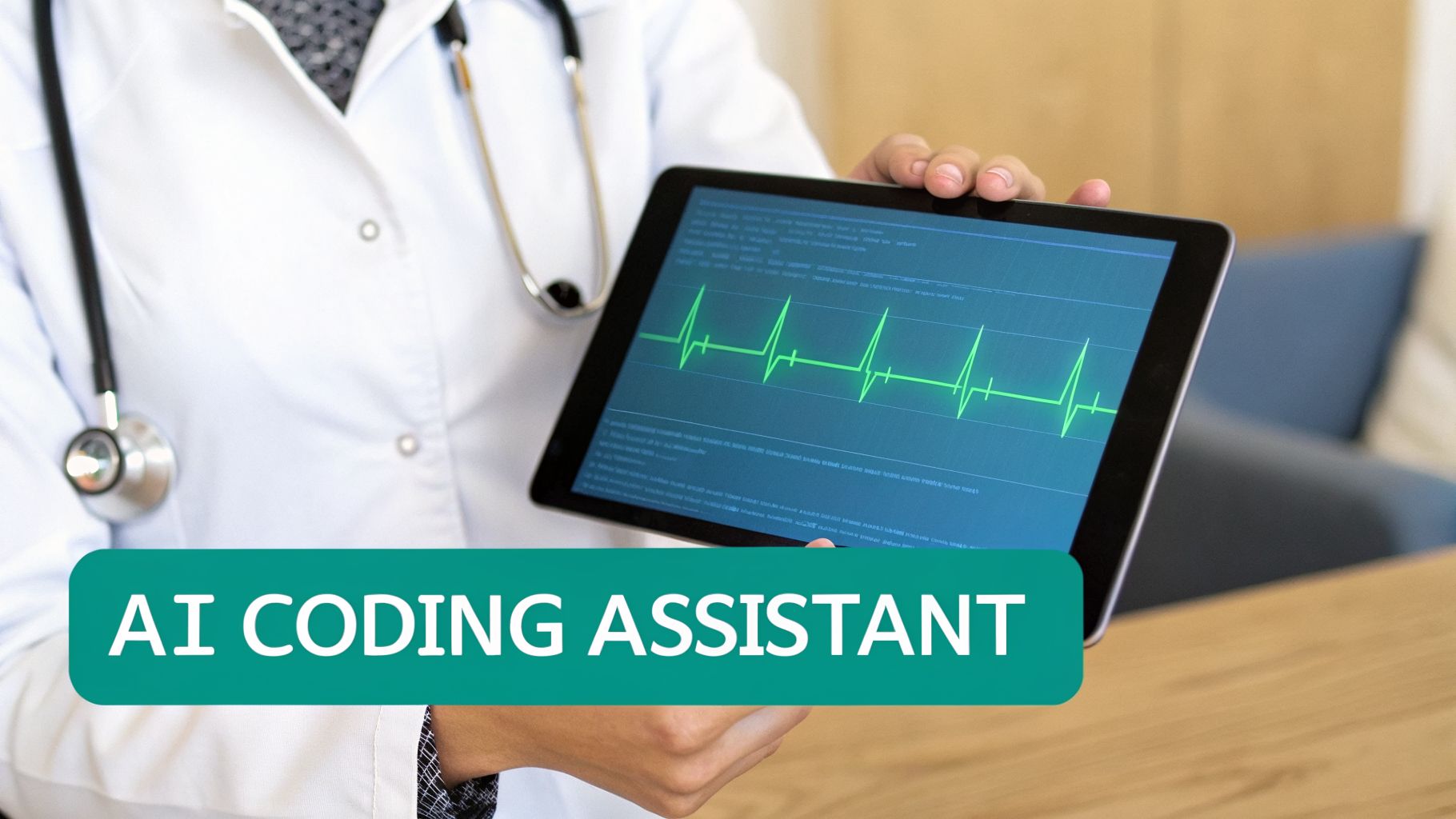
For years, manual medical coding has been a major bottleneck in healthcare. It’s a meticulous, time-consuming process that’s incredibly vulnerable to human error, which gums up the works for everyone, causing administrative headaches and payment delays. But that’s starting to change, thanks to artificial intelligence—especially in a documentation-heavy field like wound care. This technological shift is not just improving efficiency; it's enhancing accuracy and compliance.
AI-powered tools are now tackling the entire process, from the moment a clinician speaks to the moment a claim is filed. The technology captures the natural conversation between a doctor and patient during a visit. From there, it analyzes the discussion in real-time, structures the free-flowing dialogue into an organized clinical note, and suggests the most accurate ICD-10 and CPT codes based on what was said.
This isn't just a niche trend; it’s a necessary evolution. The global medical coding market is projected to hit $42.4 billion by 2033. This surge is a direct response to increasingly complex regulations and a real shortage of qualified coders. AI-assisted platforms are becoming essential for staying compliant and getting paid correctly. They represent a paradigm shift from manual labor to intelligent automation.
From Conversational Notes to Clean Claims
The real magic of this AI-driven approach is its knack for understanding clinical context. Instead of forcing clinicians to click through endless dropdown menus or type out lengthy notes, the AI simply acts as a silent scribe in the room. It listens, understands the medical narrative, and translates it into the precise language payers need to see. This allows clinicians to focus on patient interaction rather than data entry.
Think about a typical wound care visit. The clinician might describe a wound’s dimensions, point out necrotic tissue, and talk about the patient's co-existing diabetes. The AI processes all of this on the fly.
- It Structures the Chart: The conversational data is instantly organized into a standard SOAP note or whatever format your practice uses.
- It Suggests Codes: Based on the documented details, it recommends specific ICD-10 codes for the diagnoses and the right CPT codes for the procedures performed.
- It Reduces Errors: By automating the code selection, it drastically cuts down on human mistakes like choosing an unspecified code or mismatching a diagnosis and procedure.
This shift means clinicians can finally put their full focus on the patient, not the computer screen. In fact, studies show this kind of automation can slash documentation time by as much as 70%, giving clinicians back precious hours to spend on actual patient care.
Justifying Medical Necessity with Objective Data
Beyond just capturing conversations, modern AI is also making the clinical data itself much stronger. For instance, AI-powered wound analysis tools can use a simple smartphone camera to capture images and automatically calculate precise measurements like length, width, and surface area. This gives you objective, verifiable data that is gold for justifying medical necessity.
When you can support a debridement CPT code with automated, time-stamped measurements showing the wound's exact size and the percentage of non-viable tissue, you build an ironclad case for reimbursement. This hard data is far more convincing than manual estimates alone and can confidently support higher-level CPT codes for more complex work. This objective evidence strengthens claims against audits and disputes.
By bringing these intelligent tools into the clinic, practices can completely overhaul their revenue cycle. For clinics looking to make this leap, it's helpful to understand the different medical coding automation tools available and how they can fit into your specific workflow. Ultimately, AI bridges the gap between the excellent clinical care you provide and the financial side of the business, ensuring your documentation perfectly reflects your work. It aligns clinical excellence with financial performance, creating a more sustainable practice model.
Answering Your Top Wound Care Coding Questions
Even when you know the difference between ICD-10 and CPT codes, the day-to-day work of coding can throw some real curveballs. In the clinic, theory meets reality, and that’s where the most common and frustrating questions pop up. We've gathered some of the most frequent challenges clinicians and billers run into when trying to get ICD-10 and CPT codes to play nicely in wound care.
Nailing these details is the key to a healthier billing cycle. It means fewer claim denials and documentation that truly shows the value of the care you're providing. Addressing these common queries can help demystify some of the more complex aspects of wound care coding and empower your team to bill with greater confidence and accuracy.
What Happens If I Use an Unspecified ICD-10 Code?
Think of an unspecified ICD-10 code—like one for an "unspecified ulcer"—as a giant red flag for payers. Using one is one of the fastest ways to get a claim denied. Payers need the highest level of detail possible to confirm that a treatment was medically necessary, and an unspecified code just screams "incomplete diagnosis." It communicates ambiguity in a system that demands certainty.
That generic code won't give them the evidence they need to approve a debridement, for instance. Making a habit of using specific codes that detail the wound’s location, severity, and laterality is your best bet for getting paid faster and staying out of audit territory. Specificity is not just a preference; it's a requirement for reimbursement.
Can I Bill for Debridement and an Evaluation on the Same Day?
Yes, you absolutely can, but your documentation has to be rock-solid. To bill for both an Evaluation and Management (E/M) service and a procedure like debridement, you need to append Modifier 25 to the E/M code. This is a common point of confusion and a frequent source of billing errors.
Modifier 25 is your way of telling the payer, "Hey, the evaluation I did was a significant, separate service from the procedure I also performed today."
To back this up, your notes have to clearly show that you performed a distinct cognitive task. Maybe you had to manage a new, complicating health issue or address a major change in the patient's overall condition—something completely separate from the thinking and work involved in the debridement itself. The documentation must prove that the E/M service went above and beyond the usual pre-operative and post-operative care associated with the procedure.
How Do I Choose the Right Debridement CPT Code?
This is a big one. Selecting the correct debridement CPT code boils down to two critical factors: the depth of the tissue removed and, for certain codes, the wound's surface area. Your operative report must be crystal clear about the deepest layer of viable tissue you removed. That's what justifies your code choice. Ambiguity in the operative note will lead to down-coding or denials.
Here’s a quick way to think about it:
- CPT 11042: For debriding down to the subcutaneous tissue.
- CPT 11043: For debriding deeper, reaching muscle and/or fascia.
- CPT 11044: For debriding all the way down to the bone.
Simply writing "debridement of a 3 cm wound" won't cut it. Your note needs to be specific, like: "Debridement was carried down through necrotic tissue to healthy, bleeding subcutaneous tissue," to properly support using code 11042. The documentation must explicitly state the depth to remove any doubt for the payer or auditor. This level of detail is non-negotiable for accurate and compliant debridement coding.
Ready to put these coding challenges in the rearview mirror and get your wound care workflow running smoothly? Ekagra Health AI offers an end-to-end platform that helps automate documentation, suggests the right codes, and gets you paid faster. You can go from voice to claim in minutes and slash documentation time by up to 70%. See how it works at https://ekagrahealth.ai.
