
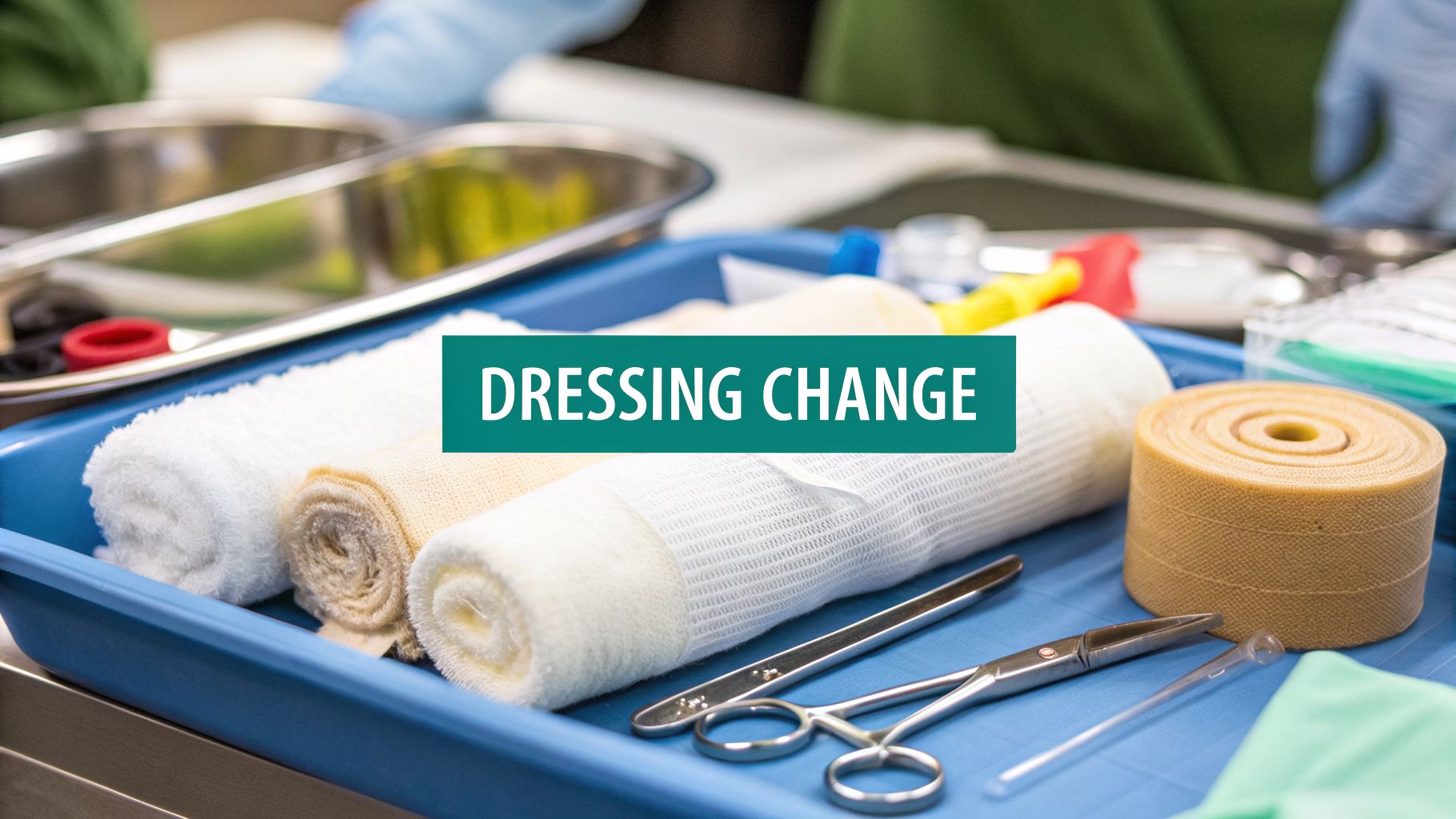
How often should a wound dressing be changed? It’s one of the most common and pivotal questions in wound care, and the expert consensus is clear: it depends. Sticking to a rigid, one-size-fits-all schedule is an outdated approach that can actively slow down healing, elevate the risk of infection, and drive up supply and labor costs unnecessarily. Modern, evidence-based care has moved far beyond the ritualistic daily change, demanding a more nuanced, clinical, and data-driven strategy.
This comprehensive guide is designed for busy clinicians, wound care specialists, and healthcare administrators. It will serve as a deep dive into the critical factors that determine optimal dressing change frequency, the significant costs associated with outdated practices, and the powerful role of technology in supporting better clinical decisions. We will explore not just the what and how, but the crucial why behind a more strategic approach to wound management.
The Core Question in Modern Wound Care

The focus today has shifted from routine-based changes to a more sophisticated, clinical judgment approach. Often, the best strategy is "less is more." The question isn't, "Is it time to change the dressing?" but rather, "Is there a compelling clinical reason to change the dressing?"
Think of a healing wound bed as a delicate, high-tech biological garden. It requires a stable, protected, and precisely controlled environment to thrive. Constantly lifting the dressing to "check on it" is akin to digging up a seedling every day to inspect its roots—you end up disrupting the very physiological processes you are trying to encourage. This disruption is not trivial; it has measurable negative impacts on cellular activity and overall healing time.
From Ritual to Reason: A Necessary Evolution
For decades, many healthcare settings were stuck in a ritualistic cycle. Dressings were changed daily or every other day simply because that was the established protocol—"the way it's always been done." This practice was not rooted in strong scientific evidence and, in many cases, likely did more harm than good by introducing temperature fluctuations, physical trauma, and increased infection risk.
Today's standard of care is much smarter and more dynamic. It is guided by a continuous assessment that takes several key factors into account. This shift requires a deep understanding of the wound healing cascade and the specific properties of modern dressings designed to create an optimal environment for the body's natural repair mechanisms to work efficiently.
This means carefully and consistently considering:
- The type, etiology, and stage of the wound
- The specific properties and intended wear time of the dressing being used
- The amount, type, and consistency of wound fluid (exudate)
- The patient’s overall health status and any local or systemic signs of infection
A core principle in today’s evidence-based wound management is to minimize trauma to the wound bed. An undisturbed wound maintains a stable temperature, pH, and moisture balance, which is essential for the complex cellular activity, angiogenesis, and collagen synthesis required for healing.
A New Framework for Clinicians
This guide offers a practical, in-depth framework for clinicians across all settings, whether in a hospital, outpatient clinic, or home health environment. It’s designed to help you make confident, evidence-backed decisions that improve patient outcomes, reduce waste, and align with the best practices in modern wound management.
Making this mindset shift from a task-oriented to a goal-oriented approach is a huge step toward providing superior, cost-effective patient care. To get there, you need to understand the why behind every decision. For a comprehensive overview of the principles guiding this change, you can learn more about evidence-based wound care practices and how they are shaping the future of treatment.
Here, we'll walk through the critical factors that should guide your clinical judgment, empowering you to move beyond the calendar and focus on what the wound and the patient truly need for optimal recovery. This is not just about changing a dressing; it's about managing a complex biological process with precision.
Why Fewer Dressing Changes Improve Patient Healing
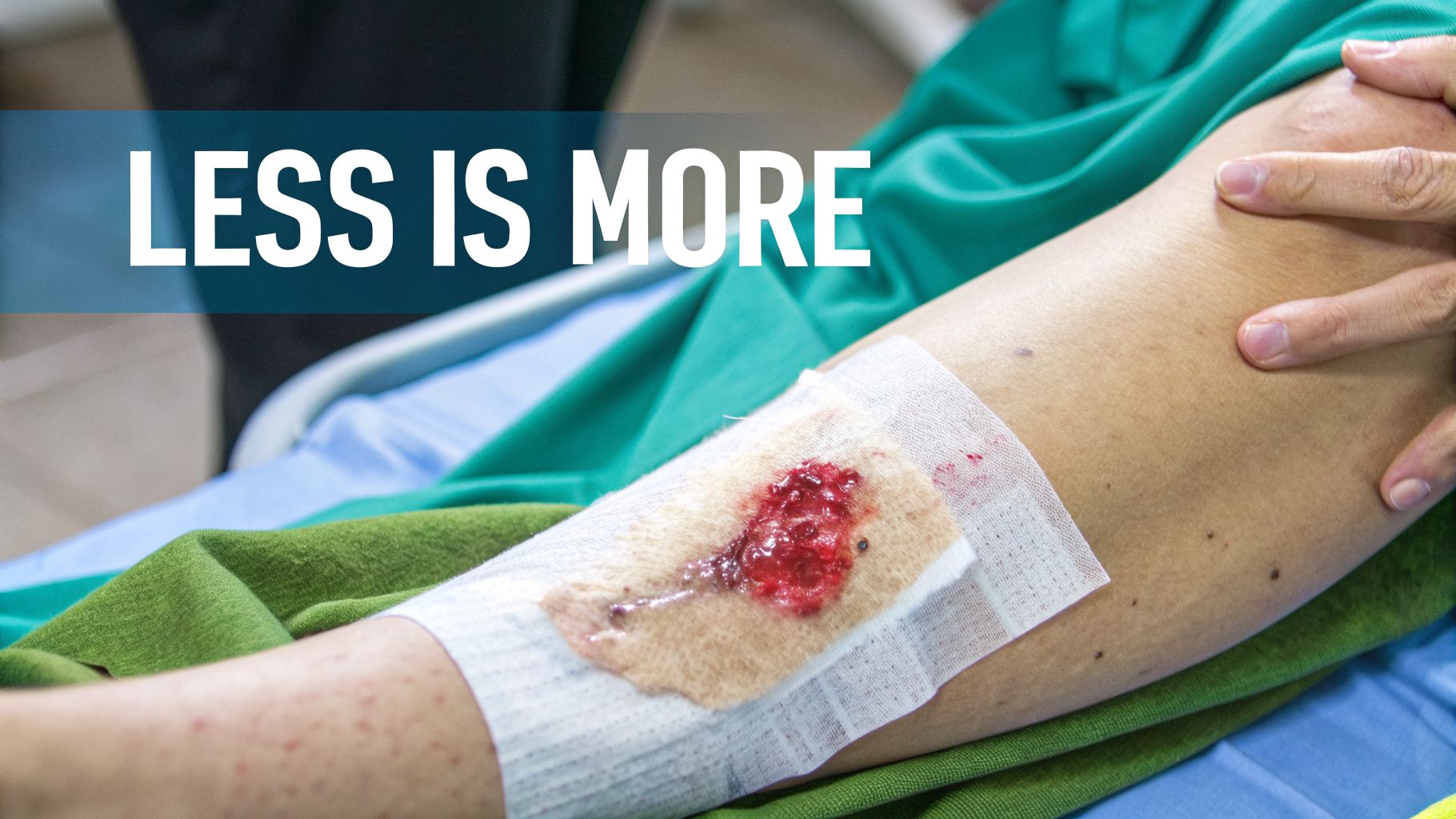
When it comes to changing a wound dressing, how often is too often? It’s a delicate balance that has profound implications for healing. For years, the prevailing instinct was to change dressings frequently, driven by the belief that it kept the wound "clean" and promoted healing. We now know, through extensive research, that this well-intentioned practice can actually set recovery back significantly.
The gold standard in modern wound care has shifted from a fixed, ritualistic schedule to an evidence-based approach. We change dressings for a specific clinical reason, not just because it's Tuesday. This simple but powerful shift doesn't just speed up healing—it makes a world of difference in patient comfort, safety, and overall quality of life.
It all comes down to basic biology. A healing wound is a carefully controlled microenvironment, and one of its most important features is temperature. The cells doing the heavy lifting of rebuilding tissue, particularly the collagen-producing fibroblasts and the migrating epithelial cells, thrive in a very narrow, warm temperature range. When you peel back that dressing, the wound bed is suddenly exposed to cool room air, and its temperature can plummet. This temperature drop effectively hits the pause button on all that crucial cellular activity.
This isn't a minor dip. The sudden chill stalls mitosis, the cell division process that creates new tissue. Research has demonstrated that once a dressing is removed, it can take up to four hours for the wound bed to warm back up to the optimal temperature and resume its healing work. This is a critical and often underestimated factor in delayed wound healing.
The Problem with Constant Disruption
Think about what that four-hour delay means in a real-world context. If a dressing is changed daily, as was common practice, the wound might spend a huge chunk of its time—up to 16% of the day—in a stalled state, unable to heal efficiently. You’re essentially resetting the healing clock every 24 hours.
This is precisely why modern international guidelines have moved away from daily changes for many wound types, now recommending just 1-3 changes per week maximum when appropriate. Research has shown that a wound bed must stay at a steady 91.4°F (or 33°C) for those vital cellular engines to run at peak performance. Every time we lift that dressing, the temperature drops and the healing process grinds to a halt. When you understand this fundamental physiological principle, it becomes obvious why leaving a wound undisturbed helps it heal faster. You can review the details on this and explore why there's a fuss over dressing change frequency.
By minimizing disruptions, you maintain the stable, warm, and moist environment a wound needs to heal. This "less is more" principle directly translates to faster tissue regeneration, reduced inflammation, and better clinical outcomes.
Protecting Fragile New Tissue
Beyond the critical issue of temperature, frequent changes also risk significant physical damage. The body works hard to lay down a delicate, bumpy, red matrix of new capillaries and collagen known as granulation tissue. This is the very foundation upon which new skin (epithelium) is built. It is incredibly fragile and essential for wound closure.
Every time a dressing is removed—especially an older, adherent gauze dressing that has dried out and stuck to the wound bed—it can rip away this fragile new growth. This is like knocking down the scaffolding on a construction site every morning. The body is then forced to expend energy and resources to start rebuilding all over again. A less disruptive approach, using non-adherent, modern dressings, protects this delicate progress, allowing the wound to close much more quickly and with less scarring.
The benefits of this evidence-based approach are clear and multifaceted:
- Maintains a stable healing environment: A consistent, warm, and moist wound bed is the fastest path to healing, supporting optimal cellular function.
- Protects new growth: You avoid traumatizing delicate granulation tissue and the new epithelial cells migrating across the wound surface, which can set healing back by days.
- Lowers infection risk: Every dressing change is a potential breach in the protective barrier, an entry point for environmental bacteria. Fewer changes mean fewer opportunities for contamination.
- Improves patient quality of life: Less frequent changes mean less pain, less anxiety, and less disruption to the patient's daily routine, leading to better compliance and satisfaction.
Making the switch from a ritualistic, "time-to-change-the-dressing" schedule to an evidence-based, goal-oriented one is a game-changer. It works with the body's natural ability to heal, creates a stronger case for cost-effective care delivery, and puts the patient's physical and emotional well-being right where it belongs: at the absolute center of the care plan.
The Four Factors That Determine Dressing Change Frequency

One of the most common questions in wound care is also one of the most complex: "How often should I change this dressing?" There’s no single right answer, and sticking to a rigid, one-size-fits-all schedule can actually do more harm than good. The truth is, the decision is a clinical judgment call that you make at the bedside, based on what the wound is telling you.
Think of yourself as a detective. To solve the case of optimal healing, you need to gather and interpret clues from four key areas. When you piece them all together, you get a clear picture that not only justifies your care plan but also drives better patient outcomes.
1. Wound Type and Stage
It all starts with the wound itself. An acute surgical incision has completely different needs than a chronic venous leg ulcer, and your approach has to reflect that. A wound’s needs also change as it progresses through the healing process, from the initial inflammatory phase to long-term maturation.
- Acute Wounds: For a clean, closed surgical wound, the best approach is often "less is more." After the initial 48-hour check, the dressing can often stay in place for up to 7 days. The main goal here is to protect the site from bacteria while the body’s natural seal forms. Changing it too often just opens the door for infection.
- Chronic Wounds: Wounds like pressure injuries or diabetic foot ulcers are a different story. In the beginning, they might need more frequent changes to manage heavy drainage or clear away non-viable tissue. But once you see healthy granulation tissue forming, the game changes. Your focus shifts to protecting that fragile new growth, which means less frequent changes are better.
The healing stage is your roadmap. The early inflammatory phase is all about managing bleeding and cleaning the wound bed. As you enter the proliferative, or "rebuilding," phase, your job is to create an undisturbed environment for new tissue to thrive. To get a better handle on identifying these stages, our guide on essential wound assessment tools for nurses is a great resource.
2. Dressing Material Properties
The dressing you choose has its own "wear time" baked right in. We’ve all seen it: a daily gauze dressing being used when an advanced, long-wear product is what the wound actually needs. This mismatch is a huge source of inefficiency and can stall the healing process.
It helps to think of dressings like tires. Simple gauze is your standard, budget tire—it gets the job done for short distances but wears out fast. An advanced foam or hydrocolloid, on the other hand, is like a premium, all-weather tire built to go the distance safely.
Matching the dressing type to the wound's needs is fundamental. A dressing's ability to manage moisture and maintain its integrity is a primary driver of how long it can safely remain in place.
Here’s how some common dressing types stack up in terms of wear time:
- Gauze: This old standby often needs to be changed daily, sometimes more, especially if it gets saturated. It just doesn't manage moisture well.
- Foams: These are fantastic absorbers. Depending on drainage, they can often be left in place for 3 to 7 days, creating a perfectly moist and protective environment.
- Hydrocolloids: These create a gel over the wound surface and are great for light-to-moderate drainage. They can typically stay on for 3 to 7 days.
- Alginates and Hydrofibers: Made from seaweed or sodium carboxymethylcellulose, these are the heavy-hitters for wounds with significant exudate. They usually need a cover dressing and are changed every 1 to 3 days.
3. Exudate Level and Type
Wound drainage—the exudate—is your most immediate source of feedback. It tells you exactly how the wound is doing and whether the current dressing is still up to the task. You have to look at both the amount of fluid and what it looks like.
The name of the game is moisture balance: not too wet, not too dry. A dressing's main job is to wick away the excess fluid without turning the wound bed into a desert. When a dressing is overwhelmed, it’s time to go.
Exudate Levels:
- Scant: You see just a light stain on the dressing. This is a good sign that you can likely extend the wear time.
- Moderate: The dressing is about 50-75% full. This is a standard trigger for a planned change.
- Heavy: The dressing is totally saturated. If you see strike-through (fluid soaking all the way to the outer layer), it needs to be changed immediately. A soaked dressing creates a wick for bacteria to travel straight into the wound.
The type of exudate is just as telling. Clear, thin fluid (serous) is normal. But if you see it becoming cloudy, thick, or developing a foul smell (purulent), that’s a major red flag.
4. Signs of Complication or Infection
This last factor trumps all the others. A planned change schedule goes out the window the moment you spot a clinical red flag. Infection stops healing in its tracks and can quickly become a systemic problem if you don’t act fast.
Stay vigilant for these classic warning signs:
- New or Increasing Pain: A sudden increase in pain at the wound site, beyond the expected level of discomfort, is a tell-tale sign of infection.
- Increased Redness and Swelling: If the redness (erythema) or swelling around the wound is spreading, the body's inflammatory response is kicking into overdrive.
- Foul Odor: A distinct, nasty smell coming from the wound (after cleaning) is a strong signal of a bacterial problem.
- Change in Drainage: When clear fluid turns into thick, discolored pus (yellow, green, or brown), you’re almost certainly looking at an infection.
- Fever: A systemic symptom like a fever, especially paired with any of the local signs above, points to a significant infection that needs immediate medical intervention.
If you see any of these signs, the dressing comes off right away for a full reassessment. This gives you a chance to get a culture, clean the wound, and adjust the treatment plan. Your clinical judgment and the patient's safety always come first.
The Hidden Costs of Unnecessary Dressing Changes
When we talk about changing a wound dressing, it’s easy to focus solely on the clinical side of things—the wound's appearance, the type of exudate, and the patient's comfort. But the truth is, the operational and financial fallout from changing dressings too often is just as damaging to the healthcare system. That small, seemingly routine task, when repeated unnecessarily across thousands of patients, adds up to a massive drain on healthcare resources. We're not just talking about the cost of some gauze and tape; we're talking about countless wasted nursing hours, frustrated and non-compliant patients, and a serious, often unmanaged, hit to the organizational budget.
The answer to the question, "How often should a wound dressing be changed?" carries enormous financial weight. Every single change consumes not only supplies but, more importantly, a clinician's valuable time—time they could be spending on more complex patient care, education, or comprehensive assessments. When a clinic, hospital system, or home health agency runs on outdated, ritual-based protocols instead of solid, evidence-based practices, these costs spiral out of control.
It's a systemic inefficiency that screams for a smarter, more strategic approach—one that is guided by objective data and gives clinicians the tools and support they need to make and justify the best, most cost-effective care decisions. This is not about cutting corners; it's about reallocating resources to where they will have the greatest impact on patient healing.
The Toll on Nurses and Patients
When you dig into the numbers, the real scope of the problem is startling. A recent UK study found that nurses are performing an incredible 180 wound dressing changes per year for every single patient with a chronic wound. Based on a survey of over 200 people, that averages out to nearly five changes a week. You can see the full research findings on this staggering workload for yourself.
This constant churn doesn't just bog down a nurse's schedule with a repetitive task; it takes a heavy toll on patients. The same research revealed that a staggering 90% of patients felt their quality of life was negatively impacted by the constant disruption of frequent dressing changes.
Think about the ripple effect of that single, inefficient process:
- A Massive Time Sink: We are losing hundreds of hours of skilled nursing care per patient, per year, on a task that could often be performed less frequently with the appropriate dressing selection and assessment.
- Clinician Burnout: Forcing highly skilled nurses to spend their days on repetitive, low-value, and often physically demanding tasks is a recipe for fatigue, job dissatisfaction, and burnout. It pulls them away from the complex care coordination and patient education they were trained to provide.
- Patient Disruption and Non-Compliance: Imagine having your life revolve around multiple appointments and home visits each week for a dressing change. It adds a layer of stress, anxiety, and inconvenience to what is already a difficult and often painful healing process, which can lead to missed appointments and poorer outcomes.
The Financial Drain from Wasted Supplies
Beyond the significant labor costs, the direct financial hit from wasted supplies is immense. Every time a dressing gets changed before it has reached the end of its useful life, you might as well be throwing cash in the clinical waste bin. This is especially true when healthcare organizations default to using cheap, low-performance dressings for wounds that really need a modern, long-wear solution designed to manage exudate effectively over several days.
Here’s a classic, real-world example we see all the time: A nurse applies a simple gauze dressing to a wound with moderate drainage, knowing full well it will have to be changed daily. A modern foam dressing might cost more upfront per unit, but it could have stayed on safely for three to five days, maintaining an optimal healing environment.
Finding the right dressing change frequency isn't about cutting corners or choosing the cheapest product. It's about a strategic shift of resources away from wasteful routines and toward high-impact care that actually helps patients heal faster and more reliably. It’s a straight line to improving both your patient outcomes and your organization's financial health.
Making that one simple switch from daily gauze to a multi-day foam dressing triggers a cascade of benefits across the entire care continuum:
- Slashes Overall Supply Costs: Using one advanced dressing instead of five gauze pads and the associated tape, gloves, and cleaning supplies over a five-day period almost always results in a net cost saving.
- Frees Up Critical Nursing Time: Four fewer dressing changes means that nurse now has significant time back in their schedule for crucial patient education, in-depth assessments, care planning with other providers, or seeing other patients on their list.
- Improves Clinical Outcomes and Reduces Complications: Most importantly, the wound gets the undisturbed, stable healing environment it needs. This often leads to faster closure, a lower risk of infection, and a reduction in other complications that would require even more costly interventions down the line.
By embracing a data-driven, evidence-based mindset for wound care, what was once a major cost center can be transformed into a powerful source of efficiency and better care. It's a strategic move that shifts the focus from just doing tasks to delivering real, measurable value for everyone involved—clinicians, patients, and the entire healthcare system.
How Smart Tools Help Clinicians Make Better Dressing Change Decisions

Every experienced clinician knows the principles of modern wound care. The real challenge isn't the knowing; it's the doing, especially in a busy clinic or home care setting. You know a longer wear time is often better, but how do you justify that decision when everything feels so subjective? How do you prove that the wound is progressing as it should, making it safe to leave the dressing in place?
This is where smart, AI-driven tools come in. They aren't here to replace clinical judgment but to augment and support it with concrete, objective evidence. By giving you precise measurements, tracking trends over time, and cutting down on administrative busywork, these platforms help you shift from a routine-based schedule to a truly data-driven, defensible one.
From Guesswork to Hard Data with AI Wound Analysis
For too long, wound assessment has relied on the naked eye, rulers, and best guesses. An AI platform changes that by turning a simple smartphone photo into a rich source of precise, consistent data. It gives you the objective proof needed to back up your clinical instincts and communicate progress clearly to the entire care team.
Here’s how this works in practice:
- See Healing in Real Time: The software automatically and accurately measures the wound’s dimensions (length, width, area, and depth), tracks its size reduction over time, and even analyzes the types of tissue present (granulation, slough, eschar). This creates a clear, visual story of healing that makes it easy to justify extending the time between dressing changes.
- Get an Objective Look at Exudate: Instead of just "moderate" or "heavy," AI can analyze a photo of the soiled dressing to give you a more standardized, percentage-based assessment of saturation. This helps you know for sure if a dressing is handling the moisture or if it’s time for a change, removing subjectivity.
- Create a Consistent Standard of Care: It ensures that every assessment is captured with the same high-quality data points, whether it's done by a veteran wound specialist or a new nurse. This consistency is invaluable for good clinical oversight, telehealth consultations, and longitudinal tracking of patient outcomes.
AI analysis helps turn the art of wound assessment into more of a science. When you have hard data showing a wound is healing properly and exudate is well-managed, the decision to leave a high-performance dressing on for another day or two becomes simple, defensible, and aligned with best practices.
Reclaim Your Time with Voice-First Documentation
One of the biggest roadblocks to thoughtful, evidence-based care is the mountain of paperwork and electronic charting. Clinicians often feel so rushed to complete their documentation that they fall back on routine, "check-the-box" care, even when it’s not the best approach for the patient.
Voice-first documentation platforms tackle this head-on. You can capture all your detailed assessment notes simply by talking during the patient visit, as you naturally would. The system transcribes your words and automatically populates the structured fields in the chart, freeing your hands and your focus to remain on the patient.
This efficiency gain is a huge deal. For example, a major audit of home care services in Denmark found that dressings were being changed an average of 3.53 times per week. The researchers calculated that reducing this by just one visit per patient each week could free up an incredible 74,300 hours of nursing time every year across their system.
That saved time goes right back to the patient. It’s more time for a thorough assessment, for patient education, for care coordination, and for making the best possible clinical decision. This is a core tenet of modern practice, much like the broader applications of Clinical Decision Support in modern healthcare. By shifting the clinician's focus from the keyboard back to the bedside, these innovative tools directly support better, safer, and more efficient wound management. For a deeper dive, our guide on the benefits of clinical decision support systems explains more about how these tools are improving outcomes across various specialties.
Your Top Questions About Dressing Change Frequency
Even when you know the principles, tough questions always pop up at the bedside. When you're with a patient, you need clear, confident answers for those tricky situations that make you second-guess your plan. Let's walk through some of the most common questions I hear from fellow clinicians.
When Should a Dressing Be Changed Immediately, No Matter the Schedule?
Think of a wear-time schedule as a goal, not a mandate. Your clinical judgment always, always comes first. If you see any sign that the dressing is failing or the wound environment is taking a turn for the worse, you need to change it.
These red flags override any schedule:
- Strike-through: This is when wound fluid, or exudate, has soaked all the way through to the outside of the dressing. A saturated dressing is no longer a barrier; it's a bridge for bacteria to march right into the wound bed.
- Dressing Displacement: If the dressing has slipped, the edges are peeling up, or it’s no longer fully covering the wound, it’s not doing its job. That broken seal compromises the moist, protected environment the wound needs to heal.
- Sudden Pain Increase: A patient telling you their pain has suddenly spiked is a massive red flag. It often points to a complication brewing under the surface, like an infection or intense pressure from fluid buildup.
- Signs of Infection: New or spreading redness (erythema), increased warmth around the wound, new swelling, or—the most obvious sign—foul-smelling, thick drainage (pus) all demand an immediate dressing change and a full reassessment.
When you see any of these signs, the question of "how often" is answered for you. The answer is now.
Can I Leave a Post-Op Dressing on for More Than 48 Hours?
Yes, and in many cases, you absolutely should. The old ritual of changing every surgical dressing at the 48-hour mark is outdated and simply not supported by modern evidence. For clean, uncomplicated surgical incisions, we've learned that less disruption is better.
The first 24 to 48 hours are crucial. During this time, the incision edges seal themselves in a process called epithelialization. After that window, if the dressing is still clean, dry, and stuck down properly, leaving it in place for up to 7 days is actually better for the patient.
Extending the wear time on a clean, dry postoperative dressing is a key strategy for infection prevention. It minimizes the wound's exposure to environmental pathogens and protects the delicate, newly formed tissue seal.
Changing these dressings too often can tear at that fragile new seal and introduce bacteria. Of course, you always follow the surgeon's specific orders. But the clear trend in surgical care is toward longer, undisturbed wear times, made possible by today’s high-performance dressings.
How Do I Document My Decision to Extend Wear Time for Reimbursement?
Clear, specific documentation is your best friend when it comes to justifying your clinical decisions and getting paid for them. A lazy note like "dressing changed" won't cut it. You have to paint a picture with your words that shows why you're extending the dressing's wear time.
Think of your note as telling the story of the wound.
Key Elements to Include in Your Documentation:
- Dressing Condition: Describe exactly what you see. For example: "Foam dressing over LLE ulcer remains intact with edges well-adhered. Approx. 25% saturated with serous exudate. No strike-through or odor."
- Periwound Skin: Note the condition of the surrounding skin. "Periwound skin is warm, dry, and intact. No erythema, maceration, or irritation noted."
- Wound Bed Appearance: Give the details. "Wound bed measures 3.2 cm x 2.8 cm, 100% red granulation tissue. No purulence or necrotic tissue present."
- The Plan: State what you're doing and why. "Based on minimal exudate and positive healing signs, current dressing will be left in place to maintain a stable healing environment. Plan to re-evaluate and change in 3-5 days or sooner if s/s of complication arise."
This level of detail gives payers the objective proof they need. It shows your decision was based on a thorough clinical assessment, which is your best defense against claim denials and the key to proving medical necessity.
What Is the Best Approach for Home Care Dressing Changes?
For home care, the name of the game is matching the dressing's wear time to your visit schedule. It’s all about smart planning to keep the wound safe between visits while empowering your patient and their family.
The key is to pick a dressing that can go the distance. If you visit twice a week—say, on Monday and Thursday—it makes no sense to use a dressing that needs daily changes. A dressing designed for 3-4 days of wear is the logical choice. It’s more efficient for you and safer for the patient.
Patient education is just as important. You have to give the patient and their caregivers simple, crystal-clear instructions on what to look for. Ditch the clinical jargon.
Example "Red Flag" Instructions for Patients:
- "Call us right away if you see any fluid leaking out from the edges of the bandage."
- "If you notice a bad smell coming from the wound, that's a reason to call."
- "Let us know if the pain suddenly gets a lot worse."
- "If the dressing comes off by accident, please call us before you try to put a new one on."
This strategy does a few things at once. It uses modern dressings to their full potential, makes the most of your limited home health visits, and gives patients the confidence to spot a real problem early. It cuts down on frantic calls for minor issues while making sure you hear about the critical ones immediately.
At Ekagra Health AI, we believe in empowering clinicians with tools that support evidence-based decisions and streamline workflows. Our "voice-to-claim" platform helps you capture detailed clinical notes effortlessly, generate objective wound analysis, and automate billing, so you can spend less time on paperwork and more time delivering exceptional care. Discover how our AI-powered solution can help you optimize dressing change frequency and improve both patient and financial outcomes. Learn more about our Early Access program at https://ekagrahealth.ai.
