If you’ve ever felt like you’re drowning in a sea of clinical documentation, you’re not alone. This is where medical coding automation tools come into play. Think of them as intelligent software platforms that use Artificial Intelligence (AI) to read and interpret clinical notes, then automatically suggest the right billing codes. This isn't science fiction; it's a practical solution to one of healthcare's biggest administrative headaches.
The goal is to cut down on manual work, boost coding accuracy, and ultimately, get you paid faster. For any practice, especially those in documentation-heavy specialties, mastering this technology is becoming a non-negotiable part of modern financial health. This guide will explore how these tools are fundamentally changing the revenue cycle, from initial patient encounter to final reimbursement.
The End of Manual Medical Coding
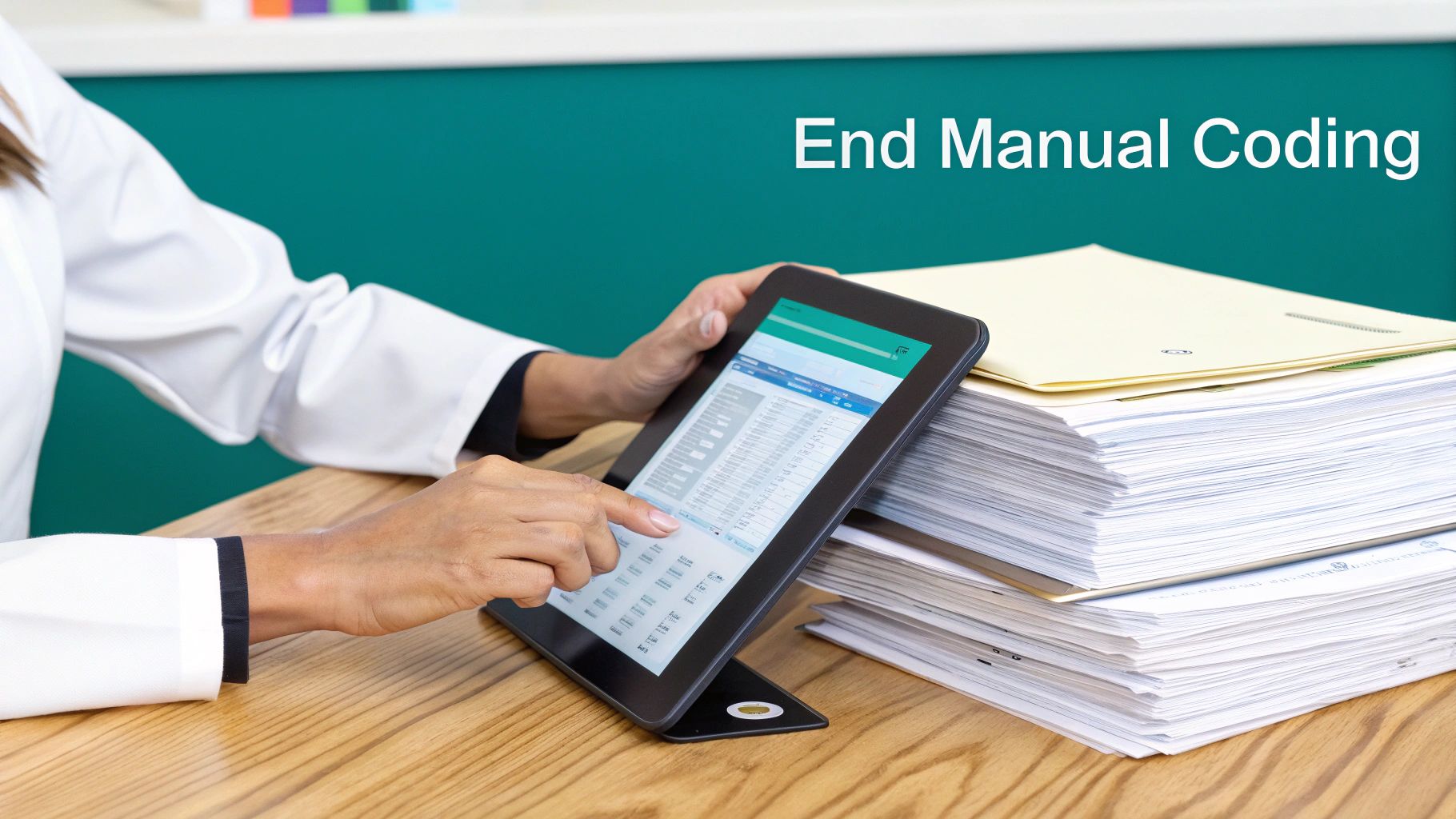
Traditional medical coding often feels like translating an epic novel by hand—slow, mentally exhausting, and with a high price for any mistake. Coders have to painstakingly sift through clinician notes, lab results, and patient histories to find the exact codes that justify the care provided. This manual grind isn't just inefficient; it's a major cause of administrative burnout and a significant drag on a practice’s financial performance. Every hour spent on tedious code lookups is an hour not spent on higher-value tasks like complex case reviews or denial analysis.
This is exactly where medical coding automation tools make a difference. These platforms aren't about replacing human expertise. Instead, they act as a powerful AI co-pilot for your team, reading, understanding, and suggesting the most accurate codes with incredible speed. It’s about turning a frustrating bottleneck into a smooth, efficient workflow that directly impacts your bottom line.
Beyond a Simple Software Fix
It’s easy to dismiss these tools as just another piece of software, but they’re much more. They are intelligent systems built to solve some of healthcare's most persistent and costly problems. By taking on the most repetitive parts of the coding process, they directly address the pain points your practice faces every day. The right platform becomes a strategic asset, strengthening both your operational efficiency and your financial stability.
- Claim Denials: Incorrect or incomplete coding is a top reason for rejected claims. Automation pushes accuracy way up—some systems even achieve 91% to 99% accuracy rates—which means far more clean claims on the first try. This directly reduces the costly and time-consuming process of rework and appeals.
- Administrative Burnout: Your clinicians and coders are buried in paperwork. Automation frees them from hours of tedious administrative work, giving them time back to focus on patient care or handle more complex, high-value coding challenges. This is not just a morale booster; it's a key to retaining top talent.
- Slow Reimbursement: The long wait between providing care and getting paid can seriously impact your practice's cash flow. By making the coding process faster, these tools help shrink the entire revenue cycle, improving financial predictability and stability.
Automation isn’t some far-off concept anymore. It’s a practical tool for building financial stability and operational excellence in healthcare today. It gives your team the support they need to handle complex billing requirements without taking time away from patients.
This guide will break down how this technology works, the real-world benefits it delivers, and how you can put it to work solving these exact problems. Especially for documentation-heavy fields like wound care and home health, automation is quickly becoming a necessity. It’s all about building a stronger, more efficient practice—from the moment you document a patient's story to the moment you get paid for it. This isn't just about streamlining a process; it's about fundamentally improving the financial health of your organization.
How AI Turns Clinical Notes Into Clean Claims

To really get what makes medical coding automation tick, you have to look under the hood. These tools aren't just scanning for keywords. They are complex systems where different technologies work together to turn messy, unstructured clinical stories into clean, billable data. The magic lies in how these different AI components collaborate to interpret nuanced medical language.
At the heart of it all is a powerful trio of AI-driven engines. This is how a clinician's free-form notes from a patient visit become a compliant claim, ready to go in a fraction of the time it would take by hand. Each piece of the puzzle plays its own specific role, ensuring everything is fast, accurate, and in line with countless payer rules. Understanding this process is key to appreciating the technology's true power.
Natural Language Processing: The Medical Scribe
First, you have Natural Language Processing (NLP). Think of it as a brilliant medical assistant who has memorized every clinical textbook ever written. NLP is the system's ability to actually read and understand a doctor's notes—not just pulling out words, but grasping the context, the intent, and how different clinical ideas connect. It can differentiate between a patient's family history of a condition and a current diagnosis, a critical distinction for accurate coding.
Right away, NLP sifts through the documentation and pulls out the important stuff:
- Diagnoses: It spots conditions like "venous stasis ulcer" or "diabetic foot infection."
- Procedures: The system flags actions taken, such as "debridement of subcutaneous tissue" or "application of a multilayer compression bandage."
- Clinical Evidence: It pinpoints the critical details that back up the codes, like wound measurements, pain scores, or how a patient responded to treatment.
This first step is the foundation. It transforms dense paragraphs of medical jargon into a neat list of clinical facts that the system can then use to figure out the right codes. It's the difference between simple word-matching and genuine comprehension of the patient encounter. This capability is what allows the system to process vast amounts of unstructured text with human-like understanding.
The Rules Engine: The Compliance Officer
Once NLP has pulled out the key clinical facts, a rules-based engine steps in. This part acts like a meticulous compliance officer, cross-checking every bit of information against a massive, always-current library of payer regulations, national coding guidelines, and local coverage rules. This engine is constantly updated to reflect the ever-changing landscape of healthcare billing.
This engine’s main job is to catch common mistakes before a claim is even built. For example, it can flag if a procedure code isn't medically justified by the diagnosis on record, or if two codes are bundled together when they shouldn't be. This automatic check stops costly denials in their tracks and saves a ton of time on manual rework. It enforces consistency and accuracy at a scale that is impossible for humans to achieve manually.
This digital gatekeeper is what separates basic automation from a truly intelligent system. It builds a layer of compliance directly into the workflow, ensuring every code suggested is not only clinically accurate but also financially sound and defensible under audit.
This proactive approach is a game-changer for the revenue cycle. Instead of reacting to denials, you're preventing them from the start. This need for smarter billing is why the medical coding market is projected to grow to between USD 14.01-70.3 billion by 2030-2032, according to marketsandmarkets.com, as more organizations look for tools to boost their billing accuracy.
Computer Vision: The Expert's Eye
Finally, for specialties that rely heavily on visuals, like wound care or dermatology, Computer Vision adds another powerful layer of insight. This technology works like an expert's eye, analyzing images to automatically pull out and measure critical, billable details. This transforms subjective visual assessments into objective, quantifiable data.
When a clinician uploads a photo of a wound, the computer vision model can:
- Measure wound dimensions (length, width, and depth) with incredible precision.
- Identify different tissue types in the wound bed, such as granulation or necrotic tissue.
- Track healing over time by comparing images from one visit to the next.
This visual data is then fed right back into the system, giving you concrete, objective evidence to support the codes you're using. It eliminates the guesswork and time drain of measuring by hand and creates documentation that can easily stand up to an audit. When you pair this with other tools like ambient listening, the entire charting and coding process gets a major speed boost. To learn more about how this works, you might be interested in our guide on voice-enabled smart charting.
What to Look for in a Modern Coding Platform
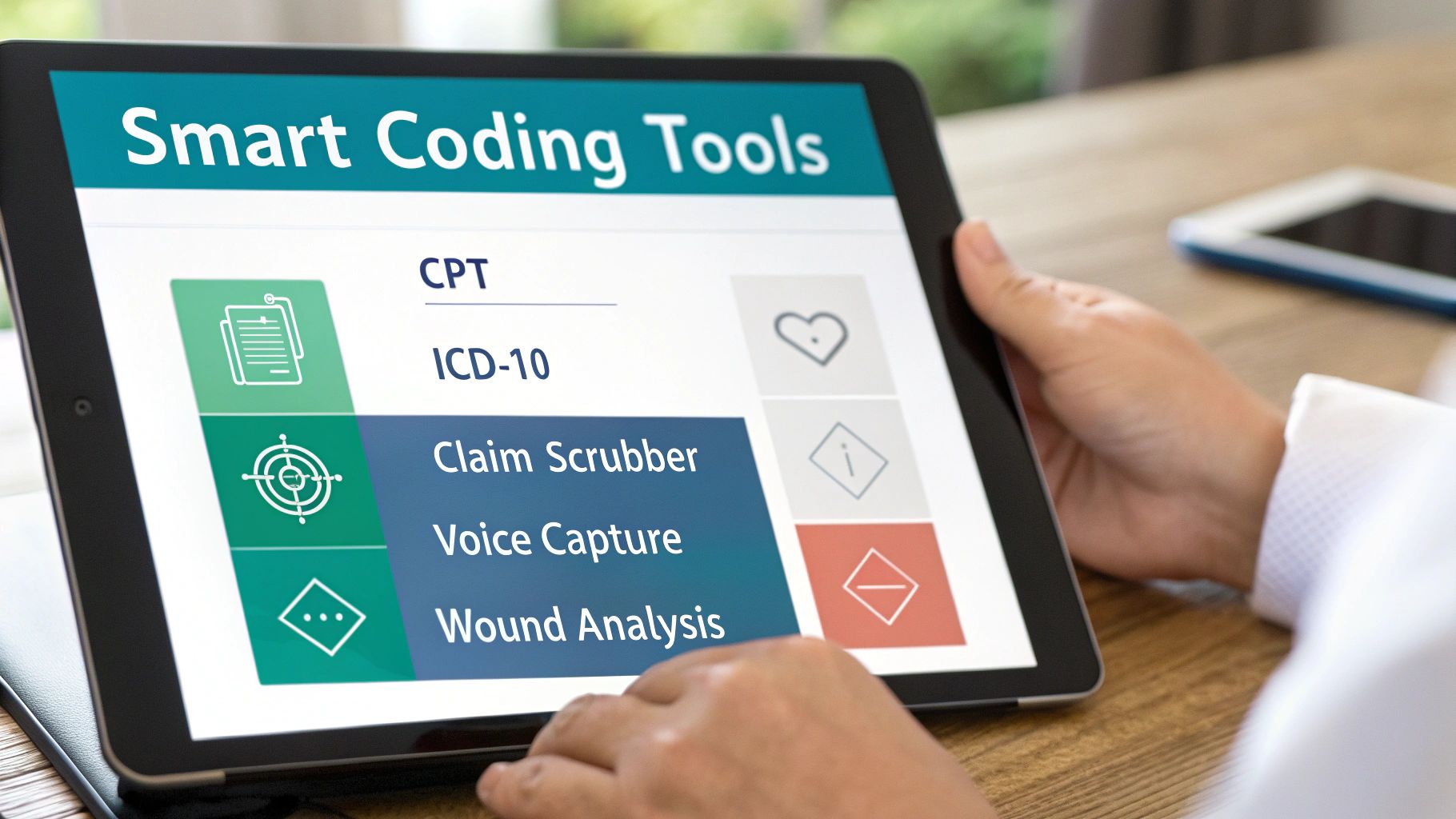
It’s easy to assume all medical coding automation tools are basically the same, but that’s far from true. Once you understand the technology under the hood, the next step is to look at what these platforms actually do. The best systems are more than just fancy code look-up tools; they weave themselves into the clinical workflow, improving both your financial health and the quality of patient care.
Think of the following features as your must-have list when evaluating any solution. These are the core functions that deliver real-world value by handling complex tasks automatically, keeping you compliant, and, most importantly, giving your clinicians back their time. A truly effective platform doesn't add steps to a workflow; it removes them.
Automated CPT and ICD-10 Suggestions
First and foremost, any platform worth its salt has to deliver smart, evidence-based code suggestions. I'm not talking about a digital codebook. I’m talking about an analytical engine that reads the entire clinical note and surfaces the most accurate CPT and ICD-10 codes for that specific encounter. It should understand the subtleties of the documentation to recommend the most specific codes available.
But here’s the crucial part: transparency. The system should show you exactly which words or data points in the documentation triggered each code suggestion. This creates an instant audit trail and gives coders the confidence to simply review and approve, turning a tedious research project into a quick validation. It's no surprise that this kind of AI-assisted workflow has been shown to boost coder productivity by 20%. This transparency builds trust and facilitates a seamless collaboration between the AI and the human coder.
Integrated Claim Scrubbing
A built-in claim scrubber is like having a quality control inspector for your entire billing cycle. Before a claim even thinks about leaving your system, this feature gives it a thorough review, checking for all the common mistakes and red flags that lead to denials. This automated review process is far more comprehensive than any manual check could be.
This pre-flight check is absolutely vital. A good scrubber will catch things like:
- Code Mismatches: It flags when a procedure code doesn't align with the diagnosis code, a classic reason for rejection.
- Payer Rule Conflicts: It knows that every payer has its own quirky, complex rules and ensures your claim plays by them.
- Missing Modifiers: It spots when a modifier is needed to give the full picture of the service provided.
By catching these issues on the front end, an integrated scrubber doesn't just lower denial rates—it speeds up reimbursement and saves your team from the headache of reworking and resubmitting claims. It shifts the entire process from reactive to proactive.
Clinician-Focused Capabilities
The most forward-thinking automation platforms are built with the clinician’s reality in mind. They recognize that great coding begins with great documentation and focus on making that process as painless as possible. This is where features designed for the point-of-care really shine. These features are designed to reduce the "pajama time" clinicians spend on charting after hours.
A platform that only focuses on the back-office misses half the opportunity. True automation bridges the gap between the clinical encounter and the final claim, supporting clinicians and coders in a single, unified workflow.
For instance, ambient voice capture lets a provider have a natural conversation with a patient, while the AI listens in, transcribes the dialogue, and organizes it into a structured, compliant clinical note. That means no more hours spent charting after clinic.
Another game-changer, especially for specialties like wound care, is AI-powered wound analysis. A clinician just needs to snap a picture of a wound, and the platform can automatically pull out billable data points like precise measurements and tissue composition. This not only creates ironclad documentation but also captures revenue that was likely being left on the table. To see how this fits into a larger efficiency strategy, you might be interested in our overview of smart coding and billing solutions.
These aren't just bells and whistles; they’re signs of a platform that truly gets the day-to-day challenges providers face. They represent a fundamental shift toward making technology serve clinicians, not the other way around.
Manual vs Automated Coding Workflow Comparison
To really see the difference these tools make, let's compare the old way of doing things with a modern, automated workflow. The table below breaks down the journey of a patient encounter from documentation to claim submission. The contrast highlights the profound efficiency gains at every stage of the process.
| Workflow Step | Manual Coding Process | Automated Coding Process |
|---|---|---|
| Documentation | Clinician types or dictates notes, often after hours. | AI captures encounter details via voice or image analysis in real-time. |
| Code Assignment | Coder manually reads the entire note and researches potential codes. | AI instantly suggests CPT/ICD-10 codes with links to supporting text. |
| Code Review | Coder spends time cross-referencing codes and payer rules. | Coder validates AI suggestions, transforming review into a quick check. |
| Claim Creation | Staff manually enters codes and details into the billing system. | System auto-populates the claim with validated codes and data. |
| Pre-Submission | Relies on human memory or separate software to check for errors. | Integrated claim scrubber automatically flags errors before submission. |
| Submission | Claim is sent to the payer with a high potential for initial denial. | Claim is submitted with a high degree of confidence in its accuracy. |
As you can see, automation doesn’t just speed up individual steps—it transforms the entire process, removing friction, eliminating redundant work, and drastically reducing the opportunity for human error. It creates a more resilient and efficient revenue cycle from end to end.
The Measurable Impact On Your Practice
Bringing medical coding automation into your practice isn't just a tech upgrade—it's a strategic move with real, measurable returns. Forget vague promises of "efficiency." The true value shows up in the key performance indicators (KPIs) that directly impact your financial health and day-to-day operations. This is about making a quantifiable difference that leadership can see and appreciate.
The first thing you'll likely notice is a huge boost in productivity for both clinicians and coders. Think about all the hours spent digging through clinical notes and cross-referencing codes. Automating that grunt work frees up a massive amount of time. In fact, many practices report up to a 70% reduction in the time clinicians spend on documentation and coding, letting them get back to patient care. This isn't just a quality-of-life improvement; it's a way to increase patient throughput and satisfaction.
Slashing Denial Rates and Accelerating Cash Flow
One of the biggest financial wins comes from getting claims right the first time. Simple human errors in manual coding are a top reason for claim denials, and each denial kicks off a frustrating cycle of rework and delayed payments. Automation is your best defense against these preventable and costly errors.
By making sure codes are accurate, fully supported by the documentation, and aligned with payer rules from the get-go, you can stop denials before they even happen. It’s not uncommon for practices to see their denial rates drop by over 50%. This has an immediate and significant effect on the bottom line.
This is about more than just avoiding the $25 average cost to rework a single denied claim. It’s about strengthening your entire revenue cycle. Fewer denials mean you get paid faster, which smooths out your cash flow and makes your revenue far more predictable.
This isn't just anecdotal. Industry-wide data backs it up. A survey from the American Health Information Management Association (AHIMA) revealed that 85% of healthcare organizations saw a jump in coding efficiency after implementing AI solutions. Some platforms have even hit over 97% coding accuracy, which points to a massive opportunity for financial improvement. You can dig into more of these industry trends on AI in medical coding on towardshealthcare.com.
Building a Stronger Business Case with Data
The positive effects of coding automation ripple out far beyond just saving time. When you connect the dots between the technology and your financial outcomes, you can build an undeniable business case for making the switch. The trick is to focus on the metrics that really move the needle and present them clearly to stakeholders.
Here are the core areas where you’ll see a clear, measurable return on your investment:
- Reduced Administrative Overhead: Start by tracking the hours your team gets back from manual coding and claim follow-up. That time can now be spent on more complex cases or other tasks that actually generate revenue. This is a direct conversion of saved time into productive capacity.
- Lower Denial Management Costs: Add up what it costs to investigate, fix, and resubmit every denied claim. This includes staff time, administrative costs, and the financial impact of delayed payments. Automation shrinks this expense category dramatically.
- Increased Revenue Capture: AI is fantastic at spotting every single billable service documented in a note, making sure you aren't leaving money on the table. This is especially true for complex procedures or ancillary services that are often under-coded.
- Faster Reimbursement Cycles: Measure your "days in A/R"—the average time it takes to get paid. As your denial rate falls and your first-pass claim acceptance rate rises, this cycle gets shorter, putting cash back in your practice much sooner.
When you look at it this way, the picture becomes crystal clear. Medical coding automation isn't just an operational tweak; it’s a powerful engine for financial performance. It turns the administrative headache of coding into a smooth, accurate, and profitable part of your workflow. To see how all these pieces fit into the bigger financial picture, it's helpful to understand revenue cycle management in medical billing.
Choosing and Implementing The Right Automation Tool
Bringing a new automation tool into your practice can feel like a huge project, but with the right game plan, it becomes a smooth and successful transition. The secret isn't to rip and replace everything at once. It's about a smart, phased approach that builds confidence and momentum, ensuring user adoption and maximizing the tool's benefits.
Think of your implementation plan as a roadmap. It breaks down the entire process into manageable steps, which means you can avoid disrupting your day-to-day operations. This is how you get from purchase to proficiency without burning out your team. A well-managed implementation is just as important as the technology itself.
Your Implementation Checklist
The best way to think about implementation is not like flipping a switch, but more like gradually weaving the new tool into your existing workflows. We’ve found that starting small with a focused pilot program is almost always the most effective strategy. It gives you a chance to gather real-world feedback, iron out any wrinkles, and create a core group of internal champions who can help you lead the charge.
Here’s a structured approach that works:
- Start with a Pilot Program: Pick a single department or even just a small group of enthusiastic clinicians to be your pioneers. Their hands-on experience will give you invaluable insights and success stories to share with everyone else. This creates a powerful internal case study.
- Define What Success Looks Like: Before you even start, agree on your goals. Is it a 20% reduction in charting time? A 30% drop in claim denials for that pilot group? Setting clear, quantifiable targets makes it simple to measure your actual impact and prove ROI.
- Invest in Real Training: Don't just hand over a login and a manual. A good partner will provide in-depth training that’s customized for different roles—from clinicians and coders to your admin staff. This upfront investment in people pays for itself almost immediately in higher adoption and proficiency.
- Listen and Tweak: The pilot phase is your listening tour. What’s working? Where is there friction? Use that direct feedback to fine-tune your workflows and training before you go live across the board. This iterative process ensures the final rollout is tailored to your organization's needs.
- Roll It Out in Phases: Once your pilot is humming along, expand the rollout department by department. This staggered approach prevents system-wide headaches and lets you give each new group of users the focused support they need to succeed.
Selecting the Right Strategic Partner
Choosing an automation platform is much less about buying a piece of software and more about finding a true strategic partner. The right vendor will understand the specific clinical and financial hurdles you face and have built a platform designed to clear them. You're looking for a partner who is as committed to your success as you are, offering ongoing support and collaboration.
When you're vetting potential vendors, dig deeper than the marketing slicks and feature lists. Focus on these non-negotiables:
- Seamless EHR Integration: The tool has to feel like it belongs inside your current Electronic Health Record (EHR) system. A clunky integration that forces people to jump between screens just creates more work, which completely defeats the purpose. Look for bi-directional integration that allows for a smooth flow of data.
- Rock-Solid Security and Compliance: Your vendor must provide an ironclad guarantee of HIPAA-level security. Look for credentials like ONC-Health IT certification, which is a clear sign they meet rigorous federal standards for data protection and interoperability. Ask about their data handling policies and security protocols.
- Validated Clinical Accuracy: Ask them to show you the data. A vendor worth their salt should be able to provide validated proof of their platform's clinical accuracy rates. Don't accept vague promises—demand to see the numbers from peer-reviewed studies or client case studies.
The most critical factor of all is choosing a platform that was clearly designed with clinicians in mind. If the tool gets in the way of the patient encounter or adds administrative burdens, your team won’t use it. The best systems feel like a natural part of the clinical process, not another box to check.
Ultimately, this comes down to finding a technology partner who speaks your language. They need to understand the unique challenges of wound care or home health. That deep industry expertise is what separates a generic coding tool from a solution that actually solves the problems your team faces every single day. This specialized knowledge ensures the tool is not just technically sound, but practically effective.
Proving Your ROI And Ensuring Compliance

Anytime a new piece of tech comes across my desk, two questions immediately jump out: "Is this thing compliant?" and "How much will it really save us?" For any healthcare leader, these are the make-or-break questions, and a smart medical coding tool has to deliver solid answers to both. The platform must be both a compliance shield and a financial engine.
The best platforms aren’t a compliance risk; they're a compliance asset. Instead of operating like a mysterious "black box" that spits out codes, a well-designed system creates a crystal-clear, defensible audit trail. Each and every code recommendation is tied directly back to the clinical evidence in the notes, making it incredibly simple to justify your claims to a payer. This transparency is your greatest ally during an audit.
Building an Unbreakable Audit Trail
True automation isn’t about hiding the coder's work—it's about making the entire process more objective. By grounding every CPT and ICD-10 code in documented clinical facts, like precise wound measurements or specific tissue types, the system strips out the subjectivity that often gets practices into trouble. This data-driven approach removes ambiguity and strengthens your compliance posture.
This turns a potentially stressful audit into a straightforward review of the facts. You're no longer defending a coder's interpretation; you're simply pointing to the evidence. That level of transparency gives you a rock-solid foundation for your billing, allowing you to operate with confidence. It transforms compliance from a manual, anxiety-inducing task into an automated, integrated function of your workflow.
A well-designed automation tool doesn’t just suggest codes; it shows its work. This built-in accountability is your best defense against audits and recoupments, transforming compliance from a manual burden into an automated safeguard.
This clear focus on accuracy and financial stability is exactly why the market is expanding so quickly. The global AI in medical coding market is projected to hit USD 10.15-10.84 billion by 2034-2035. We're already seeing impressive results from early adopters, with some reporting up to a 40% reduction in claim rejections. You can find more details on these market trends on straitsresearch.com.
A Simple Framework for Calculating ROI
Beyond keeping you compliant, the financial upside has to be real and measurable. Figuring out your return on investment (ROI) doesn't need a team of accountants. You can build a powerful business case by focusing on three key areas where automation delivers immediate value. This framework allows you to translate operational improvements into clear financial gains.
Let's walk through the math with a hypothetical wound care clinic.
Quantify Clinician Time Saved
- Calculation: (Number of Clinicians) x (Hours Saved per Week) x (Average Hourly Rate) x (52 Weeks)
- Example: Imagine 5 clinicians each saving just 3 hours a week on documentation. At an average rate of $75/hour, that's $58,500 in recovered value every year—time that can go right back into patient care. This represents a significant recapture of productive clinical capacity.
Measure the Impact of Lower Denials
- Calculation: (Total Annual Claims) x (Current Denial Rate %) x (Cost to Rework a Claim)
- Example: This clinic submits 10,000 claims annually with a 10% denial rate. It costs about $25 to rework each one. If automation cuts that denial rate in half, they save $12,500 a year in pure administrative waste. This calculation only captures the direct cost, not the added benefit of faster cash flow.
Calculate Revenue from Faster Payments
- Calculation: (Average Daily Revenue) x (Days Reduced in A/R Cycle)
- Example: With fewer rejections, the clinic gets paid 10 days sooner on average. If their daily revenue is $5,000, that speeds up cash flow by $50,000, getting much-needed money back into the practice faster. This improvement in working capital is a powerful financial benefit.
Using a straightforward model like this helps shift the conversation from cost to investment. It frames automation not as an expense, but as a tool that actively pays for itself by giving you back time, cutting down on waste, and accelerating your revenue. This makes the business case compelling and easy to communicate.
Frequently Asked Questions
When you're thinking about bringing new technology into your practice, a lot of questions pop up. It's only natural. Let's walk through some of the most common ones we hear about medical coding automation to give you the clear answers you need. Addressing these concerns head-on can help build consensus and enthusiasm for the change.
Will AI Replace Our Medical Coders?
Not at all. The goal here is to empower your coders, not replace them. Think of these tools as a powerful assistant that handles the repetitive, time-consuming tasks with incredible speed and accuracy. This allows your human experts to operate at the top of their license.
This frees up your experienced coding team to focus on the work that truly requires their expertise: auditing tricky charts, digging into complex denial trends, and managing high-level revenue cycle strategy. It’s less about replacement and more about elevating their role from production coding to strategic oversight and problem-solving. Coders become data analysts and compliance experts.
How Long Does Implementation Take?
While it depends on the size of your organization and the vendor you choose, a typical rollout usually takes a few weeks to a couple of months. The best platforms are built to plug directly into your existing EHR, which makes the whole process much smoother. A cloud-based SaaS model often allows for a faster and less disruptive setup compared to on-premise solutions.
A dedicated support team from the vendor should be there to guide you every step of the way. We often see the most success with a phased approach—start with a pilot in one department to work out the kinks and build confidence before rolling it out everywhere. This mitigates risk and ensures a successful enterprise-wide deployment.
The goal is a smooth transition, not a system-wide shock. A phased rollout allows your team to adapt and provide feedback, ensuring the tool works for your specific workflows before it's adopted by everyone.
How Does Automation Handle Complex Patient Cases?
This is where the partnership between AI and human expertise really shines. Advanced AI is trained on millions of clinical notes, so it’s incredibly good at spotting patterns and suggesting codes for even very specific conditions. The technology excels at identifying all potential codes, ensuring nothing is missed.
But the key is a "human-in-the-loop" model. The AI doesn't just spit out a code; it presents its suggestions and highlights the exact clinical evidence from the note that backs them up. A certified coder then gives the final review and approval. This way, every complex case gets the expert human judgment it deserves, blending AI's speed with your team's invaluable experience. This synergistic approach delivers the best of both worlds: efficiency and expertise.
Is This Technology Secure For Patient Data?
Absolutely. For any serious vendor in this space, security is paramount. Top-tier medical coding automation platforms are built on a foundation of HIPAA-compliant infrastructure and go through regular, tough security audits by third parties. Vendors should be transparent about their security certifications and practices.
All patient data is encrypted, both when it’s moving and when it’s sitting still. This means protected health information (PHI) is always handled with the highest level of security, giving you—and your patients—total peace of mind. Ask potential vendors about their data residency, access controls, and breach notification policies to ensure they meet your organization's security standards.
Ready to see how a clinician-designed platform can solve your documentation and coding challenges? Discover how Ekagra Health AI transforms your workflow from voice to claim in minutes. Learn more at https://ekagrahealth.ai.
