
The journey of wound healing is a remarkable, highly organized process. For a simple, acute wound, this timeline is fairly predictable. The initial inflammatory reaction might last 3-7 days, the main rebuilding (proliferative) phase can take up to 3 weeks, and the final remodeling stage often continues for 12-24 months as the new tissue gains strength and matures.
The Four Phases of the Wound Healing Timeline
Think of the wound healing process like a skilled construction crew repairing a collapsed road. Each stage is distinct, relies on the one before it, and has its own specific timeline and set of tools. The body's response to injury isn't random; it's a beautifully coordinated biological cascade that moves through four crucial phases, from immediate crisis management to long-term reinforcement.
In a healthy, acute wound, this progression provides a reliable roadmap for clinicians. Knowing the hallmarks of each phase allows you to accurately gauge a patient's progress, spot any detours from the normal path, and step in with the right support to get healing back on track.
Phase 1: Hemostasis – The Emergency Stop
The moment an injury occurs, the body’s first response is Hemostasis. It begins instantly. Picture it as the first responders arriving at the scene to stop traffic and control the immediate danger. The only goal here is to stop the bleeding.
This phase is driven by two critical actions working in tandem:
- Vasoconstriction: The blood vessels around the wound clamp down, dramatically reducing blood flow to the area. It’s the body’s own built-in tourniquet.
- Clot Formation: Platelets swarm the site, clumping together to form a temporary plug. This plug then triggers a cascade of clotting factors that create a sturdy fibrin mesh, effectively sealing the breach.
This rapid, life-saving response stabilizes the site and lays the groundwork for the real repair work to begin.
Phase 2: Inflammation – The Cleanup Crew
With the bleeding contained, the Inflammation phase kicks in, typically lasting from a few hours to about 4-7 days in an acute wound. Now, the cleanup crew arrives. Specialized white blood cells—first neutrophils, then macrophages—flood the area.
Their mission is to clear out debris: bacteria, dead cells, and any foreign material. This sanitizing process is absolutely essential for preventing infection and preparing a clean slate for new tissue. The classic signs we all recognize—redness, swelling, heat, and pain—are the visible proof that this vital cleanup is underway. It’s a clear signal that the immune system is hard at work.
The wound healing process unfolds over a precise timeline divided into four key phases, each with distinct durations and milestones that clinicians in wound care clinics and hospital teams must track meticulously to optimize patient outcomes.
Phase 3: Proliferation – The Rebuilding Phase
Starting around day three and continuing for several weeks, the Proliferation phase is all about rebuilding from the ground up. With the site prepped and clean, the construction team finally gets to work. This stage involves three major activities happening all at once.
- Granulation: The workhorses of this phase, fibroblasts, arrive and start spinning out collagen, which forms a new connective tissue matrix. This new tissue, called granulation tissue, looks pink or red and has a bumpy, granular texture—a fantastic sign of healthy healing.
- Angiogenesis: Tiny new blood vessels sprout and weave their way through the new tissue. This fresh network is crucial for delivering the oxygen and nutrients needed to fuel the intense rebuilding effort.
- Epithelialization: Meanwhile, skin cells (epithelial cells) at the wound's edge start to multiply and crawl across the wound bed, forming a new protective layer and closing the gap from the outside in.
Phase 4: Maturation – The Final Touches
The final and longest phase is Maturation, also known as remodeling. This can last for a year or even longer. This is the finishing crew—paving the road, smoothing the surface, and painting the lines. During this period, the haphazardly laid collagen from the proliferation phase is systematically broken down and re-laid in a more organized, cross-linked pattern that increases tensile strength.
Over time, the scar flattens, softens, and the color fades. While the new tissue will never be exactly like the original, it can regain up to 80% of its former strength, marking the completion of the wound healing process timeline. You can dive deeper into the stages of wound healing and their durations for a more detailed look.
To help keep these stages clear, here's a quick summary of what to look for and when.
Quick Reference Guide to the Four Healing Phases
| Phase | Typical Duration for Acute Wounds | Key Cellular Events | Visible Clinical Signs |
|---|---|---|---|
| Hemostasis | Minutes | Platelet aggregation, vasoconstriction, fibrin clot formation | Active bleeding stops; a stable clot forms |
| Inflammation | 1-7 Days | Neutrophils and macrophages infiltrate to clear debris | Redness, swelling, localized warmth, and pain |
| Proliferation | 3 Days – 3 Weeks | Fibroblast proliferation, collagen synthesis, angiogenesis | Pink/red granulation tissue, wound edges contract |
| Maturation | 3 Weeks – 2 Years | Collagen cross-linking and remodeling | Scar tissue flattens, softens, and fades in color |
This table provides a great at-a-glance reference for assessing where a wound is in its healing journey and whether it's progressing as expected.
Recognizing When the Healing Timeline Stalls
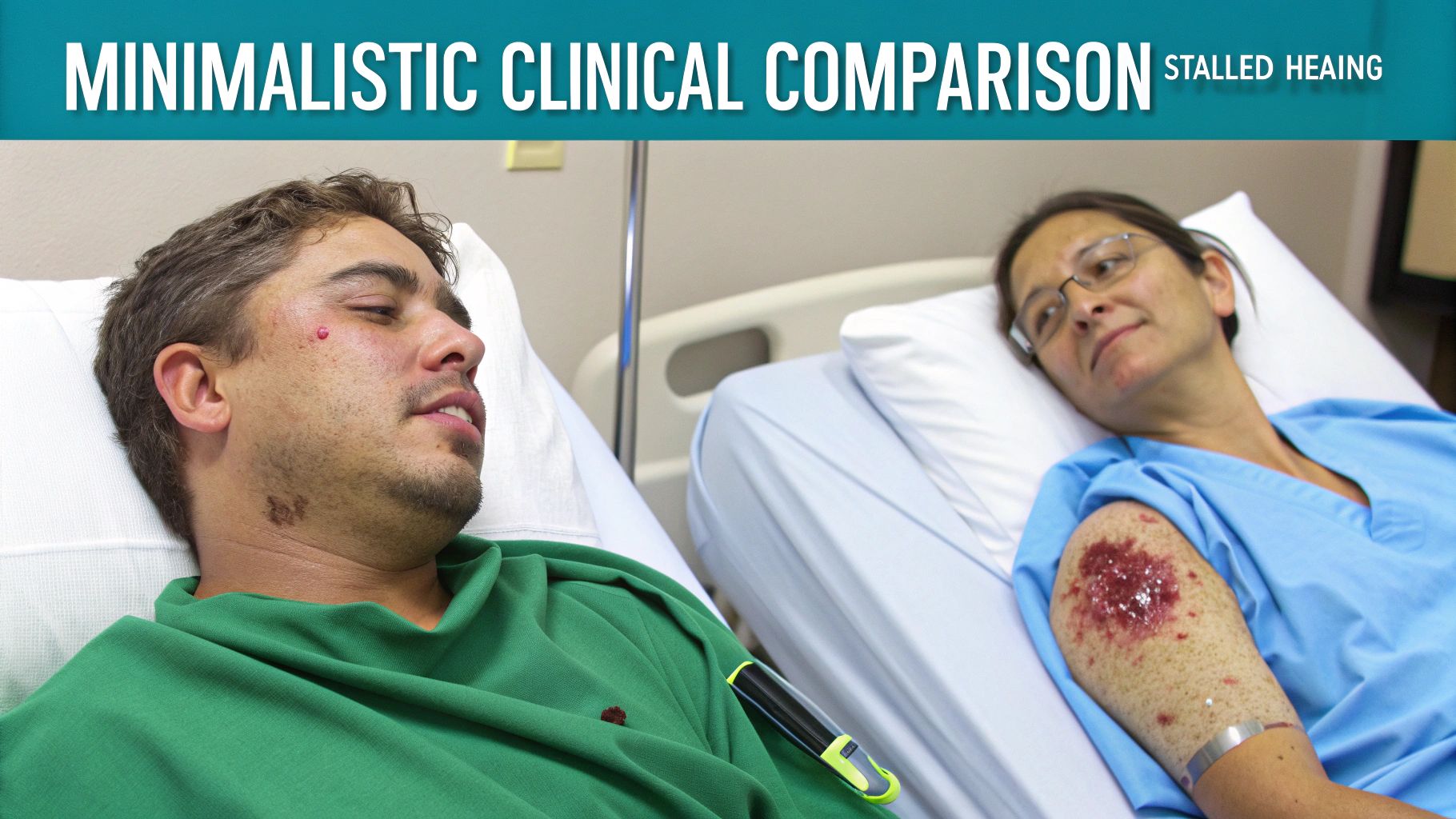
The ideal wound healing process is a beautifully choreographed sequence of repair. But what happens when the music stops and the whole process grinds to a halt? This is the frustrating reality of a chronic wound—one that has strayed from the expected path and gotten stuck.
Most often, this stall happens right in the middle of the inflammatory phase. Instead of a controlled, short-term cleanup, the wound gets trapped in a state of constant, low-grade inflammation. This environment is toxic to the cells trying to rebuild tissue, effectively putting the entire project on hold indefinitely. Spotting this shift from an acute, healing wound to a chronic, stalled one is a crucial clinical skill.
The Anatomy of a Stalled Wound
A stalled wound isn't just healing slowly; its very biology has changed. Several underlying issues can completely derail the normal healing cascade, locking the wound in a non-healing state. Understanding these culprits is the first step toward getting things back on track.
Three common reasons for a stalled healing timeline include:
- Biofilm Presence: This isn't just a few stray bacteria. Biofilm is a highly organized, protected community of microbes that creates a persistent inflammatory response the body can't clear. It effectively traps the wound in that initial inflammatory phase.
- Poor Perfusion: Healing is resource-intensive. It demands oxygen and nutrients, all delivered by the bloodstream. Conditions like peripheral artery disease or uncontrolled diabetes choke off that supply, starving the wound of the essentials it needs to start rebuilding.
- Systemic Disease: Chronic illnesses can directly interfere with healing. For instance, high blood sugar in diabetic patients messes with white blood cell function, while autoimmune disorders can create an over-the-top and prolonged inflammatory state.
From Acute to Chronic: A Clinical Shift
The transition from an acute to a chronic wound can be sneaky. A wound that seemed to be on a normal wound healing process timeline might just show less and less progress week after week. As a clinician, you have to be watching for the specific signs that signal this critical change.
By the book, acute wounds are expected to close within four to six weeks. Chronic wounds blow past this timeline, often getting stuck in the inflammatory or proliferative stages. This problem affects 6.5 million US patients a year, costing an estimated $96.8 billion as of 2023—a sobering figure for skilled nursing facilities and mobile wound programs. For a deeper dive into these numbers, you can review the comprehensive findings on the epidemiology and costs of chronic wounds from the National Center for Biotechnology Information.
This immense financial and clinical burden highlights just how important early detection is. The longer a wound stays stalled, the more complex and expensive its management becomes.
Identifying the Red Flags of Stalled Healing
Vigilant assessment is everything when it comes to catching a stalled wound early. You need to look for any deviation from the expected signs of healing, paying close attention to the wound bed, its edges, and the surrounding skin. These aren't just minor setbacks; they are clear indicators of a fundamental breakdown in the repair process. For more details, you can also check out our guide on how to properly interpret wound bed descriptions.
Key warning signs to watch for include:
- Lack of Progress: This is the most obvious one. If a wound shows no meaningful reduction in size over a 2-4 week period, something is wrong.
- Persistent Inflammation: Redness, swelling, and pain that hang around well beyond the typical 7-day inflammatory window.
- Poor Quality Granulation Tissue: Healthy new tissue should be beefy red and bumpy. If it looks pale, dusky, or friable (bleeds at the slightest touch), that's a bad sign.
- Epibole: The wound edges start to roll inward, stopping their migration across the wound bed. The body essentially gets confused and thinks the wound is closed, so healing stops dead in its tracks.
- Increased or Foul-Smelling Exudate: A sudden change in the amount, color, or odor of wound drainage often points to a high bacterial load or the presence of biofilm.
Recognizing these signs early gives you the chance to pivot your care plan, tackle the underlying cause of the stall, and restart the healing clock.
What Speeds Up or Slows Down Healing?
Ever wondered why two people with similar injuries can heal at completely different speeds? The answer is rarely just about the wound itself. It’s about the whole person—their health, their environment, and a whole host of other variables that can either put the brakes on healing or hit the accelerator.
Getting a handle on these factors is one of the most important things we do as clinicians. It's the difference between creating a plan that works and one that just spins its wheels. We generally break these influences down into two big buckets: things happening at the wound site (local factors) and things happening throughout the patient's body (systemic factors).
Local Factors: The Wound's Immediate Neighborhood
Think of the wound bed as a construction site. If the ground is constantly flooded, contaminated, or shaken by tremors, the crew can't get any work done. The same goes for our cells trying to rebuild tissue.
Here are a few key conditions at the wound site that can make or break the healing process:
- Moisture: This is a classic Goldilocks situation. Too dry, and cells shrivel up and die. Too wet, and the surrounding skin gets waterlogged and breaks down (a condition called maceration). We're always aiming for that "just right" moist environment where cells can move around and do their jobs.
- Infection & Biofilm: Bacteria, especially when they organize into a slimy, protective community called a biofilm, are a major roadblock. Their presence keeps the body stuck in the inflammatory phase, constantly cleaning up but never getting to the rebuilding stage.
- Pressure & Trauma: Any constant pressure, friction, or shear force is bad news. It crushes the fragile new blood vessels that are trying to form and physically disrupts the new tissue. This is exactly why offloading is absolutely non-negotiable for pressure injuries.
- Blood Flow & Oxygen: Healing tissue is hungry for oxygen. Anything that chokes off the blood supply to the area—like swelling or damaged blood vessels—effectively starves the cells of the fuel they need to repair and rebuild.
Systemic Factors: The Patient's Overall Health
Now, let's zoom out from the wound to the patient as a whole. If the body is the factory in charge of the repair project, these systemic factors determine if it has the right materials, enough power, and functioning equipment to get the job done.
Have you ever seen a wound where the edges just seem to roll inward and give up? That's called epibole, and it's a classic sign of a stalled wound. It's the body's way of saying, "I can't finish this job," often because a local or systemic problem hasn't been fixed.
Choosing the right dressing is important, but it's only half the battle. We have to address these bigger-picture health issues, too.
Common Systemic Roadblocks to Healing
A patient’s age, what they eat, and their other health problems have a direct line to every single phase of healing. A young, healthy person's body mounts a vigorous, efficient response. An older patient with several chronic conditions is starting from a much more challenging place.
Here are some of the heaviest hitters:
- Age: As we get older, our skin gets thinner, our circulation isn't always what it used to be, and our inflammatory response can become a bit sluggish. All of this naturally slows down the repair timeline.
- Nutrition: You can't build a house without bricks. The body can't build new tissue without the right building blocks, especially protein, vitamins A and C, and minerals like zinc. Healing is hard work and requires a ton of energy and resources.
- Chronic Conditions: Diseases like diabetes, peripheral artery disease (PAD), and autoimmune disorders can wreak havoc on healing. Diabetes, for instance, impairs both circulation and immune function, creating a perfect storm for wounds that refuse to close.
- Medications: Some drugs, like steroids, are designed to suppress inflammation, which unfortunately also puts the brakes on the first crucial stage of healing. Chemotherapy can also be a factor, as it affects the rapidly dividing cells needed for repair.
- Lifestyle: Smoking is a huge one. The nicotine in just a single cigarette causes blood vessels to clamp down, slashing oxygen delivery to the wound by as much as 30-40%.
By looking at the full picture—both what's happening at the wound and what's going on with the patient—we can build a much smarter, more effective plan. It’s about optimizing the whole system, not just treating the hole in the skin.
How to Accurately Track the Healing Journey
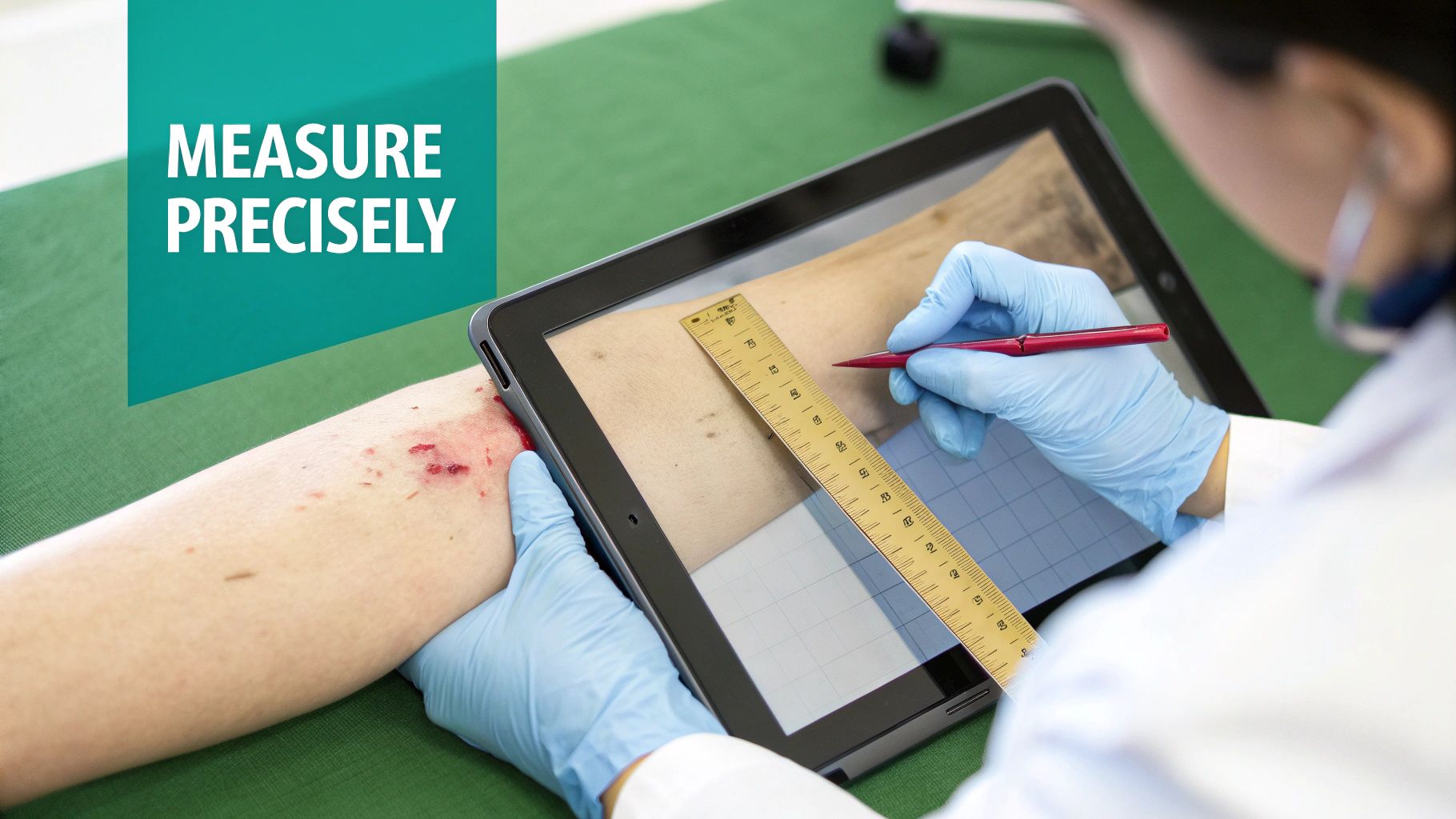
In modern wound care, just saying a wound "looks better" doesn't cut it. To truly manage the wound healing process timeline, we need meticulous and objective tracking. This isn't just about good clinical practice; it's the foundation for justifying our decisions, meeting regulatory standards, and securing reimbursement.
We have to move beyond subjective glances and adopt a systematic approach to documentation. This means capturing consistent, quantifiable data at every single assessment. Doing so builds an evidence-based story of the wound's journey—whether it's progressing, stalling, or getting worse.
The Core Metrics of Wound Documentation
Accurate tracking all starts with precise measurements and detailed observations. These are the building blocks of every assessment, giving us the raw data needed to see the full picture over time.
Think of these metrics as the wound's own set of vital signs.
Here are the key data points you absolutely must document every time:
- Dimensions: Always measure the length, width, and depth in centimeters. Consistency is king here, so stick to a standard like the "clock method"—measuring from 12-to-6 for length and 3-to-9 for width—to ensure your data is reliable week after week.
- Tissue Type and Percentage: Note the specific types of tissue in the wound bed—granulation, slough, eschar—and estimate the percentage of each. Seeing a shift from 80% slough to 60% granulation is a powerful, objective way to prove healing is on track.
- Exudate Amount and Quality: Describe the drainage. Is it scant, moderate, or copious? What does it look like—serous, sanguineous, purulent? A sudden change in exudate can be one of the first red flags for infection.
- Periwound Skin Condition: The skin around the wound is just as important. Document any redness, swelling, maceration (skin that's too moist), or epibole (where the wound edges curl inward), as these all tell part of the story.
Introducing Healing Velocity as a Key Indicator
While single measurements are crucial, the real insight comes from watching how they change over time. This is where the concept of healing velocity becomes a true game-changer. It's not just about how big the wound is today; it's about the rate at which its size is changing.
Healing velocity is simply the percentage of area reduction over a set period, usually calculated every two to four weeks. A wound that isn’t showing a 20-40% reduction in size within that window is likely stalled. That's our cue to reassess and change the treatment plan. This metric turns documentation from a chore into a powerful predictive tool.
Statistical data reveals that only 52% of chronic wound patients achieve full 100% healing by 20 weeks, underscoring the protracted timelines faced in clinical settings. This figure highlights how deviations from the ideal acute healing benchmark can balloon costs and complications, making velocity tracking essential for early intervention. You can explore the full study on wound closure rates in clinical trials to understand the data better.
This data-driven approach gives you a clear, defensible rationale for adjusting care, proving the need for advanced therapies, and demonstrating the value of your work to payers. Ultimately, solid documentation becomes your best advocate for getting your patients what they need. Exploring various wound assessment tools for nurses can help refine this process even further.
How AI Helps Predict and Standardize Healing
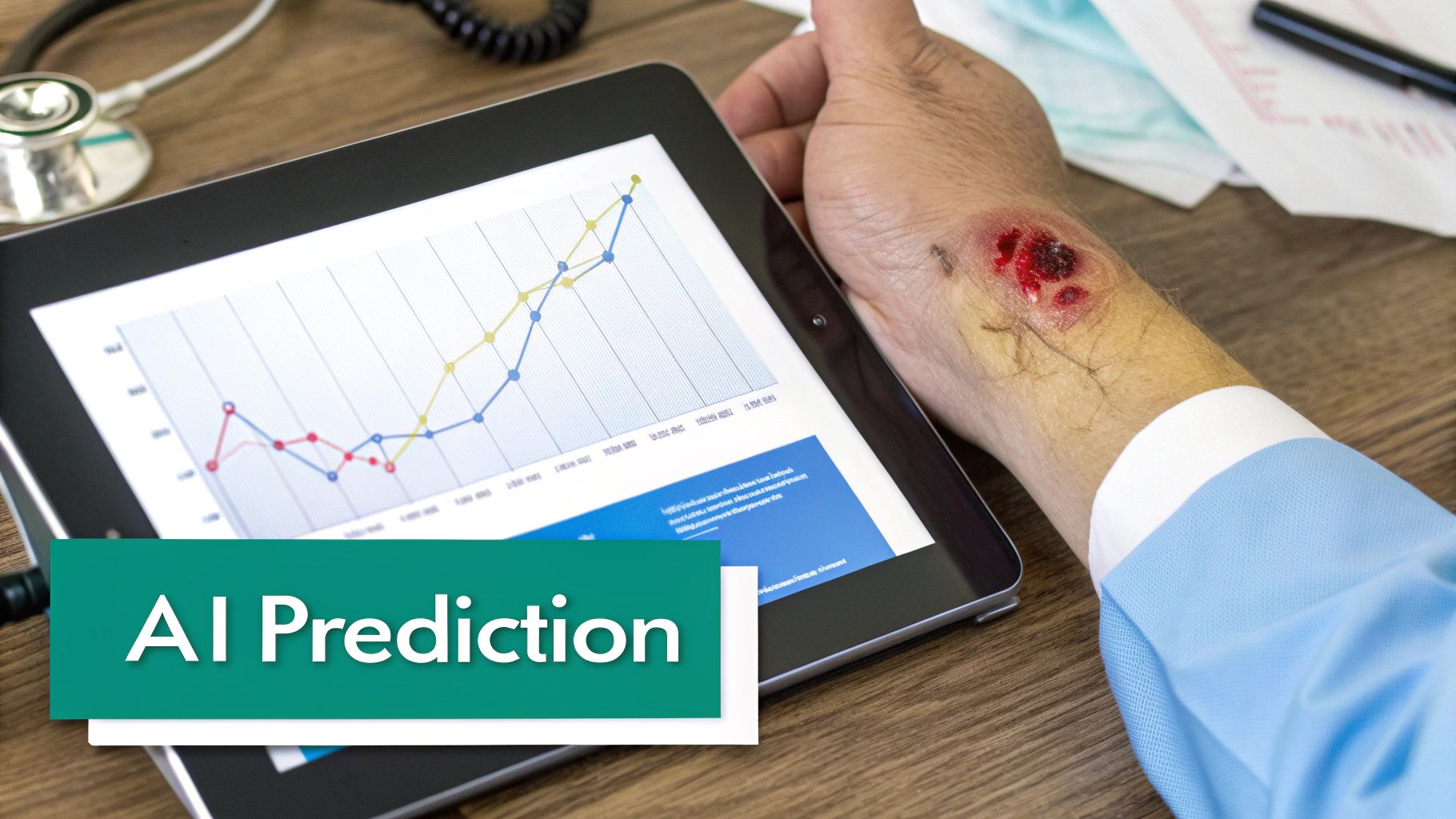
While tracking a wound by hand is fundamental, it has its limits. Assessments can be subjective, varying from one clinician to another, and tiny changes in a wound's healing path are easy to miss from week to week. This guesswork can delay crucial adjustments to the care plan, throwing off the patient's entire wound healing process timeline.
But what if we could take that guesswork out of the equation? What if we had an objective, data-backed look into the future of a wound?
That’s exactly where Artificial Intelligence (AI) is making a real difference. Modern AI tools are built to support clinicians, not replace them. They automate the tedious parts of documentation and deliver insights that were once out of reach, often using just a simple smartphone photo to bring a new level of precision to wound care.
Automating Measurements for Better Precision
One of the most practical benefits of AI is how it automates wound measurement. Forget about fiddling with paper rulers and trying to estimate tissue percentages. Now, a clinician can just take a clear picture, and the AI algorithm gets to work, instantly analyzing the image to deliver precise, objective data.
This leap forward brings a few key advantages:
- Consistency: Every measurement—length, width, depth, and surface area—is calculated the exact same way, every single time. This gets rid of the natural variation between clinicians, creating a reliable and standardized dataset.
- More Time for Patients: Measuring and documenting by hand eats up valuable time. AI does it in seconds, freeing clinicians to focus on what matters most: patient care and education.
- Incredible Accuracy: The technology can spot subtle shifts in size that the human eye might overlook, offering a much more detailed view of whether a wound is progressing or regressing.
By creating this standardized and objective record, AI builds a foundation of high-quality data. This information isn't just for looking back—it's the fuel for powerful predictive tools.
Visualizing the Healing Journey
Beyond just spitting out numbers, AI platforms are great at turning complex data into simple, intuitive visuals. They can generate graphs that plot the wound's size reduction over time, creating a clear picture of its healing velocity. This makes it incredibly easy for the whole care team—and even the patient—to see the healing journey at a glance.
AI doesn't just measure; it provides context. By comparing a wound's progress against thousands of data points from other cases, it can flag when a wound is falling behind the expected curve, allowing for early, proactive intervention.
This visual feedback loop is a powerful clinical tool. It helps clinicians spot a stalled wound much faster, prompting them to investigate potential problems sooner. Instead of waiting weeks to confirm that progress has stopped, they can see the trend developing in near real-time.
Forecasting Outcomes and Flagging At-Risk Wounds
Perhaps the most exciting part of AI in wound care is its ability to forecast outcomes. By analyzing trends in the data—like changes in size, tissue type, and other documented factors—machine learning models can predict the likelihood of a wound healing within a certain timeframe.
This predictive power is a game-changer for identifying at-risk patients. The system can automatically flag wounds that are in danger of becoming chronic or developing complications. This early warning gives clinicians a chance to step in and adjust the treatment plan before the wound gets worse.
This is how technology connects the dots between accurate documentation and better patient outcomes. By embracing these tools, we can shift from a reactive to a proactive approach to care, ensuring every patient has the best possible chance at a fast and full recovery. You can learn more about this by exploring the role of AI in wound analysis.
Common Questions About the Wound Healing Process
Even when you have the stages of healing down, practical questions always pop up during patient care. Let's tackle some of the most common ones I hear from clinicians and patients alike. This is your quick-reference guide for those moments when you need clear, actionable answers on healing speed, potential complications, and how other health issues play a role.
How Can You Differentiate Infection From Normal Inflammation?
Knowing the difference between normal, healthy inflammation and a brewing infection is one of the most critical judgment calls in wound care. I like to think of it as the difference between a well-managed construction site and a full-blown riot.
Normal inflammation is the body’s repair crew showing up to work. For the first 3-7 days, you should expect to see some localized redness, warmth, and mild swelling right around the wound. This is a good sign—it means the healing cascade is kicking off as planned.
An infection, however, is a hostile takeover. It’s an invasion of microbes that derails the entire healing process.
Here are the red flags that signal the problem has escalated from inflammation to infection:
- Spreading Redness: The redness starts creeping well beyond the wound's edges.
- Worsening Pain: The pain level is way out of proportion to the wound itself, and it might start throbbing or intensifying.
- Foul Odor or Pus: You see thick, discolored drainage (think yellow, green, or tan) or notice a distinctly unpleasant smell.
- Systemic Symptoms: The patient starts running a fever, gets the chills, or just feels generally sick.
While inflammation is a necessary first step on the healing timeline, an infection is a major roadblock that demands immediate medical attention.
What Is the Most Important Nutrient for Wound Healing?
While a well-rounded diet is always the goal, if you have to pick one MVP for wound repair, it’s protein. Hands down. Without enough of it, the entire construction project of healing grinds to a halt.
Think of it this way: you can't build a new wall without bricks. Protein provides the amino acids—the "bricks"—that are essential for every single phase of healing. These building blocks are non-negotiable for cell growth, a strong immune response, and especially for creating collagen, the very scaffolding that holds new tissue together.
When the body is dealing with a significant wound, its metabolic needs can skyrocket. A protein deficit can directly stall the proliferative and remodeling phases, leaving the wound bed stuck and unable to fill in and mature.
As clinicians, we have to assess the nutritional status of patients with chronic or complex wounds. Their protein requirements are often far higher than a healthy person's, and supplementation is frequently needed to supply the raw materials for a successful healing timeline.
Why Do Diabetic Wounds Heal So Slowly?
Diabetic wounds are notoriously stubborn because they're up against a "triple threat" that sabotages the healing process from multiple angles. This combination creates a perfect storm for wounds that can linger for months, or even years.
First, persistently high blood sugar (hyperglycemia) makes blood vessels stiff and narrow. This drastically reduces the flow of oxygen-rich blood and vital nutrients to the wound, essentially starving the repair cells of the fuel they need to do their jobs.
Second, many people with diabetes develop neuropathy, or nerve damage, which numbs the feeling in their feet. An injury like a small cut or blister can go completely unnoticed, leading to repeated trauma to the same spot without the person even knowing it's there.
And third, hyperglycemia hobbles the immune system. The body's white blood cells become sluggish and less effective at fighting off bacteria. This keeps the wound stuck in the inflammatory phase and makes it incredibly vulnerable to infection. It’s this trifecta of poor circulation, nerve damage, and a weak immune defense that makes diabetic foot ulcers such a massive clinical challenge.
How Long Does It Take for a Scar to Fully Mature?
The final phase of healing—remodeling or maturation—is a marathon, not a sprint. While it kicks off around week three, the whole process can take anywhere from one to two years to finish completely.
During this long stretch, the body is hard at work replacing the disorganized, weaker Type III collagen that was laid down in a hurry with much stronger, more organized Type I collagen. This slow-and-steady swap is what allows the scar to gradually flatten, soften, and fade.
It's so important to set realistic expectations with patients here. Even after a scar is fully mature, the new tissue will only ever regain about 80% of the original skin's tensile strength. This long timeline is why continued care—like protecting the area from the sun and keeping it moisturized—is crucial for many months after the wound looks "closed" on the surface. It helps patients understand that their new skin is still delicate and needs looking after.
Take control of your wound care documentation and get back to what matters most. Ekagra Health AI uses advanced, AI-powered technology to streamline your entire workflow, from voice-powered charting to automated billing. Reduce your documentation time by up to 70% and gain predictive insights to improve patient outcomes. Discover a smarter way to manage the wound healing journey.
