
Home health wound care isn't just about changing a bandage. It's about bringing a high level of specialized medical treatment right into a patient's living room, turning what was once a hospital-based procedure into a comfortable, in-home experience. This model is crucial for managing chronic wounds, helping patients recover after surgery, and preventing serious complications for those who are homebound. It's a powerful blend of skilled nursing services and hands-on patient education, creating an environment where healing can happen faster and more effectively.
The Growing Importance of At Home Wound Care
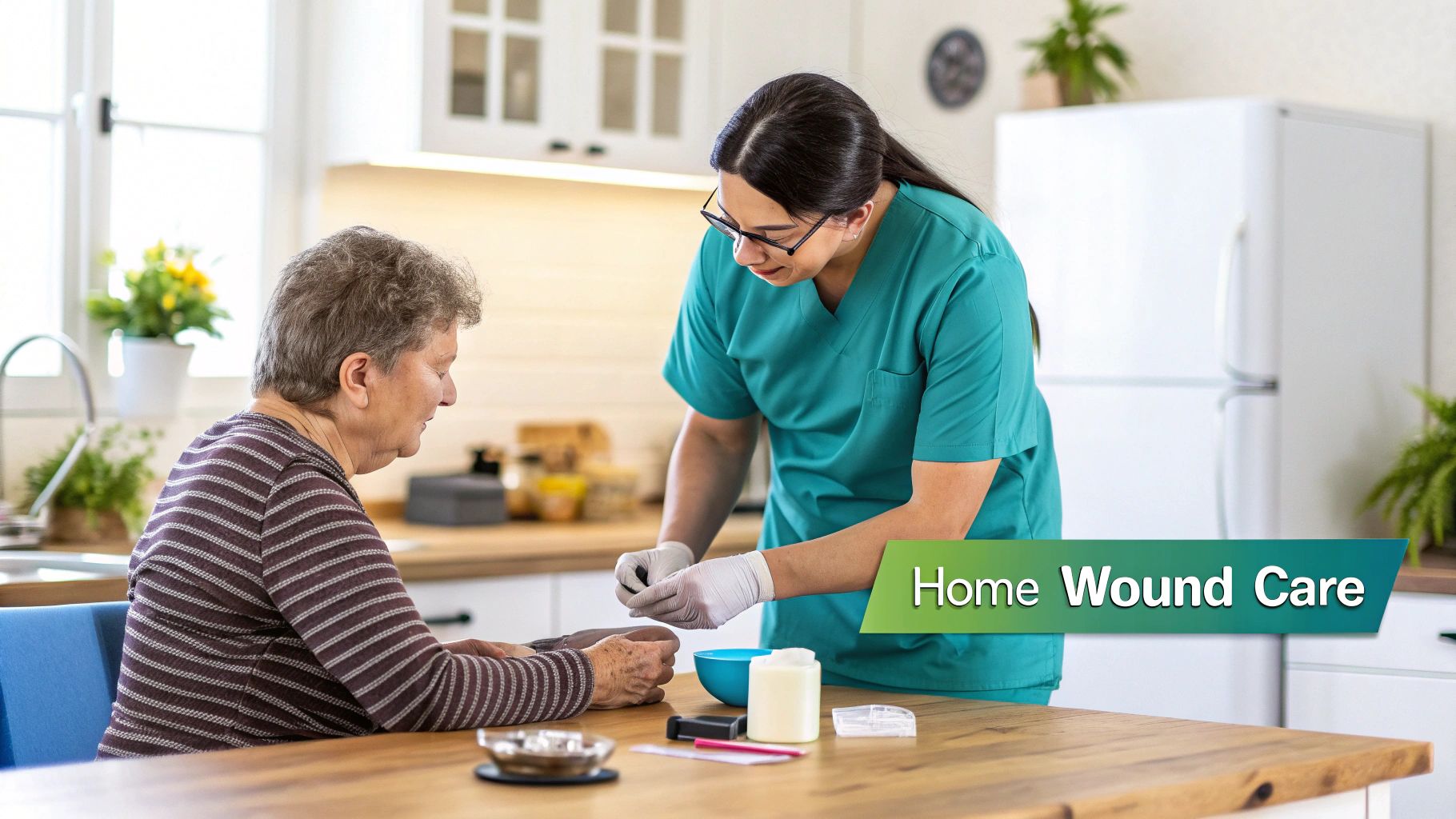
Picture a clinician providing hospital-grade care right at a patient's kitchen table. This is the modern reality of home health wound care, a service that has become a vital part of today's healthcare system. This isn't just a convenient alternative; it's a fundamental shift driven by an aging population and the growing complexity of medical issues being managed outside of a clinic.
This move is picking up steam as providers and health systems see the clear clinical and financial wins of treating people where they're most comfortable. For many patients, especially those with mobility challenges or long-term illnesses, getting to a clinic for regular appointments is a major hurdle. Home health simply removes that barrier.
The shift toward treating patients at home isn't happening by chance. It's propelled by a combination of demographic trends, clinical needs, and economic pressures that are fundamentally changing the landscape of healthcare. The table below breaks down the primary forces at play.
Key Drivers of the Shift to Home Health Wound Care
| Driving Factor | Description | Impact on Home Health |
|---|---|---|
| Aging Population | The number of older adults, particularly those over 65, is rapidly increasing, leading to a higher prevalence of chronic conditions that cause wounds. | Greater demand for skilled nursing to manage conditions like venous ulcers and pressure injuries in a comfortable, accessible setting. |
| Rising Chronic Disease | Conditions like diabetes and vascular disease are major contributors to non-healing wounds. These require ongoing, consistent management. | Home health is the ideal model for long-term wound surveillance and treatment, preventing complications that lead to hospitalization. |
| Healthcare Cost Pressures | The system is focused on reducing expensive hospital stays and readmissions. Treating wounds at home is far more cost-effective. | Payers and providers are incentivized to use home health to lower overall care costs, avoid ER visits, and manage patients efficiently. |
| Patient Preference | Overwhelmingly, patients prefer to recover in the familiar and less stressful environment of their own homes. | Higher patient satisfaction and engagement in their own care plans, which often leads to better clinical outcomes and faster healing. |
These factors work together, creating a perfect storm that makes home-based care not just a preference but a necessity for a growing number of patients.
The numbers really tell the story. The home healthcare market is expected to expand at a compound annual growth rate of around 6.9%, a boom fueled largely by the rise in chronic wounds. Think about it: diabetic foot ulcers affect 1.5 million Americans every year, and pressure ulcers impact an incredible one in six Medicare beneficiaries. More and more, these are being managed at home as hospital stays get shorter and our population gets older. You can dive deeper into these market trends in a detailed report from Grandview Research.
The core principle of home health wound care is continuity. It bridges the gap between hospital discharge and full recovery, ensuring patients receive the expert attention needed to prevent setbacks and promote healing.
For today’s clinicians, mastering the skills needed for top-tier home health wound care is no longer just a "nice-to-have." It’s become a core competency for meeting the demands of a changing patient population and delivering value-based care that is both effective and efficient.
How To Perform Accurate Wound Assessments At Home
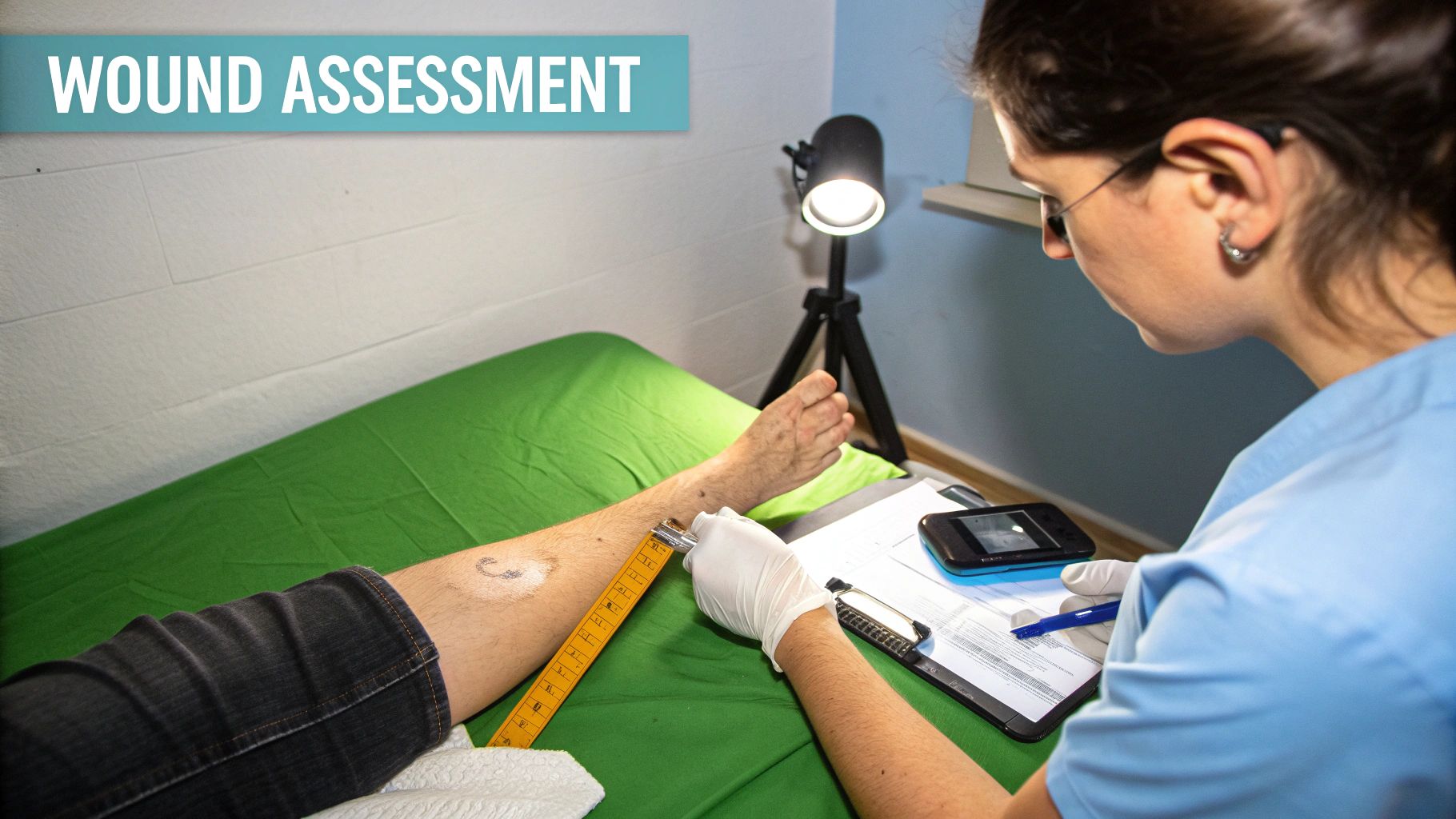
Bringing wound assessment into a patient’s bedroom introduces its own set of hurdles. The lighting isn’t perfect, and the surfaces you work on can be anything from a bedspread to a dining table. Still, precision is non-negotiable. In home health wound care, your evaluation forms the backbone of every treatment decision and even shapes how payers view your care. Think of your first assessment as drawing a treasure map. Without that first line, there’s no way to chart progress or know when it’s time to change course.
Beyond patient care, thorough documentation is a shield. When you capture every detail, you not only support clinical decisions but also secure your agency’s reimbursement.
The Core Components Of An In-Home Assessment
A reliable routine always helps when you’re working in less-than-ideal conditions. By moving step by step, you make sure nothing slips through the cracks.
- Location: Use specific anatomic terms—say “medial aspect of the right lower leg, 5 cm superior to the malleolus” rather than a vague “leg.”
- Dimensions: Measure length (12 o’clock to 6 o’clock), width (9 o’clock to 3 o’clock), and depth in centimeters to track healing over time.
- Wound Bed: Note tissue types and their percentages—granulation (red, bumpy), slough (yellow, stringy), eschar (black, leathery).
- Exudate: Record amount (scant, moderate, copious), color, and consistency—serous (clear), sanguineous (bloody), purulent (pus).
- Periwound Skin: Examine surrounding skin for signs of maceration, erythema, or induration.
Accurate documentation is not just about compliance; it’s the clinical evidence that demonstrates medical necessity. Each detailed note supports the treatment plan and validates the level of care being provided.
Documenting For Continuity And Reimbursement
Your progress notes are more than just a diary of visits. They’re the bridge between you, the next clinician, and the payer. Vague phrases like “wound looks better” won’t cut it. Instead, give concrete numbers—say, “Wound length decreased from 4.2 cm to 3.8 cm and granulation tissue climbed from 60% to 75%.”
For standardizing this process, check out different wound assessment tools for nurses that offer frameworks and tech to keep your notes consistent. When you tie every observation back to an action—changing a dressing, prescribing a therapy—you improve outcomes, maintain continuity, and ensure the financial health of your agency.
Choosing the Right Treatment and Dressing Strategy
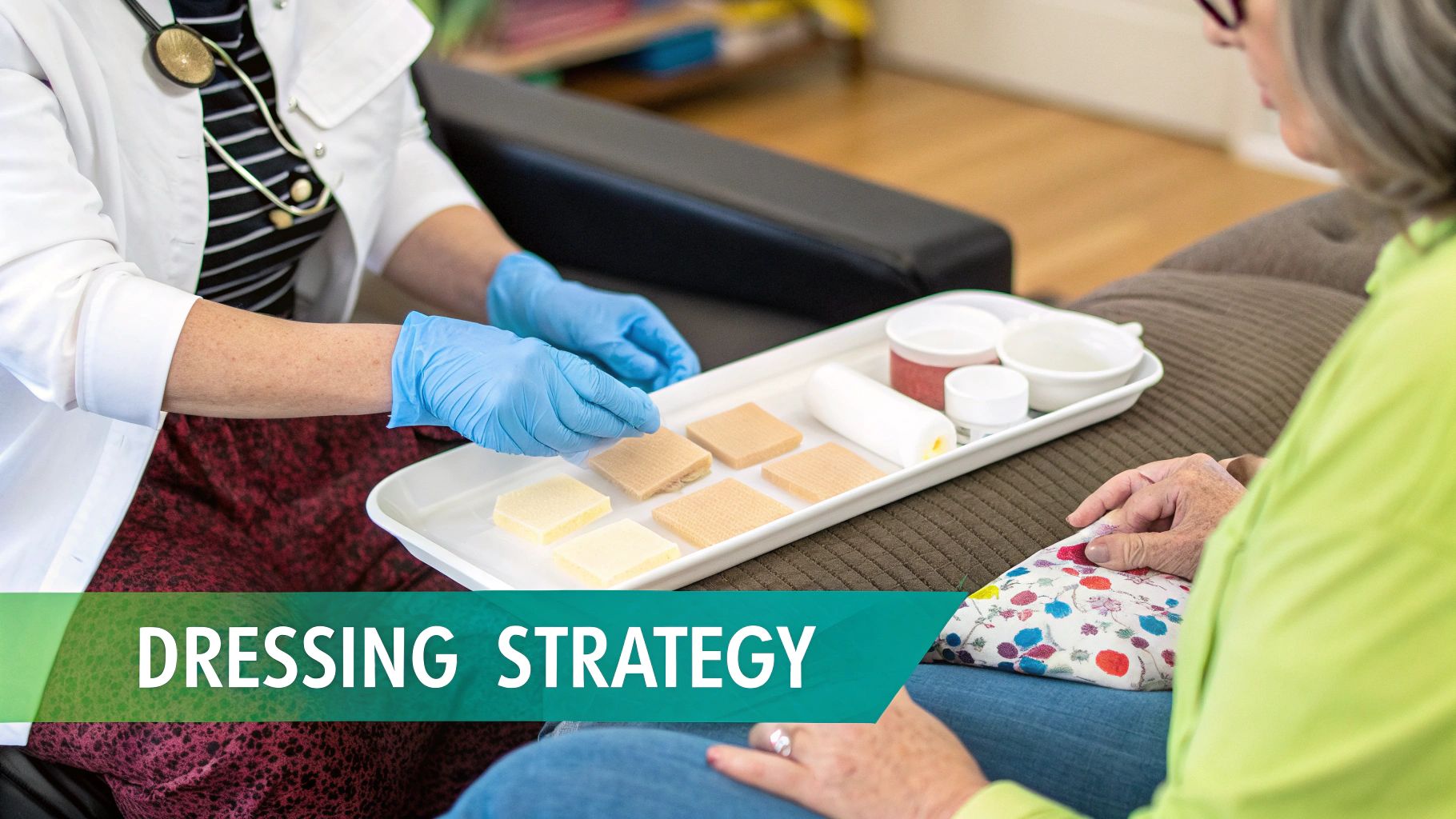
Think of wound dressings like tools in a highly specialized toolbox. You wouldn't use a hammer to turn a screw, and you shouldn't use a simple film dressing on a heavily draining wound. In home health, picking the right tool for the job is what separates a healing wound from a stalled one.
Once you’ve done a thorough assessment, the goal is to match the dressing’s function to the wound's specific needs. A wound with heavy exudate is crying out for something with high absorbency, while fragile, paper-thin skin needs a dressing with gentle adhesion. It’s all about moving beyond a one-size-fits-all approach and toward a truly tailored solution.
Comparing Common Dressing Types
Making a quick, confident decision often comes down to knowing the basics. Here’s a quick-glance guide to help narrow down the options based on what the wound is telling you.
| Dressing Type | Key Benefit | Ideal Use |
|---|---|---|
| Hydrocolloids | Maintain a moist barrier | Shallow wounds with low to moderate exudate |
| Foams | High absorbency and cushioning | Moderate to heavy exudating wounds |
| Alginates | Gel formation locks in fluid | Heavily exudating wounds with irregular shapes |
| Films | Transparent protection and monitoring | Superficial wounds needing observation |
This isn't just a checklist; it's a starting point. The key is to reassess at every visit. As the wound changes, the dressing should change with it. Staying with the same product for too long is a common reason for healing to plateau.
Advanced Therapies That Work At Home
Negative Pressure Wound Therapy (NPWT) isn’t just for hospitals anymore. Thanks to smaller, portable devices, you can bring this powerful therapy right into a patient's home. These systems apply continuous, gentle suction to pull fluid away from the wound bed and help draw the edges closer together, often reducing dressing changes to just every 48 hours.
So, when should you consider NPWT?
- The wound has copious exudate that standard dressings just can't handle.
- The patient can tolerate a small, portable suction device without significant discomfort.
- There's reliable access to a power source or a way to keep batteries charged.
- The skin surrounding the wound is healthy enough to form an airtight seal.
“Portable NPWT completely changed the game for one of my patients. We went from a stalled, draining wound to visible progress in a week. It was incredible to see.”
— Melissa R., RN, Home Health Wound Care Specialist
Getting caregivers comfortable with the pumps and alarms is crucial. A simple checklist and a few hands-on practice sessions can build their confidence and ensure the therapy works as intended.
Empowering Family Members in Wound Care
The care you provide during a visit is only part of the equation. Engaging the patient's family or support system is how you ensure that care continues around the clock. The best way to do this is with clear instructions and hands-on demonstrations.
Start with the "why"—explaining the reason behind a particular dressing helps them understand its importance.
Key Training Steps:
- Demonstrate how to open packaging without contaminating the dressing.
- Show the right technique for gently removing old dressings to avoid skin tears.
- Teach them how to apply the new dressing smoothly and secure it without tension.
- Review the red flags—signs of infection or dressing failure—and emphasize when to call for help.
Role-playing the entire process is a fantastic way to make sure the information sticks. Encourage them to ask questions and repeat the steps until they feel completely at ease.
Dressing Change Frequency and Adaptation
Figuring out how often to change a dressing isn't a guess—it's a clinical decision based on the dressing type and the wound's behavior. Changing a foam dressing every couple of days prevents the surrounding skin from getting waterlogged and breaking down.
Here are some general guidelines to keep in mind:
- Hydrocolloids can often stay in place for 3 to 5 days, as long as the seal is intact.
- Foam dressings on heavily draining wounds may need to be changed every 1 to 3 days.
- Alginates turn to a gel as they absorb fluid and usually require a daily change, or sooner if saturated.
- NPWT canisters and dressings are typically changed every 48 to 72 hours, depending on the manufacturer's instructions.
A smart dressing strategy doesn’t just fix the immediate problem; it anticipates the wound's next move. By combining standard dressings with advanced therapies when needed, you create a dynamic care plan that fosters consistent, predictable healing.
Mastering Infection Control and Patient Education
Infection control looks a lot different in a patient's living room than it does in a hospital. We can't create a truly sterile field, and we shouldn't try to. The real goal in home health wound care is to build a strong defense against infection by teaching practical, repeatable habits that fit into a person's daily life.
It all starts with flawless hand hygiene, of course. But it also means knowing how to handle used supplies and spotting risks in the home environment. The biggest difference-maker, though? Turning the patient and their family into your partners. When they know what to do and what to look for, they become the most effective first line of defense.
Non-Negotiables For Home Infection Prevention
Think of your infection control strategy as a series of small, manageable firewalls. Each one helps contain the risk. In a home, these firewalls are simple, practical actions that anyone can master with the right coaching.
Here are the core practices to drill down with every patient and caregiver:
- Hand Hygiene Mastery: This isn't just a quick rinse. Emphasize the 20-second rule using soap and warm water, both before and after touching the wound or its dressings. If soap and water aren't an option, a hand sanitizer with at least 60% alcohol is the backup plan.
- Creating a Clean Workspace: Have them pick one spot for dressing changes—a cleared-off kitchen table or a sturdy TV tray works great. The key is to wipe the surface with a disinfectant wipe before laying out supplies and again after cleaning up.
- Safe Supply Management: Show them where to keep fresh supplies—a clean, dry drawer or a plastic bin, away from pets and bathroom humidity. After a dressing change, all used materials should be sealed in a plastic bag before going into the regular trash.
The point isn't to mimic a hospital operating room. It's to establish a "clean field" that's realistic for a home setting. This simple, practical mindset is incredibly effective at lowering the risk of introducing new bacteria into the wound.
Turning Patients Into Your First Line Of Defense
Your time in the home is critical, but the real battle against infection happens in the hours and days between your visits. That’s why patient education can't just be a list of instructions. It's about building their confidence and making them feel like a true partner in their own care.
An empowered patient who understands the why behind the what is your best ally. I always teach them to become wound detectives, looking for subtle clues that something is changing. Don't just tell them to watch for redness; explain that increased warmth is a sign their body is rushing infection-fighting cells to the area. This helps the concept stick.
Teaching The Early Warning Signs
Give patients and their families a simple, clear checklist of what to watch for. It removes the guesswork and gives them the confidence to call you when something feels off.
Key Signs to Teach:
- Increased Pain: Is the pain suddenly worse than it was yesterday? Is it a new kind of sharp or throbbing pain?
- Redness or Swelling: Look at the skin around the wound. Is the red area getting bigger, like a spreading stain?
- Changes in Drainage: Is there more drainage than usual? Has the color shifted to a cloudy yellow or green? Pus is a classic red flag, and explaining if pus is a sign of infection is essential knowledge.
- Unpleasant Odor: A new or foul smell coming from the wound, especially after it's been cleaned, is a major warning sign.
- Fever or Chills: If the patient starts feeling sick, running a fever, or getting chills, the infection might be spreading. This requires an immediate call.
When you teach them to spot these signals early, you give them the power to alert you before a small problem becomes a trip back to the hospital. This proactive partnership is the heart of successful home health wound care.
How AI Is Changing the Game in Wound Care Documentation
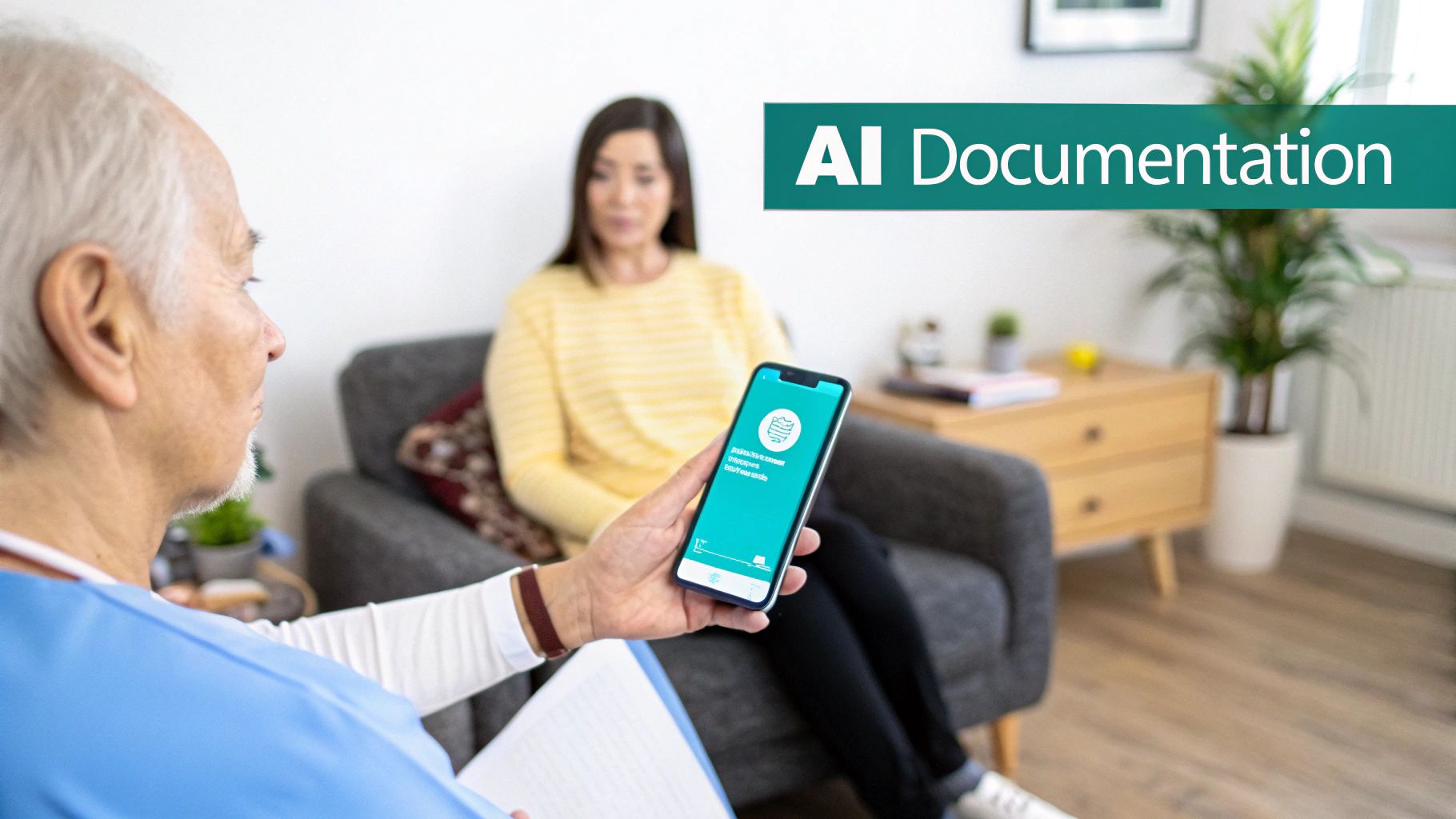
Imagine walking out of a patient's home with 90% of your charting done—not just done, but accurate and ready for billing. This isn't some far-off dream. It's what Artificial Intelligence (AI) is making possible for home health wound care right now. The paperwork burden is a huge contributor to clinician burnout, eating up time that should be spent with patients.
AI-powered tools are built to tackle this exact problem, taking over the most repetitive and time-consuming parts of documentation. Think of it as a direct line from your spoken words to a finalized insurance claim. The tech works quietly in the background, so your focus stays where it belongs: on the person in front of you.
From Spoken Words to Structured Notes
It all starts with something called ambient clinical intelligence. As you assess a wound, you can simply talk through your findings naturally. An AI system, usually running on a simple phone or tablet app, listens in. But it does more than just record your voice. It actively sorts through what you're saying to pull out the critical clinical details. For instance, if you say, "The pressure injury on the left heel is a stage two, measuring four by three centimeters with scant serous drainage and about 50% granulation tissue," the AI instantly gets to work.
It understands the clinical context, populating the right fields in the EHR with the correct measurements, tissue types, and drainage descriptions. This simple step completely removes the need to spend hours after your visits typing everything up from memory. Even with this automation, it helps to have a good framework. You can see how these automated systems align with best practices by looking at a solid wound care documentation template.
Automating Measurements and Analysis
One of the trickiest parts of home health wound care is getting consistent and precise wound measurements visit after visit. The lighting in a patient's home is never perfect, and small variations between clinicians can creep in. AI brings a whole new level of consistency here.
Using just a smartphone camera, you can snap a photo of the wound, and the AI platform takes it from there. The system analyzes the image to perform a few key jobs:
- Automated Measurements: It instantly calculates the wound's length, width, and surface area. This gives you objective data, free from guesswork.
- Tissue Identification: Smart algorithms can identify and even quantify the different tissue types in the wound bed—like granulation, slough, or eschar.
- Healing Progression: By comparing images from each visit, the AI creates clear visual charts that track whether the treatment plan is actually working.
This visual data is powerful, objective proof of medical necessity that strengthens your documentation for reimbursement and holds up under audits. It helps shift wound assessment from a subjective art to a more data-driven science.
A Smoother Path to Reimbursement
Great clinical notes are only one piece of the puzzle. They have to be coded correctly to ensure your agency gets paid for the care you provide. This is another area where AI is a huge help. After creating the structured note and analyzing the wound, the system can automatically suggest the right CPT and ICD-10 codes.
By directly linking your clinical findings to the corresponding billing codes, AI acts as a built-in safety net. It helps prevent common coding mistakes, lowers the risk of claim denials, and speeds up the entire revenue cycle.
The AI essentially cross-references the wound's characteristics—its type, location, severity—with the most current coding rules. This makes sure the claim you submit is a true reflection of the complex care delivered. For any busy home health agency, this kind of automation can be the difference between a reliable revenue stream and a constant battle with rejected claims. By taking on the heavy administrative lifting, AI frees up clinicians to focus on what they do best: delivering compassionate, expert care. This technology doesn't replace a clinician's judgment; it enhances it with powerful tools that make home health wound care more efficient, precise, and sustainable.
Getting Paid: A Practical Guide to Wound Care Billing and Reimbursement
Great clinical work is the heart of home health, but if you're not getting paid for it, your agency simply can't survive. The maze of medical billing can feel overwhelming, but mastering the basics can turn your revenue cycle from a constant headache into a reliable source of funding for the care your patients need. It all boils down to one core idea: your clinical notes have to perfectly match your billing codes. Every measurement, observation, and treatment you document is the evidence that justifies the claim you submit. Think of yourself as building a rock-solid case for every single visit.
Cracking the Code: CPT and ICD-10
Proper coding starts with using the right tools for the job. In wound care, your two most important toolkits are ICD-10-CM codes, which explain why you're providing care (the diagnosis), and CPT codes, which detail what you did (the services). When it comes to ICD-10, specificity is everything. A generic code for a "non-healing wound" is practically an invitation for a denial. You need to be much more precise, like "stage 3 pressure ulcer of the right heel." One is vague; the other tells a clear story. The same goes for CPT codes. If you're billing for selective debridement (97597), your notes better describe the process of removing non-viable tissue. The documentation is your proof.
The golden rule of reimbursement is simple: if you didn't document it, you didn't do it. A payer can only see what's in the chart. Clear, detailed notes are your number one defense against claim denials and audits.
Sidestepping Common Denial Traps
Nothing stalls cash flow like a denied claim. The good news is that most rejections aren't random; they usually come from a handful of common, fixable mistakes. Getting familiar with these pitfalls is the first step to avoiding them altogether. Here are some of the biggest reasons wound care claims get kicked back:
- No Proof of Medical Necessity: Your notes have to scream "this was absolutely necessary." Just writing "dressing changed" won't cut it. Instead, explain why it needed changing: "dressing changed due to heavy serosanguinous drainage, foam dressing applied to manage exudate."
- Wrong or Old Codes: Code sets get updated every year. Using a deleted or overly general code is a surefire way to get a denial. This makes regular training for both clinicians and billers non-negotiable.
- Vague Documentation: As we've said, payers need the details. Forgetting to document wound dimensions, tissue types present in the wound bed, or signs of infection makes your claim weak and easy to question.
How Automation Becomes Your Financial Safety Net
Let's be realistic—no one has time to manually triple-check every single detail on every claim. That's where automated systems come in, acting like a pre-submission checklist to catch errors before they cause problems. These platforms are built to spot mismatches before a claim ever leaves your system. For instance, the software can flag a claim that includes a CPT code for debridement but has no corresponding note from the clinician about removing devitalized tissue. This gives you a chance to fix it, not fight a denial later. By automatically checking codes against your notes and flagging common mistakes, these systems help you submit a clean claim the first time. It's a straightforward step that dramatically cuts denial rates, speeds up payments, and ultimately makes your home health wound care agency more financially stable.
Your Top Home Health Wound Care Questions, Answered
When you're dealing with home health wound care, questions are bound to come up. Whether you're a clinician on the front lines, a patient's family member, or an agency administrator, getting straight answers is crucial. Let's tackle some of the most common questions we hear in the field.
Who Is a Good Candidate for Home Health Wound Care?
Not everyone with a wound needs care at home. The best fit is usually someone who is officially considered homebound—meaning it takes a significant, taxing effort for them to leave the house. This is a key qualifier for Medicare and most private insurance plans.
Beyond that, the patient must have a clear medical need for skilled nursing. Think of someone recovering from surgery, an individual with a chronic diabetic foot ulcer, or a patient with pressure injuries that require a professional's touch to heal properly and avoid serious complications.
How Is Home Health Different from Palliative or Hospice Care?
It's easy to get these mixed up since they all happen in the home, but their core goals are very different. Home health is all about active treatment and recovery. Our mission is to heal the wound, get the patient back on their feet, and help them regain as much independence as possible.
Here's the distinction:
- Palliative care focuses on improving the quality of life for someone with a serious illness. They might manage wound-related pain, for instance, but healing the wound itself isn't always the main objective.
- Hospice care is reserved for patients with a terminal diagnosis. The entire focus shifts away from curative treatment to providing comfort and preserving quality of life in their final days.
What Role Does Technology Play in Modern Home Care?
Technology has become an indispensable partner in providing great home health care. Secure mobile apps are now standard, letting clinicians chart right at the bedside, capture precise digital wound measurements, and pull up patient histories in seconds. This cuts down on paperwork and makes our assessments far more accurate.
Telehealth platforms have also been a game-changer. They allow us to do virtual check-ins between visits, which is perfect for monitoring progress, answering a family's quick question, or spotting a potential problem before it escalates—all without the need for a full in-person appointment.
There's a lingering myth that home care is somehow "less advanced." The reality is that with portable diagnostic tools and AI-powered documentation platforms, we can deliver sophisticated, data-driven care right in the patient's living room.
Ekagra Health AI helps your team manage the entire home health wound care process, from voice-powered documentation to automated billing. Our platform can reduce administrative tasks by up to 70%, giving clinicians more time to focus on what truly matters: patient healing. Discover a smarter workflow at Ekagra Health's website.
