
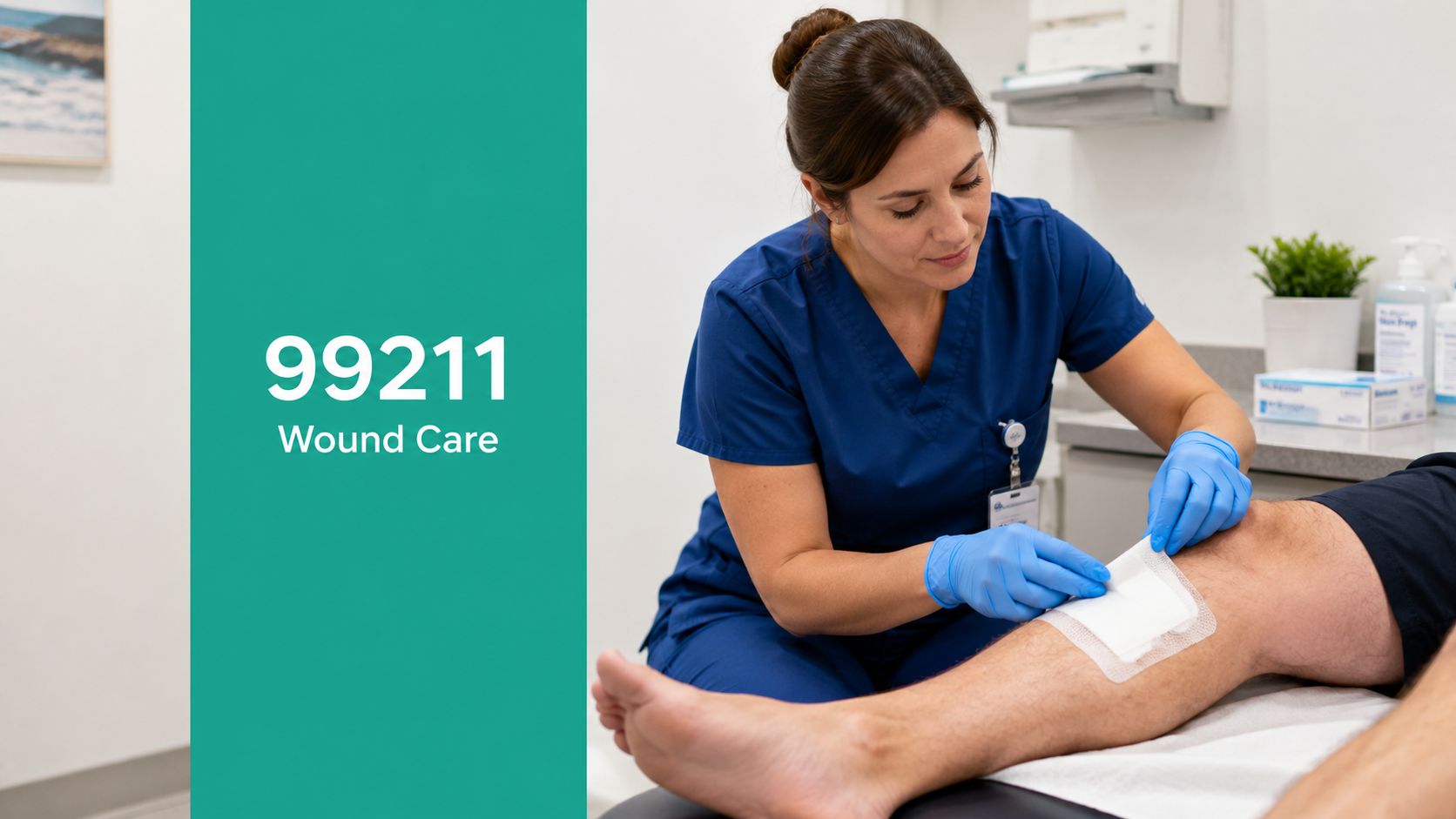
Your RN has a patient on the schedule for a venous leg ulcer wrap change. Established patient. Compression is in place. Drainage is about what it was last visit. No pain spike, no odor, no new erythema, no call to the physician, no plan change. The nurse removes the old wrap, looks at the wound, measures it, reapplies dressing and compression, and sends the patient out.
That's the visit where people start arguing about the 99211 CPT code.
In wound care, 99211 lives in the gray zone between a real, billable low-level E/M service and routine clinical work that should stay bundled with dressing care or procedure work. New clinicians often think, “It was face to face, nursing staff did an assessment, so bill it.” Payers often see it differently. If the chart reads like task completion instead of evaluation and management, expect denial risk.
If you need a broader refresher on office visit coding before getting into wound-specific nuance, this quick primer on what E/M codes are is worth a look. For the trenches of wound clinic billing, though, the issue is narrower: did the visit answer a clinical question and lead to a management action, or did staff just perform routine wound care?
Table of Contents
- The Common 99211 Question in Every Wound Clinic
- What CPT 99211 Is and What It Is Not
- Defensible 99211 Scenarios in Wound Care
- How to Document a Bulletproof 99211 Note
- Payer Traps and High-Risk Audit Triggers
- Choosing Between 99211 and Higher-Level E/M Codes
- Key Takeaways for Compliant 99211 Billing
The Common 99211 Question in Every Wound Clinic
A lot of wound clinics run on serial follow-up. That's normal. Venous ulcers need compression checks. Diabetic foot ulcers need close surveillance for drainage changes, offloading tolerance, and early infection clues. Pressure injuries need repeated reassessment of periwound skin, maceration, undermining, and caregiver adherence.
The trouble starts when people confuse frequent with separately billable.
Take a stable venous ulcer patient coming in for a scheduled nurse wrap change. If the note says the wound was inspected, measured, redressed, and wrapped per prior orders, that usually reads like routine wound care. It doesn't automatically become a 99211 just because a nurse documented it. In my experience, that's one of the most common weak claims in wound practice.
The visit has to do more than move the patient through protocol
What makes a 99211 defensible is a narrow but real E/M component. There needs to be a reason for reassessment and some management action tied to what staff found. That action can be modest. Continue the current plan because compression tolerance is good. Escalate because exudate has increased. Hold a dressing product because the periwound is breaking down. Reinforce edema control because the patient's wrap slipped and swelling increased.
If the note could be copied onto every routine dressing change on your schedule, it probably won't hold up as a 99211.
That boundary is exactly where wound clinicians struggle. The problem isn't lack of work. The problem is whether the work was evaluation and management rather than a bundled task.
What CPT 99211 Is and What It Is Not

The basic definition that matters in clinic
CPT 99211 is the lowest-level office or outpatient E/M code for an established patient. Guidance also describes it as a minimal visit, usually around 5 minutes or less, and it may be billed for a brief face-to-face service that doesn't require the physician in the room, as long as the service is medically necessary and the supervising physician is present in the office. That framework is laid out in this summary of CPT 99211 office visit guidance.
That matters in wound care because many low-acuity follow-ups are nurse-driven. A short check for increased exudate. A compression tolerance reassessment. A same-day look after selective debridement when the issue is whether the patient is tolerating the dressing plan and no new decision making is needed from the physician.
Two operational points matter:
- Established patient only: The patient must have had professional services from the physician or same specialty group within the prior 3 years.
- Face-to-face service: This isn't for phone calls, refill requests, chart updates, or paperwork.
What 99211 does not cover
Where people get sloppy is treating 99211 like a “nurse visit” code for anything quick. It isn't.
It's not your default code for:
- Routine dressing changes done exactly as already ordered
- Administrative follow-up like scheduling, paperwork, or record transfer
- Task-only encounters where no clinical question is assessed
- Quick looks with no documented management action
Practical rule: If you can remove the evaluative language from the note and the service still looks the same, you probably didn't perform a billable 99211.
The code is narrow on purpose. It works best when the chart shows a real concern, a focused assessment, and a documented response. In wound clinic, that's the difference between “dressing changed” and “patient reported increased serous drainage under compression, periwound checked, no odor or warmth, wrap tension adjusted, continue plan with earlier return precautions.”
Defensible 99211 Scenarios in Wound Care
A useful way to think about the 99211 CPT code is this: the wound visit needs to answer a small clinical question. Not a big one. Not a physician-level workup. But a genuine question with a management response.
Guidance on 99211 repeatedly leaves a gap around the practical wound clinic issue: what counts as a billable wound check versus a nursing task that should stay bundled. That boundary is discussed well in this review of 99211 coding nuance for wound-check visits.
Bill this
These are the kinds of wound scenarios that are usually more defensible:
Change in drainage pattern: An established patient returns because drainage increased since the last visit. Staff assesses exudate type, checks for odor, periwound maceration, and dressing saturation pattern, then documents a management step such as changing dressing frequency instructions or escalating to the physician if worsening develops.
Compression tolerance reassessment: A venous ulcer patient reports pain or slippage after the last wrap. Staff performs a focused lower-extremity check, documents edema findings and skin tolerance, then modifies the wrap application within the ordered plan or documents why the existing approach is continued.
Brief reassessment after debridement: The patient comes back the same day or shortly after selective debridement because of concern about bleeding through dressing or unexpected drainage. Staff evaluates the site, confirms whether the current post-procedure plan remains appropriate, and documents the action taken. This only works when it stands as a true reassessment, not a routine post-procedure task.
Focused skin tear or minor wound follow-up: The issue is whether a fragile skin flap is holding, whether a hematoma is developing, or whether a dressing choice is still protecting the periwound. Staff documents the specific concern, focused exam, and management.
Do not bill this as 99211
These are the weak scenarios. Clinics submit them every day. They're the ones that get clawed back.
- Scheduled dressing change with no issue raised: Wound measured. Old dressing removed. New dressing applied per existing order. No complaint. No change. No management.
- Routine wrap change in a stable venous ulcer: Compression reapplied and tolerated. Nothing else happened clinically.
- “Nurse checked wound, looks fine” notes: That language says surveillance, not E/M.
- Task-only encounters attached to procedure flow: Cleansing, basic dressing application, supply replacement, or standard post-treatment handling.
A wound check becomes more defensible when the documentation shows all three of these:
| Element | What it looks like in wound clinic |
|---|---|
| Clinical reason | New drainage concern, wrap intolerance, odor report, periwound breakdown, pain change |
| Focused assessment | Exudate character, periwound condition, edema check, localized symptoms, wound appearance |
| Management action | Continue with rationale, modify dressing approach, reinforce care instructions, trigger escalation |
The safest mindset is simple. Bill 99211 for a problem-focused reassessment, not for routine wound handling.
How to Document a Bulletproof 99211 Note

For a code with very low payment, the note still has to carry its weight. One published 2026 reimbursement example placed Medicare payment at $24.38, and another 2026 summary put the office-setting national average near $24 in the office setting, according to this review of 99211 reimbursement and documentation expectations. That low payment is exactly why you don't want bloated notes. It's also why weak notes aren't worth the audit risk.
What has to be in the note
Medicare guidance summarized in that same source says 99211 needs reasonable and necessary care, direct physician supervision for ancillary staff services, and documentation of what was assessed, what data were reviewed, and what action was taken.
In wound care, your note should answer four practical questions:
Why is the patient here today
- Increased drainage
- Wrap discomfort
- Concern for odor
- Follow-up on tolerance to current dressing plan
What did staff assess
- Wound appearance
- Exudate amount and type
- Periwound maceration or erythema
- Edema, tenderness, strike-through, or other focused findings
What management happened
- Continue current plan with rationale
- Adjust dressing approach within ordered care
- Reinforce offloading or edema instructions
- Escalate to physician if specific trigger appears
Who performed and supervised the visit
- Rendering staff identity
- Supervising physician identified in the office setting
A practical wound care note structure
Here's a note style that usually holds up better than vague nursing prose:
Established patient seen face to face for follow-up of wound concern. Patient reports increased serous drainage since prior visit and wrap discomfort at ankle. Focused assessment performed. Ulcer bed unchanged in general appearance. Periwound intact without warmth or spreading erythema. Mild maceration noted at edge. Compression tolerance reviewed. Dressing plan continued with reinforcement of leg elevation and return precautions for worsening drainage, odor, increased pain, or new redness. Supervising physician present in office.
That's brief, but it tells a story.
A few habits make these notes stronger:
- Lead with the reason for reassessment: Don't bury medical necessity under measurements.
- Document a focused exam, not a procedure log: “Periwound intact, no malodor, scant serous strike-through” is better than “dressing removed and replaced.”
- State the management action clearly: Continue, modify, educate, escalate. Pick one and document it.
- Name the supervision: If staff performed the visit, the note should support that structure.
If your team wants a structured starting point, Happy Billing's wound care template is a useful reference for building a cleaner wound note workflow. For practices that want a point-of-care structure designed around wound documentation and coding capture, this wound care documentation template can also help standardize what gets documented before the claim goes out.
Payer Traps and High-Risk Audit Triggers

Most 99211 problems aren't about the code definition. They're about bad habits. Clinics get comfortable with recurring nurse visits and start attaching 99211 to workflows that don't support it.
Same-day service problems
This is the big one. CMS states that since January 1, 2004, 99211 cannot be paid when billed with a drug administration service such as chemotherapy or non-chemotherapy infusion. CMS also says that if a separately billable higher-level E/M is reported on the same day as drug administration, that E/M has to be above 99211 and include modifier -25 with documentation of a significant, separately identifiable service, as explained in this CMS transmittal on 99211 and drug administration billing.
That matters because some clinics still treat every nursing touchpoint as separately billable. It isn't.
In wound clinic terms, be careful with visits tied to:
- Procedure-only encounters
- Injection or infusion workflows
- Same-day debridement support tasks
- Routine wound cleansing and dressing application
If the patient came in for treatment delivery and the note doesn't show a distinct E/M service, 99211 is a weak add-on.
Don't staple 99211 onto a procedure day just because staff documented something. Separate documentation doesn't create a separate service.
Other habits that get clinics in trouble
A few more patterns attract scrutiny fast:
- Routine blood pressure or vital checks: Not enough by themselves.
- Prescription renewal visits with no real evaluation: Administrative, not E/M.
- Repeated education with no patient-specific medical need: Payers often treat this as non-billable routine follow-up.
- Template notes that never change: If every note says “wound stable, dressing changed, tolerated well,” auditors will read that as protocol work.
I'd also be cautious in facility-linked workflows where bundled payment logic may already be swallowing work the clinic thinks is separately billable. Even when the clinical labor is real, the claim only survives if the service is distinct and documented as such.
For teams doing internal billing clean-up, Clarity RCM for medical coding issues has a practical rundown of recurring coding error patterns that are worth reviewing against your own denial trends.
Choosing Between 99211 and Higher-Level E/M Codes
The coding mistake doesn't always go in the direction of overbilling. Plenty of clinics undercode by forcing visits into 99211 when the patient needed a clinician-level E/M service.
If the encounter involves a new problem, physician or qualified professional decision making, or treatment escalation beyond a protocolized nurse reassessment, stop trying to make 99211 fit. Review the broader evaluation and management codes list and code the service that occurred.
CPT 99211 vs 99212 at a Glance
| Factor | CPT 99211 | CPT 99212 |
|---|---|---|
| Typical setting in wound care | Nurse-led or ancillary-staff follow-up under supervision | Visit performed by physician, NP, or PA |
| Patient status | Established patient | Established patient |
| Face-to-face work | Brief, minimal visit | Higher-level office/outpatient E/M |
| Clinical complexity | Very limited reassessment | Greater complexity than 99211 |
| Best fit example | Focused check of exudate change with documented management action | New concern such as suspected periwound cellulitis requiring clinician evaluation |
| Bad fit example | Routine dressing change only | Trying to bill higher-level E/M without clinician work to support it |
When the visit has outgrown 99211
Use common sense first.
If the patient shows up with a diabetic foot ulcer and now has new warmth, increased pain, tunneling concern, or spreading erythema, that's not a minimal nurse visit anymore. If the NP evaluates, considers infection, changes treatment, prescribes, or makes a more substantive decision, you've moved out of 99211 territory.
Likewise, if the primary work today is the procedure itself, such as debridement captured with 11042 to 11047, don't try to layer on a minimal E/M unless there is a clearly separate problem assessed and managed. A routine pre-procedure look at the wound is usually part of the procedure work. A distinct new issue may support separate E/M, but that bar is higher than many notes suggest.
When you're torn between 99211 and a higher-level visit, ask who made the decision and how much clinical thinking the chart actually shows.
Key Takeaways for Compliant 99211 Billing
The 99211 CPT code is useful in wound care, but only when the visit is a real low-acuity E/M service. It isn't a catch-all for nursing labor. It isn't a standing reward for frequent follow-up. And it definitely isn't protection against underbilling if the chart only shows routine dressing care.
Before a 99211 charge goes out, run a quick mental checklist:
- Was the patient established
- Was the encounter face to face
- Was there a medically necessary reason for the visit
- Did the note show both evaluation and management
- Did staff document a focused clinical finding, not just a task
- Was the service distinct from any same-day procedure or treatment workflow
If one of those answers is no, stop and reconsider the claim.
Documentation is the whole defense here. In practices that want tighter note structure and coding support, EkagraHealth AI can be used to draft wound visit documentation, map CPT and ICD-10 coding suggestions, and flag payer-specific medical necessity issues before submission. That doesn't replace clinical judgment. It does help teams capture the details that make compliant billing easier.
Clean 99211 billing comes from discipline, not optimism. If your wound clinic wants fewer weak nurse-visit claims and more consistent documentation at the point of care, take a look at EkagraHealth AI. It's built for wound practices that need tighter notes, cleaner coding support, and less rework after the visit.
