
When it comes to treating complex wounds, the right tools are everything. A purpose-built wound care documentation template isn’t just another form—it’s a critical clinical instrument designed to capture the highly specific details that guide treatment, ensure compliance, and secure reimbursement. It goes far beyond a generic note field, providing a structured way to document everything from wound measurements and tissue types to exudate levels and periwound skin condition.
Think of it as the difference between a rough sketch and a detailed blueprint. One gives a vague idea, while the other provides the precise information needed to build something that works. For a high-competition topic like this, a comprehensive guide is essential, which is why this long-form post will cover everything from template structure to AI integration and compliance, aiming to be the definitive resource for your team.
Why Generic EHR Templates Are Failing Your Wound Care Team
Let’s be honest—your standard Electronic Health Record (EHR) template probably wasn’t built for wound care. And if you’re using one, you’re likely making your team’s job harder, not easier. These general-purpose forms, often created for primary care, just don’t have the DNA to handle the nuances of wound management. They lack the specific fields, dropdowns, and structured data points that are non-negotiable for high-quality, defensible wound care.
This fundamental mismatch forces clinicians into a corner. They end up relying on clunky workarounds, like stuffing critical wound details into unstructured free-text boxes. The result? Inconsistent, non-reportable data that’s almost impossible to track over time. A note saying “wound looks better” is subjective and clinically useless for justifying the next step in treatment. It fails to capture the objective metrics—like changes in wound surface area or tissue composition—that tell the real story of healing.
The Real-World Consequences of Poor Documentation
Using a one-size-fits-all template isn’t just an inconvenience; it creates a cascade of problems that can impact patient outcomes and your organization’s bottom line. Poor documentation directly leads to communication breakdowns between shifts, delays in appropriate treatment, and significant financial losses from denied claims.
Here are some of the most common pain points I see in the field:
- Missing Critical Data: Standard EHR forms almost never include dedicated fields for essential wound characteristics like exudate color/consistency, edges, tunneling, undermining, tissue types (epithelium, granulation, slough, eschar), or the condition of the periwound skin. This missing data makes it impossible to demonstrate medical necessity for treatments.
- Killing Clinical Efficiency: Without structured fields, your team wastes precious time typing long narrative notes. Studies have shown clinicians can spend hours per day on documentation alone. That’s time they could be spending with patients, and it’s a direct path to clinician burnout.
- Inviting Audit Risks: Incomplete or inconsistent documentation is a massive red flag for auditors. If you can’t clearly demonstrate medical necessity through your notes, you’re putting every reimbursement at risk. A pattern of poor documentation can trigger wider audits and significant financial penalties.
A poorly designed template doesn’t just slow you down; it creates a defensibility crisis. When your documentation can’t tell a clear, evidence-backed story of a patient’s journey, every claim becomes vulnerable to denial.
The Growing Need for Specialized Tools
The sheer scale of wound care management makes specialized tools a necessity, not a luxury. The global wound care market was valued at $23.66 billion in 2023 and is on track to hit $38.39 billion by 2034. This isn’t just an abstract number—it represents a massive and growing patient population that requires precise, effective care. As the patient load increases, so does the administrative burden, making efficient and accurate documentation more critical than ever.
Ultimately, a dedicated wound care documentation template is a strategic investment. It empowers clinicians to perform comprehensive assessments, builds a defensible record of care, and aligns your practice with modern, evidence-based wound care practices. It transforms charting from a frustrating administrative burden into a powerful clinical asset that improves patient care, protects revenue, and reduces clinician burnout.
Building Your Template for Clinical Accuracy
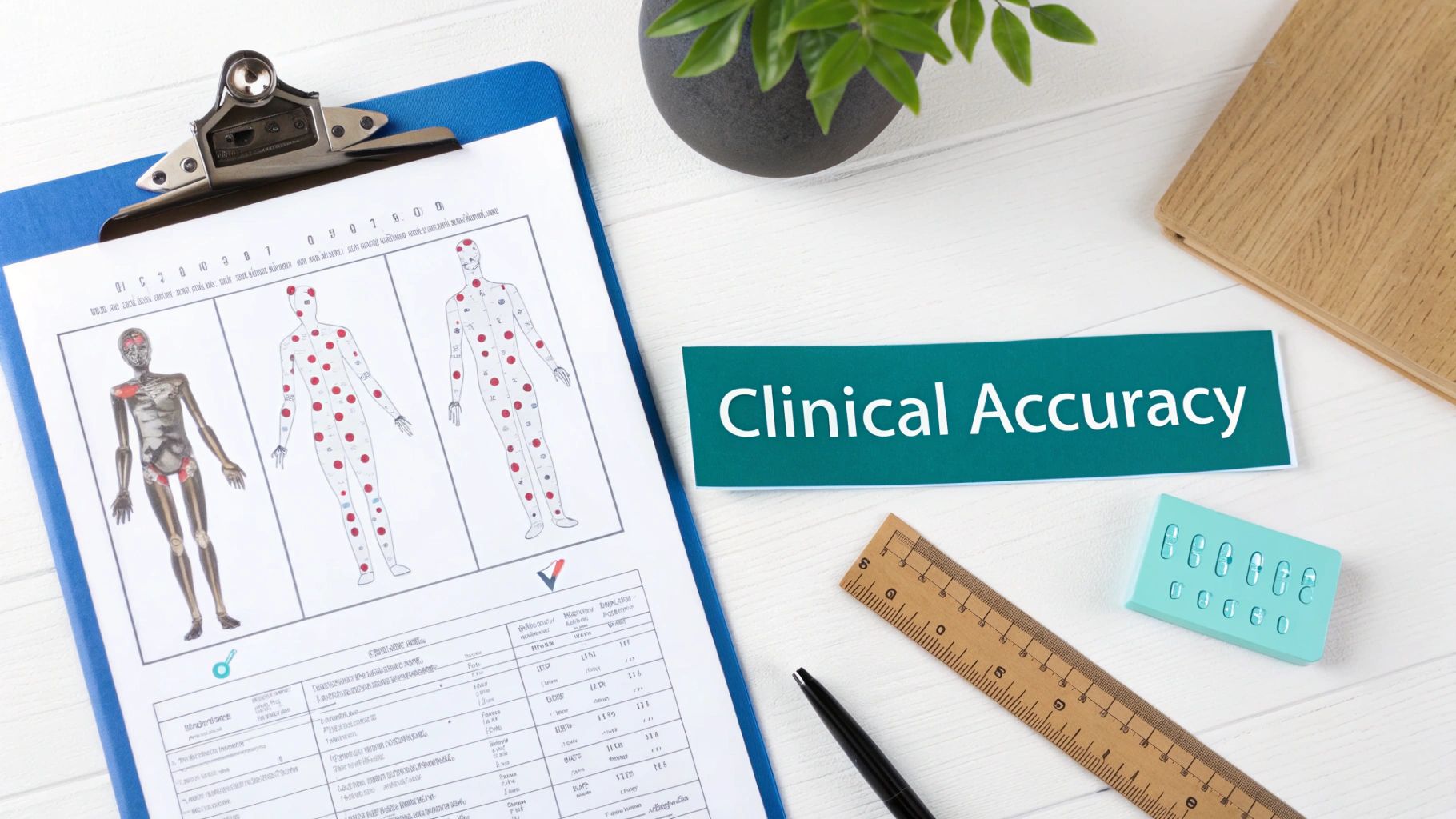
When you’re putting together a wound care documentation template, think of it less like a form and more like a clinical story. Each field should guide the clinician, step by step, toward a complete and consistent assessment. The real goal here is to create a structure that captures the full picture—from who the patient is to the nitty-gritty details of their wound. A great template is intuitive, leading the user through a logical workflow that mirrors their physical assessment process.
A solid template just doesn’t leave room for ambiguity. It standardizes how your team gathers information. This means whether a wound is seen on a Monday by a veteran wound specialist or on a Friday by a visiting nurse, the core data stays consistent and comparable. That consistency is your best defense in an audit and your best tool for actually tracking healing. It allows for meaningful data analysis over time, revealing trends in healing rates and treatment efficacy across your patient population.
Foundational Patient and Wound Information
Before you even get to the wound, you have to set the stage. This initial section of your template establishes the patient’s context, which influences every single care decision that follows. It’s where you connect the person to the problem. Overlooking this foundational information is a common mistake that can lead to misdiagnosis of etiology and ineffective treatment plans.
Of course, you’ll start with the basics, but make sure to include fields that are specifically relevant to wound care. You’re not just documenting a wound; you’re documenting a wound on a unique person with their own health challenges.
What to include here:
- Patient Demographics: The usual suspects—name, date of birth, medical record number.
- Relevant Medical History: This is huge. You need to know about comorbidities that directly mess with healing, like diabetes, peripheral vascular disease, chronic kidney disease, or immunosuppression. Also include social factors like smoking status and nutritional status.
- Wound Etiology: This field is non-negotiable. I highly recommend a dropdown menu with clear options like Pressure Injury, Venous Ulcer, Arterial Ulcer, Diabetic Foot Ulcer, or Surgical Dehiscence. Getting this right from the start is half the battle, as the etiology dictates the entire plan of care.
Precise Location and Classification
With the patient’s story established, it’s time to zoom in on the wound itself. Where is it, and what is it? Vague descriptions like “sore on left leg” are a red flag for auditors and are frankly useless clinically. Your template has to force precision. Ambiguity here can lead to medical errors, such as applying treatment to the wrong location on a patient with multiple wounds.
A great way to do this is with anatomical charts or body diagrams built right into the template. Clinicians can just click or mark the location, which eliminates all the guesswork. For patients with multiple wounds, this visual reference is a lifesaver, allowing for clear numbering and tracking of each individual site.
After location, you need to classify the wound. This is where you bring in standardized systems so everyone on the team is speaking the same clinical language.
- For Pressure Injuries: Use the NPIAP staging system (Stage 1, 2, 3, 4, Unstageable, Deep Tissue Injury). Make it a required field with clear definitions for each stage.
- For Diabetic Foot Ulcers: The Wagner Ulcer Classification Scale is the standard for grading severity, assessing depth and the presence of infection or gangrene.
- For Venous Ulcers: Consider including the CEAP (Clinical-Etiology-Anatomy-Pathophysiology) classification system for a more comprehensive assessment.
By standardizing the location and classification fields, you eliminate subjective descriptions and build a template that produces consistent, reportable data. This consistency is the backbone of effective long-term wound management and analysis.
The Core of the Assessment: Wound Characteristics
Alright, this is the heart of your wound care documentation template. These fields capture the wound’s status at each visit, giving you the objective data you need to see if it’s healing or getting worse. Every single detail tells part of the story, providing evidence for treatment adjustments and justifying ongoing care to payers.
To make this section efficient, use a mix of structured inputs like dropdowns and number fields, but always leave a small space for necessary comments. The goal is to maximize structured data capture while allowing for clinical nuance when needed.
Essential Measurement and Tissue Fields:
- Dimensions: Always measure in centimeters. Use the clock method to keep it consistent.
- Length: Head-to-toe (12 o’clock to 6 o’clock).
- Width: Side-to-side (9 o’clock to 3 o’clock).
- Depth: Measure at the deepest point with a sterile applicator.
- Tunneling and Undermining: Don’t just say it’s there. Document the depth and direction using the clock face (e.g., “Tunneling 3 cm at 2 o’clock“). This is critical for assessing the full extent of tissue damage.
- Wound Bed Tissue Type: This has to be quantified with percentages, and the total must add up to 100%.
- Epithelium (clear, cellular layer)
- Dermis (viable skin layer pink or white)
- Granulation (healthy, red tissue)
- Slough (yellow, non-viable gunk)
- Eschar (black, necrotic tissue)
- Structure (native bone, tendon, facia, nerve, artery, vein)
- Exudate (Drainage): You need to capture three things here:
- Amount: Scant, small, moderate, or large.
- Type: Serous, sanguineous, serosanguineous, or purulent.
- Odor: Crucially, note if an odor is present after cleaning the wound, as this is a key indicator of potential infection.
- Periwound Skin: What does the skin around the wound look like? Note any erythema (redness), maceration (moisture damage), induration (firmness), or signs of dermatitis.
Properly describing the wound bed is a skill, and your template should be a guide. If your team needs a refresher, our detailed guide on wound bed descriptions can help them master the details that paint a complete clinical picture.
To help you decide what to include in your own template, let’s look at the difference between the absolute must-haves and the fields that provide a richer clinical narrative.
Essential vs. Advanced Fields in a Wound Care Template
Some fields are non-negotiable for compliance and basic care, while others add layers of detail that can justify more complex treatments and give you a much clearer view of the wound’s trajectory.
| Data Category | Essential Fields (Must-Have) | Advanced Fields (For Deeper Insight) |
|---|---|---|
| Assessment | Length, Width, Depth (cm) | Wound Volume (L x W x D), Surface Area |
| Tissue Type | Percentages of Granulation, Slough, Eschar | Tissue quality descriptions (e.g., “friable,” “hypergranulation”) |
| Exudate | Amount (scant, moderate), Type (serous, purulent) | Viscosity (thick, thin), specific odor characteristics |
| Periwound Skin | Erythema, Maceration, Induration | Edema rating (pitting vs. non-pitting), signs of epibole |
| Pain | Pain score (0-10 scale) | Pain triggers (at rest, during dressing change), pain character |
| Infection | Local signs (redness, warmth, purulent drainage) | Systemic signs (fever, malaise), biofilm suspicion |
Ultimately, a template populated with just the essential fields will keep you compliant. But one that incorporates the advanced fields? That’s what empowers proactive, high-quality wound care and gives you the rock-solid documentation to back it up.
Weaving Visuals and Metrics into Your Documentation
In wound care, a picture truly is worth a thousand words. While text fields are the backbone of any good template, integrating visual evidence is what brings the patient’s story to life. It elevates a simple record into a dynamic, objective timeline of healing, moving us past vague notes like “looks better” and into the world of data-driven care.
Clear images provide undeniable proof of a wound’s status. They become your best asset for justifying treatments, proving medical necessity to payers, and ensuring everyone on the care team—from one shift to the next—is on the same page. A single photo can instantly communicate the quality of granulation tissue or show subtle signs of epibole far better than text alone ever could. This visual record is also invaluable for patient education, helping them see progress and stay engaged in their care plan.
Setting the Standard for Clinical Photography
Consistency is everything. If every photo is taken with different lighting or from a weird angle, comparing progress over time becomes a guessing game. Your template shouldn’t just have a spot to upload a photo; it needs to be backed by a simple, clear protocol for how those photos are taken. This protocol should be part of your staff training and quality assurance process.
To make sure your visual records are actually useful, build these habits into your workflow:
- Consistent Lighting: Shadows are your enemy. They hide details and distort colors. Always use a well-lit room or a portable light to get a clear, accurate shot. Avoid using a direct flash, which can create glare.
- Standardized Angles: Take photos from the same perspective every time. A direct 90-degree overhead shot is usually best. For tricky spots on curved parts of the body, grab a few extra shots from consistent side angles as well.
- Always Include a Ruler: This is non-negotiable. Place a disposable, single-use ruler next to the wound for every single photo. It gives immediate scale and validates the measurements you’ve recorded elsewhere. Ensure the ruler is placed on the same plane as the wound to avoid perspective distortion.
When you stick to a standardized approach, you can be confident that a photo from week one is truly comparable to one from week four. You’re tracking the wound’s progress, not just changes in your photography skills.
Moving from Manual Measurements to Automated Insights
Modern wound care technology is pushing visual documentation even further. Instead of just being a place to store a photo, some platforms now use that image to automatically calculate measurements and analyze tissue. This isn’t just a time-saver; it reduces the risk of human error and gives you objective data to back up your clinical judgment. Manual measurements can have significant inter-rater variability, a problem that automated systems solve.
This kind of technology can instantly calculate length, width, depth, and surface area right from the picture you upload. Some can even quantify the percentages of different tissue types in the wound bed—like granulation, slough, and eschar—with a level of precision that’s nearly impossible to eyeball.
Here’s a look at how a clinician can get precise, automated data on wound dimensions and tissue types right from their device.
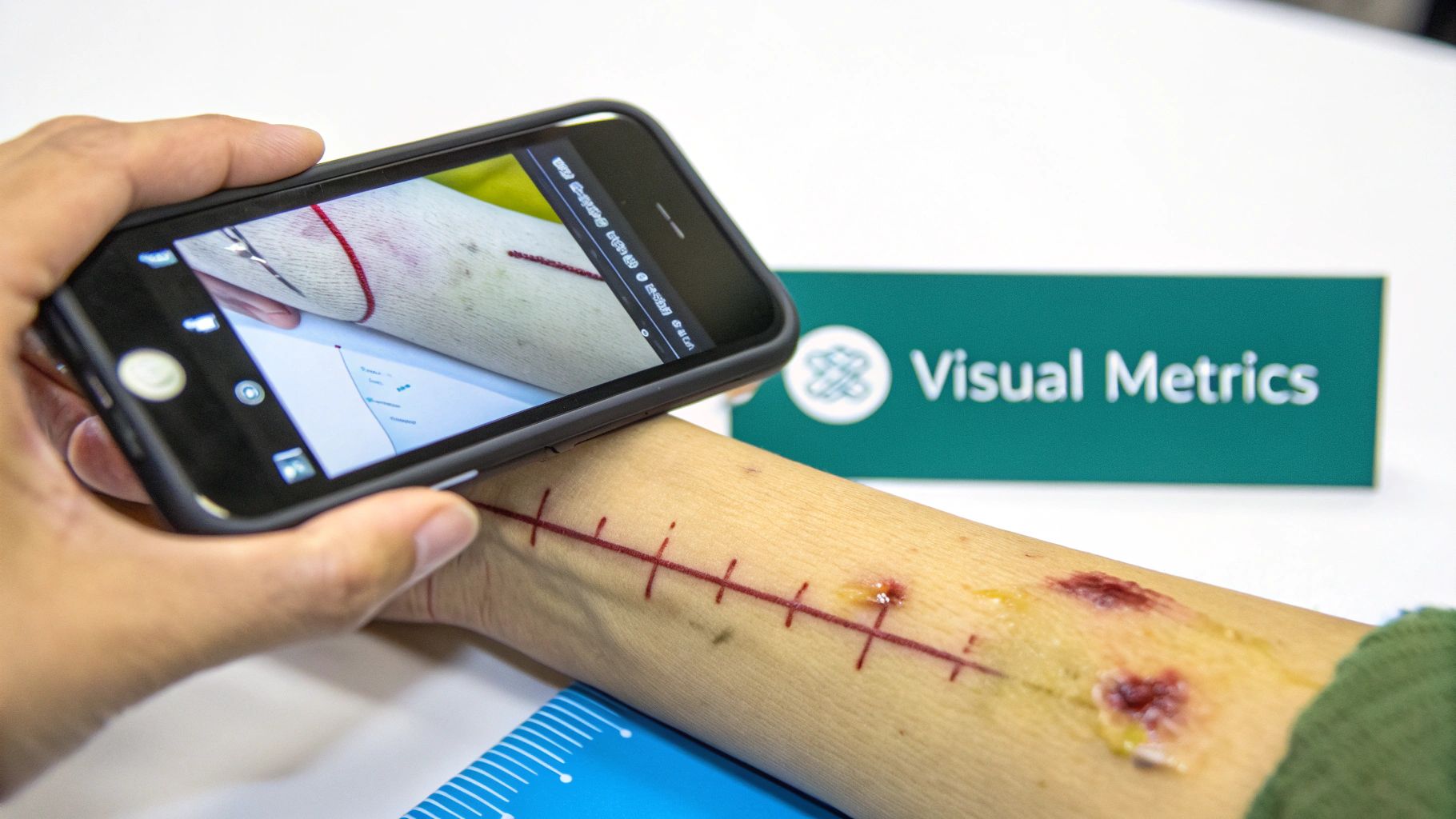
This turns a subjective assessment into an objective, reportable metric, creating a powerful feedback loop where the visual evidence and the structured data support each other. This data can then be graphed over time, providing a clear visual representation of the healing trajectory for clinicians, payers, and patients.
By building fields for high-quality photo uploads and annotations directly into your template, you’re not just keeping records. You’re creating a powerful visual timeline that serves as both a clinical tool and a defensible legal document.
Chronic wounds affect over 40 million people globally, but the lack of standardized data makes it incredibly difficult to develop better treatment strategies. A solid wound care documentation template that captures consistent visual and metric data is one of the most important tools we have to close that gap. For a deeper dive, check out this in-depth analysis from WoundSource on how digital monitoring is changing the game.
How Voice and AI Can Help You Chart Faster
Let’s be honest, documentation can feel like a major time sink. Every minute spent typing is a minute not spent with your patient. This is precisely where voice and AI are making a huge difference, turning the chore of charting into something that happens naturally during the patient visit. The goal is to make documentation a byproduct of care, not a separate, burdensome task.
Imagine being at the bedside, describing a wound out loud as you assess it. Instead of stopping to type, you just speak, and an AI-powered tool instantly fills out your wound care documentation template with clean, structured data. This isn’t science fiction anymore; it’s a real-world tool that closes the gap between talking with your patient and getting the chart done.
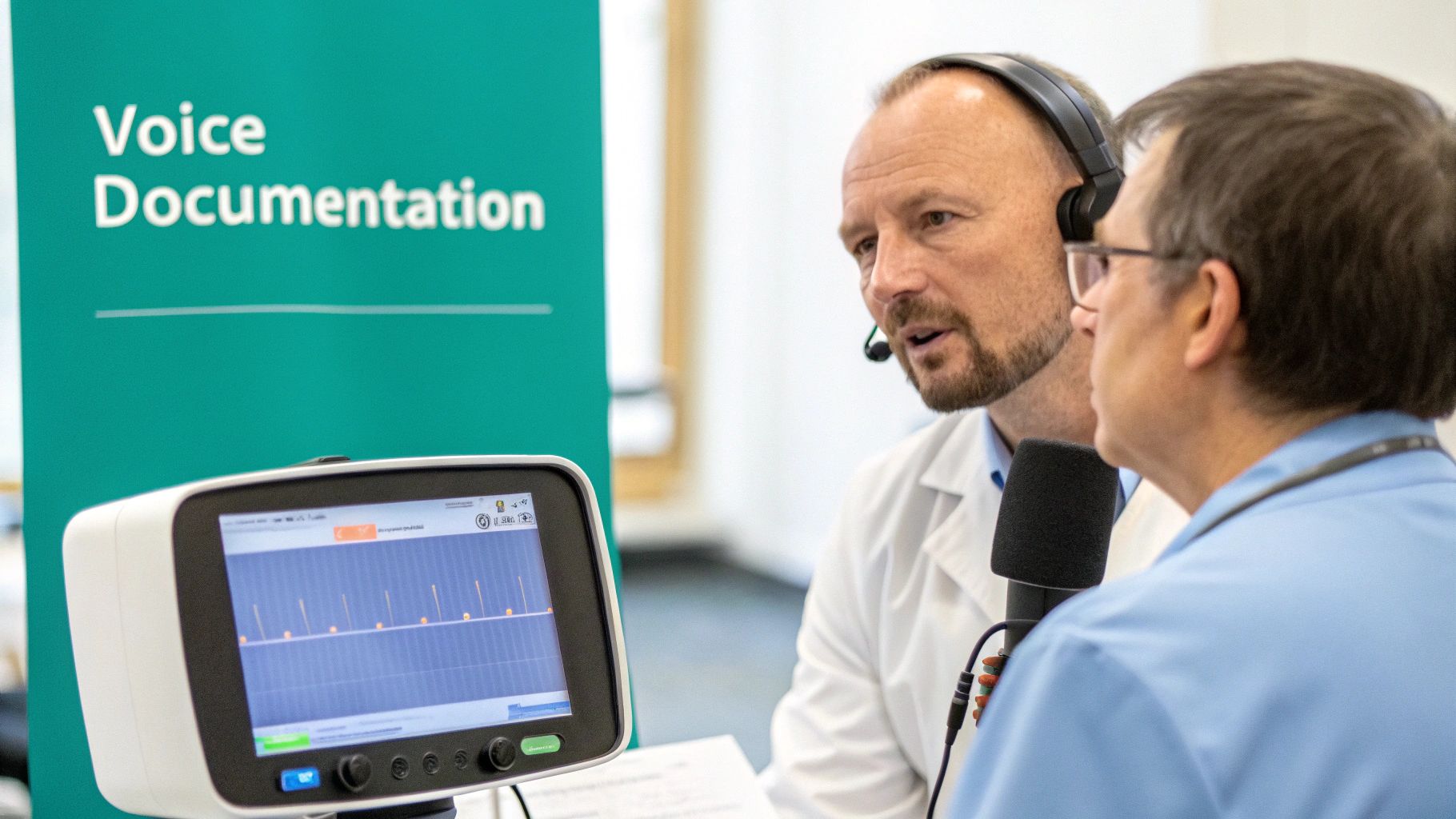
The administrative burden on clinicians is crushing. We all know the studies showing how much of our day is lost to paperwork, which is a fast track to burnout. A voice-first approach helps you claw back that time for what actually matters: patient interaction, education, and hands-on care.
Ambient Listening: The Next Leap in Charting
The next step beyond simple dictation is ambient listening. This is where things get really interesting. An ambient AI tool can listen in on the natural conversation you have with a patient and intelligently pull out the clinically important details. It differentiates between clinical findings and casual conversation, capturing only what’s relevant.
It then translates that dialogue into a complete, organized chart note—all without you having to issue a single command or even glance at a screen. The system gets the context and plugs the details right into the correct fields in your template.
For instance, during a routine wound check, a nurse might say:
- “Okay, Mr. Smith, the wound on your left calf is looking much better. The length is down to about 4.5 centimeters, and I’m seeing almost 90% healthy granulation tissue. There’s just a little bit of slough at the 12 o’clock edge.”
An ambient system hears this, understands it, and automatically fills in the fields for length, granulation percentage, and slough percentage. The whole process is invisible, letting the nurse stay completely focused on Mr. Smith. To see how tech is changing the game, it’s worth checking out some of the modern wound assessment tools for nurses now available.
How to Make Your Template AI-Ready
To really get the most out of voice and AI, your wound care documentation template needs to be built for it. An “AI-ready” template is simply one that’s structured logically, so the system can map the information you speak to the right data fields without getting confused. The more structured and standardized your template, the more accurate and efficient the AI will be.
Think of it as giving the AI a clear roadmap. If your template uses standard terms and has distinct, well-defined fields for each data point, the AI can populate it with incredible accuracy.
An AI-ready template isn’t just about adding new fields; it’s about structuring your existing ones for clarity. Standardizing terminology—like using “periwound” instead of “skin around the wound”—helps AI systems accurately parse and place data, minimizing errors and manual corrections.
Here are a few practical tips for getting your template ready:
- Use Standardized Dropdowns: Set up fields with predefined options (e.g., “scant,” “moderate,” “heavy” for exudate). This makes it easy for the AI to match a spoken word to a specific menu choice.
- Define Quantitative Fields: Make sure any fields for measurements, percentages, or scores are clearly marked for numeric input. This stops the system from trying to put text where a number should go.
- Keep Terminology Consistent: Stick to the same clinical language throughout your template. This helps “train” the AI to recognize and categorize information correctly every single time. This consistency also benefits human users by reducing cognitive load.
By designing your template with this new workflow in mind, you’re doing more than just improving a form. You’re building a more efficient, patient-first environment where technology handles the clerical grind, freeing you and your team to focus on what you do best: care for patients.
Tying Your Clinical Notes to Billing and Compliance
Let’s be blunt: great documentation is the foundation of a healthy revenue cycle. In wound care, the line connecting your clinical charting to your clinic’s financial health is incredibly direct. Every single detail you capture in that wound care documentation template either justifies your work and gets you paid or opens the door for a denial. It really is that black and white.
Think of your template as a translator. It must take the clinical work you do and convert it into the specific language payers understand—the language of CPT and ICD-10 codes. Without that direct link, even the best hands-on care can lead to a rejected claim, trapping your team in a soul-crushing cycle of appeals and rework.
Mapping Clinical Data to CPT and ICD-10 Codes
The secret to clean claims is making sure the data you enter into the template directly supports the codes you bill. For every procedure, there’s a story the payer needs to hear, and your documentation is that story. A well-designed template essentially forces the clinician to tell that story completely and accurately, every single time by making required fields mandatory.
Take wound debridement, for instance. You can’t just write “debridement performed.” Payers need to see clear, undeniable proof of medical necessity.
To justify a debridement code like CPT 97597, your template has to prompt for specifics:
- What kind of tissue did you remove? You need fields for slough, eschar, or other non-viable tissue.
- How did you do it? Was it sharp, enzymatic, or something else?
- How deep did you go? To bone? To subcutaneous tissue?
- What did the wound look like beforehand? The note needs to show why the debridement was necessary in the first place, such as documenting the percentage of necrotic tissue.
If those fields aren’t built-in and required, it’s too easy for a busy clinician to forget a detail, triggering an automatic denial. The note has to paint a picture that leaves no room for a payer to question the service.
Designing for High-Value Procedures
Some procedures, like applying Cellular and Tissue-based Products (CTPs), are under a much bigger microscope. They come with far stricter documentation rules because of their cost. Your template has to be built to meet these higher standards from the get-go.
This means building in specific checkpoints and mandatory fields that mirror the requirements found in Local Coverage Determinations (LCDs) and National Coverage Determinations (NCDs). These requirements are not suggestions; they are prerequisites for payment.
A smart template isn’t just a passive record of what happened. It actively guides the clinician to document in a way that satisfies the toughest billing criteria. It becomes a compliance tool, not just a data entry form.
For CTPs, your template absolutely must capture:
- Proof of Failed Conservative Care: A dedicated section to show that standard wound care was attempted for at least 30 days without success. This section should prompt for the types and dates of prior treatments.
- Evidence of Adequate Circulation: Fields to plug in ABI results or other vascular study findings.
- Infection Control Confirmation: A checkbox or field to confirm any infection was resolved before application.
- Nutritional Status Assessment: Documenting that the patient’s nutritional needs have been assessed and addressed.
By making these fields mandatory, the template ensures the documentation tells a complete, defensible story that justifies using these advanced and expensive therapies.
Your Template Is Your Best Audit Defense
It’s not a matter of if you’ll be audited, but when. When that day comes, your documentation is your only defense. A well-structured wound care documentation template produces a clean, chronological record that’s simple for an auditor to follow and shows a consistent, evidence-based approach to patient care.
Put yourself in an auditor’s shoes. When they see a chart filled with standardized, objective data from a structured template—with clear measurements, tissue percentages, and photos—they see a professional, compliant clinic. If they find messy, free-text notes full of subjective descriptions, they see risk. That’s when they start digging deeper.
A solid template helps you prove medical necessity at every single visit. It ensures the “why” behind every decision is clearly documented, from the first assessment to the final dressing. This kind of meticulous record-keeping is what separates a smooth audit from a costly, time-consuming nightmare. Ultimately, it’s what minimizes denials, slashes the administrative burden of rework, and gets you paid faster.
Answering Your Team’s Top Questions About Wound Care Documentation
Whenever you roll out a new wound care documentation template, you can count on a few questions popping up. It’s the same every time, whether you’re in a busy clinic or managing a home health team. Getting ahead of these common concerns is the key to a smooth transition and getting your team on board from day one.
It’s one thing to design a perfect template in a meeting room, but it’s another to make it work in the real world. Let’s tackle the questions I hear most often from clinical, admin, and tech teams.
How Often Should We Update Our Wound Care Template?
Think of your template as a living document, not something you set and forget. It needs to evolve with your practice. At a minimum, you should be reviewing it annually. But more importantly, you need to update it any time there’s a major shift in billing codes, clinical best practices, or your own internal workflows. For example, a change in an LCD from a major payer should trigger an immediate review.
For instance, if you introduce a new advanced cellular therapy, you can’t wait a year to update your forms. You need to modify the template immediately to capture the right application details, patient response, and all the specific data points required to justify its use. A template that lags behind your clinical practice is a liability.
I’ve learned that the most critical updates almost always come from the people using the template every single day. Make it a habit to gather feedback from your clinical staff. They’re the ones who will spot the workflow snags, confusing fields, or missing information that can be fixed to make everyone’s job easier.
What’s the Biggest Mistake to Avoid When We Design a Template?
The single biggest mistake I see is making it too complicated. It’s so tempting to build a “kitchen sink” template that tries to capture every possible data point for every possible wound. This always backfires.
When you overload a form with dozens of mandatory fields that aren’t always relevant, you create alert fatigue. Clinicians get frustrated, start clicking through just to get it done, and the quality of your documentation plummets. This can be just as damaging as having too little information.
The real art is striking a balance between being thorough and being user-friendly. The best wound care documentation templates achieve this with smart, conditional logic.
Think about it like this:
- Fields specific to diabetic foot ulcers should only pop up when “Diabetic Ulcer” is chosen as the wound type.
- Questions about offloading strategies are just noise when you’re documenting a post-op surgical wound, so they shouldn’t even be on the screen.
This kind of responsive design keeps the interface clean and focused on the actual wound in front of the clinician, which dramatically improves the accuracy of the information you collect.
Can a Better Template Actually Help Us Reduce Claim Denials?
Absolutely. In fact, this is one of the most immediate and tangible benefits of getting your template right. A huge percentage of wound care denials come down to one thing: poorly documented medical necessity. Payers need more than just a note saying you performed a treatment; they need a clear story that proves why it was necessary.
A well-built template basically forces good documentation by prompting clinicians for the exact details payers are looking for.
Here’s how that plays out in the real world:
- Built-in Justification: For something like debridement, your template can require the clinician to document the percentage of non-viable tissue before they can even chart the procedure. This creates a clear justification within the note itself.
- Proof of Conservative Care: Before documenting the use of a pricey CTP, a mandatory field can require notes proving that more conservative treatments failed to work over the previous 30 days. This hard-stop prevents premature billing for advanced therapies.
By making these data points required, your template ensures the final note tells a complete story that lines up perfectly with the services you’re billing. It’s a simple change that makes a huge difference in your denial rate.
What’s the Best Way to Train Our Staff on a New Template?
A “lunch and learn” demo is not a training plan. For a new template to stick, you need a thoughtful, hands-on approach that builds your team’s confidence and gets them to see the value in the change. Adoption is not just about showing them how to use it, but convincing them why it’s better.
I always recommend starting with a small group of your clinical champions. Let them use the template first. They’ll give you incredible feedback and help you work out the kinks before you go live with the entire staff. These champions then become advocates for the new system.
When you do the full training, make it interactive and scenario-based. Walk through the documentation for the types of wounds your team sees every day, not some generic test case. And most importantly, sell the benefits. Show them how features like voice capture or automatic wound measurements will save them time and headaches. Follow-up is just as important—make sure you have quick-reference guides and designated super-users who can answer questions long after the initial training is over.
Ready to stop fighting with generic EHRs and start streamlining your entire wound care workflow? Ekagra Health AI delivers an AI-powered platform that transforms documentation, billing, and patient care. From voice-to-claim in minutes, our system reduces charting time by up to 70%, minimizes denials, and gives your team the data-driven tools needed to improve outcomes. See how our clinician-designed solution can work for you at https://ekagrahealth.ai.
